
Items related to Middlemarch (Penguin Drop Caps)
Synopsis
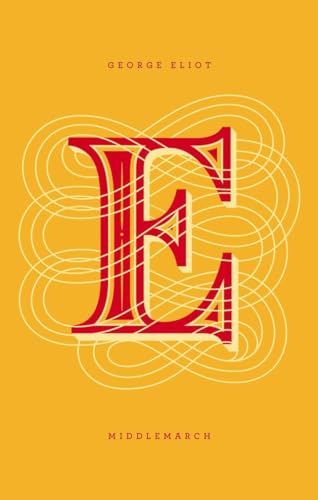
The masterpiece of Victorian realist fiction, embodying the social changes of an English town, beautifully repackaged with a stunning E for Eliot on the cover. It all begins with a letter. Fall in love with Penguin Drop Caps, a new series of twenty-six collectible and hardcover editions, each with a type cover showcasing a gorgeously illustrated letter of the alphabet for each author's surname. Middlemarch explores a fictional 19th century Midlands town in the midst of change. The proposed Reform Bill promises political revolution; and the railway social change.
"synopsis" may belong to another edition of this title.
About the Author
GEORGE ELIOT (Mary Ann Evans Cross) was born on November 22, 1819 at Arbury Farm, Warwickshire, England. She received an ordinary education and, upon leaving school at the age of sixteen, embarked on a program of independent study to further her intellectual growth. In 1841 she moved with her father to Coventry, where the influences of "skeptics and rationalists" swayed her from an intense religious devoutness to an eventual break with the church. The death of her father in 1849 left her with a small legacy and the freedom to pursue her literary inclinations. In 1851 she became the assistant editor of the Westminster Review, a position she held for three years. In 1854 came the fated meeting with George Henry Lewes, the gifted editor of <i>The Leader</i>, who was to become her adviser and companion for the next twenty-four years. Her first book, <i>Scenes of a Clerical Life</i> (1858), was followed by <i>Adam Bede</i> (1859), <i>The Mill on the Floss</i> (1860), <i>Silas Marner</i> (1861), and <i>Middlemarch </i>(1872). The death of Lewes, in 1878, left her stricken and lonely. On May 6, 1880, she married John Cross, a friend of long standing, and after a brief illness she died on December 22 of that year, in London. <p/>JESSICA HISCHE is a letterer, illustrator, typographer, and web designer. She currently serves on the Type Directors Club board of directors, has been named a <i>Forbes Magazine</i> "30 under 30" in art and design as well as an ADC Young Gun and one of <i>Print Magazine</i>'s "New Visual Artists". She has designed for Wes Anderson, <i>McSweeney's</i>, Tiffany & Co, Penguin Books and many others. She resides primarily in San Francisco, occasionally in Brooklyn.
Excerpt. © Reprinted by permission. All rights reserved.
WHO that cares much to know the history of man, and how the mysterious mixture behaves under the varying experiments of Time, has not dwelt, at least briefly, on the life of Saint Theresa,' has not smiled with some gentleness at the thought of the little girl walking forth one morning hand - in - hand with her still smaller brother, to go and seek martyrdom in the country of the Moors? Out they toddled from rugged Avila, wide - eyed and helpless - looking as two fawns, but with human hearts, already beating to a national idea; until domestic reality met them in the shape of uncles, and turned them back from their great resolve. That child - pilgrimage was a fit beginning. Theresa's passionate, ideal nature demanded an epic life: what were many - volumed romances of chivalry and the social conquests of a brilliant girl to her. Her flame quickly burned up that light fuel; and, fed from within, soared after some illimitable satisfaction, some object which would never justify weariness, which would reconcile self - despair with the rapturous consciousness of life beyond self. She found her epos in the reform of a religious order.
That Spanish woman who lived three hundred years ago was certainly not the last of her kind. Many Theresas have been born who found for themselves no epic life wherein there was a constant unfolding of far - resonant action; perhaps only a life of mistakes, the offspring of a certain spiritual grandeur ill - matched with the meanness of opportunity; perhaps a tragic failure which found no sacred poet and sank unwept into oblivion. With dim lights and tangled circumstance they tried to shape their thought and deed in noble agreement; but after all, to common eyes their struggles seemed mere inconsistency and formlessness; for these later - born Theresas were helped by no coherent social faith and order which could perform the function of knowledge for the ardently willing soul. Their ardour alternated between a vague ideal and the common yearning of womanhood; so that the one was disapproved as extravagance, and the other condemned as a lapse.
Some have felt that these blundering lives are due to the inconvenient indefiniteness with which the Supreme Power has fashioned the natures of women: if there were one level of feminine incompetence as strict as the ability to count three and no more, the social lot of women might be treated with scientific certitude. Meanwhile the indefiniteness remains, and the limits of variation are really much wider than any one would imagine from the sameness of women's coiffure and the favourite love - stories in prose and verse. Here and there a cygnet is reared uneasily among the ducklings in the brown pond, and never finds the living stream in fellowship with its own oary-footed kind. Here and there is born a Saint Theresa, foundress of nothing, whose loving heart -beats and sobs after an unattained goodness tremble off and are dispersed among hindrances, instead of centering in some long recognisable deed.
"About this title" may belong to another edition of this title.
Search results for Middlemarch (Penguin Drop Caps)

Stock Image
Middlemarch
Seller: World of Books (was SecondSale), Montgomery, IL, U.S.A.
Seller rating 5 out of 5 stars

Hardback. Condition: Fair. Hische, Jessica (illustrator). George Eliots mest ambiti sa roman Middlemarch r en komplex ber ttelse om idealism, lojalitet och uppslitande k rlek. I en engelsk sm stad under 1800-talets f rsta h lft f r vi f lja den unga idealisten Dorothea Brooke som r olyckligt gift, och den charmige men taktl se Dr Tertius Lydgate som ven han har problem p det ktenskapliga planet. Det r ett f rgstarkt och r rande drama som hyllades av Virginia Woolf som l r ha sagt att det var en av f engelska romaner skriven f r vuxna m nniskor. I original vers ttning av A. G. Engberg George Eliot, pseudonym f r Mary Anne Evans, var under sin livstid en av Storbritanniens fr msta f rfattare. Hon valde sin pseudonym efter sin f rebild Georges Sand. Seller Inventory # 00110187545
Stock Image
Middlemarch
Published by
Penguin Publishing Group, 2012
ISBN 10: 0143123815
ISBN 13: 9780143123811
Used
Hardcover
Seller: Better World Books: West, Reno, NV, U.S.A.
Seller rating 5 out of 5 stars
Condition: Very Good. Hische, Jessica (illustrator). Former library copy. Pages intact with possible writing/highlighting. Binding strong with minor wear. Dust jackets/supplements may not be included. Includes library markings. Stock photo provided. Product includes identifying sticker. Better World Books: Buy Books. Do Good. Seller Inventory # 38335570-6
Seller Image
Middlemarch (Penguin Drop Caps)
Seller: Coas Books, Las Cruces, NM, U.S.A.
Seller rating 5 out of 5 stars
Condition: good. Hische, Jessica (illustrator). Cover image may vary. Cover is worn. Binding is split. Hardcover. Seller Inventory # COBV.0143123815.G
Stock Image
Middlemarch
Seller: World of Books Inc, Montgomery, IL, U.S.A.
Seller rating 4 out of 5 stars

Hardback. Condition: Fair. Hische, Jessica (illustrator). George Eliots mest ambiti sa roman Middlemarch r en komplex ber ttelse om idealism, lojalitet och uppslitande k rlek. I en engelsk sm stad under 1800-talets f rsta h lft f r vi f lja den unga idealisten Dorothea Brooke som r olyckligt gift, och den charmige men taktl se Dr Tertius Lydgate som ven han har problem p det ktenskapliga planet. Det r ett f rgstarkt och r rande drama som hyllades av Virginia Woolf som l r ha sagt att det var en av f engelska romaner skriven f r vuxna m nniskor. I original vers ttning av A. G. Engberg George Eliot, pseudonym f r Mary Anne Evans, var under sin livstid en av Storbritanniens fr msta f rfattare. Hon valde sin pseudonym efter sin f rebild Georges Sand. Seller Inventory # CIN0143123815A
Stock Image
Middlemarch
Published by
Penguin Books December 2012, 2012
ISBN 10: 0143123815
ISBN 13: 9780143123811
Used
Hardcover
Seller: Inquiring Minds, Saugerties, NY, U.S.A.
Seller rating 4 out of 5 stars
Hardcover. Condition: Used - Very Good. Hische, Jessica (illustrator). Seller Inventory # 635124
Seller Image
Middlemarch
Seller: GreatBookPrices, Columbia, MD, U.S.A.
Seller rating 5 out of 5 stars
Condition: As New. Hische, Jessica (illustrator). Unread book in perfect condition. Seller Inventory # 18679578
Seller Image
Middlemarch
Seller: GreatBookPrices, Columbia, MD, U.S.A.
Seller rating 5 out of 5 stars
Condition: New. Hische, Jessica (illustrator). Seller Inventory # 18679578-n
Seller Image
Middlemarch (Hardcover)
Published by
Penguin Putnam Inc, New York, 2012
ISBN 10: 0143123815
ISBN 13: 9780143123811
New
Hardcover
Seller: Grand Eagle Retail, Bensenville, IL, U.S.A.
Seller rating 5 out of 5 stars
Hardcover. Condition: new. Hische, Jessica (illustrator). Hardcover. Penguin Drop Caps collect twenty-six stunning hardcovers-one for each letter of the alphabet-featuring cover art by lettering superstar Jessica Hische.E is for Eliot.From A to Z, the Penguin Drop Caps series collects 26 unique hardcovers-featuring cover art by type superstar Jessica HischeIt all begins with a letter. Fall in love with Penguin Drop Caps, a new series of twenty-six collectible and gift-worthy hardcover editions, each with a type cover showcasing a gorgeously illustrated letter of the alphabet by superstar type designer Jessica Hische, whose work has appeared everywhere from Tiffany & Co. to Wes Anderson's film Moonrise Kingdom to Penguin's own bestsellers Committed and Rules of Civility. A collaboration between Jessica Hische and Penguin Art Director Paul Buckley, the series design encompasses foil-stamped paper-over-board cases in a rainbow-hued spectrum across all twenty-six book spines and a decorative stain on all three paper edges. Penguin Drop Caps debuts with an "A" for Jane Austen's Pride and Prejudice, a "B" for Charlotte Bronte's Jane Eyre, and a "C" for Willa Cather's My ntonia, and continues with more classics from Penguin.E is for Eliot. Considered one the masterpieces of realist fiction, George Eliot's novel, Middlemarch: A Study of Provincial Life, explores a fictional nineteenth-century Midlands town in the midst of modern changes. The proposed Reform Bill promises political change; the building of railroads alters both the physical and cultural landscape; new scientific approaches to medicine incite public division; and scandal lurks behind respectability. The quiet drama of ordinary lives and flawed choices are played out in the complexly portrayed central characters of the novel-the idealistic Dorothea Brooke; the ambitious Dr. Lydgate; the spendthrift Fred Vincy; and the steadfast Mary Garth. The appearance of two outsiders further disrupts the town's equilibrium-Will Ladislaw, the spirited nephew of Dorothea's husband, the Rev. Edward Casaubon, and the sinister John Raffles, who threatens to expose the hidden past of one of the town's elite. Middlemarch displays George Eliot's clear-eyed yet humane understanding of characters caught up in the mysterious unfolding of self-knowledge. Peopling its landscape are Dorothea Brooke, a young idealist whose search for intellectual fulfillment leads her into a disastrous marriage to the pedantic scholar Casaubon; the charming but tactless Dr Lydgate, whose marriage to the spendthrift beauty Rosamund and pioneering medical methods threaten to undermine his career; and, the religious hypocrite Bulstrode, hiding scandalous crimes from his past. Shipping may be from multiple locations in the US or from the UK, depending on stock availability. Seller Inventory # 9780143123811
Seller Image
Middlemarch
Seller: Rarewaves.com USA, London, LONDO, United Kingdom
Seller rating 5 out of 5 stars
Hardback. Condition: New. Hische, Jessica (illustrator). Seller Inventory # LU-9780143123811
Buy New
£ 20.09
Free Shipping
Ships from United Kingdom to U.S.A.
Ships from United Kingdom to U.S.A.
Quantity: 4 available
Stock Image
Middlemarch
Seller: Revaluation Books, Exeter, United Kingdom
Seller rating 5 out of 5 stars
Hardcover. Condition: Brand New. Hische, Jessica (illustrator). reprint edition. 898 pages. 8.00x5.50x1.75 inches. In Stock. Seller Inventory # __0143123815
Buy New
£ 13.43
£ 12.50 shipping
Ships from United Kingdom to U.S.A.
Ships from United Kingdom to U.S.A.
Quantity: 2 available