
Items related to Statistical Procedures for Analysis of Environmental...
Statistical Procedures for Analysis of Environmental Monitoring Data and Risk Assessment (Ptr Environmental Management and Engineering Series , Vol 3) - Hardcover
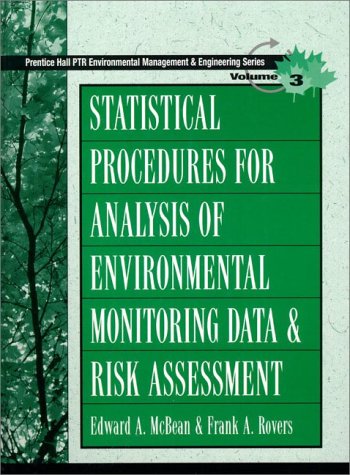
Synopsis
- Appropriate for upper-level undergraduate and graduate level Engineering and Environmental Science courses in Probability and Statistics.
- Carefully explains various statistical analysis procedures and techniques in clear, straightforward language. The book provides a foundation for statistically analyzing and interpreting environmental data for air quality, surface water quality, groundwater quality, and soil contamination.
"synopsis" may belong to another edition of this title.
About the Author
DR. EDWARD A. McBEAN is an Associate at Conestoga-Rovers and Associates, and President of CRA Engineering Inc. For more than 20 years, he has served on the faculties of the University of Waterloo and University of California, researching the challenges of interpreting environmental quality data. FRANK A. ROVERS is President, Conestoga-Rovers and Associates, an environmental engineering company with more than 850 employees located in 29 offices. In more than 25 years in environmental engineering, he has been involved with the entire spectrum of environmental quality issues.
From the Back Cover
67501-7
For students and professionals in environmental, civil, and mechanical engineering, few tasks are as challenging as statistical analysis and interpretation.
In this book, two leaders in the field address these challenges head-on. They introduce each leading statistical analysis technique, downplaying mathematical notation in favor of sample environmental applications and explanations that make sense to non-statisticians. They also address common problems in data interpretation: small data sets; the need to correlate constituents to infill missing data or identify outliers; creating early warning systems with fewer "false positives", handling noise, and assessing risk.
Coverage includes:
- Characterizing environmental quality data with Normal, Lognormal, and other distributions.
- Characterizing coincident behavior using regression, correlation and multiple regression.
- Multiple comparisons using ANOVA and associated parametric analysis techniques.
- Testing differences between monitoring records when censored data records exist.
- Focuses on "real-world" situations where data sets may be imperfect.
Reflecting decades of experience in the field, the authors also show how to use statistical analysis as the input to realistic risk assessment. In particular, they demonstrate simulation procedures for risk characterization, using sampling methodologies from probability distributions of data. Whether you are concerned with issues of air quality, surface water, groundwater, or soil contamination, the techniques covered in this book will be invaluable.
"About this title" may belong to another edition of this title.
Search results for Statistical Procedures for Analysis of Environmental...

Stock Image
Statistical Procedures for Analysis of Environmental Monitoring Data and Risk Assessment (Ptr Environmental Management and Engineering Series , Vol 3)
Seller: More Than Words, Waltham, MA, U.S.A.
Seller rating 5 out of 5 stars

Condition: Good. . . All orders guaranteed and ship within 24 hours. Before placing your order for please contact us for confirmation on the book's binding. Check out our other listings to add to your order for discounted shipping. Seller Inventory # WAL-J-4a-002884
Stock Image
Statistical Procedures for Analysis of Environmental Monitoring Data and Risk Assessment
Published by
Pearson Education, Limited, 1998
ISBN 10: 0136750184
ISBN 13: 9780136750185
Used
Hardcover
Seller: Better World Books, Mishawaka, IN, U.S.A.
Seller rating 5 out of 5 stars
Condition: Very Good. Har/Dsk. Pages intact with possible writing/highlighting. Binding strong with minor wear. Dust jackets/supplements may not be included. Stock photo provided. Product includes identifying sticker. Better World Books: Buy Books. Do Good. Seller Inventory # 13087935-6
Stock Image
Statistical Procedures for Analysis of Environmental Monitoring Data and Risk Assessment
Published by
Pearson Education, Limited, 1998
ISBN 10: 0136750184
ISBN 13: 9780136750185
Used
Hardcover
Seller: Better World Books Ltd, Dunfermline, United Kingdom
Seller rating 5 out of 5 stars
Condition: Good. Har/Dsk. Former library copy. Pages intact with minimal writing/highlighting. The binding may be loose and creased. Dust jackets/supplements are not included. Includes library markings. Stock photo provided. Product includes identifying sticker. Better World Books: Buy Books. Do Good. Seller Inventory # GRP65733226
Buy Used
£ 5.01
£ 5 shipping
Ships from United Kingdom to U.S.A.
Ships from United Kingdom to U.S.A.
Quantity: 2 available
Stock Image
Statistical Procedures for Analysis of Environmental Monitoring Data and Risk Assessment (Ptr Environmental Management and Engineering Series , Vol 3)
Seller: Phatpocket Limited, Waltham Abbey, HERTS, United Kingdom
Seller rating 5 out of 5 stars
Condition: Good. Your purchase helps support Sri Lankan Children's Charity 'The Rainbow Centre'. Ex-library, so some stamps and wear, but in good overall condition. Our donations to The Rainbow Centre have helped provide an education and a safe haven to hundreds of children who live in appalling conditions. Seller Inventory # Z1-C-056-01764
Buy Used
£ 3.25
£ 10.64 shipping
Ships from United Kingdom to U.S.A.
Ships from United Kingdom to U.S.A.
Quantity: 2 available
Stock Image
Statistical Procedures for Analysis of Environmental Monitoring Data and Risk Assessment (Ptr Environmental Management and Engineering Series , Vol 3)
Seller: Flora & Fauna Books, Gainesville, FL, U.S.A.
Seller rating 4 out of 5 stars

Hardcover. Condition: Very Good. Manual. 1998. 313pp (includes original 3-inch floppy disk in back cover pouch). Review of statistical analysis in environmental monitoring. VG (former owner name inside cover). Seller Inventory # 9-2040
Stock Image
Statistical Procedures for Analysis of Environmental Monitoring Data and Risk Assessment (Volume 3)
Seller: Anybook.com, Lincoln, United Kingdom
Seller rating 5 out of 5 stars
Condition: Good. Volume 3. This is an ex-library book and may have the usual library/used-book markings inside.This book has hardback covers. In good all round condition. Please note the Image in this listing is a stock photo and may not match the covers of the actual item,950grams, ISBN:9780136750185. Seller Inventory # 5957914
Buy Used
£ 3.25
£ 13.60 shipping
Ships from United Kingdom to U.S.A.
Ships from United Kingdom to U.S.A.
Quantity: 1 available