
Items related to Essentials of 3D Biofabrication and Translation
Synopsis
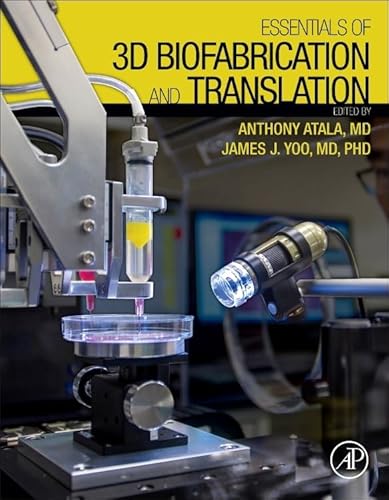
Essentials of 3D Biofabrication and Translation discusses the techniques that are making bioprinting a viable alternative in regenerative medicine. The book runs the gamut of topics related to the subject, including hydrogels and polymers, nanotechnology, toxicity testing, and drug screening platforms, also introducing current applications in the cardiac, skeletal, and nervous systems, and organ construction. Leaders in clinical medicine and translational science provide a global perspective of the transformative nature of this field, including the use of cells, biomaterials, and macromolecules to create basic building blocks of tissues and organs, all of which are driving the field of biofabrication to transform regenerative medicine. * Provides a new and versatile method to fabricating living tissue* Discusses future applications for 3D bioprinting technologies, including use in the cardiac, skeletal, and nervous systems, and organ construction* Describes current approaches and future challenges for translational science* Runs the gamut of topics related to the subject, from hydrogels and polymers to nanotechnology, toxicity testing, and drug screening platforms
"synopsis" may belong to another edition of this title.
About the Authors
Anthony Atala, MD, is the G. Link Professor and Director of the Wake Forest Institute for Regenerative Medicine. Seventeen of his lab’s technologies have been translated to patients, including the first tissue-engineered organ for permanent implantation in a human. His research led to the discovery of a multipotent source of stem cells from amniotic fluid and placenta, advances in 3D printing of tissues and organs, and body-on-a-chip technologies. His work was twice listed among Time Magazine’s top 10 medical breakthroughs of the year, and he is a recipient of the Smithsonian Ingenuity Award. He has published over 900 journal articles, is the editor of 25 books, and holds over 250 national and international patents. Dr. Atala is a member of the National Academy of Medicine, the National Academy of Inventors, and the American Institute for Medical and Biological Engineering.
Professor, Wake Forest Institute for Regenerative Medicine, Winston-Salem, NC
From the Back Cover
Built on the essentials of cell and protein biology, Essentials of 3D Biofabtication and Translation discusses the techniques that are making bioprinting a viable alternative in regenerative medicine. The use of cells, biomaterials, and macromolecules to create basic building blocks of tissues and organs is allowing researchers to study and better understand the relationship between controlled material and cell placement and the formation of tissues in three-dimensions (3D). Where current tissue engineering strategies can repair patches or parts of single tissues, biofabrication holds the potential to form complex engineered tissues, formed of different and multiple tissues, and organs. These developments are driving the field of biofabrication to transform the field of regenerative medicine.
In Essentials of 3D Biofabtication and Translation, leaders in clinical medicine and translational science provide a global perspective of the transformative nature of this field. Topics range from hydrogels and polymers to nanotechnology, toxicity testing and drug screening platforms to introduce the current applications in the cardiac, skeletal, and nervous systems as well as organ construction. A crucial resource for biomedical and bioengineering researchers, researchers in regenerative medicine and tissue engineering, as well as scientific administrators, this book is also a great text for graduate students in biotechnology as well.
"About this title" may belong to another edition of this title.
Search results for Essentials of 3D Biofabrication and Translation

Stock Image
Essentials of 3D Biofabrication and Translation
Published by
Academic Press, 2015
ISBN 10: 0128009721
ISBN 13: 9780128009727
Used
Hardcover
First Edition
Seller: One Planet Books, Columbia, MO, U.S.A.
Seller rating 4 out of 5 stars

hardcover. Condition: Good. 1st Edition. Ships in a BOX from Central Missouri! May not include working access code. Will not include dust jacket. Has used sticker(s) and some writing and/or highlighting. UPS shipping for most packages, (Priority Mail for AK/HI/APO/PO Boxes). Seller Inventory # 002189217U
Stock Image
Essentials of 3D Biofabrication and Translation
Published by
Academic Press, 2015
ISBN 10: 0128009721
ISBN 13: 9780128009727
Used
Hardcover
First Edition
Seller: Textbooks_Source, Columbia, MO, U.S.A.
Seller rating 5 out of 5 stars

hardcover. Condition: Good. 1st Edition. Ships in a BOX from Central Missouri! May not include working access code. Will not include dust jacket. Has used sticker(s) and some writing or highlighting. UPS shipping for most packages, (Priority Mail for AK/HI/APO/PO Boxes). Seller Inventory # 002189217U
Seller Image
Essentials of 3d Biofabrication and Translation
Seller: GreatBookPrices, Columbia, MD, U.S.A.
Seller rating 5 out of 5 stars
Condition: good. May show signs of wear, highlighting, writing, and previous use. This item may be a former library book with typical markings. No guarantee on products that contain supplements Your satisfaction is 100% guaranteed. Twenty-five year bookseller with shipments to over fifty million happy customers. Seller Inventory # 23847463-5
Seller Image
Essentials of 3d Biofabrication and Translation
Seller: GreatBookPricesUK, Woodford Green, United Kingdom
Seller rating 5 out of 5 stars
Condition: good. May show signs of wear, highlighting, writing, and previous use. This item may be a former library book with typical markings. No guarantee on products that contain supplements Your satisfaction is 100% guaranteed. Twenty-five year bookseller with shipments to over fifty million happy customers. Seller Inventory # 23847463-5
Buy Used
£ 155.46
£ 15 shipping
Ships from United Kingdom to U.S.A.
Ships from United Kingdom to U.S.A.
Quantity: 1 available
Stock Image
Essentials of 3D Biofabrication and Translation
Seller: brandnewtexts4sale, Houston, TX, U.S.A.
Seller rating 5 out of 5 stars
Condition: New. BRAND NEW. book. Seller Inventory # 9780128009727