
Items related to Self-Checking and Fault-Tolerant Digital Design (The...
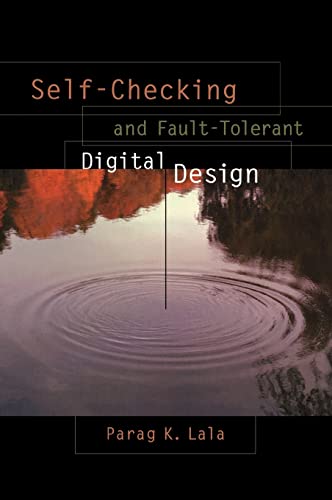
Self-Checking and Fault-Tolerant Digital Design (The Morgan Kaufmann Series in Computer Architecture and Design) - Hardcover
Synopsis
With VLSI chip transistors getting smaller and smaller, today's digital systems are more complex than ever before. This increased complexity leads to more cross-talk, noise, and other sources of transient errors during normal operation. Traditional off-line testing strategies cannot guarantee detection of these transient faults. And with critical applications relying on faster, more powerful chips, fault-tolerant, self-checking mechanisms must be built in to assure reliable operation.
Self-Checking and Fault-Tolerant Digital Design deals extensively with self-checking design techniques and is the only book that emphasizes major techniques for hardware fault tolerance. Graduate students in VLSI design courses as well as practicing designers will appreciate this balanced treatment of the concepts and theory underlying fault tolerance along with the practical techniques used to create fault-tolerant systems.
* Introduces reliability theory and the importance of maintainability* Presents coding and the construction of several error detecting and correcting codes* Discusses in depth, the available techniques for fail-safe design of combinational circuits* Details checker design techniques for detecting erroneous bits and encoding output of self-checking circuits* Demonstrates how to design self-checking sequential circuits, including a technique for fail-safe state machine design
"synopsis" may belong to another edition of this title.
About the Author
The author is currently a Professor in the Department of Electrical Engineering at North Carolina A&T State University. He is the author of more than 75 papers, and three books published by Prentice Hall. His research interests include design for testability, self-checking logic design, automatic logic synthesis of low power logic circuits, andCPLD/FPGA based system design. He received a M.S. from King's College, London, and a Ph.D. from the City University of London.
From the Back Cover
With VLSI chip transistors getting smaller and smaller, today's digital systems are more complex than ever before. This increased complexity leads to more cross-talk, noise, and other sources of transient errors during normal operation. Traditional off-line testing strategies cannot guarantee detection of these transient faults. And with critical applications relying on faster, more powerful chips, fault-tolerant, self-checking mechanisms must be built in to assure reliable operation.
Self-Checking and Fault-Tolerant Digital Design deals extensively with self-checking design techniques and is the only book that emphasizes major techniques for hardware fault tolerance. Graduate students in VLSI design courses as well as practicing designers will appreciate this balanced treatment of the concepts and theory underlying fault tolerance along with the practical techniques used to create fault-tolerant systems.
Features:
- Introduces reliability theory and the importance of maintainability
- Presents coding and the construction of several error detecting and correcting codes
- Discusses in depth, the available techniques for fail-safe design of combinational circuits
- Details checker design techniques for detecting erroneous bits and encoding output of self-checking circuits
- Demonstrates how to design self-checking sequential circuits, including a technique for fail-safe state machine design
"About this title" may belong to another edition of this title.
Search results for Self-Checking and Fault-Tolerant Digital Design (The...

Stock Image
Self-Checking and Fault-Tolerant Digital Design (The Morgan Kaufmann Series in Computer Architecture and Design)
Seller: Gulf Coast Books, Cypress, TX, U.S.A.
Seller rating 5 out of 5 stars

hardcover. Condition: Good. Seller Inventory # 0124343708-3-32317514
Seller Image
Self-Checking and Fault-Tolerant Digital Design (The Morgan Kaufmann Series in Computer Architecture and Design)
Seller: Goodwill of Silicon Valley, SAN JOSE, CA, U.S.A.
Seller rating 4 out of 5 stars

Condition: very_good. Supports Goodwill of Silicon Valley job training programs. The cover and pages are in very good condition! The cover and any other included accessories are also in very good condition showing some minor use. The spine is straight, there are no rips tears or creases on the cover or the pages. Seller Inventory # GWSVV.0124343708.VG
Stock Image
Self-Checking and Fault-Tolerant Digital Design.
Published by
Morgan Kaufmann / Academic Press, 2001
ISBN 10: 0124343708
ISBN 13: 9780124343702
Used
Hardcover
Seller: Brentwood Books, Kinnelon, NJ, U.S.A.
Seller rating 4 out of 5 stars
Hardcover. Condition: Used, like new. Glossy black hardcover with cover photo of a ripples in a pool of water, 2001, 216pp. Slightest shelf wear otherwise perfect condition. **We are a small family business selling fine new and pre-owned books online since 1999, providing professional service and individual attention to your order, daily shipments and sturdy packing. Seller Inventory # 72692
Stock Image
Self-Checking and Fault-Tolerant Digital Design (The Morgan Kaufmann Series in Computer Architecture and Design)
Seller: SHIMEDIA, Brooklyn, NY, U.S.A.
Seller rating 4 out of 5 stars
Condition: New. Satisfaction Guaranteed or your money back. Seller Inventory # 0124343708