
Items related to Stop Talking, Start Communicating: Counterintuitive...
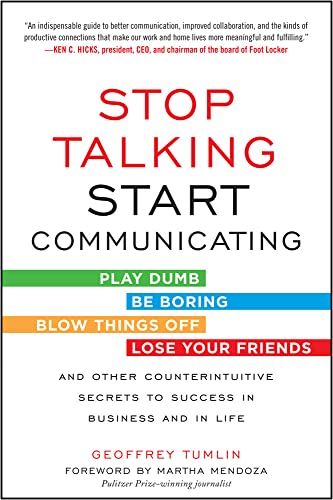
Stop Talking, Start Communicating: Counterintuitive Secrets to Success in Business and in Life, with a foreword by Martha Mendoza (BUSINESS BOOKS) - Softcover
Synopsis
PLAY DUMB. BE BORING.
DON'T SOLVE PROBLEMS.
AND ABOVE ALL, DON'T BE YOURSELF.
Not exactly what you'd expect to hear from a communication expert, but these counterintuitive strategies are precisely what we need to interact productively and meaningfully in today's digital world. Our overreliance on quick, cheap, and easy means of "staying connected" is eroding our communication skills. Speed steamrolls thoughtfulness; self-expression trumps restraint. Errors and misunderstandings increase. And our relationships suffer.
With startling insights and a dash of humor, Stop Talking, Start Communicating combines scientific research with real-world strategies to deliver a proven approach to more effective communication.
"Only Geoffrey Tumlin could write a book about a serious problem--our mounting communication deficiencies--and make me laugh and learn all the way through it. Witty, smart, and 100 percent accurate, Stop Talking, Start Communicating points the way to a better conversational future." -- Tina Morris, managing director at Standard & Poor's
"An elegantly analytical, accessible, and enjoyable guide to improving interpersonal communication, Stop Talking, Start Communicating is a key resource for anyone who wants to be a difference-making leader, manager, or team member." -- Eduardo Sanchez, deputy chief medical officer of the American Heart Association
"synopsis" may belong to another edition of this title.
About the Author
Geoffrey Tumlin is CEO of Mouthpeace Consulting LLC, a communication consulting company, and president of On-Demand Leadership, a leadership development company. A portion of the author's royalties will be donated to Critical Skills Nonprofit, a 501(c)(3) public charity founded by the author to provide communication and leadership skills training to chronically underserved populations.
Excerpt. © Reprinted by permission. All rights reserved.
STOP TALKING, START COMMUNICATING
Counterintuitive Secrets to Success in Business and in Life, with a foreword by Martha Mendoza
By GEOFFREY TUMLINMcGraw-Hill Education
Copyright © 2013 Geoffrey Tumlin
All rights reserved.
ISBN: 978-0-07-181304-4All rights reserved.
Contents
| Foreword | |
| Introduction | |
| 1: Back Up to Go Forward | |
| 2: Invert Your Expectations | |
| 3: Lose Your "Friends" | |
| 4: Stop Talking | |
| 5: Don't Be Yourself | |
| 6: Play Dumb | |
| 7: Question Your Questions | |
| 8: Ignore Your (Telltale) Heart | |
| 9: Don't Solve Problems | |
| 10: Blow Things Off | |
| 11: Let Difficult People Win | |
| 12: Respond with Weakness | |
| 13: Change Your Change Plan | |
| 14: Take Things Off the Table | |
| 15: Be Boring | |
| 16: Give People What They Want | |
| Notes | |
| Recommended Reading | |
| Acknowledgments | |
| Index |
CHAPTER 1
BACK UP TO GO FORWARD
WE ARE NEGLECTING THREE VITAL COMMUNICATION HABITS
It was the conversation that he'd been waiting—and paying me—for. After monthsof work, I was ready to brief my client, a CEO who had asked me to help himdetermine why his vision for the company wasn't being supported by keyexecutives and employees. I'd spoken with almost every manager, and manyemployees, in the company, and in the course of those discussions, a clearstructural problem and two readily available solutions emerged. I was bringinghim very serious, but also very good, news.
The CEO welcomed me into his office, closed the door, and told me how anxious hewas to hear my findings. As soon as I began speaking, the CEO's cell phone rang.Apologizing, he looked at the number and ignored the call. Minutes later, afterI started sketching out the root cause of his organizational problem, hereceived a text message. Again, he looked at the screen and ignored it. Icontinued. So did the interruptions. He never answered a call or replied to atext, but I could see that his eyes—and his mind—were steadily drawn away fromthe significant organizational issues I was presenting and toward whatever wasmaking noise at his fingertips. Even though the discussion was very important tohim, digital distractions prevented him from devoting his full attention to ourconversation.
It's not just busy CEOs who struggle to have productive and meaningfulinteractions. My mom volunteers each weekend with probationers who are requiredto do community service. In groups of four, they plant trees, weed flower beds,trim bushes, and pick up trash. When break time comes, they all go to a fast-foodrestaurant and order a drink and a snack. The four probationers sittogether, and my mom and the other supervisors give them some space to talk andconnect with one another. But instead of a conversation about the morning's workor shared experiences, a connection-stifling pattern usually unfolds: one or twolook at their phones, which encourages a third person to put in earphones, andthen the fourth person, left with nothing else to do, joins the crowd, pulls outa phone, and stares at the screen. They all miss the discussion that they couldbe having. But it's hard for face-to-face communication—which is difficult,unpredicable, and filled with the risk of errors and slips—to compete withdevices that seem to effortlessly give us what we want, when we want it.
Today, most of us struggle to have meaningful interactions because of the power,allure, and distractions of our digital devices. It's easier than ever togratify our impulses with I-based personal communication and self-expressionbefore an online audience, but harder than ever for meaningful, we-basedinterpersonal communication. As personal and mass communication exploded in thedigital age, essential interpersonal communication skills were left behind.Better digital age communication requires us to retrieve three guiding habits:we need to listen like every sentence matters, talk like every word counts, andact like every interaction is important.
These three guiding habits can banish the hyper from our communication and canrestore effectiveness and meaning to the daily conversations that constitute ourrelationships and our lives.
Listen Like Every Sentence Matters
Perhaps you've seen the setup: a television producer selects someone from a TVstudio audience—let's call her Kate—to undergo a psychic reading. Kate has nevermet the psychic and has no deeply entrenched views about psychics or theirabilities. Likewise, the psychic has never met Kate and knows nothing about heruntil the cameras start rolling.
The reading is broadcast unedited to television viewers. The psychic talks toKate about her future, punctuating his delivery with questions, comments, andpredictions. When the reading is complete, a producer interviews Kate about theexperience.
She expresses genuine surprise, noting that while initially she was a bitskeptical, now she believes that the reading was prescient and accurate. Askedif the psychic could be a fraud or a fake, Kate disagrees. He knew too muchabout her. She believes this psychic has real gifts; he is the genuine article.
Then the producer lets Kate in on the secret: she's been fooled by psychic-busterIan Rowland, the archenemy of palm readers, mind readers, tarot carddiviners, and anyone else claiming to have psychic powers.
Rowland uses a technique he calls cold reading, which consists of asking goodquestions, making guesses that have a high probability of being correct, and,above all else, listening. Rowland doesn't use magical powers. He just payscareful attention and makes high-percentage predictions based on what he hears.
Yet it feels remarkably like he knows all about a person. And in a way, he does.With the cameras rolling and his professional reputation at stake with everytelevised reading, he has no choice but to listen carefully.
The first guiding habit for better communication in the digital age is to listenlike every sentence matters.
Psychic-busting isn't the only career where listening intently matters. In fact,it's hard to think of a job or activity where careful listening doesn't matter,because all interactions—with clients, colleagues, customers, children, andfriends—benefit when we pay close attention to the other person.
Listening certainly matters in my consulting work. Most of the solutions towhat's ailing a company, group, family, or marriage are within that company,group, family, or marriage. If I listen closely, I can help clients capturetheir own insights, and those insights can often change a company, reenergizeemployees, or rehabilitate a relationship.
When people know that they are being listened to about an important matter,their words pour out in a flood. You would think that these people hadn't beenlistened to for years. It may surprise you how well your own employees orcolleagues understand the problems and the potential of your company. No matterwhat kind of organization I visit, I don't find many of the clueless workers whoare standard fare for organizational cartoons and television shows. Instead ofDilberts, I find people who have a pretty good handle on what's happening aroundthem, and many of these employees have spent a great deal of time thinking abouthow to improve work processes.
The same thing applies in my work with people in their personal lives. With rareexceptions, spouses know the state of their marriage. Parents know when theyaren't getting through to their kids, and teenagers know when they are drivingtheir parents and teachers crazy. If I listen closely, I can help themcrystallize their own workable solutions.
We need to restore the value of listening in our interactions. The digitalrevolution facilitated hypercommunication and instant self-expression, but,ironically, it made it harder for anyone to listen. There's too much clutterfrom so much noisy chatter.
Talk Like Every Word Counts
I met Neal just before the start of one of our conference planning meetings. Hewas going to be our conference operations officer, working with my boss and meto plan and execute a large leadership event at the university where we allworked.
I knew that Neal had a PhD in psychology and that he had won a monthlong trip toJapan in a leadership essay contest. I only had time to ask him a few morebiographical questions before I walked to the front of the room and welcomed theattendees. I introduced a few key people, including Neal, and we began workingthrough the agenda.
After the meeting, Neal stayed behind to talk to me.
"Geoff, I want to say thank you," he said.
I told him that I was delighted to be working with him.
"I appreciate the job," he said, "but what I really want to thank you for wasyour introduction of me."
I tried not to look confused, but I didn't understand why he was thanking me. Tome, the introduction was routine: I ran through his credentials, played up histrip to Japan, and spoke favorably about his leadership knowledge. It wasstandard stuff—background information plus a few kind words. Nothing stood outto me as unusual.
Neal continued. "What I mean to say is that's the nicest introduction I haveever received. No one's ever said things like that about me, and I reallyappreciate your kind words."
I would later learn that Neal's job at the time was unchallenging and manylevels beneath his skills.
A year after the conference ended, Neal landed a job at an East Coast universityfor twice the pay and 10 times the responsibility. A few years later, when hemade another big leap to a top leadership education position at a prominentuniversity, he called to tell me the good news.
Neal said that my introduction of him at our meeting years ago was a turningpoint in his life. Stuck in an ill-fitting job, he was starting to question hiscapabilities, but hearing someone put his accomplishments in context convincedhim to break free from the position and take bigger risks.
The second guiding habit for better communication is to talk like every wordcounts. We never know when or how what we say might make a difference. I had noidea, and neither did Neal, that my introduction of him would spur a turningpoint in his career. None of us knows when a few words of encouragement mightprevent someone from giving up on an important project, or when a call from afriend when we need it most reminds us that we aren't alone on this rock.
Sometimes our words come at just the right time, and sometimes words that wethink are perfectly timed turn out not to matter. Communication is unpredictablelike that. We don't know in advance whether what we say might make a difference,so we need to act like each word is important when we talk.
Act Like Every Interaction Is Important
Careful listening and thoughtful talking—the first two guiding habits—undeniablyset the conditions for good communication, but there's a vital third habit. Toconvert the potential of an interaction into a productive and meaningfulconnection, we need to treat every opportunity for communication like it'simportant.
Most cadets don't enjoy the first year at West Point—called plebe year—and I wasno exception. The yelling-prone upper-class cadets, a bone-crushing academicload, and the hot-blooded taskmasters in the athletic department made itvirtually impossible to relax. So I was delighted when Bernie, a family friend,called to tell me that he was driving up from New Jersey for a home footballgame on Saturday. Bernie said that he would bring food and that I could inviteas many friends as I wanted to come and tailgate before the game.
Bernie was a West Point graduate, which by tradition meant that he could offerplebes in his orbit a no-hassle zone. Even the most adventurous upperclassmanwouldn't dare ambush a plebe in the presence of an "old grad."
I took a few grateful plebes to the safe haven of Bernie's tailgate on Saturdaymorning, and for two glorious hours, we ate like princes, laughed like jesters,and completely forgot that we were serfs in the military kingdom. Overhamburgers and hotdogs, Bernie told us that plebe year would be over before weknew it and that we were all going to do just fine. He said it so convincingly,and so often, that we believed him. As kickoff time approached, I thanked Berniefor his kindness. He told me that he would be coming back to tailgate for thenext football game, and he invited me to meet up with him again. I couldscarcely believe my good fortune—I pumped his arm like it was my lucky slotmachine.
That season, Bernie attended every home football game, bringing more food eachtime as my handful of friends gradually turned into a platoon of gratefulplebes. Bernie's tailgates were a bright spot in a difficult, and occasionallymiserable, year.
Fall turned to winter (which lasted forever) and then to a glorious spring thatmarked the end of plebe year.
A few months into my more leisurely second year at West Point, it occurred to methat Bernie wasn't tailgating anymore. I asked my dad why not.
"Because you're not a plebe anymore," my dad replied. "Bernie's got a lot ofother things going on."
"But what about the football games?" I asked.
"Bernie wasn't coming up for the football, Geoff."
Bernie gave up half of his fall Saturdays to provide two hours of stressreduction and pep talks to a plebe in need of both. Once I made it through plebeyear, Bernie went back to his life.
How would I have fared at West Point if Bernie hadn't come up for the homefootball games during my very unpleasant first semester? The question, thankgoodness, is irrelevant, because he was there and because he acted like therewas no place on earth he'd have rather been. Bernie's kindness forged aconnection that has continued for over two decades.
Meaningful interactions—the kind that foster authentic connections—don't have totake a lot of time and effort, but they do require some time and effort.
Unfortunately, the underlying conditions of the digital age—we're busy, and wecan readily access quick, cheap, and easy modes of communication—encourage us toact as if speed and convenience are the most important criteria for how wecommunicate. Acting like every interaction counts pushes back against themomentum toward ever-quicker and easier interactions.
It takes me more time and effort to talk to a clerk instead of using the self-checkout machine, but the machine doesn't offer the possibility of a brief humanconnection. There's a danger that walking down the hall and talking to Jiminstead of e-mailing him might lead to a time-consuming side conversation abouthis cats, but what if that conversation points me toward the solution for along-simmering problem? And it takes time and effort to stay connected with mycolleagues from different jobs and projects, with my 95-year-old granddad, andwith my young niece and nephew, but what do I lose if we drift apart?
Implementing the three guiding habits—listen like every sentence matters, talklike every word counts, and act like every interaction is important—will helpyou be more present in conversations and will improve your digital agecommunication. But remember that these are guiding behaviors. Don't twistyourself in knots overthinking every syllable and trying to be a perfectcommunicator (which is an impossible goal because of communication'simperfectability and unpredictability). Instead, use the habits and thetechniques we'll look at in the following chapters to become a bettercommunicator. That's a goal that's well within your reach and one that willimmediately improve your quality of life.
A Life, One Interaction at a Time
The great potential of the adolescent digital age is that there are more waysthan ever to communicate and connect with each other. How we manage thesenewfound communication strengths and mitigate the weaknesses will shape ourfuture.
Higher-order communication modes (or channels) will not always trump lower-ordermodes. Face-to-face communication is not always a better choice than textmessaging or e-mails; they're different communication modes that are appropriateat different times. It makes sense for us to reach for lower-order modes ofcommunication like text messages, e-mails, and social media to manage some ofthe increasing communication load. Facebook helps me stay in touch with peoplefrom all phases of my life. E-mail is unparalleled for swapping data andinformation. Tweeting is a great way to quickly spread thoughts and ideas. We'llneed every implement in our communication toolkit to thrive in the digital age.
Our communication has the potential to provide remarkable benefits, connectingus to others in ways that facilitate innovation, prevent problems, promotesharing, and encourage fruitful exchanges. Research—and our own experience—validatesthat positive human connections fuel productive and satisfying workand home lives. And effective interpersonal communication encourages the verykinds of interactions that channel good intentions and bring out the best inpeople, creating the kinds of enduring, fulfilling relationships—creating thekind of meaningful life—at the core of our dreams.
(Continues...)
Excerpted from STOP TALKING, START COMMUNICATING by GEOFFREY TUMLIN. Copyright © 2013 Geoffrey Tumlin. Excerpted by permission of McGraw-Hill Education.
All rights reserved. No part of this excerpt may be reproduced or reprinted without permission in writing from the publisher.
Excerpts are provided by Dial-A-Book Inc. solely for the personal use of visitors to this web site.
"About this title" may belong to another edition of this title.
Search results for Stop Talking, Start Communicating: Counterintuitive...

Stock Image
Stop Talking, Start Communicating: Counterintuitive Secrets to Success in Business and in Life, with a foreword by Martha Mendoza
Seller: Orion Tech, Kingwood, TX, U.S.A.
Seller rating 5 out of 5 stars

paperback. Condition: Fair. Seller Inventory # 0071813047-4-37859043
Stock Image
Stop Talking, Start Communicating: Counterintuitive Secrets to Success in Business and in Life, with a foreword by Martha Mendoza
Published by
McGraw-Hill Education - Europe, 2013
ISBN 10: 0071813047
ISBN 13: 9780071813044
Used
Paperback
Seller: World of Books (was SecondSale), Montgomery, IL, U.S.A.
Seller rating 5 out of 5 stars
Paperback. Condition: Very Good. Describes how quality communication has been degraded by overuse of quick, cheap, and easy digital communication such as e-mails, texts, and social media. This book includes counter-intuitive methods such as, Don't Be Yourself; Don't Solve Problems; and, Play Dumb. Seller Inventory # 00108663219
Stock Image
Stop Talking, Start Communicating: Counterintuitive Secrets to Success in Business and in Life, with a foreword by Martha Mendoza
Published by
McGraw-Hill Education - Europe, 2013
ISBN 10: 0071813047
ISBN 13: 9780071813044
Used
Paperback
Seller: World of Books (was SecondSale), Montgomery, IL, U.S.A.
Seller rating 5 out of 5 stars
Paperback. Condition: Good. Describes how quality communication has been degraded by overuse of quick, cheap, and easy digital communication such as e-mails, texts, and social media. This book includes counter-intuitive methods such as, Don't Be Yourself; Don't Solve Problems; and, Play Dumb. Seller Inventory # CIN0071813047G
Seller Image
Stop Talking, Start Communicating: Counterintuitive Secrets to Success in Business and in Life, with a foreword by Martha Mendoza
Seller: Greenworld Books, Arlington, TX, U.S.A.
Seller rating 5 out of 5 stars
Condition: very_good. Fast Free Shipping â" Very Good condition book with a firm cover and clean pages. Shows normal use and some light wear or limited notes markings. A solid, nice copy to enjoy. Seller Inventory # GWV.0071813047.VG
Stock Image
Stop Talking, Start Communicating: Counterintuitive Secrets to Success in Business and in Life, with a foreword by Martha Mendoza
Seller: More Than Words, Waltham, MA, U.S.A.
Seller rating 5 out of 5 stars
Condition: Good. A sound copy with only light wear. Overall a solid copy at a great price! Seller Inventory # BOS-X-15e-01387
Seller Image
Stop Talking, Start Communicating: Counterintuitive Secrets to Success in Business and in Life, with a foreword by Martha Mendoza
Seller: Greenworld Books, Arlington, TX, U.S.A.
Seller rating 5 out of 5 stars
Condition: good. Fast Free Shipping â" Good condition. It may show normal signs of use, such as light writing, highlighting, or library markings, but all pages are intact and the book is fully readable. A solid, complete copy that's ready to enjoy. Seller Inventory # GWV.0071813047.G
Stock Image
Stop Talking, Start Communicating: Counterintuitive Secrets to Success in Business and in Life, with a Foreword by Martha Mendoza
Seller: ThriftBooks-Phoenix, Phoenix, AZ, U.S.A.
Seller rating 5 out of 5 stars
Paperback. Condition: Good. No Jacket. Pages can have notes/highlighting. Spine may show signs of wear. ~ ThriftBooks: Read More, Spend Less. Seller Inventory # G0071813047I3N00
Stock Image
Stop Talking, Start Communicating: Counterintuitive Secrets to Success in Business and in Life, with a Foreword by Martha Mendoza
Seller: ThriftBooks-Reno, Reno, NV, U.S.A.
Seller rating 5 out of 5 stars
Paperback. Condition: Good. No Jacket. Pages can have notes/highlighting. Spine may show signs of wear. ~ ThriftBooks: Read More, Spend Less. Seller Inventory # G0071813047I3N00
Stock Image
Stop Talking, Start Communicating: Counterintuitive Secrets to Success in Business and in Life, with a Foreword by Martha Mendoza
Seller: ThriftBooks-Atlanta, AUSTELL, GA, U.S.A.
Seller rating 5 out of 5 stars
Paperback. Condition: Fair. No Jacket. Readable copy. Pages may have considerable notes/highlighting. ~ ThriftBooks: Read More, Spend Less. Seller Inventory # G0071813047I5N00
Stock Image
Stop Talking, Start Communicating: Counterintuitive Secrets to Success in Business and in Life, with a Foreword by Martha Mendoza
Seller: ThriftBooks-Dallas, Dallas, TX, U.S.A.
Seller rating 5 out of 5 stars
Paperback. Condition: Fair. No Jacket. Readable copy. Pages may have considerable notes/highlighting. ~ ThriftBooks: Read More, Spend Less. Seller Inventory # G0071813047I5N00