
Items related to How to Make Money in Stocks Success Stories: New and...
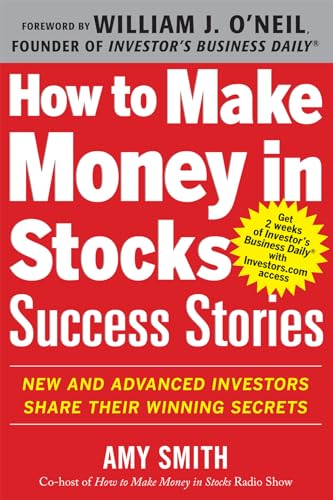
How to Make Money in Stocks Success Stories: New and Advanced Investors Share Their Winning Secrets (BUSINESS BOOKS) - Softcover
Synopsis
Proven Methods for Stock Market SUCCESS!
"Amy's book is a treasure trove of success stories you should read carefully - each of these investors share what could help you find the top 2% of great stocks."
―William J. O'Neil, Chairman & Founder of Investor's Business Daily and author of How to Make Money in Stocks
"All you need are one or two great stock in a year and you can achieve some outstanding results."
―David Ryan, three-time U.S. Investing Champion
Millions of investors around the world have used William O'Neil's bestseller How to Make Money in Stocks as their guide to profiting in the stock market.
Now, the most successful investors explain exactly how they have used O'Neil's CAN SLIM method to generate outsized returns. Packed with tips, strategies, lessons, and do's and don'ts, How to Make Money in Stocks Success Stories gives first-hand accounts explaining the ins and outs of applying CAN SLIM in real situations, in the real market.
Learn how one woman, with no financial background at all, used the CAN SLIM method to get back on her feet after losing her husband and then shortly after, losing her job; she now invests full time and travels the world. She and many other regular people who have made huge gains with O’Neil’s investing method give their first-hand insights that can help anyone who reads this book.
"Anyone can become a successful investor," writes Amy Smith. "The success stories in this book will inspire you and show you how to find the market's biggest winners."
Whether you're just starting out or have been in the market for years, this hands-on companion to the classic stock investing guide gives you the keys to beating the market on a consistent basis.
"synopsis" may belong to another edition of this title.
About the Author
AMY SMITH is the host of Investor's Business Daily's Market Wrap Video at Investors.com and co-host of 870-AM The Answer Radio How to Make Money in Stocks weekly show. She is also IBD Meetup Development Director and IBD Radio, and TV Market Commentator.
Excerpt. © Reprinted by permission. All rights reserved.
How to Make Money in Stocks Success Stories
New and Advanced Investors Share Their Winning SecretsBy Amy SmithMcGraw-Hill Companies, Inc.
Copyright © 2013 The McGraw-Hill Companies, Inc.All right reserved.
ISBN: 978-0-07-180944-3
Contents
Chapter One
Entering The Dojo: The Decision to Start Investing or to Achieve Greater Results
"Teachers open the door, but you must enter by yourself." —CHINESE PROVERB
The beginning martial artist enters the dojo with some trepidation and hesitancy, wondering what will be expected during the training. The black belt instructor enters the room preparing to teach and yells "Charyot!" (Attention!).
A new investor feels the same uncertainty. What will be required? Can I really learn to be a successful investor? And investors with more experience might wonder if they can improve their results. The answer is yes; absolutely: virtually everyone can learn to invest successfully as long as they are willing to follow a proven system and keep a simple set of rules.
"Nothing is impossible to a willing mind." —THE BOOKS OF HAN DYNASTY
You have a desire to improve your life and your financial situation. Congratulate yourself for taking the chance.
Whether your motivating factor is to take a vacation, to buy a home, to generate retirement income, to build a college fund for children or grandchildren, to do more with your own money, or a wish for complete financial independence, you can learn to invest successfully if you're willing to follow a proven investment strategy and keep some simple rules.
Mike Scott was laid off when defense industry cuts hit California and he needed to replace his income.
Calvin Shih got motivated to learn more about investing after watching his dad's stock account dwindle after the dot-com crash.
Carole Shontere wanted to stop the bleeding in her husband's 401(k).
At the age of 50, Jerry Powell was faced with a tough job reassignment and would be on the road 60% of the time.
"Aloha Mike" was disillusioned with the corporate grind.
Jim Taub was looking for retirement income.
Townsend Baldwin was wiped out financially in the dot-com crash while he was on a humanitarian mission in Argentina.
Kathleen Phillips needed to work from home when diagnosed with multiple sclerosis.
Gay Walsh's IRA accounts were losing money.
Anindo Majumdar wanted to quit his corporate job and spend more time with his family.
Katrina Guensch lost a significant amount of money that had been left to her by her father during the 2008 bear market.
Bharani was working as an IT professional and wanted to increase his income.
Brian Gonzales wanted to pay off his student loans.
Jeannie McGrew was frustrated watching an investment advisor lose money year after year with her husband's 401(k) and figured she could do a better job.
Ken Chin wanted to be financially independent.
Barbara James' husband died, she lost her job, and she needed an income.
"We are only bound by our limitations to believe." —MARK BISHOP, OKINAWAN KARATE INSTRUCTOR
Most people lose money in the market, but it definitely doesn't have to be that way.
Contrary to popular belief, you can time the market, or at least you can put the odds in your favor if you follow a few basic rules, the most important one being to follow the market's overall trend.
"Buy and hold" is an investing approach that historically has not worked very well. As a result of that type of investing strategy, many investors lost money in the bear market of 2007–2008, not only in their personal accounts but also in their IRAs. All too many baby boomers are sitting on investments that are simply underperforming their needs for retirement.
The gift that you have as an individual investor is that you can get in and out of the market with greater ease than the professional investor who may take months to fill a huge position in a single stock.
Investor's Business Daily® (IBD®) has research going back to 1880 to help guide investors through every type of market, whether bull or bear. There has also been an in-depth study of the market's biggest winners and the characteristics they had in common prior to making their big runs.
Don't be intimidated by a lack of knowledge or past failure with investing. Everyone starts somewhere, and even if you haven't succeeded in the past, it doesn't mean you can't succeed in the future. The truth is, most people lose money in the stock market because they have no strategy or system that they follow. Many investors buy stocks because they like the company, or someone gave them a hot tip, or the stock seems like a bargain because it has pulled back a lot in price.
It is the institutional investors that drive the money in the market. They are looking for companies that are making products that are in big demand.
We all know the story of Apple, one of the best examples of a company that has been completely innovative and created products that were in big demand from 2004 to 2012. Apple's innovations have produced skyrocketing earnings and sales that captured the attention of the institutional investors—the mutual funds, banks, pension funds, and hedge funds.
Finding these big stock market winners is not as hard as you might think. They appear in every bull market, cycle after cycle. You only need to look at history as your guide. You don't need insider information or a relative who works on Wall Street, and you don't have to take tips that you might hear on TV.
What if you could buy the highest quality merchandise that you can find, the true market winners that are the best the market has to offer? These are stocks that vastly outperform the major moving averages.
Get ready for an exciting and profitable journey in the stock market. The only requirements are the following:
• Set aside sufficient time to analyze the charts.
• Develop discipline.
• Follow a set of time-tested rules.
• Be willing to look at your mistakes and correct them.
Let's get started!
Chapter Two
White Belt: Understanding the Trend and Market Timing
"He who knows when he can fight and when he cannot, will be victorious." —SUN TZU
For a martial artist, bowing is a display of respect. An investor must bow to the market and respect the overall trend. Contrary to popular belief, you can time the stock market.
Every investor would like it if the stock market went up all the time, but that's not the way market cycles work. There are times to be in the market to maximize your gains, and there are times when you should step to the sidelines to avoid losses.
Understanding the Trend
It's important to understand whether the stock market is in an uptrend or a downtrend. Investing in an uptrending market is the most important factor for achieving gains.
What Starts a New Uptrend
A follow-through day signals an important change in the general market direction from a downtrend to a new uptrend.
As an index rallies a few days off its lows, one of the major indexes will close the day higher 1.5% or more on bigger volume than the previous day. This signals that professional money is coming into the market, causing the indexes and leading stocks to rise.
While not all follow-through days work, no new uptrend has started without one. Stronger follow-through days will be accompanied by leading stocks breaking out of areas of price consolidations. That is why it is a good idea to always keep a watch list of stocks up to date during any correction and start a position in one of the stocks that is breaking out on the follow-through day.
How to Tell Whether a New Uptrend Has Begun
The Big Picture column in Investor's Business Daily (IBD) has a Market Pulse section that shows one of three stages:
1. Market in confirmed uptrend (it's a good time to be buying stocks)
2. Uptrend under pressure (time for caution, avoid new buys)
3. Market in correction (market is under selling pressure; consider locking in some gains on stocks that you own and avoid new buys)
What Ends an Uptrend and Puts the Market into a Correction
A distribution day is a heavy day of selling on one of the major indexes. This heavy selling causes one of the indexes to close 0.2% lower on volume higher than that of the previous day. The CAN SLIM System focuses mainly on the S&P and the Nasdaq when counting distribution days.
IBD studies have shown that 5 or 6 days of distribution over a 4- to 5-week period are enough to turn a previously advancing market into decline, especially if distribution days start piling up quickly over a short period.
The increase in heavy selling is a signal to the individual investor that professionals are heading for the exits.
Since three out of four stocks follow the general market trend, it's best not to try and swim against the tide if the market is in a downtrend.
Chapter Three
Dojo Training: Following a Proven Strategy to Find Winning Stocks
"When the student is ready, the master will appear." —BUDDHIST PROVERB
The CAN SLIM® Investing System helps you find the market's biggest winners by looking for the traits that they have in common prior to making their big moves.
What Do the Market's Biggest Winners Have in Common?
In the 1960s, IBD Chairman and Founder William J. O'Neil asked this question as a young stock broker and studied all of the market's biggest winners going back to 1950 (IBD's ongoing study of the market's best performing stocks now goes back to 1880). He also did not want to leave any performance details out, so even though computers were in their infancy, he hired programmers and statisticians to catalog stock data so he could see if it somehow made more sense. And it did. His visionary approach to applying computers to his research paid off big. He found seven traits that winning stocks had in common prior to making their big price moves. This became the basis for the CAN SLIM Investing System, which has helped both professional and individual investors for decades.
Each of the letters in CAN SLIM stands for a different trait that winning stocks have in common.
C Current quarterly earnings. Minimum of 25% increase in the most recent quarter. Many of the market's biggest leaders will have earnings increases in the triple digits.
A Annual earnings. Rate of increase at least 25%, the higher the better.
N New (new products or services, new management, new highs). Innovative companies making new price highs indicating institutional buying.
S Supply and demand. A product or service that is in big demand by the public.
L Leadership. Stocks at the top in their industry group with earnings, sales, return on equity, and price action.
I Institutional support. Mutual funds, hedge funds, pension funds, banks. The professional money is what will drive a stock's price higher.
M Market direction. Buying leading stocks with top fundamentals in an uptrending market and selling stocks when the market goes into a correction.
KEY POINTS
• The biggest winners will have the seven CAN SLIM traits.
• Buy stocks in an uptrending market.
When Is the Right Time to Buy Stocks?
Stocks form chart bases or areas of price consolidation. When they come out of these consolidations on trading volume that is 40% higher than average, we refer to it as a breakout, and this is when a stock should be bought. Buying a stock as it is breaking out of a base pattern puts the odds in your favor. Market history shows that stocks vault out of these areas of consolidation before moving even higher. But buying a stock that is extended in price from a proper base makes the trade more risky since the stock may pull back and can shake you out of a position.
There are three main base patterns that we look for in CAN SLIM Investing.
1. The most common base is the cup-with-handle pattern. It looks like a tea cup with a handle.
2. The double bottom base looks like a W with the exception that the right part of the W undercuts, or drifts down below, the left side of the W.
3. The flat base moves sideways in a tight range as the stock digests a previous move up.
Buying stocks just as they come out of bases or areas of consolidation increases your odds of success. Look for volume that is 40% above average on the breakout.
Some secondary buy points include: (1) A three-weeks-tight pattern (where a stock closes three weeks in a tight range with less than a 1% difference in closing price during that time). (2) A stock may be bought or added to the first or second pullback to the 10-week moving average line on low volume. The low volume shows that institutions are holding onto their positions and not selling heavily.
Base Stages
As a stock is being bought and advances, it forms a series of bases, or areas of price consolidations along the way. Very few stocks move straight up from their first breakout. Most stocks stop and take a breather before moving higher.
We count these bases as first stage, second stage, third stage, and so on. The reason we count base stages is because IBD market studies have shown that earlier stage bases tend to be more successful than later stage bases. By the time a stock has made a big move and is in a third, fourth, or even fifth stage base, it's too obvious, most institutions have made big money in the stock and are ready to lock in profits and sell.
There are exceptions to the rule, and some stocks do continue to move higher in later stage bases, but you want to put the odds in your favor.
Netflix is an example of a stock that formed a series of bases along its move upward.
Look for stocks that are in earlier stage bases.
A Simple Routine for Putting It All Together
To Determine the Market Trend:
1. Check the Market Pulse found in The Big Picture column of IBD to find the current market trend.
2. Watch the Market Wrap video every day to stay in touch with what happened in the market as well as the action of leading stocks at http://investors.com/IBDTV.
To Find Leading Stocks:
1. Look at the IBD 50 in the Monday and Wednesday editions of the paper.
2. Read underneath the mini charts to identify a proper buy point in a stock's base pattern.
Particular Things to Look for in the Chart
Earnings. Ideally double or triple digit numbers, the higher the better.
Sales. Minimum of 25% increase in the most recent quarter vs. the same quarter last year.
Return on Equity. Minimum of 17%, but many market leaders will have ROEs much higher. This shows how efficient a company is with its money.
See which stocks are rising on unusual volume (meaning institutional buying is coming into the stock) with Stocks on the Move at Investors.com (http://www.investors.com) throughout the trading day.
Stay in step with the current market trend. Look at the IBD 50 and Stocks on the Move to find leading stocks.
Continue Your Education: Join a Free IBD Meetup Group
IBD Meetups are the fastest growing financial clubs in the United States. The reason for this is the success many members have had as a result of joining these groups, which meet once a month to discuss the CAN SLIM Investing System.
At a typical meeting, groups will discuss the current market trend, leading stocks, and how to build a watch list. They also go over a lesson designed by IBD Chairman and Founder Bill O'Neil, and ask questions. More seasoned investors help newer investors learn the system and how to succeed.
Katrina Guensch lives in an area that doesn't have an IBD Meetup Group, so she participates in one that has online monthly webinars: the Chicago/Naperville IBD Meetup. She says, "The group has detailed meetings that have really helped me learn." Through the webinars, she has met other investors to e-mail and discuss the current market and leading stocks.
Gay Walsh is a TV writer and had a desire to do more with her money, so she joined several IBD Meetup Groups in the Southern California area and found that attending so many increased her learning curve. She said, "Watching other people read charts was really helpful. A writer's life can be up and down; I wanted to establish security for retirement. IBD Meetups have been a great resource for me."
Carol Shontere says, "I have attended every single Thousand Oaks Meetup since June 2010. I have been blessed to find the best of the best with this group, including leadership from Mike Scott and Jerry Samet, and I have learned so much."
Prabin Bishoyi is a senior software engineer who works for IBD. He sends out a newsletter to his group after each meeting, summarizing what was discussed as well as what stocks were analyzed from the group's watch list. As a leader, he engages the group with quizzes to cement key learning points in between meetings. He also has his group participate in creating a mock portfolio to see what kind of gains the group could generate from stocks that were discussed at the monthly meetings. Prabin says, "I am a continual student of the market and work hard so I can help my Meetup group members find success with IBD."
Dennis Wilburn is an IBD Meetup leader from the Bay Area Money Makers, or BAMM for short. The group is "dedicated to technical analysis and, as a group working together, to achieve financial freedom by following CAN SLIM trading techniques." The group first discusses the current trend, builds a watch list of superior growth stocks, and goes over proper entry points and position size as well as exit points, primarily using the IBD 50. One of Dennis' most quotable statements is to "clarify and simplify so you multiply." Having studied many different investing methodologies, he has "found the IBD 50 to be a treasure trove of the market's best performing stocks. This is where the big fish hang out. If you apply strict trading strategies and follow the overall market trend, you can do exceptionally well. That's because the IBD 50 stocks have to pass stringent criteria before making the list."
(Continues...)
Excerpted from How to Make Money in Stocks Success Storiesby Amy Smith Copyright © 2013 by The McGraw-Hill Companies, Inc.. Excerpted by permission of McGraw-Hill Companies, Inc.. All rights reserved. No part of this excerpt may be reproduced or reprinted without permission in writing from the publisher.
Excerpts are provided by Dial-A-Book Inc. solely for the personal use of visitors to this web site.
"About this title" may belong to another edition of this title.
Search results for How to Make Money in Stocks Success Stories: New and...

Stock Image
How to Make Money in Stocks Success Stories: New and Advanced Investors Share Their Winning Secrets
Published by
McGraw-Hill Education - Europe, 2013
ISBN 10: 0071809449
ISBN 13: 9780071809443
Used
Paperback
Seller: World of Books (was SecondSale), Montgomery, IL, U.S.A.
Seller rating 5 out of 5 stars

Paperback. Condition: Fair. Packed with tips, strategies, lessons, and do's and don'ts, this title gives first-hand accounts explaining the ins and outs of applying can slim in real situations, in the real market. It explains exactly how they have used O'Neil's can slim method to generate outsized returns. Seller Inventory # 00101585410
Stock Image
How to Make Money in Stocks Success Stories: New and Advanced Investors Share Their Winning Secrets
Published by
McGraw-Hill Education - Europe, 2013
ISBN 10: 0071809449
ISBN 13: 9780071809443
Used
Paperback
Seller: World of Books (was SecondSale), Montgomery, IL, U.S.A.
Seller rating 5 out of 5 stars
Paperback. Condition: Good. Packed with tips, strategies, lessons, and do's and don'ts, this title gives first-hand accounts explaining the ins and outs of applying can slim in real situations, in the real market. It explains exactly how they have used O'Neil's can slim method to generate outsized returns. Seller Inventory # 00110638495
Seller Image
How to Make Money in Stocks Success Stories: New and Advanced Investors Share Their Winning Secrets
Seller: Zoom Books Company, Lynden, WA, U.S.A.
Seller rating 5 out of 5 stars
Condition: very_good. Book is in very good condition and may include minimal underlining highlighting. The book can also include "From the library of" labels. May not contain miscellaneous items toys, dvds, etc. . We offer 100% money back guarantee and 24 7 customer service. Seller Inventory # ZBV.0071809449.VG
Seller Image
How to Make Money in Stocks Success Stories: New and Advanced Investors Share Their Winning Secrets
Seller: Zoom Books East, Glendale Heights, IL, U.S.A.
Seller rating 5 out of 5 stars
Condition: very_good. Book is in very good condition and may include minimal underlining highlighting. The book can also include "From the library of" labels. May not contain miscellaneous items toys, dvds, etc. . We offer 100% money back guarantee and 24 7 customer service. Seller Inventory # ZEV.0071809449.VG
Seller Image
How to Make Money in Stocks Success Stories: New and Advanced Investors Share Their Winning Secrets
Seller: 2nd Life Books, Burlington, NJ, U.S.A.
Seller rating 5 out of 5 stars
Condition: very_good. Used book in very good condition. May have some minor wear. May NOT include discs, or access code or other supplemental material. Ships directly from Amazon and is eligible for Prime or super saver FREE shipping. We ship Monday-Saturday and respond to inquiries within 24 hours. Seller Inventory # BXM.CK33
Seller Image
How to Make Money in Stocks Success Stories: New and Advanced Investors Share Their Winning Secrets
Seller: Greenworld Books, Arlington, TX, U.S.A.
Seller rating 5 out of 5 stars
Condition: very_good. Fast Free Shipping â" Very Good condition book with a firm cover and clean pages. Shows normal use and some light wear or limited notes markings. A solid, nice copy to enjoy. Seller Inventory # GWV.0071809449.VG
Stock Image
How to Make Money in Stocks Success Stories: New and Advanced Investors Share Their Winning Secrets
Published by
McGraw Hill (edition 1), 2013
ISBN 10: 0071809449
ISBN 13: 9780071809443
Used
Paperback
Seller: BooksRun, Philadelphia, PA, U.S.A.
Seller rating 5 out of 5 stars
Paperback. Condition: Very Good. 1. It's a well-cared-for item that has seen limited use. The item may show minor signs of wear. All the text is legible, with all pages included. It may have slight markings and/or highlighting. Seller Inventory # 0071809449-8-1
Seller Image
How to Make Money in Stocks Success Stories: New and Advanced Investors Share Their Winning Secrets
Seller: EZ USED BOOKS LLC, East Providence, RI, U.S.A.
Seller rating 5 out of 5 stars
Condition: very_good. Any images shown are stock photographs. The actual item may differ from the image displayed. Very Good condition. Dust Jacket included, Light signs of handling or shelf wear may be present. Pages are clean and the binding is secure. If you would like to confirm the exact condition of this copy before purchasing, please feel free to contact us for photos. Seller Inventory # EZBV.0071809449.VG
Stock Image
How to Make Money in Stocks Success Stories: New and Advanced Investors Share Their Winning Secrets
Published by
McGraw-Hill Education - Europe, 2013
ISBN 10: 0071809449
ISBN 13: 9780071809443
Used
Paperback
Seller: World of Books Inc, Montgomery, IL, U.S.A.
Seller rating 4 out of 5 stars

Paperback. Condition: Fair. Packed with tips, strategies, lessons, and do's and don'ts, this title gives first-hand accounts explaining the ins and outs of applying can slim in real situations, in the real market. It explains exactly how they have used O'Neil's can slim method to generate outsized returns. Seller Inventory # CIN0071809449A
Stock Image
How to Make Money in Stocks Success Stories: New and Advanced Investors Share Their Winning Secrets
Published by
McGraw-Hill Education - Europe, 2013
ISBN 10: 0071809449
ISBN 13: 9780071809443
Used
Paperback
Seller: World of Books Inc, Montgomery, IL, U.S.A.
Seller rating 4 out of 5 stars
Paperback. Condition: Very Good. Packed with tips, strategies, lessons, and do's and don'ts, this title gives first-hand accounts explaining the ins and outs of applying can slim in real situations, in the real market. It explains exactly how they have used O'Neil's can slim method to generate outsized returns. Seller Inventory # CIN0071809449VG