
Items related to The CustomerCentric Selling® Field Guide to Prospecting...
The CustomerCentric Selling® Field Guide to Prospecting and Business Development: Techniques, Tools, and Exercises to Win More Business (BUSINESS BOOKS) - Softcover
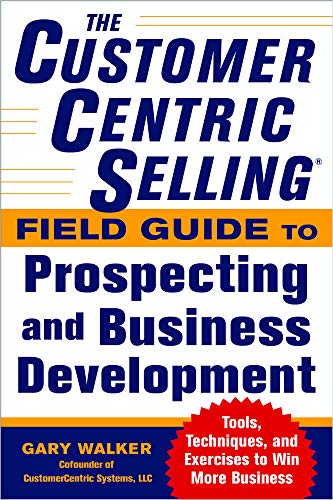
Synopsis
The Proven Approach to Prospecting for the Long Sales Cycle
It's a fact: 92 percent of C-level executives never respond to e-mail blasts or cold calls . . . so why would you continue to rely on these approaches to generate new business?
If you're like most sales professionals, it's time to transform your selling method by listening rather than talking and by asking questions rather than stating opinions. In short, you need to be customer-centric. This revolutionary new guide will show you how.
The CustomerCentric Selling Field Guide to Prospecting and Business Development gives you the tools and methods necessary to refocus your energy from blindly delivering sales pitches to developing lasting relationships with profitable clients. This clear, concise, and proven-effective field guide covers:
- The six steps to prospecting success
- Calculating pipeline strength and requirements
- Successfully engaging decision makers at the "point of need"
- Ways to develop and deliver a sales-ready message
- How to leverage relationships through social networking
The CustomerCentric Selling Field Guide to Prospecting and Business Development provides the tools you need to improve prospecting and business development effectiveness. Most important, it helps you increase productivity, win more business, and develop lasting relationships with your ideal customers.
"synopsis" may belong to another edition of this title.
About the Author
Gary Walker is a cofounder of CustomerCentric Systems, LLC, which Training Magazine routinely lists among its top 25 sales training companies.
Excerpt. © Reprinted by permission. All rights reserved.
The CustomerCentric Selling Field Guide to Prospecting and Business Development
Tools, Techniques, and Exercises to Win More Business
By GARY WALKERThe McGraw-Hill Companies, Inc.
Copyright © 2013 McGraw-Hill Education
All rights reserved.
ISBN: 978-0-07-180805-7All rights reserved.
Contents
| Acknowledgments | |
| Introduction | |
| Chapter 1 • Getting the Most Out of This Field Guide | |
| Chapter 2 • CustomerCentric Selling Primer | |
| Chapter 3 • What Is Prospecting? | |
| Chapter 4 • Planning—The Six Steps to Prospecting Success | |
| Chapter 5 • Pipeline Analysis | |
| Chapter 6 • Preparation | |
| Chapter 7 • Engaging at the Point of Need | |
| Chapter 8 • Sales Ready Messaging | |
| Chapter 9 • Leveraging Relationships and Results Through Social Networking | |
| Chapter 10 • Prospecting Methods | |
| Chapter 11 • Telephone Prospecting | |
| Chapter 12 • E-mail Prospecting | |
| Chapter 13 • Five-Step Prospecting Methodology | |
| Chapter 14 • Thunder and Lightning | |
| Chapter 15 • Direct Mail Prospecting | |
| Chapter 16 • Referral Prospecting | |
| Chapter 17 • Drip Marketing | |
| Chapter 18 • Getting Started | |
| Sources | |
| Index |
Excerpt
CHAPTER 1
Getting the Most out of This Field Guide
Why a Field Guide?
If you are like many sales or business professionals, this is not the firstbusiness book you have had your hands on. However, it may be the first businessfield guide you have encountered.
Personally, I have gained much from reading the ideas expressed by authors inmany fine professional books. Often they give me new ideas to consider as I'mrelaxing on an airplane or feeling contemplative. But generally speaking, it isa one-way affair, with the role of the reader simply being to read the wordsneatly arranged on the pages and having to figure out how to implement the ideasthe book's author suggests.
Field guides are different. They aim to strike a partnership with the readerthrough a collaboration of sorts, with the field guide providing facts, tips,and a frame of reference for the reader, who calls upon them at a time of need.
For example, if you are walking in the woods, you may find a field guide tomushrooms or trees a handy resource. Before you bend over and pick what you hopeis a tasty morel mushroom, you whip out your field guide and examine thepictures and the written description carefully until you feel comfortable withyour skills of identification. You are then rewarded with the most deliciousmushroom you have ever savored and become something of a hero to your intrepidpeers, who remain firmly entrenched in their way of doing things—and offthey go to the grocery store to buy their button mushrooms.
As your knowledge grows, your confidence grows, and you move from elementaryskills to more advanced techniques for identification and problem solving. As aparallel to your business objectives of prospecting for customers, perhaps youwill even use a field guide to prospect for rocks, Civil War relics, or preciousmetals. Over time, your practiced use of field guides results in you havingimproved your confidence, competency, and satisfaction.
The CustomerCentric Selling Field Guide to Prospecting and Business Developmentis designed to help you navigate the same path in the field of prospecting forgold in the form of new business.
While there are words on these pages just as there are on the pages of anybusiness book, as with all field guides the benefits accrue once you apply thetips, tools, methods, and exercises in real-world settings. This book isdesigned to go with you and to be practiced as much as read. There is space foryou to scribble, annotate, and express your thoughts. In a way, you become apartner in finishing this book by customizing it for you.
Learning to Exercise
You probably are familiar with the expression "no pain, no gain." That sayingpermeates our culture for good reason; if you want results, you generally haveto work for them. While it is not my intention to inflict pain on you, it isimportant for you to realize that you will need to apply yourself if you want toimprove at anything. This is true for getting those ripped abs, becoming avirtuoso on the piano, or finishing that marathon. And it is even truer forbecoming truly proficient at the science and art of prospecting and businessdevelopment, differentiating yourself from the masses of salespeople.
Funny thing, though, about the profession of selling; there are far too manypeople who act as if you can walk right into success with no planning, noforethought, and no practice. More often than not, these folks give selling abad name and achieve little success. This strikes me as odd given the lucrativeincomes that many sales professionals can and do earn, either equaling orgreatly surpassing that earned by other professionals such as doctors andlawyers, who, by contrast, study and practice rigorously to earn their keep.
Sure, every now and then someone comes along and succeeds wildly in a salescareer without any formal training. Then again, every few hundred years musicalprodigies like Mozart come around. The rest of us would be well advised toprepare for success rather than hoping or wishing for success, and thispreparation means practicing new skills. This is something I believe in fullyrather than talking about hypocritically.
In my business, I practice and institutionalize every one of the methods andtactics described in this book. Sometimes it is not glamorous or sexy ... moreakin to the way the tortoise runs the race than the hare. But it worksconsistently and has always proved to be effective.
Using This Field Guide
My recommendation is for you to read through this field guide in the order it iswritten. There are several exercises for you to complete along the way, andcompleting these exercises accomplishes three things.
First, it requires you to demonstrate that you have grasped what you have read.If you haven't, then the subsequent materials become more difficult and won't beas clear to you. Writing your own answers allows you to think about what youhave read and how you can apply it to the uniqueness of your selling situation.I have no way of knowing if your aim is to sell commodity products, high-valueintangible services, big-ticket luxury items, and so on. The exercises allow youto take the tips, tools, and tactics described and adapt them to your particularproducts, services, and markets.
Second, it allows you to make an investment in the authorship of this book. Inaddition to my words on the page, the book becomes alive with your words on thepage. Go beyond simply answering the questions to scribbling notes in themargins when you read something that excites, concerns, or inspires you.
Finally, by participating in the book, you will begin a process of planning foryour own success. The elements of the process—reading, thinking, andresponding—will all align to the goal that you are aiming for: improvingyour prospecting and business development effectiveness. You will begin thinkingmore about who your prospective customers are, what they want, and how you canultimately get what you want by helping them to get what they want. Without evenrealizing it, your thoughts on prospecting and business development will becomemore serious, more planned, and more deliberate. You will be on your way toachieving your professional goals.
After you have completed your initial reading of the book, you should have anunderstanding of its contents. But the pages are still crisp, or if you arereading a digital copy, the screen still has few smudges. Over time, your goalis to smudge that screen, to weather those pages, as a result of referencingtime after time the strategies and tactics you want to practice, hone, andimprove upon. Each time you will add notes where you have been successful, whereyou have stumbled, and how you have adapted. It is, after all, a field guide,and not a leather-bound book that must never be removed from "Ron Burgundy's"bookshelf.
If you let it, this field guide will help you to become a more successful salesprofessional by unleashing the greatness that is already within you. But thereis a catch, and it is an obvious one. Just as world-class golfers make golfinglook easy, you probably falter considerably by comparison when you swing thesticks. That's because for most of us, golf is just playtime. Winning newbusiness is where our income is earned ... for many of us, it funds ourlivelihood.
If you want to earn enough to swing the sticks and to have the life youfinancially crave, the catch is that you need to take selling seriously. Thatmeans taking prospecting and business development seriously.
Wearing out the pages of The CustomerCentric Selling Field Guide to Prospectingand Business Development is the place to start.
CHAPTER 2
CustomerCentric Selling Primer
Whether you are an existing CustomerCentric Selling client or a salesperson notyet familiar with the CustomerCentric Selling approach, it is appropriate totake a moment to cover the core concepts of the CustomerCentric Sellingmethodology.
The main focus of The CustomerCentric Selling Field Guide to Prospecting andBusiness Development is to help individuals and organizations involved in salesto become better, more effective prospectors and developers of new business.Specifically, the aim is to help people move from traditional prospectingapproaches and techniques to "customer-centric" behavior. It is my sincerebelief that the CustomerCentric Selling methodology can help you become morecustomer-centric and therefore more successful.
The worldwide team at CustomerCentric Selling is engaged in the business ofsales process improvement, Sales Ready Messaging, and sales training. Thepractical concepts within this book are the result of years of experience,research, and field testing—first as sales professionals ourselves, lateras executives with increasing levels of sales management responsibility, andfinally as leaders in a firm that has taught tens of thousands of customers toachieve better sales results.
As teachers, we work with all levels within client organizations. We help chiefexecutive officers (CEOs) to learn how to take responsibility for theircustomers' experience and to shape them.
We teach sales executives how to own and manage their revenue engines.
We show marketing executives how to manage their content and create Sales ReadyMessaging.
We teach first-line sales managers how to assess and develop the talent of theirsalespeople, manage a sales process, and build a quality pipeline.
Last—but certainly not least—we teach salespeople customer-centricbehavior. In doing so, we focus on how to influence the words that sellers usewhen developing buyer needs for their offerings.
What Is Customer-Centric Behavior?
Customer-centric behavior has eight basic tenets. These are summarized in Table2.1 and are explained in order in this chapter. As you read these descriptions,I invite you to imagine a spectrum of selling behavior ranging from traditionalon one end to customer-centric on the other. Try to find yourself on thatspectrum. Are you where you want to be? Are you as successful as you can be? Ifnot, what needs to change?
Tenet 1. Having Situational Conversations Versus Making Presentations
Traditional salespeople rely on making presentations or doing productdemonstrations, often using applications such as PowerPoint or using a member ofthe professional services or presales staff to perform the demonstration. Why?Because they believe that this approach gives them the opportunity to addexcitement in the form of highly polished graphics, animation, and so on. Itaffords them the opportunity to turn down the lights and increase the dramaticeffect of their presentations.
In successful selling we find that conversations are far more powerful thanpresentations. Your ability to converse effectively (have a meaningful two-waydialogue) is the key to your prospecting and selling success. And yes, it ispossible to converse with audiences using PowerPoint—as opposed topresenting to them—but it is far more difficult. Have you ever had aconversation with a friend or a colleague that was based on a pre-scripted slideshow? Of course you haven't, and so it shouldn't be a surprise that when seniorexecutives see salespeople enter their offices with a laptop under their arm,many roll their eyes and sneak a peek at their watches.
When conducting sales calls, how often do salespeople dominate by doing themajority of the talking? Salespeople have their own agenda of what they wouldlike to accomplish.
Good conversations require both parties to actively participate and exchangeideas. Sellers that do a great deal of telling and sharing opinions to havebuyers draw the desired conclusions can be viewed as trying to manipulate thebuyers.
Consider this: In order to be effective, a salesperson must be able to relatehis or her offering to the buyer in a way that will allow the buyer to visualizeusing it to achieve a goal, solve a problem, or satisfy a need. This, in turn,requires a conversation. For a variety of reasons, though, only a smallpercentage of salespeople are able to converse effectively with buyers,especially executives and decision makers.
The CustomerCentric Selling Field Guide to Prospecting and Business Developmentaims to help you engage in relevant, situation-specific conversations withsenior executives that have the ability to purchase your offering. It is phaseone of the selling marathon.
By contrast, CustomerCentric Selling is a broad methodology designed to help younavigate the entire sales process with decision makers, without depending oncanned slide presentations. In short, it can help you to become more effectiveand more successful.
Tenet #2. Asking Relevant Questions Versus Offering Opinions
Traditional salespeople offer their opinions to prospects, whereas customer-centricsalespeople ask relevant questions. It is far more comfortable forbuyers if sellers focus on asking versus telling. This allows the buyers tosteer the direction of the sales call based on their own responses. It alsoallows the buyers to draw their own conclusions.
Another potential issue occurs when sellers attempt to develop a vision for asolution to their buyer's goal or problem before their prospective buyer does.When a traditional seller sees the solution, he or she tends to project thatvision onto the buyer, saying things like, "In order to deal with that problem,you will need our seamlessly integrated software solution ..."
When that occurs, what is happening on the other side of the table? Very oftenthe prospective buyer is thinking something along the lines of "Oh, yeah? Do wenow? Says who?"
People don't like loved ones telling them what they need, much less asalesperson with a motive and a mission! Most people, when in the role of buyer,would resent it when sellers try to control or pressure them.
People love to buy but hate feeling like they are being sold to. Buying meansthey are in control. Being sold to means they are being controlled, and fewpeople like to be controlled.
At CustomerCentric Selling, we have found that top-performing salespeople usetheir expertise to frame interesting and helpful questions rather than deliveropinions. Asking intelligent and relevant questions shows respect for the buyersand engages them.
When buyers encounter a series of intelligent questions—questions that areon point and that can be answered, and the answers to which build toward auseful solution—they do not feel that they are being sold.
Asking Questions: Are You Up to the Test?
Write three to five questions you normally ask during a sales call.
Now, take a look at the five questions you have just written. Do traditionalsalespeople typically ask similar questions? What's your budget? What's yourtimeline? Do you have the ability to buy?
When asking questions similar to those, whose needs are you attempting toprocess, yours or the prospect's? Whose needs is the prospect interested inprocessing, yours or his or her own? Being customer-centric means focusing onthe needs of the prospect.
Tenet #3. Solution Focused Versus Relationship Focused
Traditional sellers are relationship focused, and customer-centric sellers aresolution focused.
If the seller does not understand how the buyer will use the seller's offeringto achieve a goal, solve a problem, or satisfy a need, he or she really has nochoice but to fall back on relationships. Why does it happen? In many cases theanswer lies in the training (or lack of) that the salesperson receives. Manyorganizations engage their product marketing department to teach salespeopleabout their products. Not surprisingly, the result is a sales force that cantell you all about the esoteric features of the products but can't tell you howthe products are used or how the buyers can benefit from them. And the rareproduct marketers who do understand the uses of the products tend to have theirunderstanding at the day-to-day user level, not at the decision-maker level.
(Continues...)
Excerpted from The CustomerCentric Selling Field Guide to Prospecting and Business Development by GARY WALKER. Copyright © 2013 by McGraw-Hill Education. Excerpted by permission of The McGraw-Hill Companies, Inc..
All rights reserved. No part of this excerpt may be reproduced or reprinted without permission in writing from the publisher.
Excerpts are provided by Dial-A-Book Inc. solely for the personal use of visitors to this web site.
"About this title" may belong to another edition of this title.
Search results for The CustomerCentric Selling® Field Guide to Prospecting...

Stock Image
The CustomerCentric Selling? Field Guide to Prospecting and Business Development: Techniques, Tools, and Exercises to Win More Business
Seller: World of Books (was SecondSale), Montgomery, IL, U.S.A.
Seller rating 5 out of 5 stars

Condition: Acceptable. Item in acceptable condition! Textbooks may not include supplemental items i.e. CDs, access codes etc. Seller Inventory # 00100302467
Stock Image
The CustomerCentric Selling? Field Guide to Prospecting and Business Development: Techniques, Tools, and Exercises to Win More Business
Seller: World of Books (was SecondSale), Montgomery, IL, U.S.A.
Seller rating 5 out of 5 stars
Condition: Good. Item in good condition. Textbooks may not include supplemental items i.e. CDs, access codes etc. Seller Inventory # 00096966652
Seller Image
The CustomerCentric Selling® Field Guide to Prospecting and Business Development: Techniques, Tools, and Exercises to Win More Business
Seller: Greenworld Books, Arlington, TX, U.S.A.
Seller rating 5 out of 5 stars
Condition: very_good. Fast Free Shipping â" Very Good condition book with a firm cover and clean pages. Shows normal use and some light wear or limited notes markings. A solid, nice copy to enjoy. Seller Inventory # GWV.0071808051.VG
Stock Image
The Customercentric Selling(r) Field Guide to Prospecting and Business Development: Techniques, Tools, and Exercises to Win More Business
Seller: ThriftBooks-Atlanta, AUSTELL, GA, U.S.A.
Seller rating 5 out of 5 stars
Paperback. Condition: Good. No Jacket. Pages can have notes/highlighting. Spine may show signs of wear. ~ ThriftBooks: Read More, Spend Less. Seller Inventory # G0071808051I3N00
Seller Image
The CustomerCentric Selling® Field Guide to Prospecting and Business Development: Techniques, Tools, and Exercises to Win More Business
Seller: -OnTimeBooks-, Phoenix, AZ, U.S.A.
Seller rating 5 out of 5 stars
Condition: very_good. Gently read. May have name of previous ownership, or ex-library edition. Binding tight; spine straight and smooth, with no creasing; covers clean and crisp. Minimal signs of handling or shelving. 100% GUARANTEE! Shipped with delivery confirmation, if you're not satisfied with purchase please return item! Ships USPS Media Mail. Seller Inventory # OTV.0071808051.VG
Stock Image
The CustomerCentric Selling Field Guide to Prospecting and Business Development
Published by
McGraw-Hill Education - Europe, 2013
ISBN 10: 0071808051
ISBN 13: 9780071808057
Used
Paperback
Seller: World of Books Inc, Montgomery, IL, U.S.A.
Seller rating 2 out of 5 stars

Paperback. Condition: Fair. Gives you the tools and methods necessary to refocus your energy from blindly delivering sales pitches to developing lasting relationships with profitable clients. This guide covers: the six steps to prospecting success; calculating pipeline strength and requirements; and how to leverage relationships through social networking. Seller Inventory # CIN0071808051A
Stock Image
The CustomerCentric Selling Field Guide to Prospecting and Business Development
Published by
McGraw-Hill Education - Europe, 2013
ISBN 10: 0071808051
ISBN 13: 9780071808057
Used
Paperback
Seller: World of Books Inc, Montgomery, IL, U.S.A.
Seller rating 2 out of 5 stars
Paperback. Condition: Good. Gives you the tools and methods necessary to refocus your energy from blindly delivering sales pitches to developing lasting relationships with profitable clients. This guide covers: the six steps to prospecting success; calculating pipeline strength and requirements; and how to leverage relationships through social networking. Seller Inventory # CIN0071808051G
Stock Image
The CustomerCentric Sellingî Field Guide to Prospecting and Business Development: Techniques, Tools, and Exercises to Win More Business
Seller: Better World Books: West, Reno, NV, U.S.A.
Seller rating 5 out of 5 stars
Condition: Very Good. Pages intact with possible writing/highlighting. Binding strong with minor wear. Dust jackets/supplements may not be included. Stock photo provided. Product includes identifying sticker. Better World Books: Buy Books. Do Good. Seller Inventory # 10733090-20
Stock Image
The CustomerCentric Sellingî Field Guide to Prospecting and Business Development: Techniques, Tools, and Exercises to Win More Business
Seller: Better World Books: West, Reno, NV, U.S.A.
Seller rating 5 out of 5 stars
Condition: Good. Pages intact with minimal writing/highlighting. The binding may be loose and creased. Dust jackets/supplements are not included. Stock photo provided. Product includes identifying sticker. Better World Books: Buy Books. Do Good. Seller Inventory # 4006045-75
Stock Image
The CustomerCentric Sellingî Field Guide to Prospecting and Busi
Seller: Hawking Books, Edgewood, TX, U.S.A.
Seller rating 4 out of 5 stars

Condition: Very Good. Very Good Condition. Five star seller - Buy with confidence! Seller Inventory # X0071808051X2