
Items related to The Zigzag Principle: The Goal Setting Strategy that...
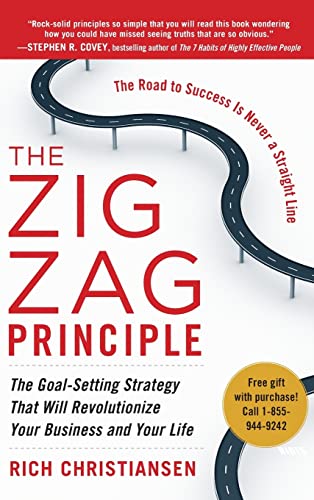
The Zigzag Principle: The Goal Setting Strategy that will Revolutionize Your Business and Your Life (BUSINESS BOOKS) - Hardcover
Synopsis
Zigzag Your Way to Success!
Have you ever set your sights on the top of a mountain and then started your ascent by heading straight through the trees and up the sheer cliffs? Or driven in your car to the other side of town―as the crow flies? Of course not! Because you instinctively know that, just as a river has to wend its way around obstacles, the best route is never actually a straight line!
In The Zigzag Principle, Rich Christiansen applies a foundational law of nature to business management, entrepreneurship, goal-setting, and life in general as he explores why zigzagging toward our intended outcomes is more effective than trying to bulldoze our way through whatever stands between us and our objectives.
Christiansen helps you get started, make your way over the big hill to initial profitability, and minimize risks along the way. A s the head of well-established corporations and as the brains behind numerous start-ups, Christiansen has been through it all, and he’s charted all the zigs and zags you’ll encounter. In The Zigzag Principle, he documents everything he has learned, including how to:
- Identify your destination
- Create a defined set of values to help you as your business finds its way
- Add resources and hire the right people, as you turn the cash you have into fuel for more
- Replicate your successes to bring your product to the masses
- Protect your resources, your family, and your sanity
The simplicity of a straight line can be seductive. But it’s not a realistic way to go about achieving your goals, because you will always come upon unexpected obstacles in the road. Zigzagging requires you to be nimble and flexible, to “bootstrap,” and to be able to take advantage of multiple opportunities. What it delivers is success―in business and in life―far beyond your initial plans and dreams.
Use The Zigzag Principle to assess your resources, use them to their fullest, and keep yourself and your team motivated―all while living a life of balance.
Praise for The Zigzag Principle
“Rock-solid principles so simple that you will read this book wondering how you could have missed seeing truths that are so obvious.”
―Stephen R. Covey, bestselling author of The 7 Habits of Highly Effective People
“Our economy will be saved and grow again through the industry of focused entrepreneurs who will hire thousands of employees to meet the needs of customers. This thoughtful and inspired book will guide creative and energized business men and women to accomplish their loftiest dreams and restore America’s prosperity once again.”
―Alan E. Hall, entrepreneur, angel investor, venture capitalist, cofounder of Mercato Partners
“The Zigzag Principle is the new way of doing business. It will increase your chances of success by 90 percent and eliminate so much of the stress that business owners face.”
―Garrett Gunderson, New York Times bestselling author of Killing Sacred Cows
“The Zigzag Principle has revolutionized the way I run my business. It works, it measures, it performs. Every business should know and implement this principle!”
―Curtis Blair, cofounder and general manager, Froghair
“Rich Christiansen is one of the most insightful, practical, and cost-conscious entrepreneurs in the world today. Listen to Rich. He won’t steer you wrong.”
―Roy H. Williams, author of the New York Times and Wall Street Journal bestselling Wizard of Ads trilogy
”I don't believe entrepreneurship is something you can truly learn from a book. Everyone has to make their own mistakes. Nevertheless, if you've already made some mistakes then you'll find The Zig Zag Principle to be a no b.s. guide to starting, nurturing and succeeding at entrepreneurship.”
―Jeffrey Eisenberg, author of the New York Times and Wall Street Journal marketing bestsellers Call to Action and Waiting For Your Cat To Bark?
“Entrepreneurs, you need not fear failure anymore! With The Zigzag Principle in hand, you will have all the tools you need to increase your probability of success the instant you apply the concepts in this book.”
―Rick Sapio, founder and CEO of Mutual Capital Alliance, Inc, Dallas, Texas
“The Zigzag Principle isn’t feel-good fluff―it is a logical and practical formula that you can put your hands on, and it will increase the rate of success of any business you apply it to.”
―Moe Abdou, Principal and founder, 33 Voices
“The Zigzag Principle is more powerful than the ‘release and iterate’ mentality which is so prevalent today. I have adjusted my planning to incorporate this principle in our product launches. Properly executed, The Zigzag Principl will keep folks like me out of financial hot water.”
―David McInnis, founder of PRWeb.com and founder and CEO of Cranberry LLC, Venture Partners
“Most entrepreneurs find it complicated and difficult to build their businesses. Rich has done a masterful job with The Zigzag Principle to make complex things simple and the difficult easy―and it works! It will help you get where you want to be with more confidence and certainty.”
―Murray Smith, New York Times bestselling coauthor of The Answer and CEO of MainStreetMentor.com
“Whether you are a parent, an entrepreneur, a factory worker, or a middle manger, The Zigzag Principle will provide you with a framework and a formula that will empower you to make changes in your world you had never felt were possible.”
―Joseph Grenny, New York Times bestselling coauthor of Influencer: The Power to Change Anything
"The Zigzag Principle delivers the epiphany of the decade for business owners. These strategies are non-intuitive, but proven to be solid and dependable, which is why this is such an important work. Not only will you profit faster than you thought possible, you'll also enjoy greater balance and fulfillment in the process."
―Leslie Householder, Award-winning bestselling author of The Jackrabbit Factor: Portal to Genius
About the Book:
"synopsis" may belong to another edition of this title.
About the Author
Rich Christiansen spent the first half of his career as an executive, running the PC division of Mitsubishi Electronics, working at Novell, and becoming general manager of About.com. Today, he is in high demand as a mentor and small business consultant. Christiansen is coauthor of Bootstrap Business: A Step-by-Step Business Survival Guide.
Excerpt. © Reprinted by permission. All rights reserved.
The Zigzag Principle
The Goal-Setting Strategy That Will Revolutionize Your Business and Your Life
By Rich ChristiansenThe McGraw-Hill Companies, Inc.
Copyright © 2012 Mountain Grabbers, LLC
All rights reserved.
ISBN: 978-0-07-177458-1All rights reserved.
Contents
| Acknowledgments | |
| Introduction: Deliberate Detours | |
| ONE Assessing Resources—What's in Your Pocket? | |
| TWO Beacons in the Fog and Catalyzing Statements | |
| THREE Values—A Firm Foundation | |
| FOUR Zig Number 1—Drive to Profitability | |
| FIVE Zag Number 2—Adding Processes and Resources | |
| SIX Zig Number 3—Adding Scale | |
| SEVEN Boundaries and Guardrails | |
| EIGHT Rewards—Finding Hidden Treasures | |
| NINE Avoiding the All-or-Nothing Trap | |
| Index |
Excerpt
<h2>CHAPTER 1</h2><p><b><i>Assessing Resources—What's in Your Pocket?</i></b></p><br><p>After I wrote my first book, <i>Bootstrap Business</i>, which told the story ofhow my partner, Ron Porter, and I took $5,000 and within one year grew it into a$1.2 million business, I had the opportunity to be interviewed by GarrettGunderson for a national radio show. Garrett is the author of the <i>New YorkTimes</i> bestseller, <i>Killing Sacred Cows</i>, and he started the interviewby asking, "Rich, tell me about how you started this last business." I said,"Oh, I took $5,000 and ..." Garrett interrupted me midsentence and said, "No! Noyou didn't."</p><p>I was kind of stunned and tried to explain, "Well, yes, I actually <i>did</i>start it with $5,000." He corrected me again, "No you didn't." And I retorted,"Yes, I did!"</p><p>After what I initially thought was a rather awkward beginning, Garrett went onto explain that the $5,000 my partner and I put up was the smallest part of theequation. In fact, in his words, the money was really meaningless. And in makingthat point, Garrett was teaching an invaluable lesson.</p><p>Most people assume we need to have money to succeed in business and to reach ourgoals in life. If we want to start a business, the reasoning goes, we first needcapital. If we're given a major project at work, we immediately want to knowwhat our budget is. If we want to take our family on a much-needed vacation, thefirst thing we do is check the balance of our bank account (or, if we reallyenjoy paying interest, our credit cards). That view develops a straight-linementality as we undertake whatever we have set our sights on—whether it'sa house, a business, a contribution to our team at work, a strong marriage and astable family ... you name it. But if all you think in terms of is how muchmoney you need to achieve your goals, you're missing the fact that success isactually the result of identifying and maximizing a couple of foundationalresources that have nothing to do with our traditional view of "capital" andhave everything to do with zigzagging toward our intended outcome.</p><p>The point Garrett was making was that Ron and I succeeded because of what hecalls "The Value Equation," which is that <i>mental capital</i> (meaning ourknowledge, skills, talents, and passions) plus our <i>relationship capital</i>(meaning the quality of our relationships with a broad pool of friends andassociates) will equal <i>financial capital</i>.</p><p>Yes, at some point money is often needed if we are to reach our goals. But thatform of capital will grow out of the knowledge and the relationships we have,and the pace at which it grows will be influenced in large measure by ourpassion. If you need proof of this point, consider this extremely condensed listof transformative businesses that got their start in a college dorm room orgarage: Apple, Facebook, Microsoft, Hewlett-Packard, and Google. And while thefounders of each of these companies are now household names worth billions, theyall began with little more than their smarts and their passion to achieve theirgoals, combined with their networks of friends.</p><p>This view of capital is very different from how most of us think aboutresources, and most people get the equation backwards. We think, "If only I hadsome money, I could reach my goals or realize my dreams." Money cannot buildintelligence, relationships, or passion. But intelligence, relationships, andpassion can always yield money. Coming to this view, though, may require you toadjust your thinking.</p><p>A few years after I graduated from college with a degree in electronicengineering, I enrolled in an executive MBA program while working for Novell,then the pioneer in computer networking (and yet another company founded by fourguys with little capital, a bright idea, and a lot of passion—who are nowmultimillionaires). The vice president in charge of the division where I workedwas Dave Owens. As I neared the completion of my MBA, I was preparing to move toanother division in the company. Before I made the move, Dave called me into hisoffice and asked me a simple question: "Rich, who do you work for?" The answerseemed obvious, and I told him I worked for him. His response was "Wrong!" andthat was the end of that meeting.</p><p>A week later he called me back in and again asked me, "Rich, who do you workfor?" Well, I had been thinking about his question, and this time I confidentlytold him, "Novell!" Again, he told me I was wrong. A week or so later, hisadministrative assistant made yet another appointment. I rather timidly wentinto his office, only to be asked the same question for the third time. But thistime when he asked, "Who do you work for?" I answered, "I work for myself."</p><p>Finally, I had found tthe right answer, and as a result my view of resourcesshifted dramatically. Whether we work for someone or are off on our own,,,, seeing<i>ourselves</i> as the person we work for will light a fire under us toidentify the resources we can access, rather than waiting for buckets of moneyto appear through venture capital coups or budget allocations.</p><br><p><b>What Are Your Resources?</b></p><p>Now that you know who you work for, you need to take an honest look at twothings: what your resources are right now and where they can take you.</p><p>I currently drive an Audi A6. I love this car, and I love going on road trips init. No matter the distance or destination, I know I'm going to get there, and Iknow I'll travel in comfort. I can sing along with my favorite music on thesatellite radio, and my biggest worry is that my speed will creep up to thepoint where I'll get a ticket. Driving this car is an absolute pleasure!</p><p>My Audi A6 is dramatically different from what I drove in college. When my wifeand I were first married, we drove a 1972 Dodge Colt that had been wrecked threetimes. I know people joke about cars that are held together with bailing wireand duct tape, but ours actually was. We tried to improve its appearance bycovering up some of the larger dents with a rough coat of Bondo and thenpainting the entire car with blue spray paint. That plan didn't work very well.In fact, I was so embarrassed by the car that when I was working on my MBA, Iwould park half a mile away so that no one would see what I drove. The car had abroken oil pan, and the head was cracked. It would get me to school and back,but I never dared take it out on the freeway, let alone on a road trip.</p><p>Back then, that was my only resource for getting to my destination. I can go alot farther now in my Audi A6 than I could in that old Dodge Colt. But the Coltwas better than my eight-year-old son's current resources. He recently founded abusiness selling homemade crafts around the neighborhood. When he makes hisdeliveries, his mode of transportation is a kick scooter. So, while my DodgeColt was constrained by the city limits, his radius is a few blocks from ourhome. But he is making do with the resources at his disposal. His vehicle isdifferent from my Audi A6 and even my Dodge Colt. But it can still take himplaces.</p><p>Of course, the business he is building with his resources is dramaticallydifferent than the type of businesses I am able to build. But then, thebusinesses I build are dramatically different than the ones Donald Trump builds.Which is why he has a jet!</p><p>Obviously, we can go farther if we have a jet than if we just have a kickscooter. But any one of these vehicles will get us somewhere. We may havefarther to go and more zigs and zags to create if we are starting with the kickscooter, but even when we think we have no resources, we actually do. Whateveryour circumstances, it is important to look deep down in your pockets.</p><p>I grew up in a rural southern Utah town with a population of about 2,000, if youinclude the cows and chickens. My family did not have any worldly wealth tospeak of. But I had dreams of going to college, succeeding as an engineer andbusinessman, and moving somewhere a bit bigger than my beloved hometown. When Iwas a young boy, my resources were the equivalent of my son's kick scooter. Theyconsisted mainly of sheer determination, the guts to move forward, time, andboundless energy. I also had a bicycle, which was handy because a nice neighborwho knew I wanted to work offered me a paper route. With that paper route, I wasable to save enough money to fix up an old lawn mower that was sitting unused inour shed. After a bit of self-promotion, another neighbor offered me the job ofmowing the hospital's lawns. Between the paper route and the lawn mowing, I wasable to buy more lawn mowers, and I invited my brothers to help mow other lawns.I kept a percentage of what they earned, which seemed fair because I wassupplying the equipment. I saved most of the money I earned and put it toward mygoal of going to college. I also worked hard in high school and received ascholarship, which added more resources toward my goal to graduate from college.</p><p>It may seem that I traveled in a fairly straight line toward my goal, but if youlook more carefully, I did a lot of zigging and zagging. It may also seem that Ihad very limited resources, but let's review them before arriving at thatconclusion:</p><p>-> Determination</p><p>-> Time</p><p>-> Energy</p><p>-> Good health</p><p>-> Supportive parents</p><p>-> A bicycle</p><p>-> A neighbor who offered me a paper route</p><p>-> An old lawn mower in the shed</p><p>-> Money to fix the lawn mower</p><p>-> Knowledge to fix the lawn mower</p><p>-> Another neighbor who offered me the lawn-mowing job</p><p>-> Friends who wanted to mow lawns</p><p>-> Good grades, which led to a scholarship</p><br><p>I love speaking to young, enthusiastic college students. But whenever I talkabout resources, one of them will say, "Rich, it's great you've been able tostart all these businesses, but look at where you are!" I then have to tell themthat I had to climb the ladder, rung by rung, starting at the very bottom.</p><br><p><b>Mental Capital</b></p><p>I value education. I grew up determined to graduate from college, and I did.Twice. First, I earned a bachelor's degree in electronic engineering (which isnot a major I would recommend if you want to sail through college), and second,I earned an MBA.</p><p>I give you this background because I don't want you to misunderstand when I saythat getting an MBA or any other degree is not mental capital. Information aloneis not sufficient. I know enough "educated idiots" who are very book smart butare not able to put what they've learned to good use. Whether your sources ofinformation are traditional or nontraditional, your mental capital is yourability to apply that information.</p><p>I learned things in my MBA program that have been of directbenefit—lessons having to do with finances, human resources, motivationalphilosophies, and so on. But the greatest benefits came from experiencing thediscipline of learning—exploring, digging, experimenting, and applying. Imade it a point to continue to explore and discover after I received my diploma,and I've learned some lessons since that have stayed with me far longer than thecontent I was tested on in the classroom.</p><p>As you assess your mental capital, by all means consider what you've learned inschool, but also consider what you're good at. What special skills do you havethat you could apply to your current situation? What are you curious about? Doyou have unique insight or understanding about a particular field?</p><p>For me, I think I have some natural ability as a salesman, which helped meconvince my brothers to mow lawns for me. I'm good at understanding technology,something I was aware of when I set out to repair that old lawnmower in myparents' garage. Both are forms of mental capital I've continued to use to thisday. Somewhere in my career, I became adept at search-engine optimization, ormaking sure websites show up at the top of the list you see when you push"search." That knowledge didn't exist when I graduated from college, but Ipicked it up along the road and it's paid big dividends.</p><p>I have an acquaintance who had a solid career in print journalism at the timepersonal computers first made their appearance back in the early 1980s. Likeeveryone around him, he had to learn a new set of skills. Some of his coworkersbalked at the changes this new technology was bringing to the newsroom and didas little as humanly possible to adapt. But Bob got excited, learned all hecould, dug deeper than most, then kept digging, and today oversees a vast andcomplex website for an international organization.</p><p>I know another man who didn't quite finish his degree in graphic design, in partbecause he needed to get a job to support a growing family. He had worked for asmall television station as a student and was able to get on full-time when hedropped out of college. Rather than feeling he was at a dead end, though, hetaught himself everything he could about a technology that was shifting fromanalog to digital and from standard definition to high definition. Soon hebecame indispensable to the organization, and a few years later he caught theeye of a major television studio that needed someone who could keep pace withsystems that change almost daily. It was not a degree that got him this higherpaying job, it was his mental capital.</p><p>Sometimes our schools present learning as a straight line: you learn this, youpass the test on that, you get your diploma, you get your first job, and youmove up the ranks. But identifying and applying our mental capital willinevitably lead us to zigs and zags throughout our lives, if we are willing toopen our eyes to our potential and to the possibilities that lie before us.</p><p>Passion is a vital form of mental capital. It not only drives us, but it getspeople aligned with us as we pursue our goals. In my professional pursuits, I ampassionate about technology and about building businesses. Now, technology canbe a pretty dry subject, but I can almost guarantee you I'll bring so muchpassion to any discussion we have that you'll find yourself fascinated beforelong. Recently, I was given one hour to meet with an internationally knownfigure to discuss a technology I thought might benefit him. The one hour heagreed to turned into four hours, and at the end of our discussion he introducedme to his colleagues by proclaiming, "This is the coolest geek I've ever met!"</p><p>Your passions will be different from mine. But find them. Make sure your ownfire is burning brightly, and others will see it and support you in yourpursuits.</p><br><p><b>Relationship Capital</b></p><p>If you take your smarts and your intelligence and do nothing but sit in a darkroom and think about how bright you are, then obviously nothing is going to comeof them. But if you take your smarts and your intelligence and use them to thebenefit of people around you, the relationships you build will propel you towardyour goals. Likely, you won't find yourself traveling in a straight line, but,even with twists and turns, you'll get there.</p><p>While I was still in college, I worked in technical support for a startupcompany named Netline. Everyone in the company was busting their guts to makethis little leading-edge technology business work, and we had advanced to thepoint where we had attracted the attention of a billionaire who was coming tosee if he wanted to invest in the company.</p><p>The day before he was to arrive, we set up a demo wall and prepared everythingneeded to show him the technology. I was just a peon in this company, but as Iwas getting ready to leave that night, I noticed our cement floor had not beenswept or mopped, and the place was filthy. We were a startup, and we were sofocused on the technology that those small details were overlooked. But I guessI had learned enough from my mother to feel embarrassed to have this incrediblysuccessful businessman see our offices looking as they did.</p><p>So I drove home and got my wife, and we went back and cleaned the building. Asit happened, everyone was gone by the time we started, and the next day I didn'tfeel any need to point out what we had done.</p><p>We made our presentation to the businessman, he was impressed with thetechnology, and the company got the funding it needed. As we celebrated, therewas a buzz about who had cleaned the building; and even though I didn't sayanything, someone figured out who had corrected a glaring oversight. As simpleas my contribution was, it created relationship capital with the vice presidentof marketing, who asked me to be his technician. Before long, he was promotingme within the company and inviting me to travel with him to trade shows.</p><p>I didn't have much mental capital at that point, but—without evenintending to do so—I formed relationships that have lasted for years,simply by knowing which end of a broom to hold on to.</p><p>Several years ago I traveled to Lake Tahoe to deliver a lecture. Before theappointed time, I had the opportunity to meet with a group of about 20 youngentrepreneurs from Canada who had asked if I'd spend an hour with them answeringquestions on starting businesses.</p><p>We had a delightful exchange, and, as we got to the end of our time together,they asked me what they could do to help me. Not thinking anything about it, Isaid something like, "Oh, everything's good. Thanks for the offer." As I washeading to the presentation I had come to make, one of my associates told me wehad misplaced the handouts we were going to use. He was a little panicked andwas hoping we could find a copy machine in time to make new copies.</p><p>The next thing that I knew, Ernistina, one of the young Canadians, had gatheredher team together. They figured out where to make the photocopies and then tookthe time to hand them out to the group of people who were gathered in thelecture hall. Because of her awareness and service, the event went off withoutany glitches and was a success. I was so grateful to Ernistina that I instantlyinvited her to a seminar we were teaching on entrepreneurship. We, of course,waived the tuition and even helped with her travel expenses.</p><p>Ernistina certainly hadn't met with me with the plan that she could then turnher energies toward making photocopies, and I can only assume that she had otherthings to do after we finished our discussion. But by being willing to serve me,she was able to expand her relationship capital considerably. And I was able tomake a new friend.</p><p>Building networks of relationships does not happen overnight, and it takesattentiveness and hard work. I've seen people who set out with a very clear goalto build a network as quickly as possible. They see their goal, and they seeothers as a way to reach the goal. And they often bulldoze straight ahead,leaving expendable bodies in their wake. Some of the greatest relationships I'vebeen fortunate to enjoy have come at the end of zigzagging that took place overmonths and even years—and could never have been envisioned if I had satdown and tried to map out who I needed to know and where knowing them would getme.</p><p>As part of my MBA program while I was still working at Novell, I had theopportunity to go on a trip through Asia to study various businesses in Japan,Korea, and China. When I returned, Mitsubishi had just signed a contract withNovell for some strategic engineering work. As it happened, I was the only onein our department who had ever been to Japan. So, even though I did not speakthe language, I got assigned to be the strategic engineer for Mitsubishi.</p><p><i>(Continues...)</i>
(Continues...)
Excerpted from The Zigzag Principle by Rich Christiansen. Copyright © 2012 by Mountain Grabbers, LLC. Excerpted by permission of The McGraw-Hill Companies, Inc..
All rights reserved. No part of this excerpt may be reproduced or reprinted without permission in writing from the publisher.
Excerpts are provided by Dial-A-Book Inc. solely for the personal use of visitors to this web site.
"About this title" may belong to another edition of this title.
Search results for The Zigzag Principle: The Goal Setting Strategy that...

Seller Image
The Zigzag Principle: The Goal Setting Strategy that will Revolutionize Your Business and Your Life
Seller: Zoom Books Company, Lynden, WA, U.S.A.
Seller rating 5 out of 5 stars

Condition: very_good. Book is in very good condition and may include minimal underlining highlighting. The book can also include "From the library of" labels. May not contain miscellaneous items toys, dvds, etc. . We offer 100% money back guarantee and 24 7 customer service. Seller Inventory # ZBV.0071774580.VG
Stock Image
The Zigzag Principle: The Goal Setting Strategy that will Revolutionize Your Business and Your Life
Seller: New Legacy Books, Annandale, NJ, U.S.A.
Seller rating 5 out of 5 stars
hardcover. Condition: Very Good. Fast shipping and order satisfaction guaranteed. A portion of your purchase benefits Non-Profit Organizations, First Aid and Fire Stations! Seller Inventory # mon0000045428
Stock Image
The Zigzag Principle: The Goal Setting Strategy that will Revolutionize Your Business and Your Life
Published by
McGraw Hill (edition 1), 2011
ISBN 10: 0071774580
ISBN 13: 9780071774581
Used
Hardcover
Seller: BooksRun, Philadelphia, PA, U.S.A.
Seller rating 5 out of 5 stars
Hardcover. Condition: Very Good. 1. With dust jacket. It's a well-cared-for item that has seen limited use. The item may show minor signs of wear. All the text is legible, with all pages included. It may have slight markings and/or highlighting. Seller Inventory # 0071774580-8-6-29
Stock Image
The Zigzag Principle: The Goal Setting Strategy that will Revolutionize Your Business and Your Life
Seller: World of Books (was SecondSale), Montgomery, IL, U.S.A.
Seller rating 5 out of 5 stars
Condition: Very Good. Item in very good condition! Textbooks may not include supplemental items i.e. CDs, access codes etc. Seller Inventory # 00106816960
Stock Image
The Zigzag Principle: The Goal Setting Strategy That Will Revolutionize Your Business and Your Life
Seller: ThriftBooks-Atlanta, AUSTELL, GA, U.S.A.
Seller rating 5 out of 5 stars
Hardcover. Condition: Very Good. No Jacket. May have limited writing in cover pages. Pages are unmarked. ~ ThriftBooks: Read More, Spend Less. Seller Inventory # G0071774580I4N00
Stock Image
The Zigzag Principle: The Goal Setting Strategy That Will Revolutionize Your Business and Your Life
Seller: ThriftBooks-Dallas, Dallas, TX, U.S.A.
Seller rating 5 out of 5 stars
Hardcover. Condition: Very Good. No Jacket. May have limited writing in cover pages. Pages are unmarked. ~ ThriftBooks: Read More, Spend Less. Seller Inventory # G0071774580I4N00
Stock Image
The Zigzag Principle: The Goal Setting Strategy That Will Revolutionize Your Business and Your Life
Seller: ThriftBooks-Dallas, Dallas, TX, U.S.A.
Seller rating 5 out of 5 stars
Hardcover. Condition: As New. No Jacket. Pages are clean and are not marred by notes or folds of any kind. ~ ThriftBooks: Read More, Spend Less. Seller Inventory # G0071774580I2N00
Stock Image
The Zigzag Principle: the Goal Setting Strategy That Will Revolutionize Your Business and Your Life
Published by
McGraw-Hill Education, 2011
ISBN 10: 0071774580
ISBN 13: 9780071774581
Used
Hardcover
First Edition
Seller: Better World Books, Mishawaka, IN, U.S.A.
Seller rating 5 out of 5 stars
Condition: Fine. 1st Edition. Used book that is in almost brand-new condition. May contain a remainder mark. Better World Books: Buy Books. Do Good. Seller Inventory # 13874292-6
Stock Image
The Zigzag Principle: the Goal Setting Strategy That Will Revolutionize Your Business and Your Life
Published by
McGraw-Hill Education, 2011
ISBN 10: 0071774580
ISBN 13: 9780071774581
Used
Hardcover
First Edition
Seller: Better World Books, Mishawaka, IN, U.S.A.
Seller rating 5 out of 5 stars
Condition: Very Good. 1st Edition. Pages intact with possible writing/highlighting. Binding strong with minor wear. Dust jackets/supplements may not be included. Stock photo provided. Product includes identifying sticker. Better World Books: Buy Books. Do Good. Seller Inventory # 4265113-6
Stock Image
The Zigzag Principle: the Goal Setting Strategy That Will Revolutionize Your Business and Your Life
Published by
McGraw-Hill Education, 2011
ISBN 10: 0071774580
ISBN 13: 9780071774581
Used
Hardcover
First Edition
Seller: Better World Books: West, Reno, NV, U.S.A.
Seller rating 5 out of 5 stars
Condition: Very Good. 1st Edition. Former library copy. Pages intact with possible writing/highlighting. Binding strong with minor wear. Dust jackets/supplements may not be included. Includes library markings. Stock photo provided. Product includes identifying sticker. Better World Books: Buy Books. Do Good. Seller Inventory # 8287327-6