
Items related to Manager's Guide To Business Writing 2/E (Briefcase...
Manager's Guide To Business Writing 2/E (Briefcase Books Series) - Softcover
Book 34 of 43: Briefcase Books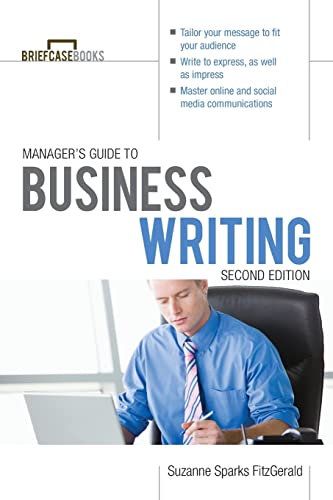
Synopsis
Write every business correspondence with speed, precision, and power
The number one prerequisite for effective management is effective communication―and writing is a critical part of it. Simply put, whether it’s a quick e-mail or a 20-page report, your writing is a reflection of you―and people will make judgments accordingly.
Manager’s Guide to Business Writing, Second Edition, provides everything you need to give colleagues, customers, and other stakeholders the most information accurately and quickly. Learn how to express yourself as a serious professional by writing everything with clarity, quality, and decisiveness.
Manager’s Guide to Business Writing teaches you how to:
- Know your audience and your purpose before you start writing
- Engage readers’ curiosity from the first sentence
- Compose instructions that are easy to understand and follow
- Write effectively on social media platforms and blogs
- Master the foundations of effective writing―grammar, sentence structure, spelling, and style
Briefcase Books, written specifically for today’s busy manager, feature eye-catching icons, checklists, and sidebars to guide managers step-by-step through everyday workplace situations. Look for these innovative features to help you navigate each page:
- Clear definitions of key terms and concepts
- Tactics and strategies for applying writing skills to management issues
- Tricks of the trade for crafting clear and effective documents
- Examples of successful business writing
- Cautions for when things can go wrong in composing memos, e-mails, and reports
- Practical advice for avoiding common errors
- Specific procedures for planning and executing your writing on the job
"synopsis" may belong to another edition of this title.
About the Author
McGraw-Hill authors represent the leading experts in their fields and are dedicated to improving the lives, careers, and interests of readers worldwide
Excerpt. © Reprinted by permission. All rights reserved.
Manager's Guide to Business Writing
By Suzanne Sparks FitzGeraldThe McGraw-Hill Companies, Inc.
Copyright © 2011 The McGraw-Hill Companies
All rights reserved.
ISBN: 978-0-07-177226-6All rights reserved.
Contents
| Preface | |
| 1. Write for Your Readers | |
| 2. From Purpose Through Process | |
| 3. The Power of Words to Express, Not Impress | |
| 4. Structure Your Writing to Reach Your Reader | |
| 5. The Power of Visuals, White Space, and Headings | |
| 6. Writing Basics: Grammar and Style | |
| 7. How to Start and Stop | |
| 8. Writing for Social Media | |
| 9. Zero-Based Writing | |
| 10. Dealing with Tough Situations | |
| 11. Reports, Reports, Reports | |
| 12. Persuading Your Readers | |
| Appendix. Postscript: Top 10 Tips for Writing Well in Business | |
| Index |
Excerpt
CHAPTER 1
Write for Your Readers
Consider ...
A camera manufacturer provides an instruction manual written only in French,frustrating the English-speaking buyer.
An environmental services brochure sent to purchasing managers used suchtechnical language (an "aquifer characterization" and "in situ volatilization totreat the vadose zone") that many confused purchasers chose another source.
A direct mail piece with a pro-life message sent to a pro-choice audienceactually caused those people to feel more vehemently opposed to the pro-lifeposition.
A Web page designed for college students tried to arouse a sense of activism inthe students; unfortunately, the Web page referred to famous activists likeRalph Nader, whom the students didn't recognize.
The dean of a college sent an e-mail to the chairmen of five departments. Threeof the five were women.
Coors committed a faux pas when it used its slogan "Turn it loose" in Spanish.Unfortunately, it translated as "Suffer from diarrhea."
American Airlines also neglected global manners with its campaign "Fly inLeather," that translated means "Fly Naked."
These real-life examples show what can happen when you don't know your audience.Your communication can confuse, anger, or simply fail to connect with the peopleyou want to reach. This chapter focuses on knowing your readers and how you canbetter connect with them.
Know Your Readers
The first tip to effective writing is to know your audience. The more you know,the more you can tailor or customize your message for an individual or group.
First, think of the person or persons you write to most frequently. Visualizeyour supervisor or your key customer as you write. Try to obtain informationsuch as age, education level, income, and gender.
If you can discover interests, opinions, and values, you can persuade yourreaders more effectively. And you have a great advantage knowing the readers'understanding of your topic. Let's go back to the opening examples.
If the person who wrote the instructions for the camera had known the firstlanguage of the reader, he could have avoided using the incorrect language.
Whoever created the environmental services brochure did not take into accountthe educational level of the readers or the readers' knowledge of thetopic, confusing potential purchasers.
The pro-life group ignored the values held by the people who would readits message.
The person who designed the Web page to arouse activism in college studentsignored an important demographic, age: the students were too young toremember or care about Ralph Nader.
The dean should have considered gender and addressed his e-mail to"chairs" or "chairpersons."
Coors' marketers ignored the nationality of Spanish speakers, as didAmerican Airlines by confusing or humoring customers.
You can see that if the writers of these pieces had known their audiences, theycould have avoided serious blunders.
What If You Don't Know Your Readers?
The scenario: You have 15 minutes to write an e-mail and you don't know muchabout the manager you're addressing. Here are some quick tips.
In most cases you need only spend a few minutes determining which of thefollowing categories most closely fits your reader. Then you can easily adjustyour writing.
It's helpful to evaluate whether your reader is a layperson, anexpert, an executive, a user, or a complex type.Here are some guidelines to help you categorize your readers, with some "Dos andDon'ts" and a few examples.
Layperson
A layperson by definition has little expertise in a subject matter and usuallyno particular motivation to read what you write. So to be effective, you mustmotivate or attract your reader; starting with a benefit helps. A layperson isnot knowledgeable, so you must adjust your tone, style, and vocabulary.
Do: Find a way to attract attention.
Don't: Bore your reader with detail.
For example ... If you're writing to employees (normally laypersons)about various health care plans, find an interesting fact or a reason (benefit)to catch their attention in your first paragraph, for example, how they canreceive 100 percent coverage for dependents. If you're writing to people who usecomputers but do not know contemporary software well, you might attractattention by using an easy-to-understand analogy. You might also present one ofthe benefits of using a particular software program, like the grammar- andstyle-checking feature of a word processing program.
Expert
An expert cares about process and detail. An expert who is a chemist, forexample, would want to know how to reproduce your results by using all theprocedures you followed. Give experts the specifics. The same detail would scareor bore the layperson.
Do: Focus on procedure or process.
Don't: Only give bottom-line data.
For example ... If you write to an expert in health care benefits, spellout the details of the policy. The expert will understand and appreciate thespecifics. If you're writing about computer software for programmers, you'llwant to go into particulars about how you developed a particular program and itsability to interface with other programs.
Executive
An executive audience wants bottom-line information. Detailed descriptions thatwork for experts would not work with this audience. Use straightforward languageand tone. Give a benefit and the critical information first.
Do: Get to the point immediately.
Don't: Explain in detail.
For example ... Give the executive audience a summary of the medicalbenefits package in one paragraph or less. Then proceed with other importantpoints. A sales executive will look for benefits and product value more than thenuts and bolts of the package.
User
The user must carry out your instructions. For example, users of a softwarepackage must understand your documentation in order to do their job. Users don'tcare how you wrote the software; they want to know how to make it work.
Do: Realize that this person might not know as much as you do.
Don't: Be too brief.
For example ... The user in our health care plan example wouldneed to understand the features of a complicated medical policy. Help the userby explaining clearly how to use each feature and where they can find help. Theperson who must use the software and understand how he can make it work needsthe basics and in sufficient detail.
Writers make a common mistake with user audiences: they overestimate thereaders. This error seems to be particularly true in technical matters. So oftenwriters of technical manuals think they're writing to other technical peopleusing a string of acronyms and jargon unknown to the user. Just buy a newelectronic product and check out the manual and you will instantly know themindset of the writer. These writers neglect to start at the beginning, toprovide the basics.
Complex
You must write to fit your reader, to establish a connection that will make yourwriting more effective. This is especially difficult when the reader might be acomplex audience, a combination of styles. Here are a few examples.
* The person who serves as your supervisor may be a layperson/executive,a manager with no particular expertise in your specific field. You must motivatehim to read what you've written. Use benefits to catch his attention and abottom-line style to keep his interest.
* You might report to an expert/executive, an engineer who has workedher way up in the company to become CEO. An executive summary followed by adetailed explanation will work for this CEO.
* A communication manager who still writes and edits newsletters is anexpert/user. Tell the expert/user how the process works and how she canpersonally implement it.
* An employee using the Internet could be a layperson/user. This personneed not understand how the Internet works, only how he can obtain theinformation he seeks. Give the layperson/user the necessary information in a waythat encourages him to use it.
Sometimes you may write for a mixed audience, meaning that your readers compriseall four types. When writing a company newsletter, for example, you must addresslaypersons, experts, executives, and users as well as complex types. In thiscase, you must write for the "lowest common denominator," the layperson.
Dealing with the Differences
Now, let's look at an example. Imagine that you're writing a series of lettersto promote your company's newsletter about baseball, Buzz Around theBases, and your promotional campaign includes a free copy of a booklettitled The Story Behind Major League Baseball Contracts. In preparingthe pitch letters, you need to appeal to a fan, an agent, an owner, and aplayer—four types of readers. Notice how you write to deal with thedifferences among your readers!
Layperson (baseball fan)
Dear Kate:
When you watch your favorite baseball player in action, have you ever wonderedhow an athlete makes it from the amateur ranks into the big leagues?
An agent, employed by the player to act on his behalf with the general manager,negotiates contracts based on salary caps or limits. When you see your favoritemajor league baseball player, you may not be aware of the behind-the-scenesdiscussions among these agents and owners to contract with valuable players.
When negotiating, agents must consider the player's capability, the market valueof players who play the same position, compatibility with a team, length ofcontract, and available monies. The result should be a contract acceptable toboth the player and team ownership.
Note the simple vocabulary and informal tone. The fan may not care aboutcontract negotiations, so you use a benefit (watching a favorite player) toattract attention. Then you describe in simple terms how an agent negotiates.
Expert (Agent)
Dear Pete:
To negotiate a major league contract for your new client, you will need to takethe following factors into account:
his playing capability, marketability, and compatibility with the team withwhich you negotiate,
current rules on salary cap, including how much of the signing bonus countsagainst the cap and the team's budget,
whether available players are plentiful or in short supply, and
the team's needs and the fit with your player's skill.
Once you narrow the number of teams based on your client's geographicpreference, you'll need to obtain comparable salary data among players ofsimilar skills, age, and performance. Once you locate a team on your preferencelist with the needs that match your client's skills, you'll need to determinewhether the team has available money under the salary cap and budget. If so,begin to negotiate. If not, move to the next team on your preference list.
Note the emphasis on the explanation of the process, with more details and usingterms familiar to Pete. The agent would want to know how—what process touse when negotiating a contract for a player.
Executive (owner)
Dear Marge:
As an owner, your team must consistently win and advance into the playoffs onsome regular basis. Therefore, you must assemble the right combination ofplayers and decide what type of contracts you can offer based on your budget andthe goals you've set for yourself and the team. The critical balance for you toachieve is between your vision for the team and available resources.
Note the emphasis on the bottom line and the direct approach. This executiveneeds to know how to quickly and effectively negotiate for selected players.She's not necessarily concerned about the complete process because she relies ona general manager to negotiate for her, so you don't tell her every step thegeneral manager must take. This letter is concise, direct, and informative.
User (player)
Dear Lenny:
How do you improve your ability to negotiate a major league contract? It'srelatively easy, but many players make crucial errors.
Carefully select an agent who will represent you well. Decide which teams appealto you and what you can bring to those teams.
Also, determine the range of salary you would accept. Discuss with your agentthe importance you place on a winning team and on your chemistry with otherplayers.
Note the step-by-step approach to telling the player what to do to get the bestcontract. Lenny needs to use the information you're providing to work withagents and owners to join the team of his choice and make the salary he desires.He must live with the results of the negotiation. Just because he knows baseballdoesn't make him an expert in contract negotiations. Spell it out for Lenny in asimple, benefit-oriented way.
Isn't it amazing how you can deal with one topic in several very different ways,depending on your readers? Be sensitive to your particular audience and theresponse will reflect your effort. If you addressed our executive, Marge, as ifshe were a player like Lenny or if you wrote to Pete, the agent, as if he weresimply a fan like Kate, they probably wouldn't respond as you'd like. Make everyeffort to adjust your vocabulary, tone, and approach for each type of reader.
Check for Readability
Writing for your readers includes knowing their knowledge level and theirinterest. Those two key factors vary greatly, depending on whether your readersare laypersons, experts, executives, users, complex, or mixed. While this pointmay seem obvious to you, it bears repeating, because all too often we forgetthis critical principle.
There's another key factor—reading ability. That's not just a matter ofliteracy. It also involves attention span, the environment (time anddistractions), and comfort level. That's why you want to be sensitive to thereading level of your writing, to minimize what experts call fog.
Many managers seem to feel that they should use big words and long sentences toimpress their readers. Unfortunately, their efforts just tend to fog up theircommunication and make their writing less effective.
How can you avoid this problem? By testing your writing to determine the fogindex—then editing it to bring it up or (generally) down to a readinglevel more appropriate to your readers.
Here's how to determine the Gunning-Mueller Fog Index, as presented in Howto Take the Fog Out of Writing by Robert Gunning and Douglas Mueller:
1. Select a sample of your writing that consists of 100 words.
2. Divide the number of words in the sample by the number of sentences to getthe average sentence length.
3. Count the number of words with three or more syllables in your sample. Don'tinclude proper nouns (names), compound nouns (such as "briefcase" or"bookkeeper"), or verb forms that have three syllables because of a suffix(e.g., "created" or "entering" or "advises").
4. Divide the number of long words by the number of words in your sample to getthe percentage of long words.
5. Add the average sentence length (from Step 2) and the percentage of longwords (from Step 4), dropping the percentage sign. Multiply the sum by .4 tofind your fog index.
That index represents the number of years of education needed to understand thewriting easily. An index of 7, for example, would mean that the writing isappropriate for a reader with seven years of school, while 12 would be the levelof a high school graduate and 16 would be the level of a college graduate.
Let's check the fog index for the following writing sample:
Knowing your audience might be the most critical factor in effective writing.The more you know, the easier it is to tailor your message for an individual orgroup. Sometimes all you know is that your audience has a short attention span.
I once wrote a report for 18-year-old readers. I referenced a classic musical,My Fair Lady; unfortunately, this group was too young and had no ideawhat I was talking about. I lost credibility and the attention of my audience.So again, knowing your audience and understanding its demographics willdramatically improve your ability to communicate.
This writing sample conveniently has 100 words in seven sentences, which givesus an average sentence length of 14.3 words. It contains 16 words of three ormore syllables; divide that number by the 100 total words and we get 16%. Then,we add 14.3 and 16 and multiply the result, 30.3, by 0.4. Ouranswer—12—shows that this sample would be appropriate for readerswith at least a high school education.
Most newspapers in the United States are written at a 12-year-old reading level,a fog index of 7 or so. That's generally a safe index when you don't know thelevel of your specific readers. Unfortunately, if you write above or below yourreaders' ability, they will find your writing either difficult to understand orinsulting.
But how do you account for situational factors that impede understanding? Afterall, you can't expect your readers to concentrate on your words if they're in ahurry or trying to do several things at once. If you want to make your writingeasier to read without insulting your readers, the best bet is to shorten yoursentences (and your paragraphs), but not necessarily to find shorter words.(We'll consider word choice in Chapter 3.)
(Continues...)
(Continues...)
Excerpted from Manager's Guide to Business Writing by Suzanne Sparks FitzGerald. Copyright © 2011 by The McGraw-Hill Companies. Excerpted by permission of The McGraw-Hill Companies, Inc..
All rights reserved. No part of this excerpt may be reproduced or reprinted without permission in writing from the publisher.
Excerpts are provided by Dial-A-Book Inc. solely for the personal use of visitors to this web site.
"About this title" may belong to another edition of this title.
Search results for Manager's Guide To Business Writing 2/E (Briefcase...

Stock Image
Manager's Guide to Business Writing
Published by
McGraw-Hill Education - Europe, 2011
ISBN 10: 007177226X
ISBN 13: 9780071772266
Used
Paperback
Seller: World of Books (was SecondSale), Montgomery, IL, U.S.A.
Seller rating 5 out of 5 stars

Paperback. Condition: Very Good. More than 700,000 Briefcase Books sold! A concise guide to communicating ideas in writing like a true professional--with clarity, accuracy, and decisiveness. Seller Inventory # 00100316992
Stock Image
Manager's Guide to Business Writing
Published by
McGraw-Hill Education - Europe, 2011
ISBN 10: 007177226X
ISBN 13: 9780071772266
Used
Paperback
Seller: World of Books (was SecondSale), Montgomery, IL, U.S.A.
Seller rating 5 out of 5 stars
Paperback. Condition: Good. More than 700,000 Briefcase Books sold! A concise guide to communicating ideas in writing like a true professional--with clarity, accuracy, and decisiveness. Seller Inventory # 00098157017
Stock Image
Manager's Guide to Business Writing 2/e
Seller: Better World Books, Mishawaka, IN, U.S.A.
Seller rating 5 out of 5 stars
Condition: Good. 2nd Edition. Pages intact with minimal writing/highlighting. The binding may be loose and creased. Dust jackets/supplements are not included. Stock photo provided. Product includes identifying sticker. Better World Books: Buy Books. Do Good. Seller Inventory # 6287057-6
Stock Image
Manager's Guide to Business Writing
Published by
McGraw-Hill Education - Europe, 2011
ISBN 10: 007177226X
ISBN 13: 9780071772266
Used
Paperback
Seller: World of Books Inc, Montgomery, IL, U.S.A.
Seller rating 4 out of 5 stars

Paperback. Condition: Very Good. More than 700,000 Briefcase Books sold! A concise guide to communicating ideas in writing like a true professional--with clarity, accuracy, and decisiveness. Seller Inventory # CIN007177226XVG
Stock Image
Manager's Guide to Business Writing
Published by
McGraw-Hill Education - Europe, 2011
ISBN 10: 007177226X
ISBN 13: 9780071772266
Used
Paperback
Seller: World of Books Inc, Montgomery, IL, U.S.A.
Seller rating 4 out of 5 stars
Paperback. Condition: Good. More than 700,000 Briefcase Books sold! A concise guide to communicating ideas in writing like a true professional--with clarity, accuracy, and decisiveness. Seller Inventory # CIN007177226XG
Stock Image
Manager's Guide to Business Writing 2/e
Seller: Better World Books Ltd, Dunfermline, United Kingdom
Seller rating 5 out of 5 stars
Condition: Very Good. 2nd Edition. Former library copy. Pages intact with possible writing/highlighting. Binding strong with minor wear. Dust jackets/supplements may not be included. Includes library markings. Stock photo provided. Product includes identifying sticker. Better World Books: Buy Books. Do Good. Seller Inventory # 14007188-6
Buy Used
£ 4.83
£ 5 shipping
Ships from United Kingdom to U.S.A.
Ships from United Kingdom to U.S.A.
Quantity: 1 available
Stock Image
Manager's Guide To Business Writing 2/E (Briefcase Books Series)
Seller: The Book Cellar, LLC, Nashua, NH, U.S.A.
Seller rating 4 out of 5 stars
paperback. Condition: Good. Has heavy shelf wear, but still a good reading copy. Slight wrinkling/discoloration to some pages, but does not affect readability. A portion of your purchase of this book will be donated to non-profit organizations.Over 1,000,000 satisfied customers since 1997! Choose expedited shipping (if available) for much faster delivery. Delivery confirmation on all US orders. Seller Inventory # 10467511
Seller Image
Manager's Guide to Business Writing
Seller: GreatBookPrices, Columbia, MD, U.S.A.
Seller rating 5 out of 5 stars
Condition: good. May show signs of wear, highlighting, writing, and previous use. This item may be a former library book with typical markings. No guarantee on products that contain supplements Your satisfaction is 100% guaranteed. Twenty-five year bookseller with shipments to over fifty million happy customers. Seller Inventory # 12478147-5
Stock Image
Manager's Guide To Business Writing 2/E (Briefcase Books Series)
Seller: Textbooks_Source, Columbia, MO, U.S.A.
Seller rating 5 out of 5 stars
paperback. Condition: Good. 2nd Edition. Ships in a BOX from Central Missouri! May not include working access code. Will not include dust jacket. Has used sticker(s) and some writing or highlighting. UPS shipping for most packages, (Priority Mail for AK/HI/APO/PO Boxes). Seller Inventory # 001163896U
Seller Image
Manager's Guide To Business Writing 2/E (Briefcase Books Series)
Seller: WeBuyBooks, Rossendale, LANCS, United Kingdom
Seller rating 5 out of 5 stars
paperback. Condition: Good. Most items will be dispatched the same or the next working day. A copy that has been read but remains in clean condition. All of the pages are intact and the cover is intact and the spine may show signs of wear. The book may have minor markings which are not specifically mentioned. Seller Inventory # rev9152694641
Buy Used
£ 10.78
£ 5.40 shipping
Ships from United Kingdom to U.S.A.
Ships from United Kingdom to U.S.A.
Quantity: 1 available