
Items related to Effective Coaching: 2nd Edition (BUSINESS BOOKS)
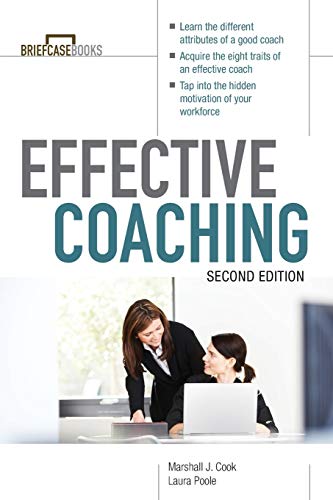
Synopsis
Boost productivity by making the switch from “boss” to COACH!
Effective managers know their job is to help employees succeed, not to give them orders. They create relationships that build collaboration and meaningful performance improvement. These managers know that when they facilitate the success of their team members, they facilitate their own success. Effective Coaching teaches you practices you can use immediately to engender employee commitment and help employees gain the skills necessary to sustain and grow any type of organization. You’ll learn:
- The attributes of a successful coach
- How to set up an effective coaching session
- How to use coaching to correct unproductive behavior
- How to use coaching to be a better trainer
Briefcase Books, written specifically for today’s busy manager, feature eye-catching icons, checklists, and sidebars to guide managers step-by-step through everyday workplace situations. Look for these innovative design features to help you navigate through each page:
-Clear definitions of key terms and concepts
-Tactics and strategies for coaching employees
-Tricks of the trade for executing effective coaching techniques
-Practical advice for minimizing the possibility of error
-Warning signs for when things are about to go wrong
-Examples of successful workplace coaching
-Specific planning procedures, tactics, and hands-on techniques
"synopsis" may belong to another edition of this title.
About the Author
McGraw-Hill authors represent the leading experts in their fields and are dedicated to improving the lives, careers, and interests of readers worldwide
Excerpt. © Reprinted by permission. All rights reserved.
Effective Coaching
A Briefcase Book
By Marshall J. Cook, Laura PooleThe McGraw-Hill Companies, Inc.
Copyright © 2011 The McGraw-Hill Companies, Inc.
All rights reserved.
ISBN: 978-0-07-177111-5All rights reserved.
Contents
| Preface | |
| About the Authors | |
| 1. The Goals of Good Coaching | |
| 2. The Attributes of a Good Coach | |
| 3. What Do Your Players Want? | |
| 4. The Signs of Good Coaching | |
| 5. Asking Good Questions | |
| 6. Powerful Listening | |
| 7. Creating Solutions Through Coaching | |
| 8. The Coach as Trainer | |
| 9. The Coach as Mentor | |
| 10. The Coach as Corrector | |
| 11. Coaching Trouble Spots | |
| 12. Steps to Effective Coaching | |
| 13. Once More, with Feedback | |
| 14. Coaching and Rewards | |
| 15. Principles of Good Coaching (and Good Living) | |
| Index |
Excerpt
CHAPTER 1
The Goals of Good Coaching
Morale in the desktop publishing group is low. Some of the employees seem towork furiously every day, but Molly seems to have time to kill. No deadlineshave been missed, but the hard-working group seems resentful of the slacker, andshe distracts others when she wanders around the office chatting or sits at hercomputer playing solitaire. You have been getting complaints about Molly, andit's your responsibility to address this issue. What's your first move?
We'll return to this situation after you learn about the goals of good coachingand how management with coaching will help you get the information you need towork toward a solution.
Why Should a Manager Be a Coach?
Coaching is a relatively new field of development (see Chapter 2 fordefinitions and distinctions of what coaching is). It's quickly growing inpopularity, both as a stand-alone profession and as a tool set for businessleaders. Coaching in the workplace can create a positive environment in whichemployees are empowered, engaged, and valued. In teams, coaching can fosterbetter communication, synergistic thinking, and productivity. For individuals,good coaching can lead to career development, increased resourcefulness,personal empowerment, sustainable change and improvement, and bigger thinking.
Managers and supervisors are often expected to be role models, mentors, leaders,and now coaches. Adding coaching to your skill set not only improves your valuein the workplace, it creates new opportunities for your employees and theorganization as a whole.
Are You Tapping Your Most Valuable Resource?
Employees offer an enormous source of only partially tapped potential. Eachperson in a workplace has a specific job, but people are rarely limited to anarrow category. There is much that each employee can offer, in terms of his orher own job performance, creative ideas, skills, and strengths to put to use forthe organization, and personal growth and learning. Are you tapping thisvaluable resource? Connecting with your employees through coaching can open upfar more possibilities than you might imagine!
Research by Gallup (Harter, Schmidt, Killham, and Agrawal, Q12Meta-Analysis, August 2009) studying the link between employeeengagement and performance indicated that highly engaged business/workteams basically doubled their odds of success! Employee engagement is astrategic foundation, not just lip service from human resources. Gallup hasshown that engaged workers are more productive, profitable, loyal, and customerfocused. In addition, their research discovered that consistently, an employee'simmediate manager had the most profound impact on his or her retention andsatisfaction.
Accessibility
Your Accessibility quotient is your openness to input from your staff. (It alsogives some insight into how engaged employees are.) How would your workersrespond to the following statements? Answer "yes" or "no" as you think theywould really respond, not as you'd like them to.
My boss:
1. asks for my opinion frequently.
2. listens to my suggestions.
3. takes my ideas seriously.
4. values my opinion.
5. checks with me before making a decision that affects my work.
6. would defend me in a meeting of supervisors.
7. explains goals clearly when giving me a new project.
8. welcomes my questions about an ongoing project.
9. gives me latitude in deciding how to carry out a project.
10. saves criticism for one-on-one sessions.
Your Responses and Your Management Style
Did you rack up seven or more positive responses in the Accessibility quiz? Ifso, you already exhibit many of the attributes of a good coach. One of the maingoals of management by coaching is to create an atmosphere in which employeesare willing and able to share their ideas with a superior. When employees feelheard and valued, they are more invested in their work and the organization.
Getting fewer than seven positive responses doesn't mean you're a failure. A lowscore means you have some work to do. (A lower score may also indicate thatyou're more honest and self-critical than most managers.)
Let's look at each statement and what it indicates about your workingrelationship with your employees.
1. My boss asks for my opinion frequently. The people who work with youalready know you don't have all the answers. When you ask for an employee'sinput, three good things happen, before you even get a response: (1) you showrespect for the employee, (2) you show that you don't think you have a corner onwisdom, and (3) you open yourself to an opportunity to get valuable information."How do you think we should handle it?" can be one of the best things you everask an employee.
2. My boss listens to my suggestions. Asking is only half the process.Listening is the other half (see Chapter 6 for more on listeningskills). Give employees your full attention. Indicate by word and gesture thatyou're taking in what they say. Ask questions. Respond honestly.
3. My boss takes my ideas seriously. You say, "Uh huh. That's ...interesting." The employee hears, "Thanks for nothing. Now we'll do it my way."You won't necessarily agree with employees' perspectives, and you may not act ontheir suggestions. But if they offer the input sincerely, you should take itseriously. If you think an idea has merit, say so. If you think it's flawed,explain why. Discuss ideas, not personalities. Don't allow the discussion tobecome a battle between "your idea" and "their idea" or a contest with a winnerand a loser.
4. My boss values my opinion. You show that you value an opinion bylistening to it, taking it seriously, and rewarding it. Most businesses rewardresults—jobs successfully completed, goals reached, bottom linesenriched—if they reward employee performance at all. Appreciation shouldbegin much earlier in the process, when you're looking for hard work,cooperation, and creative input.
It takes courage and initiative for an employee to speak up. Reward that couragethrough your words and deeds. Questions and suggested alternatives are positivecontributions, not threats.
5. My boss checks with me before making a decision that affects my work.You're the boss, and you make the decisions. When a decision affects workingconditions, you should talk it over with employees and get their inputfirst—not only to show that you respect them, but also to help you makethe best decision.
6. My boss would defend me in a meeting of supervisors. Are you willingto go to bat for your employees, fight for them, defend them from unjustattacks, and take your share of the blame when something goes wrong?
Would your workers say that you're a "stand-up boss"? There's no higher praisethey can give you.
7. My boss explains goals clearly when giving me a new project.Employees are no better at reading your mind than you are at reading theirs.When you assign a task, do you take the time to outline in clear, simple termsexactly what should be accomplished? An employee who understands the overallpurpose of her work will do a better job and feel better about doing it. Andyou'll prevent costly mistakes down the line.
8. My boss welcomes my questions about an ongoing project. "Do youunderstand?" When most folks ask that question, they expect a quick "yes" (thesame way most of us expect a perfunctory "Fine, thanks" when we ask, "How areyou?").
Employees' questions will seem like interruptions and irritations—unlessyou train yourself to expect and welcome them. Questions are often the only wayyou really know what an employee has heard and understood. Employees willing toask you a question now—knowing that they won't be penalized for showing"ignorance"—will do a better job.
9. My boss gives me latitude in deciding how to carry out a project.Explain goals clearly and precisely. Answer all questions. But don't alwaysspell out exactly how those goals should be reached. Whenever possible, leaveroom for creativity and initiative.
10. My boss saves criticism for one-on-one sessions. Praise in public,criticize in private—not so that people will think you're a nice personbut because it works. Public criticism engenders defensiveness andanger—in the employee criticized and in everybody else within earshot.Criticism in private, delivered decisively but respectfully, has a much betterchance of getting you what you want—improved performance.
The Benefits of Good Coaching
Effective coaching moves an employee from WIIFM (what's in it for me?) to WIIFU(what's in it for us?)—essentially, creating a higher level of engagement.It enables you, as the coach, to reap specific benefits from your efforts. Let'slook at the advantages you can derive from being a successful coach.
Develop Employees' Competence
Watch a loving parent initiate a child into the mysteries of riding a bicycle.First the parent instructs the child and then shows how it is done. But at somepoint the kid has to climb on that bicycle and ride it alone.
Now imagine that you're the loving parent, running beside the wobbling bike,shouting encouragement, your hand first tightly clutching the handle bars andthen gradually loosening your grip until finally, your heart in your throat, youlet go, launching your child into the world.
Now imagine that you're the child on the bike. You're terrified and exhilarated,concentrating on keeping the pedals pumping and the bike from falling over. Butat some point—hours, days, or maybe even weeks later—you realizethat the balancing act, at first seemingly impossible, has become second nature.You don't have to think about riding the bike; you can just do it—andenjoy it.
Coaching is similar. A good coach helps workers "learn to fly" without regularcoaching. And that's the point. Good coaches create situations where they're nolonger needed.
Diagnose the Roots of Performance Problems
If employees aren't performing at peak efficiency, you have to figure out thereasons behind it. Too often, getting input from the people closest to the job,the employees themselves, is overlooked.
A good coach asks for employee input and then listens carefully to it. By doingso, you're more likely to make an accurate assessment, discover the deepestroots of the issue, and get cooperation and investment in arriving at asolution. If employees feel empowered to solve the problem, they'll solve it.
Change Unsatisfactory or Unacceptable Performance
Once you have found the source of a problem or unacceptable performance, you candecide how to go about creating a change. Here again, don't overlook a richpotential source of solutions—the employees themselves. Brainstorm with agroup of employees and let them help you evaluate potential actions. Whenworkers are asked about their thoughts and potential solutions, they become moreinvested in the process. They might get more excited about making a change, andthey will feel valued because they were heard. Creating a change with agroup, instead of handing down a decision without input, gets buy-in from thestart.
Address a Behavioral Issue
Behavioral problems are sticky territory in the workplace. Performance is atleast somewhat objective. You can count outputs and actions taken, and you cancompare today's performance with yesterday's and mine with yours. But evaluatingemployees' behavior is often a matter of assessing attitude and demeanor.
You may think that some employees spend too much time chatting about personalmatters when they should be tending to business. But how much time is "toomuch"? Others may view your workplace and comment on the friendliness andapparent cooperation among staff members. You're on safer ground when youconfine employee evaluations to measurable outputs. If chatty employees aregetting their work done, that work is satisfactory, and their conversation isn'tbothering anyone else, the "problem" may be nothing more than your ownirritation.
Behavioral guidelines are often vague, but the stakes can be staggeringlyhigh—in lawsuits and grievances alleging discrimination, for example.
Using the basic principles of good coaching is important in these situations.Involve relevant employees in defining the situation and in determining whetherbehaviors are getting in the way of performance. Check to make sure the"problem" isn't irritation on your part. Keep an open mind, and keep yourassumptions to yourself. Be willing to explain any decisions you may make toaddress the issues, along with options for appeal to a higher level.
For example, imagine that three of the four members of your office staff arechatting happily; the fourth is seething. Patti finds this distracting andannoying, she tells you, especially when she's on the phone with a potentialclient. She feels that her own job performance is suffering. She also lets youknow, without saying so directly, that she doesn't see how the others couldpossibly be getting their work done with all that conversation. She wantspermission to listen to her MP3 player so that she can use music to screen outthe noise.
There's more than one way forward here: huddle up with all the playersand talk it through. You'll learn how to conduct these sessions, step by step,in later chapters. You'll get the results you want—and you'll save time.Plus, you'll have group buy-in, awareness, and investment in change.
Foster Productive Working Relationships
"Works well with others." When we were growing up, teachers let parents know onreport cards how we were getting along with the other kids. We went to school tolearn social skills (take turns, share the crayons, no kicking, and so on) aswell as academic subjects.
In an office setting, people are not graded on their social skills—atleast not in so many words. Companies set performance objectives but still talkabout intangibles like "attitude" and whether an employee is a "team player."They still want people to work well with others; they just call it somethingelse.
As you apply the techniques of coaching in the workplace, you'll notice betterperformance from your employees and also employees helping each other. When youset the example, people take the hint and start coaching each other to higherlevels of performance. You can't order them to do it, but it can happen withoutyour saying a thing.
Create Opportunities for Conveying Appreciation
Many of us have a hard time saying "Thank you" or "Good job." We lack formaloccasions and established patterns for giving praise, and we find it difficultto ad lib.
Coaching provides natural opportunities to praise good work and strong effort.
Foster Self-Coaching Behaviors
As you become an effective coach, you'll find that employees will become morecompetent. When you coach an employee through a challenge, you teach him or herto figure out how to deal with similar problems in the future and tap innerpersonal resources.
Remember: Your role goes beyond getting specific tasks completed. It's aboutcreating more competent and committed employees who have the ability to addever-higher levels of value to the organization.
Improve Employee Performance, Engagement, and Morale
Call it morale, self-esteem, or whatever you want. How your staff members feelabout themselves and their roles in the workplace makes a big difference intheir performances.
Coaching employees with respect does a lot to improve morale and engagement. Italso affects their performance. By allowing employees to take responsibility andinitiative for their work, you'll empower them, and thus improve their morale inways no seminar, pep talk, or self-help book ever could.
This final point, then, is the culmination of all those already listed. As youincrease performance through coaching, you also improve morale and engagement.Your ability to coach effectively communicates to employees that you care aboutthem and are committed to helping them improve. This can translate intocommitment and excitement about their work. And this naturally leads to higherperformance and higher morale. In other words, all these actions go together,and coaching is the method that makes it happen.
Meanwhile, Back at the Publishing Group
Let's go back to the story at the beginning of this chapter. Along withcomplaints from the other desktop publishers, you hear from the writers andproject managers that Molly distracts them when she constantly "pops in" totheir offices to say hello. You've noticed that she seems distracted, bored, anddisengaged. What are your options?
1. Send the entire publishing department to a team-building event. Maybe thatwill improve morale and get Molly back to work.
2. Warn Molly about the problem, give her three months to shape up, and put anote in her personnel file. She needs to shape up or get out.
3. Send Molly to a training workshop on the software she uses. She's probablytrying to do a good job, maybe she just doesn't know how to use the softwarecorrectly.
4. Rearrange the work flow system. You may be able to fix the problem withoutupsetting anyone.
5. Do nothing. The situation might work itself out when things simmer down.Besides, Molly has made no secret about being unhappy with her job. Maybe she'llleave soon.
(Continues...)
(Continues...)
Excerpted from Effective Coaching by Marshall J. Cook. Copyright © 2011 by The McGraw-Hill Companies, Inc.. Excerpted by permission of The McGraw-Hill Companies, Inc..
All rights reserved. No part of this excerpt may be reproduced or reprinted without permission in writing from the publisher.
Excerpts are provided by Dial-A-Book Inc. solely for the personal use of visitors to this web site.
"About this title" may belong to another edition of this title.
Search results for Effective Coaching: 2nd Edition (BUSINESS BOOKS)

Stock Image
Manager's Guide to Effective Coaching, Second Edition
Published by
McGraw-Hill Education - Europe, 2011
ISBN 10: 0071771115
ISBN 13: 9780071771115
Used
Paperback
Seller: World of Books (was SecondSale), Montgomery, IL, U.S.A.
Seller rating 5 out of 5 stars

Paperback. Condition: Good. More than 700,000 Briefcase Books sold! Proven techniques for going from a boss to a coach to maximize the efficiency of every employee. Seller Inventory # 00108977642
Seller Image
Manager's Guide to Effective Coaching, Second Edition (A Briefcase Book)
Seller: Zoom Books Company, Lynden, WA, U.S.A.
Seller rating 5 out of 5 stars
Condition: very_good. Book is in very good condition and may include minimal underlining highlighting. The book can also include "From the library of" labels. May not contain miscellaneous items toys, dvds, etc. . We offer 100% money back guarantee and 24 7 customer service. Seller Inventory # ZBV.0071771115.VG
Seller Image
Manager's Guide to Effective Coaching, Second Edition (A Briefcase Book)
Seller: 2nd Life Books, Burlington, NJ, U.S.A.
Seller rating 5 out of 5 stars
Condition: very_good. Used book in very good condition. May have some minor wear. May NOT include discs, or access code or other supplemental material. Ships directly from Amazon and is eligible for Prime or super saver FREE shipping. We ship Monday-Saturday and respond to inquiries within 24 hours. Seller Inventory # BXM.CKMB
Stock Image
Manager's Guide to Effective Coaching, Second Edition (A Briefcase Book)
Seller: Evergreen Goodwill, Seattle, WA, U.S.A.
Seller rating 5 out of 5 stars
paperback. Condition: Good. Seller Inventory # mon0000744074
Seller Image
Manager's Guide to Effective Coaching, Second Edition (A Briefcase Book)
Seller: Greenworld Books, Arlington, TX, U.S.A.
Seller rating 5 out of 5 stars
Condition: very_good. Fast Free Shipping â" Very Good condition book with a firm cover and clean pages. Shows normal use and some light wear or limited notes markings. A solid, nice copy to enjoy. Seller Inventory # GWV.0071771115.VG
Stock Image
Manager's Guide to Effective Coaching, Second Edition
Published by
McGraw-Hill Education - Europe, 2011
ISBN 10: 0071771115
ISBN 13: 9780071771115
Used
Paperback
Seller: World of Books Inc, Montgomery, IL, U.S.A.
Seller rating 4 out of 5 stars

Paperback. Condition: Good. More than 700,000 Briefcase Books sold! Proven techniques for going from a boss to a coach to maximize the efficiency of every employee. Seller Inventory # CIN0071771115G
Stock Image
Manager's Guide to Effective Coaching, Second Edition (A Briefcase Book)
Seller: Read&Dream, SAINT LOUIS, MO, U.S.A.
Seller rating 4 out of 5 stars
Condition: Good. Seller Inventory # 1.5M_MG_H0005QQU
Stock Image
Manager's Guide to Effective Coaching, Second Edition (A Briefcase Book)
Seller: Wonder Book, Frederick, MD, U.S.A.
Seller rating 5 out of 5 stars
Condition: As New. Like New condition. 2nd edition. A near perfect copy that may have very minor cosmetic defects. Seller Inventory # V09A-04412
Stock Image
Manager's Guide to Effective Coaching, Second Edition
Seller: ThriftBooks-Atlanta, AUSTELL, GA, U.S.A.
Seller rating 5 out of 5 stars
Paperback. Condition: Very Good. No Jacket. May have limited writing in cover pages. Pages are unmarked. ~ ThriftBooks: Read More, Spend Less. Seller Inventory # G0071771115I4N00
Stock Image
Manager's Guide to Effective Coaching, Second Edition
Seller: Better World Books: West, Reno, NV, U.S.A.
Seller rating 5 out of 5 stars
Condition: Very Good. 2nd Edition. Pages intact with possible writing/highlighting. Binding strong with minor wear. Dust jackets/supplements may not be included. Stock photo provided. Product includes identifying sticker. Better World Books: Buy Books. Do Good. Seller Inventory # 8581597-6