
Synopsis
GENERATE BIG PROFITS WITH TODAY’S HOT TEST COMMODITIES!
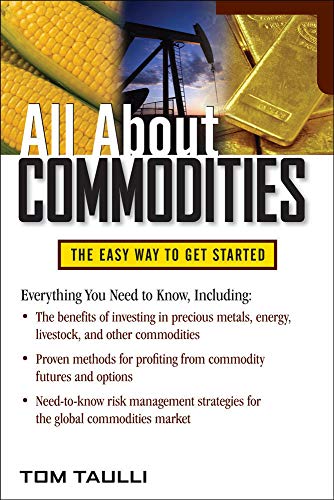
During the average trading day, trillions of dollars’ worth of commodities change hands. If you want to snatch some profits from this booming market, you fi rst need to understand all the fundamentals―and All About Commodities is the place to go.
Without the confusing jargon and complex language of other investing guides, this book uses simple language to explain what drives price fluctuations of commodities―from energy, industrial metals, and mines to livestock, agriculture, and precious metals―and how to design a powerful, reliable strategy for profi ting from them. Learn everything there is to know about:
- Using futures and options to enter the commodities market
- Risks unique to commodities trading―and how to manage them
- Ways to identify important patterns to steer your investing decisions
- The benefits and disadvantages of commodity funds
"synopsis" may belong to another edition of this title.
About the Author
Tom Taulli (Ventura, CA) is founder of the online investment company WebIPO and is the author of The Streetsmart Guide to Short Selling. 10 Illustrations
Excerpt. © Reprinted by permission. All rights reserved.
All About COMMODITIES
By TOM TAULLIThe McGraw-Hill Companies, Inc.
Copyright © 2011 The McGraw-Hill Companies, Inc.
All rights reserved.
ISBN: 978-0-07-176998-3All rights reserved.
Contents
| Chapter 1 Introduction to Commodities Investing | |
| Chapter 2 The Futures Markets | |
| Chapter 3 Understanding Futures Prices | |
| Chapter 4 Futures Trading Strategies | |
| Chapter 5 Options on Futures | |
| Chapter 6 Fundamental Analysis | |
| Chapter 7 Technical Analysis | |
| Chapter 8 Precious Metals | |
| Chapter 9 Energy | |
| Chapter 10 Agriculture | |
| Chapter 11 Industrial Metals | |
| Chapter 12 Livestock and Dairy | |
| Chapter 13 Investing in Miners | |
| Chapter 14 Global Commodities Investing | |
| Chapter 15 Buying Physical Commodities | |
| Chapter 16 Funds | |
| Futures Contracts Reference | |
| Glossary | |
| Web Resources | |
| Index |
Excerpt
CHAPTER 1
Introduction to Commodities Investing
Key Concepts
• Look at the main drivers of commodities prices
• Understand the benefits of investing in commodities
• Discuss the risks
Commodities are pervasive throughout the world economy. Every day we buy foodand energy. We drive our cars, which are made out of an assortment of metals andother materials. We live in homes and apartments, which are also made out ofvarious commodities. Without these valuable materials, civilization wouldvanish. It's that simple.
On a global basis, commodities markets are massive and trade in trillions ofdollars on a daily basis. There is also much diversity. For example, investorscan invest in the following categories:
• Agriculture: Includes corn, wheat, soybeans, cotton, sugar, cocoa,orange juice, coffee, and oats.
• Livestock: Includes live cattle, feeder cattle, pork bellies, and leanhogs.
• Precious metals: Includes gold, silver, and platinum.
• Industrial metals: Includes copper, palladium, aluminum, tin, nickel,zinc, lead, and cobalt.
• Energy: Includes crude oil, unleaded gasoline, natural gas, coal,heating oil, uranium, ethanol, and electric power.
There are also a variety of ways for investors to participate in these markets.For example, these include buying and selling futures and options. There arealso exchange-traded funds (ETFs), mutual funds, hedge funds, and managedfutures. And yes, you can even buy the physical commodity, such as gold orsilver, and put the metals in a vault.
COMMODITY MANIA?
Over the past decade, there has been a major bull market in commodities. Infact, it has become a popular topic on cable business channels like CNBC andeven mainstream websites. Perhaps one of the most interesting signs of thefervor is that even criminals are focusing on stealing commodities. For example,copper has seen a spike in thefts. After all, the high prices could meansubstantial profits. It also helps that you cannot trace copper back to thesource.
Criminals are stealing power lines and cooling pipes. Unfortunately, this posesserious problems to communities. Because of this, law enforcement agencies havebeen putting more resources into combating this new crime wave. Consider that acriminal was able to extract the copper from an irrigation system in PinalCounty, Arizona. There was about $10 million in damages. The theft even ruined aharvest. In 2008, a report from Electrical Safety Foundation International(ESFI) listed over 50,000 incidents of copper theft in the United States. Thetotal damages were $60 million.
But for investors, is this a classic sign that the commodities market is in abubble and will peak soon? Perhaps, but the fact is that bull markets can easilylast 15 to 20 years, and some commodities experts believe that the commoditiesmarkets are in a bullish "super cycle" that could last for several decades. Ifyou don't believe this is possible just take a look at Table 1-1. Itdetails the bull markets in commodities that have taken place since thebeginning of the twentieth century.
During the first three periods, the biggest commodities bull market was actuallyduring the Great Depression. Even during bad times, people still buycommodities. Also, because of the difficulties in raising capital, there werecontinued difficulties with entrepreneurs to find new sources of commodities(this also happened during the 2008–2009 global recession). In otherwords, a drop in supply could have a huge impact on prices.
Why consider the long trends? A key reason is the difficulty of extractingcommodities. To understand this, let's take a look at an example. Suppose thatcopper prices have surged and are likely to increase for some time. Tocapitalize on this, you decide to start up a copper mine. To do so you willfirst need to explore for a large deposit. This requires sophisticatedscientific equipment. It also probably means you will need to focus on areas ofthe world that are treacherous, in terms of the geography and politics. Theexploration process can easily take several years. Assuming you find a richdeposit, you will then need to negotiate the copper rights and get the necessarygovernmental permits. To do this, you will likely need to raise a substantialamount of capital from investors. This process can take several years. After youlock up everything, you will then need to hire miners and purchase expensiveequipment to extract the copper. It can take a year or two to get anysubstantial amount of the commodity.
As you can see, it takes a great deal of time to find new sources ofcommodities. Thus, price increases can last a long time because the supply willlag. But, when the supply hits the market, there can quickly be anoverabundance. The excess could also last 10 to 20 years. But over this time,there will eventually be an underinvestment in the commodity and the supply willslowly contract, which will set the stage for the next bull market.
In the case of the current bull market, there are some major demand forces thatare likely to keep prices robust. The main one includes the growth in emergingmarkets.
COMMODITIES IN BRIC COUNTRIES
The main players in emerging markets—Brazil, Russia, India, andChina—are known collectively as the BRIC countries. Combined, thesecountries have 42 percent of the world's population and are responsible forabout 23 percent of the world's output.
Brazil
Brazil is a country that has had its share of turmoil. Until the mid-1980s, thegovernment had military dictatorships and populist leaders. The country alsoexperienced severe bouts of inflation and economic slumps. But over the pastdecade, Brazil has made great strides. Then again, the country has rich naturalresources and a large workforce.
Because of its tropical climate, it is possible to grow crops year-round inBrazil. Some of the key crops include coffee and sugarcane.
Oil is another big commodity. Over the years, there have been major discoveriesoff its shores. Brazil also has the second-largest mining company in the world,which is Vale. It produces nickel, coal, aluminum, and other commodities.
The gross domestic product (GDP) of Brazil is roughly $2.2 trillion and theeconomy grew by about 7.5 percent in 2010. Because of the strength of itseconomy, the country has been a popular destination for foreign investment.
Russia
Since communism was abolished in the early 1990s, Russia has undergone extremechanges. During 1998, the country defaulted on its foreign debt. The result wasan economic plunge. Despite all this, Russia remains a major power. Besidesbeing a big producer of oil and natural gas, the country also has large depositsof iron ore, bauxite, and gold.
The GDP is $2.2 trillion and the economy grew by 3.8 percent in 2010. However,there are still big challenges. Corruption is a big problem in Russia. Moreover,Russia has had difficulty in attracting foreign capital because of theuncertainty regarding property rights.
India
Because it was originally under British rule, India has a Western legal systemand other institutions. This certainly makes international trade easier. Butsince gaining independence in 1947, India has seen lots of problems. The Gandhiand Nehru governments focused on a pro-socialist agenda, which had a dampeningimpact on the economy. Yet since the early 1990s, there has been a move towardfree-market economics. As a result, growth has been particularly strong andIndia has become a leader in industries like information technology.
With a population of 1.2 billion, India has a GDP of about $4 trillion. In 2010,the economy grew by about 8.3 percent.
China
When it comes to investing in commodities, perhaps the most important drivingfactor is China. The country has shown an insatiable appetite for manycommodities and the demand is likely to continue for many years.
China is no stranger to global power. The country has had the largest economyfor 18 of the past 20 centuries. China has a long history of innovation andinternational trade. But during the twentieth century, there was mostly turmoil.During the first half of the century, Japan invaded China several times. Then in1949, Mao Zedong came to power and created a communist state, called thePeople's Republic of China. There were purges, famines, and massive takeovers ofprivate businesses. The upshot was a substantial decline in the nationaleconomy.
But in the late 1970s, there was a major shift. Deng Xiaoping, who was a keyplayer in the communist revolution, began the process of economic reforms.Interestingly enough, he said that "being rich is glorious."
The reforms certainly paid off. Over the past 26 years, China has had thefastest growing economy in the world, with its GDP increasing by roughly tentimes. The economy is now ranked second in the world and is expected to surpassthe economy of the United States by 2027. Even with the global financial crisisof 2008, China was able to recover quickly. Consider that within two years, theeconomy was already 20 percent higher.
With the economic growth, China has undergone significant urbanization, as ruralpopulations moved into the cities. From 2004 to 2008, the urban populationincreased from 542.8 million to 606.7 million, representing 45.7 percent of thetotal population. The result has been a surge in demand for housing and consumergoods. And of course, this will mean tremendous demand for commodities like oil,coal, copper, nickel, and zinc. Keep in mind that by 2035, China is expected toaccount for one-fifth of all global energy, according to the InternationalEnergy Agency (IEA). With its rising wealth and dependence on the importation ofcommodities, China has been aggressive in buying mines, energy properties, andcommodities. These investments came to $2.4 billion in 2010 and will probablyincrease over the years.
Looking back at economic history, China is no aberration. There are certainlyother examples of the impact of emerging economies on commodities prices. Justlook at what happened after World War II. Countries like Japan and South Koreahad to rebuild their economies. This meant a substantial long-term demand forcommodities. A key indicator of this was the staggering rise in oil consumption.Back in the 1960s, it was roughly 2 barrels of oil per person in Japan. Now theratio is 15 barrels per person. As for China, it is about 2 barrels per person.So despite the strong growth since the early 1980s, the country appears to stillhave much room to catch up with developed countries.
OTHER MEGATRENDS
While the growth in emerging economies should have a lasting impact oncommodities prices, there are yet other megatrends. Because ofindustrialization, there will be changes in climate. This could result in moreconstraints placed on the supplies of commodities, especially in agriculture. Atthe same time, global pools of money are coming into commodities markets. Thisshould result in even more pressure on prices.
Global Warming
Global warming refers to the general increase in the average temperature on theearth. In the twentieth century, the average global temperature increased by1.33 degrees Fahrenheit (°F). Of course, many scientists believe that this wasthe result of the emissions of carbon in the atmosphere, which creates theGreenhouse Effect. The primary sources of carbon emissions are from fossil fuelsand deforestation. Since the Industrial Revolution, there has been a 40 percentincrease in carbon levels. While temperatures are expected to increase, it isfar from certain what the temperatures will be during the twenty-first century.Keep in mind that scientists rely on sophisticated computer models, which arebased on new data and changing assumptions.
There is still much political controversy about the causes of global warming.Some people believe that the science is far from exact. Yet investors are notconcerned about politics. Instead, investors are interested in theimpact of climate change. Already, there is a growing number of examplesof the impact. Just look at 2010. The price of cotton spiked 92 percent,reaching an all-time high, and corn was up 52 percent. Some of the drivingfactors included snowstorms in the United States and Europe, a drought inRussia, and floods in Pakistan and Australia.
Based on reports from the National Aeronautics and Space Administration (NASA)and the National Oceanic and Atmospheric Administration (NOAA), 2010 sawtemperatures that tied the record set five years earlier—1.12 degreesFahrenheit higher than average, which was 57 degrees Fahrenheit in the twentiethcentury. It was the thirty-four straight year that temperatures were higher thanthe century average. In fact, nine of the ten warmest years recorded were from2001 to 2010.
Institutional Interest
Institutions—including insurance companies, endowments, and pensionfunds—represent some of the largest buyers and sellers of investments.These organizations are typically large and have long-term perspectives.Traditionally, institutions have focused mostly on equities and fixed income. Nodoubt, these will continue to represent a major part of their portfolios. Theseinvestments provide long-term growth potential and offer much liquidity, makingit easier to sell the investments.
However, institutions are focusing more attention on alternative investments.These typically include private equity, hedge funds, and venture capital. For atypical institution, the percentage of a portfolio's stake in alternativeinvestments is usually 5 percent to 10 percent. But of this segment, little isinvested in commodities. There are several reasons for this. First, someinstitutions are not legally able to own physical commodities. Next, commoditiesare usually not a part of investment theory. Thus, a portfolio manager may nothave much experience in this asset class.
Yet as commodities continue to increase in value, it is inevitable thatinstitutions will invest more in them. Actually, with the emergence of ETFs andcommodities hedge funds, it is getting easier for institutions to put money intothis asset class. Because of this, there has been growing investment demand forcommodities, which should remain a key driver for rising prices.
Rise of Sovereign Wealth Funds
As a country accumulates wealth—such as through its exports—it maydecide to create a fund to manage and grow it. This is known as a sovereignwealth fund (SWF). This sector is expected to experience substantial growth,going from $3 trillion in 2007 to $12 trillion in 2012. Part of this growth hasactually come about from the commodity boom. For example, the oil-rich MiddleEastern countries have major SWFs. Singapore is also a large player. And ofcourse, China is also bolstering its SWF, called the China InvestmentCorporation (CIC). Started in 2007 with $200 billion, CIC has grown to over $332billion in assets.
A sovereign wealth fund often has a wide investment mandate, such as putting itsmoney into mines, companies, and hedge funds. When it comes to investments incompanies, they usually have minority positions, such as 5 percent to 10 percentstakes. The reason is that there will be little political concerns about controlof key assets. Despite this, the demand from SWFs is likely to be a significantfactor in the commodities industry. These funds will want to diversify intoother commodities that their country does not have much supply. In the case ofthe CIC, the fund has been making key investments to get access to strategicmetals.
Going Beyond Equities and Fixed Income
Investing in equities will remain a key part of any individual investor'sportfolio. If a portfolio is diversified—and there is exposure to foreignmarkets—there should be long-term growth from capital gains and dividends.Fixed income investments are also critical to a portfolio. While the capitalgains may not necessarily be as strong as with equities, these investments tendto provide higher income and are often less volatile. Despite all this, equitiesand fixed income asset classes can undergo grueling bear markets. From 2000 to2010, the U.S. stock market underwent a brutal period. Known as the Lost Decade,the Standard & Poor's 500 Index (S&P 500) averaged a loss of 0.5 percent peryear. This was even worse than what happened during the Great Depression.
In the case of fixed income, this asset class suffered tremendous losses duringthe 1970s because interest rates had increased to high levels; they reached 20percent by 1980. This caused the value of fixed income investments to plunge invalue. A big problem was the spike in inflation. Because of this, investorsbegan looking at alternatives. For example, some investors began looking forcompanies to short sell. This means making money when the value of a stock falls(for more on this, you can check out my other book, All About ShortSelling).
Investors also began looking at alternative asset classes. One of the mostinteresting is commodities. Interestingly enough, some investors think that thecommodities asset class is not an asset class. One reason is perception. Thefact is that there have been many colorful promoters in the industry. Forexample, there are the gold bugs. They believe that the world is on the verge ofcollapse and that purchasing gold is their only salvation for survival. Thus,commodities have historically had a credibility problem.
All asset classes have their fringe elements. There are penny stock schemers andreal estate scammers. So, like any asset class, it is important to be vigilantand to do the necessary research. The upshot is that there should be betterinvestment results for any asset class.
THE BENEFITS OF COMMODITIES
Despite all the controversy, the fact is that the commodities asset class is aneffective way to diversify your portfolio. It is often the case that whencommodities prices are in a bull market, the stock market is in the bear phase.Why? A key reason is that companies get squeezed by higher materials prices. Ifsugar prices surge, then it will be more expensive for Hershey's and Mars tomanufacture their treats. While these companies will be able to pass on some ofthe higher prices, there are limits to this. In the end, the candy manufacturersare likely to have lower profits as well as stock prices.
Other key benefits to investing in commodities include: the lack of obsolescenceand the inflation hedge.
Obsolescence
When investing in stocks, there is always the risk of obsolescence. There aremany famous examples. Consider the travel agency business, which quicklyevaporated because of the emergence of the Internet, where people can book theirown airline flights and vacations. Other examples of obsolescence include thedestruction of classified ads because of Craigslist, the fall of theEncyclopedia Britannica because of Wikipedia, and the disappearance ofpay phones because of cell phones.
(Continues...)
(Continues...)
Excerpted from All About COMMODITIES by TOM TAULLI. Copyright © 2011 by The McGraw-Hill Companies, Inc.. Excerpted by permission of The McGraw-Hill Companies, Inc..
All rights reserved. No part of this excerpt may be reproduced or reprinted without permission in writing from the publisher.
Excerpts are provided by Dial-A-Book Inc. solely for the personal use of visitors to this web site.
"About this title" may belong to another edition of this title.
Other Popular Editions of the Same Title

Search results for All About Commodities (All About Series)

Stock Image
All About Commodities (All About Series)
Seller: World of Books (was SecondSale), Montgomery, IL, U.S.A.
Seller rating 5 out of 5 stars

Condition: Very Good. Item in very good condition! Textbooks may not include supplemental items i.e. CDs, access codes etc. Seller Inventory # 00102200565
Stock Image
All About Commodities (All About Series)
Seller: World of Books (was SecondSale), Montgomery, IL, U.S.A.
Seller rating 5 out of 5 stars
Condition: Good. Item in good condition. Textbooks may not include supplemental items i.e. CDs, access codes etc. Seller Inventory # 00101332945
Stock Image
All about Commodities
Seller: Better World Books, Mishawaka, IN, U.S.A.
Seller rating 5 out of 5 stars
Condition: Good. Pages intact with minimal writing/highlighting. The binding may be loose and creased. Dust jackets/supplements are not included. Stock photo provided. Product includes identifying sticker. Better World Books: Buy Books. Do Good. Seller Inventory # 5657360-6
Stock Image
All about Commodities
Seller: ThriftBooks-Atlanta, AUSTELL, GA, U.S.A.
Seller rating 5 out of 5 stars
Paperback. Condition: Good. No Jacket. Pages can have notes/highlighting. Spine may show signs of wear. ~ ThriftBooks: Read More, Spend Less. Seller Inventory # G0071769986I3N00
Stock Image
All about Commodities
Seller: ThriftBooks-Atlanta, AUSTELL, GA, U.S.A.
Seller rating 5 out of 5 stars
Paperback. Condition: As New. No Jacket. Pages are clean and are not marred by notes or folds of any kind. ~ ThriftBooks: Read More, Spend Less. Seller Inventory # G0071769986I2N00
Stock Image
All about Commodities
Seller: ThriftBooks-Atlanta, AUSTELL, GA, U.S.A.
Seller rating 5 out of 5 stars
Paperback. Condition: Very Good. No Jacket. May have limited writing in cover pages. Pages are unmarked. ~ ThriftBooks: Read More, Spend Less. Seller Inventory # G0071769986I4N00
Stock Image
All About Commodities (All About Series)
Seller: WorldofBooks, Goring-By-Sea, WS, United Kingdom
Seller rating 5 out of 5 stars
Paperback. Condition: Very Good. The book has been read, but is in excellent condition. Pages are intact and not marred by notes or highlighting. The spine remains undamaged. Seller Inventory # GOR005391525
Buy Used
£ 4.62
£ 5.60 shipping
Ships from United Kingdom to U.S.A.
Ships from United Kingdom to U.S.A.
Quantity: 1 available
Stock Image
All About Commodities (All About Series)
Seller: AwesomeBooks, Wallingford, United Kingdom
Seller rating 5 out of 5 stars
Paperback. Condition: Very Good. All About Commodities (All About Series) This book is in very good condition and will be shipped within 24 hours of ordering. The cover may have some limited signs of wear but the pages are clean, intact and the spine remains undamaged. This book has clearly been well maintained and looked after thus far. Money back guarantee if you are not satisfied. See all our books here, order more than 1 book and get discounted shipping. Seller Inventory # 7719-9780071769983
Buy Used
£ 8.61
£ 4.12 shipping
Ships from United Kingdom to U.S.A.
Ships from United Kingdom to U.S.A.
Quantity: 2 available
Stock Image
All About Commodities (All About Series)
Seller: Bahamut Media, Reading, United Kingdom
Seller rating 5 out of 5 stars
Paperback. Condition: Very Good. This book is in very good condition and will be shipped within 24 hours of ordering. The cover may have some limited signs of wear but the pages are clean, intact and the spine remains undamaged. This book has clearly been well maintained and looked after thus far. Money back guarantee if you are not satisfied. See all our books here, order more than 1 book and get discounted shipping. Seller Inventory # 6545-9780071769983
Buy Used
£ 8.50
£ 6.98 shipping
Ships from United Kingdom to U.S.A.
Ships from United Kingdom to U.S.A.
Quantity: 2 available
Stock Image
All About Commodities
Seller: Hamelyn, Madrid, M, Spain
Seller rating 5 out of 5 stars
Condition: Aceptable. : Descubre cómo generar grandes beneficios en el mercado de materias primas con esta guía esencial. Tom Taulli explica de manera sencilla los fundamentos que impulsan las fluctuaciones de precios en energía, metales industriales, agricultura y metales preciosos. Aprende a diseñar estrategias sólidas para invertir en futuros y opciones, gestionar riesgos y reconocer patrones clave para tomar decisiones informadas. Este libro te proporciona el conocimiento necesario para aprovechar las oportunidades en el mercado de commodities. EAN: 9780071769983 Tipo: Libros Categoría: Negocios y Economía Título: All About Commodities Autor: Tom Taulli Editorial: McGraw-Hill Idioma: en Páginas: 304 Formato: tapa blanda. Seller Inventory # Happ-2025-06-19-c33cf111