
Items related to The Negotiation Fieldbook, Second Edition: Simple Strategies...
The Negotiation Fieldbook, Second Edition: Simple Strategies to Help You Negotiate Everything (BUSINESS SKILLS AND DEVELOPMENT) - Softcover
Book 28 of 36: BUSINESS SKILLS AND DEVELOPMENT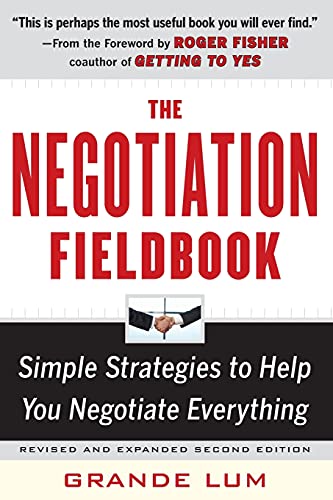
Synopsis
The classic guide to collaborative negotiation--updated for today's ultracompetitive environment
"We negotiate every day--in school, in business, in politics, in everything we do. Every time I want to influence someone or deal with someone who wants to influence me, I am negotiating. For that world, this is perhaps the most useful book you will ever find." -- Roger Fisher, bestselling coauthor of Getting to Yes
The definitive practical guide to the art of negotiating, this revised and expanded edition of The Negotiation Fieldbook details topics other books don't even touch upon. It helps you steer a negotiation first to collaboration and then to agreement--a much more effective tactic than "dominating" the process.
Filled with quizzes to reinforce what you’ve learned, The Negotiation Fieldbook is a complete package with everything you need to enter negotiations with skill and confidence--and create a win-win situation for all.
NEW TO THIS EDITION:
- Analysis of different negotiation styles and situations
- The fundamentals of ethical negotiating
- Important breakthroughs in negotiation psychology
- Conducting negotiations on behalf of others
"synopsis" may belong to another edition of this title.
About the Author
McGraw-Hill authors represent the leading experts in their fields and are dedicated to improving the lives, careers, and interests of readers worldwide
Excerpt. © Reprinted by permission. All rights reserved.
THE NEGOTIATION FIELDBOOK
Simple Strategies to Help You Negotiate Everything
By GRANDE LUMThe McGraw-Hill Companies, Inc.
Copyright © 2011 The McGraw-Hill Companies, Inc.
All rights reserved.
ISBN: 978-0-07-174347-1All rights reserved.
Contents
| Foreword | |
| Preface | |
| Introduction | |
| Using The Negotiation Fieldbook | |
| PART ONE: THE ICON NEGOTIATION MODEL | |
| Chapter 1 Interests: Get Underneath Negotiating Positions | |
| Chapter 2 Criteria: Use Objective Standards | |
| Chapter 3 Options: Brainstorm Creatively | |
| Chapter 4 No-Agreement Alternatives: Know Your BATNA | |
| PART TWO: THE 4D APPROACH | |
| Chapter 5 Step 1. Design: Frame the Negotiation | |
| Chapter 6 Steps 2 and 3. Dig for Interests and Develop Options | |
| Chapter 7 Step 4. Decide: Close the Negotiation | |
| PART THREE: BEFORE YOU GET TO THE TABLE | |
| Chapter 8 Strategize Fully | |
| Chapter 9 Dealing with Difficult Tactics | |
| Chapter 10 Treat All Negotiations as Cross-Cultural | |
| Chapter 11 Act with a Clear Conscience | |
| PART FOUR: APPENDIX | |
| Prepare! Prepare! Prepare! | |
| ICON and 4D Summary | |
| 4D Key Points Summary | |
| Worksheets | |
| Glossary | |
| References | |
| About Accordence | |
| About the Author | |
| Index |
Excerpt
CHAPTER 1
Interests: Get Underneath Negotiating Positions
Interests underlie positions. They are subjective—the needs,goals, drivers, concerns, and fears of each party.
THE CHALLENGE
In the late 1980s and early 1990s, the health-care system of a major U.S.metropolitan area was widely acclaimed for being able to provide effectivecoverage and care for local residents at a low cost. Cooperation among thearea's hospital systems, insurance providers, governments, and businessesreceived nationwide praise. The situation worsened over the next several years,however, resulting from changes in the health-care environment, governmentderegulation, and leadership turnover at the hospital systems. By the late1990s, one of the area's largest hospitals was forced to shut its doors,physicians shuttled from one system to another lured by politicking andbenefits, and the business community watched as health-care costs increasedrelentlessly.
In 2001, the local business community sought to change this dynamic and reducehealth-care costs. A major health insurer forced the matter by issuing an RFP(request for proposals) for medical laboratory testing, with the goal oflowering its reimbursement costs for these services. After local hospitalsystems were unable to develop a collaborative agreement, two submitted a jointbid, and the third joined with a fourth hospital to submit a competing bid. Acycle of exclusion and collusion developed, forcing a race to the bottom inwhich even the winning bidders would regret their bids. Because of a lack oftrust, the hospitals found it easier to disrupt each other's bidding than createa community-based, collaborative solution.
THE SOLUTION
Encouraged by local business leaders to return to the bargaining table, theparties, through a mediator, began probing each other's interests in designing acommunity lab. Pathologists, lab operations managers, financial officers, andsenior management from hospital systems shared their underlying interests.Interests that emerged as critical were reducing duplication, creating economiesof scale, and maintaining or improving the quality of care.
The group developed a solution calling for the creation of a new entity to beshared by all hospital groups: a "virtual" lab that would channel testingaccording to agreed-upon guidelines and that had a single reimbursement rate(between this new entity and the insurance companies). As negotiationsprogressed, however, the parties still lacked a common ground on the businessand operational vision of their new venture. In particular, the parties found itdifficult to discuss reimbursement without feeling threatened. Outsidecommercial lab administrators serving similar markets helped unify theirobjectives. By the end of the negotiation, the hospitals had designed areimbursement plan to be negotiated with insurers. The reimbursement rate issuewas the critical final hurdle to reaching an agreement.
Two days before the deadline, all parties signed the framework agreement tocreate the new community medical testing lab and agreed with insurers on areimbursement rate that saved the community millions of dollars annually. Theproposed new lab also incorporated a new information system to provideunprecedented secure access to patient lab results for all area physicians,especially for patients whose records were associated with more than onehospital.
Interests are the nuts and bolts of agreements. They are the concerns, drivers,incentives, underlying needs, and motivators of the parties. They are thereasons people are involved in a negotiation in the first place. Interests havebeen the focus of some of the best research and writing on negotiation,including the work of Roger Fisher, William Ury, David Lax, and James Sebenius.
Interests are not the same as positions. For negotiation purposes, I definepositions as the demands of the parties. Another way of explaining thedifference between interests and positions is to say that positions are what youwant, while interests are what you need.
People sometimes make the simple mistake of negotiating on the basis of statedor implied demands. Understanding that important interests underlie demands is apowerful insight into negotiation because you free yourself from having torespond to and counter with demands of your own, which are often extreme andunreasonable.
For instance, consider this typical example of positional negotiating (see theflowchart below):
Customer: How much do you want for that black velvet picture of Elvis?
Storekeeper: This one, the one signed by the King himself? I suppose I could letit go for $500.
Customer: Whoa! That's out of my league. (Starts heading toward the door)
Storekeeper: Well, seeing that you're such an aficionado, I'll give you aspecial deal for $425.
Customer: Well, I am in a rush to get to the airport, so tell you what, I'llgive you $175 for it.
Storekeeper: This is a one-of-a-kind collector's item. I've owned it for 10years. I could never let it go for less than $350.
Customer: $200 is my final offer.
For the most part, these negotiators are focused on price and numbers. Sometimesthis feels like the best path to a quick and satisfying conclusion to a deal.This is often the case for one-time, low-value transactions, such as buyingitems at a garage sale or a bazaar where haggling is the accepted "game." Butwhat happens if you're negotiating over something of more value to you? Hagglingis not the best strategy for life's more complex relationships. Even when you'rebuying a new car, price haggling alone never fully addresses your variedinterests in price, financing, rebates, options, and so on. Positionalbargaining becomes increasingly painful, costly, and inefficient as thecomplexity of the negotiation and importance of the deal increases.
Addressing interests is the first key to unlocking yourself from the trap ofpositional bargaining. Interests are the reasons underlying positions. Whilethere is only one way to satisfy a position, there are many ways tosatisfy an interest. And the more an agreement satisfies the parties' interests,the better the deal.
Imagine for a moment that Helen Hoops, a top women's professional basketballplayer, is renegotiating her contract with the San Francisco Golden Gaters. Shehas just ended an all-star season. Helen's agent, Monique Lee, and the team'sgeneral manager, Kerry West, will be discussing the potential deal.
Let's look at the interests of the two principals (see the table on thefollowing page). If Monique (Helen's agent) and Kerry (the Golden Gaters generalmanager) truly understand each other's interests, they can craft an agreementthat meets their underlying needs well. Monique and Kerry should also identifytheir high-priority interests. For Helen, these include getting the bestpossible deal and long-term security. The Golden Gaters' first priority is tocreate a foundation for continued success. Without understanding interests, thenegotiators will likely resort to haggling over dollars and leave value on thetable unclaimed by either party.
Truly effective negotiators know the interests of the individuals across thetable and other decision makers away from the table. This gives them insightinto what kind of a deal they can craft and what type of offers they can makethat will be valuable to all. Asking about these interests is a much morepowerful approach than guessing. For one, making assumptions like, "They want tomake more money," may not be valid—the true interest may be, "to startpreparing for retirement." Demonstrating genuine desire in finding a mutuallybeneficial resolution to a problem will go further than simply pitting yourinterests against what you perceive to be theirs.
Let's look at the interests of other parties who will have an impact on the dealbetween Helen and the team. For now, let's explore the interests of Monique Lee,the player's agent, and Kerry, the general manager (see the table above).
Once we examine the interests of all the parties with a stake in the outcome,including the player and the team, our perspective on the negotiation and ourthoughts about possible solutions may evolve. This examination is vitalintelligence for any negotiator, but is often overlooked because people tend tofocus on positions. It is more challenging and rewarding to discover underlyinginterests because they are what motivated us to come to the negotiation table inthe first place.
Interests are not necessarily fixed or written in stone. Yours may shift as younegotiate, which means that you need to be aware of your interests at all times.Indeed, how you perceive your own interests and how your interests are perceivedby others is another overlooked but important aspect of negotiating. The leasthelpful perception for either party is that, "You will give in to my demands, orI will give in to yours."
In order to reach valuable agreements that everyone can live with, interestshave to be met and satisfied. Positions are often little more than openingdemands and should be treated as such.
If you look at the tables listing the interests of various parties in the HelenHoops-Golden Gaters negotiation, you are likely to find several things aneffective negotiator looks for: shared interests, differing interests, andinterests that may actually be conflicting (for instance, salary compensation:Helen wants more and the Golden Gaters would prefer to pay less). Obviously, youcan create attractive proposals, packages, and offers by knowing (or at leastguessing) how all these interests relate to each other.
Examine the following table of interests to get a sense of some of the shared,differing, and conflicting interests in this negotiation between Helen and theowner. Shared interests are those the parties have in common. Differinginterests are just that, different—not held in common, but also not atodds with the other party. Conflicting interests are not only differing, butthey are in some fashion in tension with each other. For example, both Helen andGeorge share an interest in having the team do well. Helen may be indifferent tothe owner's concern about the sale value of the team—she may not have astrong opinion one way or the other. At first glance, their salary interests mayconflict since more money for Helen means less for George.
As you can see, though, many interests are shared by Helen and the team.Although positions and demands might seem opposed when the agent and teammanagement first meet, they share many underlying goals. Relatively few of theirinterests are actually in conflict. With those that are, a creative negotiatorwill look for even deeper layers of interests in order to find some point atwhich the interests complement each other.
Indeed, you build negotiation value by understanding the parties'differing interests and the priorities they assign to them. Not all interestsare created equal, after all, so understanding whether they are of high, medium,or low priority will help you reach agreements by making sure higher-priorityinterests are satisfied first. This is an important step—negotiationrequires understanding as much as it does persuasion and influence.
Once priorities are assigned, both parties can begin understanding each other'smotivations and begin working toward an agreement. The first step is torecognize the importance of assigning priorities and then look more deeply fordifferences, similarities, and conflicts. Examine the table at the top of thenext page. Both parties are clearly interested in limiting tax liabilities thisyear, for instance; keeping down the up-front costs of the team is an area whereboth parties can find immediate agreement.
The following scenario offers you an opportunity to practice understandinginterests.
SCENARIO
Darrin and Wayman are the co-owners of a restaurant. Darrin is also therestaurant's head chef. The two are trying to renegotiate the terms of theirpartnership. Their conversation has been heated. Here are some of theirstatements. Take a guess at their interests. Write your answers on theworksheets that follow.
Right away we can see that Darrin and Wayman are both looking for morerecognition from each other. This might be a good starting point for findingcommon ground.
A few possible answers are listed below—possible interests of these twoparties.
Darrin's Possible Interests
• Clearly he has financial interests, but he may be concerned about hisinvestment of time and energy relative to return.
• Gaining recognition and acknowledgment
• Maintaining staff morale and a positive work environment
Wayman's Possible Interests
• Getting a good return on his investment
• Gaining recognition and acknowledgment
• Maintaining respect and politeness
SMART NEGOTIATOR TIP
Do the Tough Job of Putting Yourself into Their Shoes
Why is it hard? Because people tend to think they see the world as it is and ifsomeone else sees it another way, they are naive, ignorant, or worse. Peoplealso tend to take credit for their own success and blame others when things gobadly. They tend to believe information that supports their opinions and beliefswhile disregarding information that challenges or contradicts their opinions andbeliefs. All these things make it difficult to truly see the world from theother side's perspective. This is especially true if conflict and hostilitysmolders between the parties.
Social psychologist Lee Ross researched naive realism, a conviction that theperson sees the world as it is, and when people do not see it similarly, they donot see the world as it is. People are generally very good at spotting bias inothers, but not in themselves. Ross found that in the Israeli-palestinianconflict, both Israelis and Palestinians who viewed the same media coverage ofan event perceived bias. Israelis saw bias in favor of Palestinians, whilePalestinians saw bias in favor of Israelis. Ordinary group discussion canpolarize the view, because it shifts toward right and wrong. By having groupmembers articulate one argument that the other side makes that holds legitimacy,100 percent of the subjects were led to a potential solution for the conflict.
For you as a negotiator, ask the other party to share an interest or an argumentthat has merit. You are not asking that party to agree, but you are making itmore possible to reach an agreement. You can also do the same by articulatingone argument of the other party that has legitimacy.
SUMMARY
• Interests are the foundation of successful negotiation.
• Interests can be shared, differing, or conflicting.
• Understanding interests that underlie positions or demands frees you fromhaving to respond or counter with positions or demands of your own.
• Prioritizing interests as you prepare to negotiate will help you reachagreement.
QuickGuide: Interests
YOUR NEGOTIATION WORKSHEET
Now let's focus on your own negotiation—the one you jotted down earlier.Spend some time listing the interests of the various parties involved in thenegotiation on the worksheet on the following page. Then indicate whether theseinterests are shared, differing, or conflicting, and also identify the prioritylevel of the interests.
Your Negotiation Worksheet
REVIEW (SEE ANSWER KEY AT END OF CHAPTER)
Check all that apply
1. What are interests?
___ a) The underlying needs, concerns, and motivations of the parties
___ b) Proposals for agreement
___ c) The foundation of effective negotiation
___ d) Objective standards, benchmarks, and precedents
2. What is a position?
___ a) A demand that a party makes at the outset of a negotiation
___ b) The fear a person expresses—his or her "driver"
___ c) A single solution that is presented as the right answer for agreement
___ d) A clue to a person's underlying interests
3. When comparing the interests of parties in a negotiation, look for those thatare:
___ a) shared, difficult, and constant
___ b) shared, differing, and constant
___ c) shared, differing, and conflicting
___ d) bizarre, outrageous, and funny
Is the statement conveying an interest or a position?
1. We are not painting the house yellow.
2. We need to price this project at $15,500.
3. We will need to satisfy our safety concerns.
4. We must have five more community members on this project.
5. I am worried about the lack of resources that are allocated.
True or False
___ 1. Interests are unchanging indicators of what parties really want.
___ 2. Interests lie just below the surface demands parties make and are alwaysjust one layer down.
___ 3. Parties can assign different values and priorities to their variousinterests.
___ 4. Prioritizing interests is a waste of time because they change.
ANSWER KEY
Check all that apply
1. What are interests?
a) Yes. This is the fundamental definition of interests.
b) No. When someone makes a proposal, this is a position. The underlying needsbehind the statement would be the interests behind that proposal.
c) Yes. Understanding the interests of the parties is the key to successfulnegotiations.
d) No. Interests are subjective rather than objective.
2. What is a position?
a) Yes. This is the fundamental definition of a position.
b) No. While fears and drivers may lead a party to state a position, they arestill interests. Whether the other party views them as rational or not, fearsare "subjectively" believed by the person holding them.
c) Yes. A position is a solution that is presented as the "right" answer.
d) Yes. By figuring out the "why" of the stated position, parties are uncoveringthe interests.
3. When comparing the interests of parties in a negotiation, look for those thatare:
c) shared, differing, and conflicting.
(Continues...)
(Continues...)
Excerpted from THE NEGOTIATION FIELDBOOK by GRANDE LUM. Copyright © 2011 by The McGraw-Hill Companies, Inc.. Excerpted by permission of The McGraw-Hill Companies, Inc..
All rights reserved. No part of this excerpt may be reproduced or reprinted without permission in writing from the publisher.
Excerpts are provided by Dial-A-Book Inc. solely for the personal use of visitors to this web site.
"About this title" may belong to another edition of this title.
Search results for The Negotiation Fieldbook, Second Edition: Simple Strategies...

Stock Image
The Negotiation Fieldbook, Second Edition
Published by
McGraw-Hill Education - Europe, 2010
ISBN 10: 0071743472
ISBN 13: 9780071743471
Used
Paperback
Seller: World of Books (was SecondSale), Montgomery, IL, U.S.A.
Seller rating 5 out of 5 stars

Paperback. Condition: Good. A fully revised edition of the classic guide to negotiation providing brand-new perspectives and skills for succeeding in today's competitive business landscape. Seller Inventory # 00084565867
Seller Image
The Negotiation Fieldbook, Second Edition: Simple Strategies to Help You Negotiate Everything
Seller: Zoom Books Company, Lynden, WA, U.S.A.
Seller rating 5 out of 5 stars
Condition: very_good. Book is in very good condition and may include minimal underlining highlighting. The book can also include "From the library of" labels. May not contain miscellaneous items toys, dvds, etc. . We offer 100% money back guarantee and 24 7 customer service. Seller Inventory # ZBV.0071743472.VG
Seller Image
The Negotiation Fieldbook, Second Edition: Simple Strategies to Help You Negotiate Everything
Seller: Greenworld Books, Arlington, TX, U.S.A.
Seller rating 5 out of 5 stars
Condition: very_good. Fast Free Shipping â" Very Good condition book with a firm cover and clean pages. Shows normal use and some light wear or limited notes markings. A solid, nice copy to enjoy. Seller Inventory # GWV.0071743472.VG
Stock Image
The Negotiation Fieldbook, Second Edition: Simple Strategies to Help You Negotiate Everything
Seller: Evergreen Goodwill, Seattle, WA, U.S.A.
Seller rating 5 out of 5 stars
paperback. Condition: Good. Seller Inventory # mon0000736796
Stock Image
The Negotiation Fieldbook, Second Edition: Simple Strategies to Help You Negotiate Everything
Published by
McGraw Hill (edition 2), 2010
ISBN 10: 0071743472
ISBN 13: 9780071743471
Used
Paperback
Seller: BooksRun, Philadelphia, PA, U.S.A.
Seller rating 5 out of 5 stars
Paperback. Condition: Very Good. 2. It's a well-cared-for item that has seen limited use. The item may show minor signs of wear. All the text is legible, with all pages included. It may have slight markings and/or highlighting. Seller Inventory # 0071743472-11-1
Stock Image
The Negotiation Fieldbook, Second Edition
Published by
McGraw-Hill Education - Europe, 2010
ISBN 10: 0071743472
ISBN 13: 9780071743471
Used
Paperback
Seller: World of Books Inc, Montgomery, IL, U.S.A.
Seller rating 4 out of 5 stars

Paperback. Condition: Good. A fully revised edition of the classic guide to negotiation providing brand-new perspectives and skills for succeeding in today's competitive business landscape. Seller Inventory # CIN0071743472G
Stock Image
The Negotiation Fieldbook, Second Edition: Simple Strategies to Help You Negotiate Everything
Seller: ThriftBooks-Atlanta, AUSTELL, GA, U.S.A.
Seller rating 5 out of 5 stars
Paperback. Condition: Good. No Jacket. Pages can have notes/highlighting. Spine may show signs of wear. ~ ThriftBooks: Read More, Spend Less. Seller Inventory # G0071743472I3N00
Stock Image
The Negotiation Fieldbook, Second Edition: Simple Strategies to Help You Negotiate Everything
Seller: ThriftBooks-Dallas, Dallas, TX, U.S.A.
Seller rating 5 out of 5 stars
Paperback. Condition: Very Good. No Jacket. May have limited writing in cover pages. Pages are unmarked. ~ ThriftBooks: Read More, Spend Less. Seller Inventory # G0071743472I4N00
Stock Image
The Negotiation Fieldbook, Second Edition: Simple Strategies to Help You Negotiate Everything
Seller: ThriftBooks-Dallas, Dallas, TX, U.S.A.
Seller rating 5 out of 5 stars
Paperback. Condition: Very Good. No Jacket. Former library book; May have limited writing in cover pages. Pages are unmarked. ~ ThriftBooks: Read More, Spend Less. Seller Inventory # G0071743472I4N10
Seller Image
The Negotiation Fieldbook, Second Edition: Simple Strategies to Help You Negotiate Everything
Seller: Dream Books Co., Denver, CO, U.S.A.
Seller rating 5 out of 5 stars
Condition: good. Gently used with minimal wear on the corners and cover. A few pages may contain light highlighting or writing, but the text remains fully legible. Dust jacket may be missing, and supplemental materials like CDs or codes may not be included. May be ex-library with library markings. Ships promptly! Seller Inventory # DBV.0071743472.G