
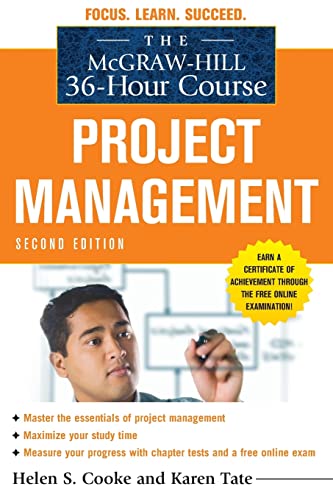
The McGraw-Hill 36-Hour Course: Project Management, Second Edition (McGraw-Hill 36-Hour Courses) - Softcover
Synopsis
Schedule and coordinate projects seamlessly, start to finish!
In today's ultracompetitive world of business, those in charge want results on time and on budget--and they're turning to project managers to deliver. Skilled project managers are in high demand, and the profession is growing at an unprecedented rate.
The McGraw-Hill 36-Hour Course: Project Management, Second Edition, combines expert insight, advice based on realworld experience, and the latest developments into a single, concise package. In the span of 36 hours, you'll learn how to:
- Plan, launch, manage, and close projects
- Build the best team for each project
- Shape and drive a project using effective leadership
- Manage quality, costs, time, and risk
- Deploy the latest project management technologies
Complete with chapter-ending self-tests and a comprehensive online final exam, The McGraw-Hill 36-Hour Course: Project Management, Second Edition, provides the guidance you need to manage any project under any conditions.
"synopsis" may belong to another edition of this title.
About the Authors
Helen S. Cooke is a recognized leader in the project management field, an officer in PMI, and has more than two decades of experience in project management consultation and implementation.
Karen Tate is president of project management consultancy The Griffin Tate Group, Inc., and coauthor of Getting Started in Project Management and the bestselling Project Management Memory Jogger. Karen serves on the board of PMI, The Project Management Institute.
Excerpt. © Reprinted by permission. All rights reserved.
THE McGRAW-HILL 36-Hour Course PROJECT MANAGEMENT
By Helen S. Cooke, Karen TateThe McGraw-Hill Companies, Inc.
Copyright © 2011 The McGraw-Hill Companies, Inc.
All rights reserved.
ISBN: 978-0-07-173827-9All rights reserved.
Contents
| Chapter 1 Project Management | |
| Chapter 2 Project Management Concepts | |
| Chapter 3 The Project Management Leader | |
| Chapter 4 The Process of Managing Projects | |
| Chapter 5 Planning Concepts | |
| Chapter 6 High-Level Planning | |
| Chapter 7 Detailed Planning for Execution | |
| Chapter 8 Building and Developing a Team | |
| Chapter 9 Facilitating Project Execution and Closeout | |
| Chapter 10 The Context for Project Management | |
| Chapter 11 Controlling Project Work | |
| Chapter 12 Organizational Project Management Maturity | |
| Appendix A: Process Model | |
| Appendix B: Templates | |
| Appendix C: Organizational Assessment | |
| Appendix D: Case Study | |
| Appendix E: Deliverables' Life Cycle | |
| Notes | |
| Index | |
| Instructions for Accessing Online Final Exam and Chapter Quiz Answers |
Excerpt
CHAPTER 1
PROJECT MANAGEMENT
OVERVIEW AND GOALS
This chapter provides a general overview of the broad field of projectmanagement and its role in the work world. It describes how an age-old processbecame formalized in the late twentieth century, shows how professional projectmanagement evolved to where it is today, and distinguishes thousands of peoplein the occupation of project management from the new project managementprofessional. It explains why organizations undertake projects, clarifies terms,and provides examples of different types of projects. Its goal is to distinguishproject management from other functions.
WHAT IS PROJECT MANAGEMENT?
Many sectors of the economy are identifying project management as a newkey business process. As project management gains recognition as a distinct wayof managing change, differences exist in how it is applied and understood acrossindustries, corporations, governments, and academia. The term projectmanagement is used freely throughout profit-oriented companies,not-for-profit organizations, and government agencies, but people do not alwaysmean the same thing by it. Some organizations use the term projectmanagement to describe the task of managing work. Others use it to definethe field of work focused on the delivery of project results. Still others meanthe profession of project management, encompassing not only project managers butalso other project-related specialists. Some use the term to describetraditional management practices or technical management practices, simplytransferring those practices from organizational operations to projects. Becausethis field is emerging into the mainstream, definitions abound. During thecourse of describing project management practices and concepts, this book willhelp to distinguish what is unique to this field from what it has in common withgeneral management and the management elements of technical disciplines. It alsowill identify many of the misleading assumptions about project management thatobscure the value of this new field of professionalism.
Project Management Evolves
Projects have been managed since prehistory. Strategies for project managementcan be found in records of the Chinese warlords (Sun Tzu), Machiavelli, andother, more obscure writers (see Chapter 2). Large projects such as the1893 World's Fair in Chicago clearly used it. As projects became more complexand more difficult to execute in a context where profit, time lines, andresource consumption competed with defined objectives, twentieth-centurymanagers began to codify the practices needed to plan, execute, and controlprojects. The government led the way in developing the techniques and practicesof project management, primarily in the military.
It is popular to ask, "Why can't they run government the way I run my business?"In the case of project management, however, business and other organizationslearned from government, not the other way around. A lion's share of the creditfor the development of the techniques and practices of project managementbelongs to the military, which faced a series of major tasks that simply werenot achievable by traditional organizations operating in traditional ways. TheUnited States Navy's Polaris program, NASA's Apollo space program, and morerecently, the space shuttle and the strategic defense initiative ("star wars")programs are instances of the application of these specially developedmanagement approaches to extraordinarily complex projects. Following suchexamples, nonmilitary government sectors, private industry, public serviceagencies, and volunteer organizations have all used project management toincrease their effectiveness.
Thus, for modern-day project management, the Polaris submarine program and laterthe Apollo space program launched the systematic application of knowledge,tools, methods, and techniques to the planning, execution, and completion ofprojects. While these techniques have proliferated broadly among othergovernment programs since the 1960s and 1970s and through research anddemonstration programs among other branches of government as well as theircontractor organizations, the construction industry was a key beneficiary ofthese improvements. Large, complex projects, such as the construction of HooverDam and the carving of the faces of American presidents into stone at MountRushmore in South Dakota, applied these improvements. Since then, projectmanagement methods have been implemented in information management and movement,pharmaceuticals, information systems, the entertainment and service sectors, anda variety of global projects. Project management's value continues to grow.
For a clearer idea of what the term project management means, compare itwith the term medicine in a health context. Each term can have manymeanings. The all-inclusive view of project management—just as inmedicine—will address the practice, as well as the role, the field, theoccupation, and the profession. The variations of meaning will also expanddepending on which view is taken. Project management in a professional contextmeans applying knowledge, skills, processes, methods, tools, and techniques toget desired results.
Like the word medicine, the term project management can take ona broad definition or a narrow one. A doctor practices medicine (broad).A patient takes a dose of medicine (narrow). Athletic discipline is saidto be good medicine—an ambiguous definition that combines both.The term medicine takes on a different meaning depending on the contextin which it is used, yet the term is always associated with certain values andgoals: medicine supports health; it does not compromise it. Medicine thereforeimplies a commitment of individuals to the goal of preserving or restoringhealth. Similarly, although one definition of project management may notfit all uses, there are common elements inherent in all meanings ascribed to it.These common elements bind together the individuals and the practices withinproject management. Together they create a common understanding of what projectmanagement is and help us come to grips with why project management is gettingsuch visibility today and why we need to know about it. This book will define acontext for project management and put its various roles and uses in perspectivefor both individuals and organizations.
Definition of the Project Management Profession
A project is a temporary endeavor undertaken to create a unique product,service, or result. Because projects create something for the first time, thereis a fundamental uniqueness to project work that makes it different from theoperational work of the organization: the uncertainties of a project, its lackof existing procedures, and the need to make trade-offs among variablesnecessitate more dedicated planning and a unique body of knowledge, skill, andcapability.
In the late 1960s, several project management professionals from theconstruction and pharmaceutical industries believed that project management hadmoved beyond being simply a job or an occupation. Together they undertook thetask of defining professional project management and created aprofessional association to put the elements of professional support in place.They called it the Project Management Institute (PMI). They expected PMI to haveas many as 1,000 members someday, and they ran initial operations out of thedining room of one of the members in Drexel Hill, Pennsylvania. These visionaryleaders considered project management to be an international profession; earlymembers were from not only the United States but also from Canada, South Africa,Europe, and Australia. By the mid-1970s, the goal of 1,000 members had alreadybeen reached. PMI chapters had been formed in five countries, and discussions ofprofessional standards were under way at the association's 1976 annual meetingin Montreal, Canada. By 1983, the discussions included topics such as ethics,standards, and accreditation. University programs were being developed (seeChapter 12), a formal examination was created, and by 1984 professionalsbegan to be designated as project management professionals (PMPs). Overthe following decades, that effort would spread to countries all over the globe,with PMI offices today located not only in Newtown Square, Pennsylvania, themore recent location for the Global Operations Center in the United States, butalso in Singapore, Brussels, Mumbai, and Beijing, and their efforts arecertifying almost 400,000 credential holders across 385 countries—morecertifications than all of PMI's active membership worldwide. There arecertified professionals active in the project management profession all aroundthe globe.
Definition of Project Management Standards
The creation of a professional association allowed hundreds of professionalsfrom the field of project management to collaborate in developing an acceptabledefinition of what project management means. The original founders ofthe Project Management Institute, together with colleagues from business,government, and academia, assembled the professional writings on projectmanagement into a massive book-length document called the Project ManagementBody of Knowledge. It started by focusing on the project itself, but by 1986a framework had been added to incorporate the relationship between the projectand its external environment and between project management and generalmanagement.
Almost 10 years later, the standards committee published a new version of thedocument that described the processes used to manage projects, aligning it withthe common knowledge and practices across industries, adding knowledge areas,and reducing the original document's construction emphasis. More than 10,000people in almost 40 countries received the document for review, and the"standard" truly began to proliferate around the world. In a few years 300,000copies were in circulation. There was common agreement that project managementinvolves balancing competing demands among:
• Scope, time, cost, risk, and quality
• Stakeholders with differing needs, identified requirements, and expectations
A project was defined as distinct from operations in that operations areongoing and repetitive, whereas projects are temporary and unique. Further, itclarified terms: "Temporary means that every project has a definitebeginning and a definite end. Unique means that the product or serviceis different in some distinguishing way from all similar products or services."
An Evolving Professional Standard
The purpose of PMI's A Guide to the Project Management Body of Knowledge(PMBOK Guide) was to identify and describe that subset of the projectmanagement body of knowledge that is generally accepted, or "applicable to mostprojects most of the time." With so many professionals contributing to thedefinitions and processes, and given its proliferation around the world, AGuide to the Project Management Body of Knowledge was becoming a de factoprofessional standard. While everyone seemed to agree, however, that theenvironment in which a project operates is important, they could not agree onwhat it should consist of. Different levels of organizational project managementmaturity across industries prevented building a consensus on the organizationalcontext for project management. For this reason, parts of the originalProject Management Body of Knowledge (1986) that related toorganizational responsibilities were left out of the published standard. It was10 years before those concepts were accepted broadly enough that the scope couldbe extended to include programs and portfolios as organizationalcontexts for housing and strategically managing multiple projects within asingle organization.
Projects are now linked explicitly to achieving strategic objectives, andorganizational planning is considered part of the human resources managementfunction. Processes and process groups are also now more fully defined. Somework was done in various countries around the world on professional competenciesand credentialing, but these cannot yet be defined as a "standard" because thebusiness context differs so much from one country to the next. As the professionadvances, these areas also may merge into one common definition, providingsignificant benefits to organizations that operate globally.
A New Core Competency for Organizations
Awareness grew that project management, far from being an adjunct activityassociated with nonstandard production, actually was the means by whichorganizations implemented their strategic objectives. The consensus also grewthat project management has become part of the core competency of organizations.The definition captured in the 2000 Guide to the Project Management Body ofKnowledge reflects this growing awareness:
Project management is the application of knowledge, skills, tools, andtechniques to project activities to meet project requirements. Projectmanagement is accomplished through the use of the processes such as: initiating,planning, executing, controlling, and closing. The project team manages the workof the projects, and the work typically involves:
• Competing demands for: scope, time, cost, risk, and quality.
• Stakeholders with differing needs and expectations.
• Identified requirements.
This change reflected a shift from seeing project management not only as aprofession but also as an organizational function with defined processesaddressing both the needs and the expectations of people with a stake in theproject's outcome, as well as the functional requirements of the product orservice to be produced. It also set as a standard the understanding that theorganization has explicit responsibility for the success of its projects. Anorganization's management is responsible not only for establishing anenvironment that allows and enables project success but also for approving andauthorizing the requirements that the project is to meet. The project team usesthose approved requirements to embark on their work.
The shift to an organizational context meant that the project manager was nolonger an independent practitioner within the organization, making projectssuccessful despite contrary forces. He now had a defined job title, function,and place on the organizational chart. Just as an attorney works within theorganization's legal function, the project management professional works withinthe organization's project management function. Formalizing the occupation intojobs and career tracks creates a space in which the professional can operatelegitimately (see Chapters 3 and 12).
New Groups Embrace Project Management
Organizations and industries tend to embrace project management when they standto gain significantly by doing so or to lose by not doing so. Many historicalprojects left a visible legacy behind them, but those in prior centuries leftlittle in the way of a project record. In the twentieth century, the navy andNASA projects mentioned earlier could not have been achieved without projectmanagement. The construction industry and other government contractors that wonmajor contracts began to embrace the same project management practices as theirsponsoring government agency did. Other industries, such as the pharmaceuticalindustry, made significant gains in quality and mitigated complexity by usingproject management. The examples could go on and on.
During the past several decades, most large organizations were integratingcomputer technology, first into streamlined operations and then into theirstrategic business systems. This evolving technology was generating hundreds ofprojects. The shift to an organizational context in project management thereforecoincided with an influx of professionals from information systems, informationtechnology, and information management functions into project management. Theyjoined the professional associations in record numbers. Previously, professionalpractitioners were from the construction industry, streamlined as it was byproject management methods and tools from government. The motto of the ProjectManagement Institute's marketing thrust during the early 1990s was "Associatewith Winners."
In contrast, information systems and information technology projects weregetting media coverage citing 200 percent budget overruns and schedule delays.Low project success rates unheard of in the quality environment were routine.
As these groups shifted their attention from software engineering to projectmanagement, they brought the attention of management with them. All were awareof the wasted resources and the opportunity costs of not managing projects well.The idea resonated with senior management that projects simply were not"nonstandard operations" but rather a core business process for implementingstrategic initiatives. Senior management was ready to begin managing projectsmore systematically. Project management became the topic for executive forums,and some executive groups began to review all projects biannually to determinethe best use of the organization's strategic resources (see Chapter 12).
The response of the marketplace to recognition of the project manager and theproject management function caused interest to skyrocket. Membership in theprofessional association grew quickly, swelling in a single decade from justunder 10,000 members in 1992 to 100,000 by 2002, then to 150,000 by 2005, and300,000 by 2009. There were more certified personnel than there were PMImembers. An increasing contingent of practitioners working on projects aroundthe globe continued to apply for certification without joining PMI. Projectmanagement was the subject of articles in business newspapers and corporatejournals. Research began to show that organizations with mature projectmanagement environments derive more value from project management than thosebeginning to implement it.
The government had funded a means by which software engineering professionalscould judge the maturity of their software development environments, but noparallel instrument existed for assessing the maturity of project managementenvironments. By 1999, professionals from all over the world were collaboratingto create an "Organization Project Management Maturity Model" (OPM3), releasedin 2003 (PMI). Various maturity models were developed in leading businessschools (e.g., Stanford University and the University of California atBerkeley), as well as by vendors, and these models were applied to productsserving the maturing project management marketplace (see Chapter 12).Like people weaving different corners of the same tapestry, the detail andrichness of the profession are emerging from the combined cooperative efforts ofmany professional bodies and are being advanced by their common application ofstandards and training in the agreed-on and "generally accepted" projectmanagement process. While there is still a good deal of work to be done beforethese separate fronts merge into one picture, movement toward that end is steadyand positive.
(Continues...)
(Continues...)
Excerpted from THE McGRAW-HILL 36-Hour Course PROJECT MANAGEMENT by Helen S. Cooke, Karen Tate. Copyright © 2011 by The McGraw-Hill Companies, Inc.. Excerpted by permission of The McGraw-Hill Companies, Inc..
All rights reserved. No part of this excerpt may be reproduced or reprinted without permission in writing from the publisher.
Excerpts are provided by Dial-A-Book Inc. solely for the personal use of visitors to this web site.
"About this title" may belong to another edition of this title.
Other Popular Editions of the Same Title

Search results for The McGraw-Hill 36-Hour Course: Project Management,...

Stock Image
The McGraw-Hill 36-Hour Course: Project Management, Second Edition (McGraw-Hill 36-Hour Courses)
Seller: Your Online Bookstore, Houston, TX, U.S.A.
Seller rating 5 out of 5 stars

paperback. Condition: Good. Seller Inventory # 0071738274-3-35400921
Stock Image
The McGraw-Hill 36-Hour Course: Project Management, Second Edition
Seller: World of Books (was SecondSale), Montgomery, IL, U.S.A.
Seller rating 5 out of 5 stars
Condition: Very Good. Item in very good condition! Textbooks may not include supplemental items i.e. CDs, access codes etc. Seller Inventory # 00094552652
Stock Image
The McGraw-Hill 36-Hour Course: Project Management, Second Edition
Seller: World of Books (was SecondSale), Montgomery, IL, U.S.A.
Seller rating 5 out of 5 stars
Condition: Good. Item in good condition. Textbooks may not include supplemental items i.e. CDs, access codes etc. Seller Inventory # 00098256471
Stock Image
The McGraw-Hill 36-Hour Course: Project Management, Second Edition
Seller: ThriftBooks-Reno, Reno, NV, U.S.A.
Seller rating 5 out of 5 stars
Paperback. Condition: Very Good. No Jacket. May have limited writing in cover pages. Pages are unmarked. ~ ThriftBooks: Read More, Spend Less. Seller Inventory # G0071738274I4N00
Stock Image
The McGraw-Hill 36-Hour Course: Project Management, Second Edition
Seller: ThriftBooks-Phoenix, Phoenix, AZ, U.S.A.
Seller rating 5 out of 5 stars
Paperback. Condition: Very Good. No Jacket. May have limited writing in cover pages. Pages are unmarked. ~ ThriftBooks: Read More, Spend Less. Seller Inventory # G0071738274I4N00
Stock Image
The McGraw-Hill 36-Hour Course: Project Management, Second Edition
Seller: ThriftBooks-Dallas, Dallas, TX, U.S.A.
Seller rating 5 out of 5 stars
Paperback. Condition: Very Good. No Jacket. May have limited writing in cover pages. Pages are unmarked. ~ ThriftBooks: Read More, Spend Less. Seller Inventory # G0071738274I4N00
Stock Image
The McGraw-Hill 36-Hour Course: Project Management, Second Edition
Seller: ThriftBooks-Atlanta, AUSTELL, GA, U.S.A.
Seller rating 5 out of 5 stars
Paperback. Condition: Very Good. No Jacket. Former library book; May have limited writing in cover pages. Pages are unmarked. ~ ThriftBooks: Read More, Spend Less. Seller Inventory # G0071738274I4N10
Stock Image
The McGraw-Hill 36-Hour Course: Project Management, Second Edition
Seller: ThriftBooks-Atlanta, AUSTELL, GA, U.S.A.
Seller rating 5 out of 5 stars
Paperback. Condition: Very Good. No Jacket. May have limited writing in cover pages. Pages are unmarked. ~ ThriftBooks: Read More, Spend Less. Seller Inventory # G0071738274I4N00
Stock Image
The McGraw-Hill 36-Hour Course: Project Management, Second Editio
Seller: Hawking Books, Edgewood, TX, U.S.A.
Seller rating 4 out of 5 stars

Condition: Very Good. Very Good Condition. Five star seller - Buy with confidence! Seller Inventory # X0071738274X2
Stock Image
The Mcgraw-Hill 36-Hour Course: Project Management, Second Edition
Seller: Better World Books, Mishawaka, IN, U.S.A.
Seller rating 5 out of 5 stars
Condition: Good. Former library copy. Pages intact with minimal writing/highlighting. The binding may be loose and creased. Dust jackets/supplements are not included. Includes library markings. Stock photo provided. Product includes identifying sticker. Better World Books: Buy Books. Do Good. Seller Inventory # GRP102694770