
Items related to ConnectAbility: 8 Keys To Building Strong Partnerships...
ConnectAbility: 8 Keys To Building Strong Partnerships With Your Colleagues And Your Customers (BUSINESS SKILLS AND DEVELOPMENT) - Softcover
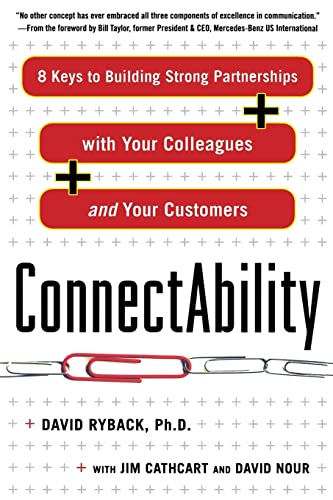
Synopsis
ConnectAbility
-noun: 1. an agile approach to running an organization that takes into account the psychology of human interaction; 2. the only way to do business in today’s economy
Drawing from the powerful lessons of emotional awareness and relationshipdynamics, ConnectAbility promotes a sophisticated yet simple method for developingsuperior partnerships guaranteed to create quality results on a consistentbasis. Even the best-intentioned team players too often focus more oncommunicating their own ideas than hearing and understanding what othershave to say. ConnectAbility changes all this using eight steps to fostering optimumcommunication, which include:
- Sharing your power with others
- Expressing yourself with authenticity
- Engaging your audience with humor
- Challenging yourself by taking charge
- Maintaining awareness of emotional dynamics
The book contains two tests you can take that will help you pinpoint your own levelof ConnectAbility.
ConnectAbility is your key to getting things done in a positivemanner that benefits not only you and your team--but the organization as a whole.
"synopsis" may belong to another edition of this title.
About the Author
David Ryback, Ph.D., is an internationally acclaimed speaker and consultant, as well as a columnist for Business to Business.
Jim Cathcart is president of Cathcart Institute, Inc., a research and consulting firm.
David Nour is a popular speaker and head of The Nour Group, a provider of business solutions for Fortune 500 clients.
Excerpt. © Reprinted by permission. All rights reserved.
ConnectAbility
8 Keys to Building Strong Partnerships with Your Colleagues and Your CustomersBy DAVID RYBACK JIM CATHCART DAVID NOURThe McGraw-Hill Companies, Inc.
Copyright © 2010 The McGraw-Hill Companies, Inc.All right reserved.
ISBN: 978-0-07-163885-2
Contents
Chapter One
Show Me the PeopleKEY 1: SHARE YOUR POWER WITH OTHERS
There's a human trait that fears the yielding of power. The delusion is that if an individual were to yield whatever power he or she now has, that person will lose it and all the benefits that accompany it. The truth is, if the individual is secure enough in his or her power to share it with others, that power is enhanced (many times over) through the respect others gain for you when they see your inner confidence.
In developing strong partnerships with your colleagues and customers, allow yourself to feel secure enough in your own power as an individual to share it with others who contribute in a meaningful fashion. As a result, you'll significantly enhance your power through the respect others gain for you after witnessing such inner confidence.
If you feel somewhat overwhelmed by these issues, you're not alone. Power over others is a daunting proposition. Sure, there's a primal sense of power that feels good when we can tell others what to do and they are forced, more or less, to obey our commands. It's as if we are stronger, better, more privileged, and more worthy of reward. It's not easy to give up that primal feeling. But there's a feeling that's more fulfilling in the long run: cooperating with others freely. It's the option to be more productive and successful in the business world because we're part of a team that functions more efficiently and effectively, while making us feel more involved and appreciated on the basis of who we are in terms of our skills and deeper values. We get the job done with less effort and less stress, and in the process, we help others become even more capable of producing their own results.
As Warren Bennis, guru on business leadership and professor of business administration at the University of Southern California, puts it in a Time magazine article, "There's a point at which you find an interesting kind of nerve circuitry between optimism and hubris. It becomes an arrogance of conceit, an inability to live without power."
In addition, the Awareness Factor is not the dominant culture in much of today's business world. Rather, the Status Factor—based on competition and conflict, even within an organization—still reigns supreme among many who believe in divided interests rather than cooperation. "It has become clear that nature is filled with competition and conflicts of interest," writes journalist D. Brooks in The Atlanta Journal-Constitution. "Status contests came before humanity, and are embedded deep in human relations. We strive for dominance and undermine radical egalitarian dreams. We're tribal and divide the world into in-groups and out-groups."
It's much easier to be simplistic, self-serving, and single-minded in the world of business—easier but not more profitable, at least not in the long run. What really works—in terms of effective leadership, employee loyalty, a more successful marketing approach, superior customer service—is the framework of ConnectAbility. But since confronting the status quo presents a greater challenge, the Status Factor rules the day in more cases than not. This leaves a tremendous margin for success for those who choose the Awareness Factor.
The Status Factor is the favored structure of traditional business organizations, in which power is tightly controlled from top down, resulting in what one expert calls "industry dissonance." More dynamic business organizations integrate ConnectAbility into their value structure. In the following sections, we'll see how the manufacturers at Ford and Mercedes moved toward more ConnectAbility values.
Now that we have a meaningful understanding of the Awareness and Performance Factors, we're ready to explore the basis on which the structure of ConnectAbility stands.
* Relationships are assets. In any business setting, relationships are assets. As such, they can be created, managed, nurtured, measured, and even discontinued, intentionally and consciously.
* It's all about who cares. Business cannot exist in the absence of people relationships. The stronger the relationships, the more potential for success in the business. It's not whom you know that counts; rather, it's who cares whether or not you know them. The more they authentically care—whether the "they" are associates, prospects, customers, or vendors—the greater the potential for success.
* People relationships make up the business. When the purpose of a relationship changes, the expectations and "rules" that apply also change. In that sense, the purpose defines the nature of the relationship, which survives until the purpose or Desired Outcome is met. Then that particular relationship ends, or transforms into a new one if a new purpose is agreed on. Therefore, Desired Outcome is the organizing factor in business relationships. Without it, there is no meaning to the relationships.
* The Desired Outcome defines the business. All relationships can be evaluated with regard to the Desired Outcome, which may be as simple as casual friendship or as complex as the organization of a federal institution. A marriage contract is one that overlaps broadly between personal and legal aspects of a relationship. The success of a business relationship always refers back to the Desired Outcome, which might change over time, requiring ongoing evaluation.
* The key to success is the core group. Any business, other than "mom- and-pop" operations, is run by a select few, which we refer to as the "core group." Core groups, committed to reaching the Desired Outcome, are the key to success. The ConnectAbility of the core group is of utmost importance, for without an effective inner circle, the business will fail. The potential for success of any business can accurately be predicted on the basis of the ConnectAbility of its core group.
* Show me the people. A primary contribution to the structure of ConnectAbility is that businesses are not the brick-and-mortar buildings that house them, but rather the relationships that constitute the social network of the individuals making up the organization. Accordingly, the business is the dynamic interaction between and among its members as they focus on the Desired Outcome. All the rest, including brick-and-mortar physical space, the paperwork files, and the related inventory (if there is such), are merely the physical manifestation of the business, not its essence.
* We have met the business, and it is us. It then follows that the business exists whenever and wherever two or more people communicate to achieve the Desired Outcome, including virtual connection over the Internet. A "virtual" business may have no brick-and-mortar home yet be highly successful. But it must have a relationship network of individuals focusing on a Desired Outcome.
* ConnectAbility works at work. Since relationships make up the essence of any business, ConnectAbility is key to potential for success. Fortunately, ConnectAbility is learnable, through a commitment to education and training. The large body of research on emotional and social intelligences, as well as other aspects of multiple intelligences as revealed by Howard Gardner's seminal work, proves this beyond a doubt.
We improve our chances of success if we appropriately combine the emotional parts of our brain with the thinking component. For example, we pride ourselves on being in control of our lives. Yet if we get too controlling and analytical about everyday decisions, we become stymied, even neurotic, in our "paralysis of analysis." That's because overanalyzing may interfere with our ability to make quick, intuitive business decisions.
Why are some people of comparable circumstances able to profit from personal investment opportunities while others aren't? When a friend, Richard, first began to invest in real estate some years ago, he found that some individuals, as intelligent as they were in other areas, seemed unable to buy any properties, though they had the financial capability and the desire. What was happening was that they'd analyze all the numbers, over and over, and while that was going on, some much less analytical person, probably less intelligent in the conventional sense but more confident about the big picture and with more ConnectAbility, would move ahead and snap up the good buys. The others, with their overly analytic thinking, couldn't follow through and commit quickly enough. So whether it's communicating with authenticity or making rapid decisions based on both gut and brain, ConnectAbility has lots to offer.
The Sounds of Business: Nuances in Feelings
Business is made up of interpersonal communication, whether in person, by phone, over the Internet, or via whatever new electronic instrument that outperforms yesterday's darling device. The most revealing communication, because it reveals so much more in terms of nonverbal information, takes place in person.
Everyone can benefit from the nonverbal aspects of person-to-person communication. Leaders benefit by knowing how their staff members are feeling about the process of reaching set goals. Salespeople benefit by knowing if they're on the right track in terms of sensing the feelings of the prospective customer as they ask for commitment. Team leaders benefit by sensing how close the group members feel to one another as they merge their efforts in accomplishing the most recent mission or project.
We are interested in hearing—and seeing—how others talk, for the most part, so we can sense the subtext behind the context of the situation, making the business venture, whatever it is, a successful one.
Having good sense about people is essential, both within the organization as well as between the organization and its clients or customers. To the extent that a sense of alliance in the first case and a sense of allegiance in the second can be created, success will be enhanced markedly. This accounts for at least a third of the success in both cases. How well we recognize the emotional dynamics underlying business (the Awareness Factor) and how well we perform with the use of this information (the Performance Factor) determines our degree of success.
Where did it all begin? In the next section, we'll look at what came together to set the scene for ConnectAbility, a concept that ties together the tested and proven principles of enhanced communication to make them work in the challenging context of business.
Tips for Advancing Your ConnectAbility
* Don't overanalyze! Make important decisions based on both rational facts as well as the gut feeling you have about the deal.
* When you treat people with integrity, authenticity, and concern, you become more powerful. This is true both in terms of being effectively persuasive as well as in bottom-line dollars.
* Listen, show that you've heard—then sell! Remember: people don't buy until they feel they've been heard.
Where It All Began
"What the heck is going on? Who's that laughing out there?"
A sudden burst of laughter shot through the hallway, making its way through Erik's door and landing on his desk, or so it felt to him, right on top of the numbers he was looking at—to determine whether or not his figures were working out. In charge of sales for his group at a biotech corporation in Atlanta, Georgia, Erik was determined to get the numbers he needed by forcing his sales group to get to their prospects and find out what the sales potential of each client was.
"Is that you, Elizabeth?"
Elizabeth, who had recently moved down from Connecticut, was learning quickly that barging in just to "get numbers" from her new prospects was not acceptable in this work environment. She had encountered a company whose president knew all sorts of important people in the area and they represented a prize potential if only she could "schmooze" him up a bit before demanding figures.
Erik, who had been brought up and trained in Frankfurt, Germany, was more comfortable with a facts-and-figures approach. As in many organizations we know, achieving sales manager status is based more on productivity than on people skills. Erik was mired in the details of getting things accomplished. He demanded to know exactly what percentage of each type of DNA sequencing was taking place at each prospect, how many plates were being processed each week. Elizabeth knew from her clients how hard this was to determine on a weekly basis. So there was tension building between the two. When the laughter, which Erik recognized as coming from Elizabeth, "landed" on his desk, he became furious.
He fired up his computer and distributed a memo, office-wide, over e-mail: "There will be no more laughter in the hallway. This team has got to produce more specific, accurate, and dependable numbers for us to work on. I will not tolerate wasting time, telling jokes, and laughing when we need everyone to focus on the details that are important. Please note this memo applies to everyone."
From that moment on, there was no laughter in the hallways. Nor was there the same degree of productivity that had existed before. Two key players—the best of the group—were preparing to leave, as the gossip mill revealed they were looking for other positions. Tension filled the air, and people left the moment the clock registered 5 P.M. After a few weeks of this, Erik called on me to help him figure out what was going on.
"What were you thinking?" I asked, waving a printout of the memo in his face.
"I just wanted to let them know how serious I was about getting the numbers we needed," he replied, a sheepish half-smile crossing his face. "I thought it was a good move to motivate my people, to raise their morale."
"Erik," I began, "do you realize how people felt when they read this? Do you realize how people react when they're told, commanded, how to think, feel, act? This is modern America, not the old days of bosses telling everybody what to do. You can't just 'legislate' how people will feel, whether or not they can laugh."
"OK," he confessed, "I screwed up. That's why you're here. So what can you do to help?"
I spent the next 45 minutes explaining why this message was the ultimate demotivator. Then I spent the next few days defusing the highly volatile, negative conversations that continued to erupt throughout the building as a direct result of the e-mail. The company had experienced a downturn and had recently been "right-sized," and employees were still reeling from the layoffs. How could someone as smart as Erik make such a blunder?
Everyone reading the e-mail knew that three or four individuals, who were part of a well-known group of yes-men, came in early each morning to talk about others in Erik's office. They were also facts-and-figures people who disliked the informality of the rest of the group. They supported the e-mail, which was seen as an insult and fuel for dissent among the others.
What I couldn't fathom was how Erik could actually believe that his e-mail would raise morale and motivate employees to work harder and longer hours. The term ConnectAbility was not known yet in this organization, and this was a clear example of the absence of business intelligence in the workplace—on a grand scale.
As we're learning, ConnectAbility has a lot to do with understanding the social environment, a skill that Erik lacked. I had to explain to him how using e-mail to communicate such a thoughtless memo was wrong in so many respects. Had he dealt with this issue on a one-on-one basis, with a more realistic and personal approach, the results would have been quite different.
The whole point of ConnectAbility is enhanced communication for greater success, whether it refers to the evolution of organizational values, effectiveness of delivery systems, or ultimate sales figures. Communication that is clear, specific, and relevant trumps superficial image and the appearance of smooth sailing at all costs. Ongoing, honest discussion of all relevant factors is crucial.
Certainly there is nothing new since the advent of relationship selling and other aspects of communication involving sensitivity to the other's point of view. But ConnectAbility makes this the highest priority rather than a casual opportunity. Customer service has certainly been headed in that direction for some time now. And for good reason—it works! So by giving it a proper name and highlighting its components, we approach success much more quickly. We create more meaningful teams with ConnectAbility, not only within the organization but also with our clients and customers.
Beginnings
Let's take a look at the origins of ConnectAbility from the research structure of emotional and social intelligence and how it leads us to the importance of emotional awareness (for which we coin the term Awareness Factor), along with the need for communicating effectively. Then we'll explore how this Awareness Factor trumps the Status Factor in organizations that exemplify how ConnectAbility leads the way to greater business success.
Since the beginning of recorded history, there has been an ongoing debate about the nature of intellect and emotions and their respective benefits. Typically, intellect was seen as the superior faculty, whereas emotions were seen as distractions.
In the field of psychology, intellect was king over its "peasant" cousin, emotions. One text of the 1930s—Motivation of Behavior—characterized emotions as a "complete loss of cerebral control" without a "trace of conscious purpose." IQ tests were first used to measure the absence of emotions. But by the 1970s, emotions were finally recognized as part of the intelligence package, thanks in part to the book Frames of Mind, by Howard Gardner, wherein he formulated the concept of multiple intelligences, including intrapersonal intelligence (emotional self- awareness) and interpersonal intelligence (social skills).
Finally, the path was cleared for the concept of emotional intelligence, made up of four basic components: emotional self-awareness, self-control over extreme emotion, empathy, and the social wherewithal to integrate these skills. Eventually, intellect and emotion, instead of being on opposite sides of the ledger, became unified in a framework that found wide acceptance not only in psychology but in the worlds of education and business as well.
(Continues...)
Excerpted from ConnectAbilityby DAVID RYBACK JIM CATHCART DAVID NOUR Copyright © 2010 by The McGraw-Hill Companies, Inc.. Excerpted by permission of The McGraw-Hill Companies, Inc.. All rights reserved. No part of this excerpt may be reproduced or reprinted without permission in writing from the publisher.
Excerpts are provided by Dial-A-Book Inc. solely for the personal use of visitors to this web site.
"About this title" may belong to another edition of this title.
Search results for ConnectAbility: 8 Keys To Building Strong Partnerships...

Stock Image
ConnectAbility: 8 Keys to Building Strong Partnerships with Your Colleagues and Your Customers
Seller: Giant Giant, Reston, VA, U.S.A.
Seller rating 5 out of 5 stars

paperback. Condition: Very Good. Very Good condition.Crisp pages. Clean cover and pages. Book shows minimal shelf wear. No highlighting/marking. Not Satisfied? Contact us to get a refund. Seller Inventory # BRG-40_6_980
Stock Image
ConnectAbility: 8 Keys to Building Strong Partnerships with Your Colleagues and Your Customers
Published by
McGraw-Hill Education, 2009
ISBN 10: 0071638857
ISBN 13: 9780071638852
Used
Softcover
First Edition
Seller: Better World Books, Mishawaka, IN, U.S.A.
Seller rating 5 out of 5 stars
Condition: Very Good. 1st Edition. Pages intact with possible writing/highlighting. Binding strong with minor wear. Dust jackets/supplements may not be included. Stock photo provided. Product includes identifying sticker. Better World Books: Buy Books. Do Good. Seller Inventory # 11475687-6
Stock Image
ConnectAbility: 8 Keys to Building Strong Partnerships with Your Colleagues and Your Customers
Published by
McGraw-Hill Education, 2009
ISBN 10: 0071638857
ISBN 13: 9780071638852
Used
Softcover
First Edition
Seller: Better World Books, Mishawaka, IN, U.S.A.
Seller rating 5 out of 5 stars
Condition: Good. 1st Edition. Former library copy. Pages intact with minimal writing/highlighting. The binding may be loose and creased. Dust jackets/supplements are not included. Includes library markings. Stock photo provided. Product includes identifying sticker. Better World Books: Buy Books. Do Good. Seller Inventory # 11586280-6
Stock Image
Connectability: 8 Keys to Building Strong Partnerships with Your Colleagues and Your Customers
Seller: ThriftBooks-Dallas, Dallas, TX, U.S.A.
Seller rating 5 out of 5 stars
Paperback. Condition: Good. No Jacket. Former library book; Pages can have notes/highlighting. Spine may show signs of wear. ~ ThriftBooks: Read More, Spend Less. Seller Inventory # G0071638857I3N10
Stock Image
ConnectAbility: 8 Keys to Building Strong Partnerships with Your Colleagues and Your Customers
Published by
McGraw-Hill Education, 2009
ISBN 10: 0071638857
ISBN 13: 9780071638852
Used
Softcover
First Edition
Seller: Better World Books Ltd, Dunfermline, United Kingdom
Seller rating 5 out of 5 stars
Condition: Good. 1st Edition. Pages intact with minimal writing/highlighting. The binding may be loose and creased. Dust jackets/supplements are not included. Stock photo provided. Product includes identifying sticker. Better World Books: Buy Books. Do Good. Seller Inventory # 5466225-75
Buy Used
£ 13.28
£ 5 shipping
Ships from United Kingdom to U.S.A.
Ships from United Kingdom to U.S.A.
Quantity: 1 available
Stock Image
ConnectAbility: 8 Keys to Building Strong Partnerships with Your Colleagues and Your Customers
Print on DemandSeller: Majestic Books, Hounslow, United Kingdom
Seller rating 4 out of 5 stars

Condition: New. Print on Demand pp. 240. Seller Inventory # 8281830
Buy New
£ 27.20
£ 6.50 shipping
Ships from United Kingdom to U.S.A.
Ships from United Kingdom to U.S.A.
Quantity: 4 available
Stock Image
ConnectAbility: 8 Keys to Building Strong Partnerships with Your Colleagues and Your Customers
Published by
McGraw-Hill Education - Europe, 2009
ISBN 10: 0071638857
ISBN 13: 9780071638852
New
Paperback / softback
Seller: THE SAINT BOOKSTORE, Southport, United Kingdom
Seller rating 5 out of 5 stars
Paperback / softback. Condition: New. This item is printed on demand. New copy - Usually dispatched within 5-9 working days. Seller Inventory # C9780071638852
Buy New
£ 23.38
£ 11.48 shipping
Ships from United Kingdom to U.S.A.
Ships from United Kingdom to U.S.A.
Quantity: Over 20 available
Stock Image
ConnectAbility: 8 Keys to Building Strong Partnerships with Your Colleagues and Your Customers
Print on DemandSeller: Books Puddle, Woodside, NY, U.S.A.
Seller rating 4 out of 5 stars
Condition: New. Print on Demand pp. 240 1st Edition. Seller Inventory # 26647481
Stock Image
ConnectAbility: 8 Keys To Building Strong Partnerships With Your Colleagues And Your Customers (BUSINESS SKILLS AND DEVELOPMENT)
Seller: Chiron Media, Wallingford, United Kingdom
Seller rating 5 out of 5 stars
Paperback. Condition: New. Seller Inventory # 6666-ING-9780071638852
Buy New
£ 21.13
£ 15.49 shipping
Ships from United Kingdom to U.S.A.
Ships from United Kingdom to U.S.A.
Quantity: Over 20 available
Stock Image
ConnectAbility: 8 Keys to Building Strong Partnerships with Your Colleagues and Your Customers
Print on DemandSeller: Biblios, Frankfurt am main, HESSE, Germany
Seller rating 4 out of 5 stars
Condition: New. PRINT ON DEMAND pp. 240. Seller Inventory # 18647475