
Items related to I See Rude People: One Woman's Battle To Beat Some...
I See Rude People: One Woman's Battle To Beat Some Manners Into Impolite Society (NTC SELF-HELP) - Softcover
Synopsis
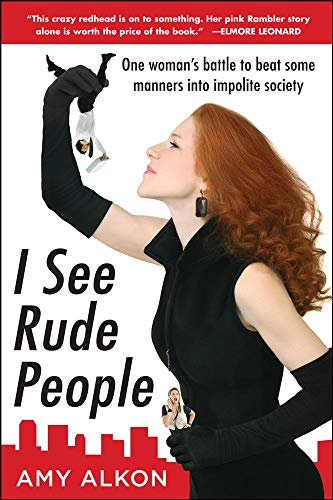
"This crazy redhead is on to something. Her pink Rambler story alone is worth the price of the book." - Elmore Leonard
''Amy Alkon is intellectually promiscuous-and funny as hell." - Paleopsychologist Howard Bloom, author of The Lucifer Principle
We all just suck it up every day. You leave the house for a latte and somebody'll flip you the bird on your way and force their loud cellphone conversation on you once you're there.
It doesn't have to be that way, says award-winning syndicated columnist Amy Alkon. Her hilarious stories of in-your-face encounters with rude people and businesses will inspire you to stand up to the boors in your own world.
Alkon not only gives the offenders a taste of their own medicine, she delves into anthropology, pscyhology, and behavioral science to figure out why we're rude and how we can stop all the intruding, shoving, and shouting. She ensures that all these rude people get their comeuppance:
- Lax parents
- Internet bullies
- Rude drivers
- Negligent businesses
- Telemarketing executives
- Car thieves
- Parking space hogs
- That loud jerk in the drugstore line
In this funny, ferocious and freewheeling expose, Alkon gives you the tools you need to confront these abusers and restore common courtesy, respect and good manners to society. . .one chastened cellphone shouter at a time.
"synopsis" may belong to another edition of this title.
About the Author
Amy Alkon writes the award-winning nationally syndicated advice column, The Advice Goddess, which appears in about 100 papers across the U.S. and Canada. She has been featured in The New York Times, Los Angeles Times, The Wall Street Journal, Glamour and Psychology Today, and has appeared on Good Morning America, The Today Show, NPR, CNN, MTV, Politically Incorrect and Nightline. She blogs daily at advicegoddess.com. Twitter: amyalkon
Excerpt. © Reprinted by permission. All rights reserved.
I See Rude People
One woman's battle to beat some manners into impolite societyBy AMY ALKONThe McGraw-Hill Companies, Inc.
Copyright © 2010 Amy AlkonAll right reserved.
ISBN: 978-0-07-160021-7
Contents
Chapter One
RUDE AWAKENING
Yes, Barry, it's me, a total stranger, calling you on your cell phone.
"Who are you? Who are you?" Barry asked, again and again. "I don't know you."
"No, you don't, but I know lots of things about you, Barry! Yes, I know lots and lots of personal details about you ... down to your name and phone number, which you shouted into your phone at Starbucks, not caring in the least whether the rest of us wanted to hear all about you or not."
Barry was speechless—for a change.
"Just calling to let you know, Barry, that if you'd like your private life to remain private, you might want to be a little more considerate next time! Bye!"
Just because you have a self doesn't mean you should express it. I know, I know ... as the Barrys of the world, commandeering the airspace of every coffee shop, grocery store aisle, and post office line inform me, "IT'S A FREE COUNTRY!" "IT'S NONE OF YOUR BUSINESS!" And then, there's my favorite: "IT'S A PUBLIC PLACE!" Yes, Barry, it is, which means you share it with a lot of other people—people who'd rather not have their thoughts bullhorned away by the revelation that you're in Starbucks, you'll be home at six, and you have genital warts.
We're all sick of this, yet it's the rare person who squeaks out a word of protest to the perps. If anything, when I shush a cell phone bellower or ask them to pipe down, some other restaurant or café patron being forced to listen to them will come to their abuser's defense, snapping at me, "If you don't like it, go to the library!" (Uh, I wasn't aware the librarians had started serving breakfast—and besides, the library is no place to escape all the asshats yakking it up on their cells.)
What gives? Did somebody put something in all the latte foam that gave the entire nation Stockholm syndrome, where the hostage goes all cuddly on their kidnapper? It seems so simple to me: We need to tell these thought-snatchers that our attention doesn't belong to them, that their right to have loud, dull cell phone conversations ends where our ears begin.
When I ask the brave defenders of others' noise pollution if they're actually enjoying it, nobody ever stands up, pounds their chest, and says, "I live to hear some lady take over the psychiatrist's waiting room with the story of her car trouble!"
Picture a woman, early 50s, voice all broken glass and gravel, shouting into her phone and out to a captive audience of patients, patients' friends and families, all of them reading magazines and talking in low tones to one another. And lucky you, you only have to picture this. I was one of 15 or so hostages forced to listen to the woman power-babbling into her phone for 20 minutes straight:
Shut up and listen! Cars have four motor mounts, not five. So, I should go over to Eddie's and have him drive the car around the block. And I'm at Dr. Jaffe's and maybe I'll come over when I'm done.... I won't throw a fit! I won't throw a fit! ... Just give me five minutes. Can you do that? Can you do that? ... That's fine ... that's reasonable. Okay ... alright.
Okay ... alright ... so that was one situation where I kept my big red trap shut. Since the woman was waiting to see a shrink, I figured there was a chance she was not only madder than a bag of ferrets, but violent, too. I likewise make it my business to just suck it up whenever somebody barking into a cell phone is wearing one of those gangland shower caps or looks like they might be armed. But, what's weird to me is how many people always suffer in silence, even if it's just a 13-year-old mall brat "like, yeah, ya know"-ing so loud in line behind them that it's impossible to hear the counter guy trying to take their lunch order.
If it isn't fear of bodily injury that keeps people from speaking up, it's probably fear of verbal confrontation, or maybe they're just not that practiced at it. I'm a syndicated advice columnist with somewhat controversial views, so I regularly get mail from readers that opens with something like "Dear Bitch." (If you're going to refer to me as "Bitch," maybe drop the "Dear"?) I guess it's a little easier for me to take the heat after telling somebody, usually in somewhat politer terms, to put a muzzle on it.
Just Call Me Revengerella
Perhaps you're picturing me as a little redheaded girl marching around telling the grownups where to put their teaspoons. It really wasn't that way. In fact, I'm no more educated in that sort of etiquette than the average person, and for most of my life, I didn't pay much attention to rudeness. And then, one day, I can't pinpoint exactly when, I just couldn't take it anymore. Overnight, I was like that "I see dead people" kid, except it was "I see rude people." They were everywhere. And they weren't just on cell phones. Cell phone rudeness is just the most prevalent form of modern mannerlessness, or what I call "the new rudeness"—people wildly indifferent to other people. Like Peter Parker, bitten by a radioactive spider and turned into Spiderman, I was transformed: Amy Alkon, nice Midwestern girl, became Amy Alkon, manners psycho, the illegitimate child of Miss Manners and Johnny "Jackass" Knoxville. And, not long afterward, at a Venice, California, Starbucks, a boor named Barry started taking his calls outside.
Barry's just one tiny link in the great, rude chain of being. There's a meanness, a hostile self-centeredness, that's overtaken our society since around the turn of the millennium, and nobody's safe from all the pushing, shoving, and shouting. Contrast the age-old notion of respect for the elderly with "Outta my way, Gramps!"—the message shoppers at a Los Angeles Trader Joe's supermarket sent as they nearly flattened a frail little old man in a walker in their rush to get to the organic veggies.
Now, maybe you're feeling a wave of smug rising in you, those of you who don't live in New York or Los Angeles, suspecting this new rudeness is just one of those big bad coastal city things. Sorry, but when I travel in America, even when I go back to the Midwest, I experience it: "The land of the free" is now the land of the free to be rude, and what used to be called "common courtesy" is getting to be about as common as suburban sightings of the spotted owl.
Assholes Go Back Farther Than Aristotle
Yeah, yeah, yeah ... once again, somebody's sounding the alarm that civilization's going down the tubes. So, what else is new? Humans probably developed speech largely so they could tell each other to shut the hell up already. And probably since early humans grunted their first words, somebody's been shrieking that the world's about to end, and more often than not, blaming that perennial menace, The Teenager:
I see no hope for the future of our people if they are dependent on the frivolous youth of today, for certainly all youth are reckless beyond words ... exceedingly (disrespectful) and impatient of restraint.
— Hesiod, 700 B.C.
There's more to recent rudeness than some 21st century version of kids street-racing their chariots through the middle of town, listening to death-lute, and tossing their ouzo bottles into some nobleman's yard. Just like teens throughout time, basically doing their thing without a whole lot of thought for anybody else's thing, today's unruly teenagers are bush- league bad-mannered compared to legions of grannies, grandpas, well-dressed businessmen, suburban mommies, and the 40-something woman who came within inches of crashing her Volvo station wagon into my car while simultaneously trying to park with one hand and yammer into the cell phone she was holding in the other.
When I beeped to keep her from swerving into me, she vigorously and repeatedly flipped me the bird (I guess to punish me for existing, and directly behind her to boot). For her grand finale, she exited her car in workout gear, toting a yoga mat, and snarled back at me, "Just off to find a little inner peace, you redheaded bitch!"
Uh, have a nice day!
Meet Homo Barbarus
I call it the "Verizon made 'em do it! defense"—blaming the recent surge in rudeness on advances in technology like cell phones, the Internet, and mobile sound systems that shake the foundation of your house whenever some jackass in a tricked-out Lincoln Navigator turns his radio on in your zip code.
Technology isn't to blame. It just allows rudeness to be spread farther, faster, and to a wider audience. The unfortunate truth is, rudeness is the human condition. We modern humans are a bunch of grabby, self-involved jerks, same as generations and generations of humans before us. It's just that there are suddenly fewer constraints on our grabby, self- involved jerkhood than ever before.
Few people understand exactly how far we haven't come. While it may seem like just yesterday that the phone company's "Reach out and touch someone" morphed into the cell phoner's "Reach out and annoy the crap out of everyone," today's projectile bad manners probably date back about two million years. That's the time period from which anthropologists and archeologists unearthed the first traces of humanity, our near-human redneck cousin, Homo Erectus, and the beginnings of behavior and social structures that are more human than ape—making fire, using tools, cooperating to find dinner, and maybe even speaking: "Hurry and invent the wheel so I can get me a pickup with a gun rack and stop chasing squirrels with a sharpened bone!"
Sure, in a couple years, you'll probably be able to e-mail your vacuum cleaner to ask it to be a dear and get the tuna casserole started, but psychologically we're still back in the cave awaiting the invention of the broom. Evolutionary psychologists Leda Cosmides and John Tooby explain in "Evolutionary Psychology: A Primer" that contemporary humans are working off some seriously obsolete mental software; or, as they put it, "Our modern skulls house a Stone Age mind." By this, they mean our brains are programmed to respond to 21st century problems using the adaptations that best solved prehistoric hunter-gatherer mating and survival issues.
Flash forward to now, and our old-world genes can't quite make sense of all the "evolutionarily novel" stuff in our world. Regular famines have been replaced by all-you- can-eat buffets, and just as we're becoming less and less physically active, our Stone Age brains are barraging us with mental pop-up ads: "Eat, eat! You'll never know when you'll see the next Ho Ho!" Then there's the way the news cycle revolves around important global developments like whether Paris Hilton is wearing underpants. Back when our ancestors were hiking across the Sahara, survival was precarious and dependent on the cooperation of one's tribe members, so humans evolved a mechanism compelling us to be nosy about people we know. Unfortunately, our quaint little Pleistocene brains aren't wired to differentiate between people we know and people we know from movies and TV.
Might our brains get wired for 21st century living? It's unlikely; at least, not in the 21st century. There is evidence that human biological evolution did not stop in the Pleistocene era; for example, the discovery of changes in the human genome that occurred within the past 500 to 15,000 years, apparently in response to shifts in the human environment. Peter J. Richerson, a professor of environmental science and co- author of Not By Genes Alone, points to the advent of agriculture 10,000 years ago, then the domestication of cattle, and the subsequent evolution of a gene in people in cattle-raising regions giving them the ability to digest lactose, the sugar in milk.
But, modern advances, especially modern medical care, have mucked things up. It used to be just the "fittest"—those best mentally and physically suited for the challenges of their environment—who survived to pass on their genes. Today, you could be born without arms, legs, and a left lung and you still might make it.
Further complicating the issue are the rapid changes in our environment in the past 10,000 years. Evolutionary psychologist Satoshi Kanazawa believes it's been changing too rapidly for evolution to catch up. In Why Beautiful People Have More Daughters, he and co-author Alan S. Miller write that "evolution cannot work against moving targets ... it requires a stable, unchanging environment for many, many generations." By this, they mean small, isolated populations that stay in the same place, reproduce amongst themselves, and do the same kind of work for generations upon generations. That describe anybody you know? Even if it did, as another evolutionary psychologist, Donald Symons, writes in The Adapted Mind, "Natural selection takes hundreds or thousands of generations to fashion any complex adaptation." In other words, don't count on everybody's genes getting the message to upgrade their operating system to Cave 2.0 anytime soon.
The Extremely Selfish Gene
People don't just blame technology for social problems, they idealize living without it. The more high-tech and complex our world gets, the more people tend to romanticize "the simple life." Now, maybe you're a better person if you live in a cabin in the woods with no TV, electricity, or running water—or maybe you're Ted Kaczynski. Kaczynzski, a.k.a. the Unabomber, now lives in more modern surroundings—a federal prison where he's serving a life sentence for maiming and murdering numerous people to sound the alarm about the "tyranny" of a high-tech society.
We have a tendency to get all misty-eyed about early men and women, painting them as "noble savages," living in Bambi-like harmony with nature while selflessly looking out for each other. The reality? They had the same genetically programmed tendencies to lie, sneak, steal, cheat, and behave like thoughtless buttwads that we do today. But, back then, being seen as greedy or narcissistic or being caught scamming another member of your band could get you voted out of the cave and forced to go it alone—very likely a death sentence in an environment not exactly rife with Motel 6s and 7-Elevens.
Back in cave days, they didn't have cops patrolling the hood, and not just because there were no such things as blue uniforms, badges, or even shoes. Life was one big Neighborhood Watch program. Humans lived in small tribes where they traded favors (you scratch my hairy back and I'll scratch yours), and had self-interest and a group interest in rewarding cooperation and policing free-riders.
You can't get away with much in an environment where everybody knows you. In contemporary terms, it's like living in a small town your whole life, then robbing the bank, and having half the customers go home and call your mother. For much of human existence, life with other humans was life in a small town where everybody knew your mother. Unless there was a plague or a famine or the Cossacks were coming, people pretty much stayed put and had families that stayed put. While the railroads and mass production of the automobile allowed for somewhat increased mobility, they didn't move people fast enough over great distances to make it attractive for many to uproot themselves from their familial moorings. So, even in the 20th century, in the United States, many people were born and died in the same house, or on the same street, or just a few miles away.
This began to change after 1949, the year when Pacific Southwest Airlines, the first successful budget carrier, opened its doors in San Diego. They used a Marine Corps latrine as their reservation center, weighed luggage on a bathroom scale, and charged passengers $15.60 to fly from San Diego to San Francisco. In 1971, in Texas, Rollin King and Herb Kelleher started the low-fare Southwest Airlines, with the goal of making flying between two points less expensive than driving. And then, in 1978, the airlines were deregulated, and in the decades that followed, ticket prices dove and kept diving, and vast distances shrunk fast. For the first time, ordinary people had access to cheap, easy, extremely rapid transit across thousands of miles. Air travel, formerly the province of the few and the rich, became more like flying by Greyhound.
Moving across the continent from your family now means living only a few hours and a few hundred dollars away. Cheap or free long-distance phone service and the Internet help bridge the miles. So, if you're like a lot of us these days, your friends and family are scattered like piñata confetti around the country, the continent, and even the globe. Maybe you know a few of your nearest neighbors, but probably not for long, as the days of working for one company for a lifetime are no more, and your neighbors are likely to move or be transferred. If you live in a housing development, you probably get from place to place encased in an automotive bubble. Unless you frequent a bar or coffee shop, you may go an entire day or days without running into anybody you know, and the same goes for many or most of the people you speed past in your car. More and more, we're all living in endlessly sprawling areas that would more accurately be called "stranger-hoods" than neighborhoods.
Now, I'm not arguing against affordable airplane travel. In fact, I find it completely thrilling that you can hop a big winged bus in Los Angeles and get off that big winged bus in New York five or six hours later. I've also taken advantage of the bonuses of not living in a small-town world, like being able to reinvent myself and escape my nerdy loser past. But, we have a serious problem on our hands: The societies we live in are too vast and too transient for our poor little Stone Age brains. As much as it seems we're ruder than ever, human nature really hasn't changed; in a matter of decades we've just spread out to the point where our genes tell us common courtesy is optional.
We have to do something, and fast, to counter the way our societal sprawl is out of whack with our mental and psychological limitations for rudeness management. Understanding what these limitations are is the first step. And that starts with a bit of nit-picking.
(Continues...)
Excerpted from I See Rude Peopleby AMY ALKON Copyright © 2010 by Amy Alkon. Excerpted by permission of The McGraw-Hill Companies, Inc.. All rights reserved. No part of this excerpt may be reproduced or reprinted without permission in writing from the publisher.
Excerpts are provided by Dial-A-Book Inc. solely for the personal use of visitors to this web site.
"About this title" may belong to another edition of this title.
Search results for I See Rude People: One Woman's Battle To Beat Some...

Stock Image
I See Rude People: One Woman?s Battle to Beat Some Manners into Impolite Society
Published by
McGraw-Hill Education - Europe, 2010
ISBN 10: 0071600213
ISBN 13: 9780071600217
Used
Paperback
Seller: World of Books (was SecondSale), Montgomery, IL, U.S.A.
Seller rating 5 out of 5 stars

Paperback. Condition: Very Good. I See Rude People: One Woman's Outrageous Battle to Beat Some Manners into Impolite Society. Seller Inventory # 00087694160
Stock Image
I See Rude People: One Woman?s Battle to Beat Some Manners into Impolite Society
Published by
McGraw-Hill Education - Europe, 2010
ISBN 10: 0071600213
ISBN 13: 9780071600217
Used
Paperback
Seller: World of Books (was SecondSale), Montgomery, IL, U.S.A.
Seller rating 5 out of 5 stars
Paperback. Condition: Good. I See Rude People: One Woman's Outrageous Battle to Beat Some Manners into Impolite Society. Seller Inventory # 00099932822
Seller Image
I See Rude People: One woman's battle to beat some manners into impolite society
Seller: Greenworld Books, Arlington, TX, U.S.A.
Seller rating 5 out of 5 stars
Condition: good. Fast Free Shipping â" Good condition. It may show normal signs of use, such as light writing, highlighting, or library markings, but all pages are intact and the book is fully readable. A solid, complete copy that's ready to enjoy. Seller Inventory # GWV.0071600213.G
Stock Image
I See Rude People: One woman's battle to beat some manners into impolite society
Published by
McGraw Hill (edition 1), 2009
ISBN 10: 0071600213
ISBN 13: 9780071600217
Used
Paperback
Seller: BooksRun, Philadelphia, PA, U.S.A.
Seller rating 5 out of 5 stars
Paperback. Condition: Very Good. 1. It's a well-cared-for item that has seen limited use. The item may show minor signs of wear. All the text is legible, with all pages included. It may have slight markings and/or highlighting. Seller Inventory # 0071600213-11-1
Stock Image
I See Rude People: One Woman's Battle to Beat Some Manners Into Impolite Society
Seller: ThriftBooks-Phoenix, Phoenix, AZ, U.S.A.
Seller rating 5 out of 5 stars
Paperback. Condition: Very Good. No Jacket. May have limited writing in cover pages. Pages are unmarked. ~ ThriftBooks: Read More, Spend Less. Seller Inventory # G0071600213I4N00
Stock Image
I See Rude People: One Woman's Battle to Beat Some Manners Into Impolite Society
Seller: ThriftBooks-Atlanta, AUSTELL, GA, U.S.A.
Seller rating 5 out of 5 stars
Paperback. Condition: Very Good. No Jacket. May have limited writing in cover pages. Pages are unmarked. ~ ThriftBooks: Read More, Spend Less. Seller Inventory # G0071600213I4N00
Stock Image
I See Rude People: One womans battle to beat some manners into i
Seller: Hawking Books, Edgewood, TX, U.S.A.
Seller rating 4 out of 5 stars

Condition: Good. Meets or exceeds the good condition guidelines. Nice copy. A few pages have crinkling and staining. Five star seller - Buy with confidence! Seller Inventory # X0071600213X3
Stock Image
I See Rude People: One Woman?s Battle to Beat Some Manners into Impolite Society
Published by
McGraw-Hill Education - Europe, 2010
ISBN 10: 0071600213
ISBN 13: 9780071600217
Used
Paperback
Seller: World of Books Inc, Montgomery, IL, U.S.A.
Seller rating 4 out of 5 stars
Paperback. Condition: Very Good. I See Rude People: One Woman's Outrageous Battle to Beat Some Manners into Impolite Society. Seller Inventory # CIN0071600213VG
Stock Image
I See Rude People: One Woman?s Battle to Beat Some Manners into Impolite Society
Published by
McGraw-Hill Education - Europe, 2010
ISBN 10: 0071600213
ISBN 13: 9780071600217
Used
Paperback
Seller: World of Books Inc, Montgomery, IL, U.S.A.
Seller rating 4 out of 5 stars
Paperback. Condition: Good. I See Rude People: One Woman's Outrageous Battle to Beat Some Manners into Impolite Society. Seller Inventory # CIN0071600213G
Seller Image
I See Rude People: One woman's battle to beat some manners into impolite society
Seller: Cycle Books LA, South el monte, CA, U.S.A.
Seller rating 5 out of 5 stars
Condition: new. Seller Inventory # AMTV.0071600213.N