
Items related to The Handbook of Credit Portfolio Management (PROFESSIONAL...
Synopsis
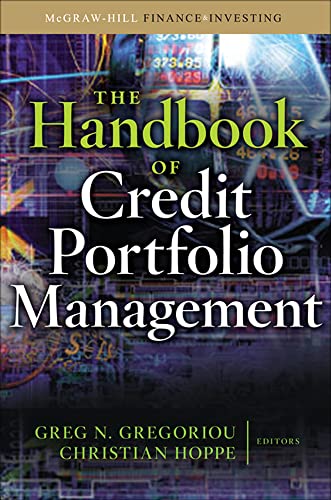
As the credit bubble fallout plagues the institutional finance sector--and will continue to do so in coming years--a strategic approach to credit portfolio management has never been more critical. The Handbook of Credit Portfolio Management provides all the information you'll need to successfully rebalance and manage your credit portfolios.
Together with co-author Christian Hoppe and a team of thirty-five international contributors, Greg N. Gregoriou provides strategies for calculating risk-weighted assets, reevaluating hedging strategies, and implementing Basel II standards. Providing a thoroughly global perspective of the subject, this comprehensive guide includes input from Moorad Choudhry (Group Head of Treasury at Europe Arab Bank plc, London); Christophe Godlewski (Université Louis Pasteur in Strasbourg, France); Roland Fuss (University of Freiburg, Germany); and Valerio Potí (Trinity College in Dublin, Ireland), who shed light on such key topics as:
- Investment opportunities of hedge funds
- Basis arbitrage trading strategies
- Issues regarding securitization of a sector basket
- Cost-saving aspects of portfolio hedging with credit futures
The Handbook of Credit Portfolio Management covers the latest developments and most current portfolio management techniques to help you implement strategies that best suit your institution's needs.
"synopsis" may belong to another edition of this title.
About the Author
Greg N. Gregoriou is Professor of Finance in the School of Business and Economics at the State University of New York, Plattsburgh. He holds a Ph.D. in finance from the University of Quebec in Montreal. Gregoriou specializes in hedge funds, funds of hedge funds, and managed futures. He has published 26 books and more than 50 journal articles and serves as hedge fund editor for the Journal of Derivatives and Hedge Funds and editorial board member of the Journal of Wealth Management and the Journal of Risk Management in Financial Institutions.
Christian Hoppe works as senior specialist for securitization and credit derivatives in the credit portfolio management in the corporate banking of Commerzbank AG Frankfurt. Prior to this, he was credit portfolio manager at Dresdner Kleinwort, the Investment Bank arm of Dresdner Bank AG in Frankfurt. He started his career as a Business and Financial Controller for Dresdner Bank. While earning his master's degree, Hoppe served in the Institutional Research Department of Benchmark Alternative Strategies GmbH, Frankfurt. He is the author of Derivatives Based on Alternative Investments.
Excerpt. © Reprinted by permission. All rights reserved.
THE HANDBOOK OF CREDIT PORTFOLIO MANAGEMENT
The McGraw-Hill Companies, Inc.
Copyright © 2009 The McGraw-Hill Companies, Inc.All right reserved.
ISBN: 978-0-07-159834-7
Contents
Chapter One
Implementing Credit Portfolio ManagementThomas Ridder
ABSTRACT
As more credit markets have become liquid in recent years and new financial instruments have been developed, an increasing number of institutions became capable of active portfolio-based credit management. Thus, implementing a dedicated credit portfolio management function has evolved as a major project in many financial institutions. This chapter discusses fundamental issues in setting up this function.
INTRODUCTION
The management of credit portfolios in financial institutions has undergone material changes in the last decade. Due to essentially illiquid credit markets, until the mid-1990s, relationship banking dominated credit business and lead to positions that were mainly buy and hold. Accordingly, financial institutions understood credit management mainly as a part of their client management. The focus of credit management was set on the analysis, monitoring, and risk-return measurement of individual clients. The rationale behind this was the cognition that "at the end of the day," it is always individual obligors that default. Accordingly, a single-client-based design of business processes and risk measurement was regarded as adequate to ensure a sufficient quality of credit management. If used at all, the phrase credit portfolio management was mainly understood as consecutively monitoring and processing the positions of a given credit portfolio.
Today's credit portfolio management (CPM) practice does not consider a portfolio just a collection of financial positions any more, put together mainly for administrative purposes. Rather, CPM understands a portfolio as a set of interdependent credit positions with related risk-return profiles. The focus on understanding and profitably shaping these relationships constitutes the difference from traditional credit management. Credit portfolio management delivers additional value by creating higher transparency with respect to the portfolio's key characteristics, which by itself usually helps to make more efficient management decisions. Advances from modern statistical portfolio analysis are picked up and deliver a toolbox comparable to the well-known quantitative instruments that tackle market risk. However, CPM also opens up new sources of additional income for financial institutions. Immediate cash flows are generated by driving origination to accomplish more risk adequate prices, by freeing capital tied up to less profitable assets to foster profitable growth or by fees from trading, structuring, or repackaging credit risk. Felsenheimer et al. (2006) and De Servigny and Renault (2004) provide a detailed introduction to strategies, methods, and instruments of modern CPM.
This chapter surveys major issues when implementing a CPM function in financial institutions. It addresses the change management necessary to transform an essential buy-and-hold credit strategy to a more active approach of shaping the performance of credit portfolios. The second section of this chapter discusses the potential levers of CPM, and the third section highlights questions of the organizational implementation of CPM functions. Recent experience with the so-called subprime crisis has heavily challenged the use of quantitative methods in CPM. As such, the fourth section of this chapter will pick up some of the arguments. The chapter concludes with some evidence from a market survey.
THE LEVERS OF CREDIT PORTFOLIO MANAGEMENT
In general, the outline of credit portfolio management in financial institution encompasses a great variety of potential activities and responsibilities. This can easily be recognized by discussing a stylized credit process (Figure 1.1) from a CPM point of view.
Step 1: Individual Risk Analysis
The first step is the classical credit risk management responsibility, which is focused on analyzing the credit risk linked to individual obligors or projects before granting new loans and other defaultable contracts. The creditworthiness of the individual risk positions is to be revealed and is transformed into the probability of future obligor or project default, ultimately. Elaborate analysis is usually necessary to minimize asymmetric information between obligors and creditors and, thus, to reduce implications of moral hazard and adverse selection. This is achieved by analyzing business plans, balance sheets, income statements, and additional information from the customer relationship management typically to be attached to credit applications. Most financial institutions today apply internal rating systems for individual credit analysis. These were developed not just for reasonable and consistent economic risk assessment but in many institutions to also determine regulatory capital requirements. Thus, obligor and project risk analysis delivers the basic input of managing the quality of inflow to the credit portfolio. By definition, this analysis does not refer to comprehensive portfolio-based reasoning.
Step 2: Pricing and Credit Approval
The second step of the credit process might introduce specific portfolio-based activities. First, to ensure sustained profitability of the credit business risk adequate prices have to be accomplished. It is important to recognize that a requirement of sufficient high profitability is reasonable ex-ante and on a mean portfolio level, only. Due to the binary character of default events, any credit position that suffers a default will typically result in a net loss. Margins received up to the credit event rarely cover subsequent losses of principal and interest. Otherwise, in the case of no default a certain profit can be earned from the position. As there always will be some residual risk in credit analysis, ex post wrong decisions will continue to be derived in some cases, and this will possibly lead to losses with respect to some individual credit positions. The goal of risk adequate pricing is, thus, to generate enough aggregated earnings on the portfolio to provide an adequate net return on capital with a high degree of confidence. Therefore, typical loan pricing systems require that loan prices have to cover the following four different building blocks: (1) funding cost, (2) administrative and operational cost, (3) expected loss, and (4) a given target profitability above cost constituents (1) to (3).
Funding cost, administrative cost, and expected loss can be allocated to single risk positions in a straightforward way. The breakdown of the target portfolio profitability to required individual profit margins affords a little reflection. In general, a simple, flat profit margin will not be accepted since more risky positions ought to contribute more earnings to the portfolio than less risky ones. Portfolio profitability is usually defined as the economic performance of the capital required to cover total portfolio risk. A natural way to determine individual profit margins would then be to break down total capital to individual risk positions and determine the required pro rata profitability. Expressed as a margin on nominal exposure, this price component is usually called cost of economic capital.
The breakdown of total capital may be achieved according to regulatory rules or according to the institution's internal portfolio model. While being basically simple, the regulatory approach has several shortcomings when applied to pricing. For example, even the new Basel II rules do not account for diversification within the portfolio, and the regulatory acceptance of risk mitigation instruments is strictly constrained. A comprehensive assessment of the capital needed to cover the credit risk of a given portfolio is thus better based on internal portfolio analysis representing the financial institution's own understanding of material economic risks. In doing so, economic relationships between the individual return distributions can consistently be allowed for in the loan pricing system.
Even if the rating is above the required minimum threshold and adequate prices can be accomplished, the credit approval process might take into account additional criteria like the region, the sector, the product type, or other structural characteristics of the application. The reason for this is the experience that credit positions with similar structural characteristics are usually exposed to common risk factors. This leads to a higher degree of credit quality dynamics within a portfolio. Especially when credit positions are determined to be held to maturity, for strategic reasons or because there are no liquid secondary markets, credit quality management should include structural portfolio limits for new risks to be taken. Structural limits may address the distribution of nominal exposure, expected loss, or economic capital along material systematic risk factors. The goal of these limits is to reduce risk volatility by ensuring a sufficiently diversified portfolio allocation with respect to material structural risk factors. Structural portfolio limits can be derived by comparing results from scenario simulations to a given risk appetite and/or allocated risk capital, for example.
Step 3: Monitoring
Credit portfolio management contributes to monitoring and reporting by regular analysis of the portfolio structure, evaluation of its aggregated return distribution and the conduction of stress tests. This enables senior bank management to check whether the portfolio is in line with given structural limits and whether required aggregated economic capital needs conform to the institution's risk appetite. Additionally, detailed capital analysis contributes to the risk-adjusted performance measurement of the business lines.
Monitoring and reporting data may reveal the need for corrective management action to bring back the credit portfolio to the intended risk-return profile. As the rationale for these actions is usually grounded on a formal and rather abstract understanding of the dynamic relationships within the portfolio, a particular confidence regarding the applied quantitative methods is essential throughout the financial institution. The section Quantitative Methods in Credit Portfolio Management of this chapter will address this point.
Step 4: Secondary Market Activities
Recent years have seen considerable progress regarding the evolution of liquid credit markets. More institutions find themselves in a position where secondary market activities may extend their scope of credit portfolio management. Instruments are no longer confined to syndication or other true sale activities. Today, a variety of single-risk and portfolio-specific derivative and securitization instruments are available for hedging and investing purposes. Derivative instruments and securitization products may be used for managing a classical loan portfolio originated from client business, or they may be understood as an asset class of its own. Meanwhile, the traditional credit business paradigm of "buy and hold" has been replaced with "buy, structure, and sell" by many institutions. Earning fees by structuring, repackaging, and trading credit risk has evolved as a new business for many of today's banks and often defines the credit portfolio management function as a profit center within the investment banking division.
As discussed above, CPM touches nearly all steps of the credit process. To complete the discussion, we can illustrate the CPM approaches with the help of the statistical credit portfolio return distribution. Figure 1.2 displays the typical shape of such a distribution and depicts portfolio return at the horizontal axis with positive return to the right of zero. The bold black line shows a stylized return probability distribution allocating a large probability to positive returns and a small probability to extreme losses (negative returns). Usually, expected return E[R] should be positive to ensure sustained profitability of the portfolio. However, as the plot displays, upside is limited by some amount, and downside risk can be fierce.
All CPM efforts can now be characterized as means of shifting or reshaping the return distribution. A rise of margins of originated loans or, in general, a more efficient use of available capital will shift the distribution to the right giving more probability to positive returns. Decreasing concentration by structural limits or hedging activities will narrow the distribution with a large cut of the left tail of the distribution. In general, the laws of financial markets admit higher (expected) returns at the cost of higher risk, only. This implies a heavier left tail of the return distribution. The challenge of the CPM function can then best be described as striving for more probability at the right-hand side of the graph while keeping the left tail in compliance with the institution's risk appetite.
ORGANIZATION OF CREDIT PORTFOLIO MANAGEMENT
Until now, a general best practice design of the CPM function in financial institution has not been established. Further, it probably never will as strategic and operative objectives differ widely between institutions. Subsequently, a variety of organizational implementations can be found in today's financial firms. The implementation of CPM usually takes place in living organizations with more or less well-established management processes. A new CPM function might then be regarded as a hostile invader claiming responsibilities and earnings at the expense of established units. Therefore, to achieve a successful implementation, a careful design of responsibilities and interfaces between the different organizational units involved is required. A set of key questions has been established that an institution might work through to ensure a consistent implementation of CPM activities. The questions are discussed in the following paragraphs. The answers should result in an explicit mandate of the CPM unit describing the goals to be achieved, the tasks and responsibilities of the CPM unit as well as performance measurement topics.
Which are the Goals of the Credit Portfolio Management Function?
Without a precise understanding of which goals the CPM function has to accomplish, a consistent division of labor within the institute is probably impossible. Most financial institutions use a stepwise implementation of the CPM function. The typical start of CPM is to complement the traditional single- client risk management. At this stage, the task of the CPM function is mainly to build up a risk-focused view on the credit portfolio structure. Setting up information technology (IT) and databases, ensuring data quality, and developing of methods and reports to assess aggregated risk dominate the activities. The CPM function then usually moves into an advisory function. Based on sound analytics and the institution's given risk appetite, specific opinions on the optimal portfolio structure, the current risk-return profile, and appropriate management actions are developed by the CPM. These should be obligatory inputs to the internal decision and credit approval processes. The goal of the CPM function at this stage is mainly to contribute to the alignment of the comprehensive credit portfolio's profile with the institute's business and risk strategy.
Of course, if the CPM function is explicitly expected to generate profit, the general advisory function can no longer be sustained. Instead, CPM is to be dealt with as a true profit center-responsible for the profit and loss of a precisely defined portfolio under management. Then, acting as credit treasury, CPM should be sited in the investment banking division.
(Continues...)
Excerpted from THE HANDBOOK OF CREDIT PORTFOLIO MANAGEMENT Copyright © 2009 by The McGraw-Hill Companies, Inc.. Excerpted by permission of The McGraw-Hill Companies, Inc.. All rights reserved. No part of this excerpt may be reproduced or reprinted without permission in writing from the publisher.
Excerpts are provided by Dial-A-Book Inc. solely for the personal use of visitors to this web site.
"About this title" may belong to another edition of this title.
Search results for The Handbook of Credit Portfolio Management (PROFESSIONAL...

Stock Image
The Handbook of Credit Portfolio Management
Seller: HPB-Red, Dallas, TX, U.S.A.
Seller rating 5 out of 5 stars

hardcover. Condition: Good. Connecting readers with great books since 1972! Used textbooks may not include companion materials such as access codes, etc. May have some wear or writing/highlighting. We ship orders daily and Customer Service is our top priority! Seller Inventory # S_486918898
Stock Image
The Handbook of Credit Portfolio Management
Seller: Better World Books, Mishawaka, IN, U.S.A.
Seller rating 5 out of 5 stars
Condition: Good. Former library copy. Pages intact with minimal writing/highlighting. The binding may be loose and creased. Dust jackets/supplements are not included. Includes library markings. Stock photo provided. Product includes identifying sticker. Better World Books: Buy Books. Do Good. Seller Inventory # 56163604-6
Stock Image
The Handbook Of Credit Portfolio Management
Seller: Basi6 International, Irving, TX, U.S.A.
Seller rating 5 out of 5 stars
Condition: Brand New. New. US edition. Expediting shipping for all USA and Europe orders excluding PO Box. Excellent Customer Service. Seller Inventory # ABEOCT25-52846
Stock Image
The Handbook Of Credit Portfolio Management
Seller: Romtrade Corp., STERLING HEIGHTS, MI, U.S.A.
Seller rating 5 out of 5 stars
Condition: New. This is a Brand-new US Edition. This Item may be shipped from US or any other country as we have multiple locations worldwide. Seller Inventory # ABBB-109217
Stock Image
The Handbook of Credit Portfolio Management (McGraw-Hill Finance & Investing)
Published by
McGraw-Hill Education 16/10/2008, 2008
ISBN 10: 0071598340
ISBN 13: 9780071598347
Used
Hardcover
Seller: Bahamut Media, Reading, United Kingdom
Seller rating 5 out of 5 stars
Hardcover. Condition: Very Good. Shipped within 24 hours from our UK warehouse. Clean, undamaged book with no damage to pages and minimal wear to the cover. Spine still tight, in very good condition. Remember if you are not happy, you are covered by our 100% money back guarantee. Seller Inventory # 6545-9780071598347
Buy Used
£ 70.67
£ 3.99 shipping
Ships from United Kingdom to U.S.A.
Ships from United Kingdom to U.S.A.
Quantity: 1 available
Stock Image
The Handbook of Credit Portfolio Management (McGraw-Hill Finance & Investing)
Seller: AwesomeBooks, Wallingford, United Kingdom
Seller rating 5 out of 5 stars
Hardcover. Condition: Very Good. The Handbook of Credit Portfolio Management (McGraw-Hill Finance & Investing) This book is in very good condition and will be shipped within 24 hours of ordering. The cover may have some limited signs of wear but the pages are clean, intact and the spine remains undamaged. This book has clearly been well maintained and looked after thus far. Money back guarantee if you are not satisfied. See all our books here, order more than 1 book and get discounted shipping. . Seller Inventory # 7719-9780071598347
Buy Used
£ 74.38
£ 2.49 shipping
Ships from United Kingdom to U.S.A.
Ships from United Kingdom to U.S.A.
Quantity: 1 available
Stock Image
The Handbook of Credit Portfolio Management
Published by
The McGraw-Hill Company, 2008
ISBN 10: 0071598340
ISBN 13: 9780071598347
Used
Hardcover
Seller: Books Puddle, Woodside, NY, U.S.A.
Seller rating 4 out of 5 stars

Condition: Used. pp. xxix + 472 Index. Seller Inventory # 26648378
Seller Image
The Handbook of Credit Portfolio Management
Seller: San Francisco Book Company, Paris, France
Seller rating 5 out of 5 stars
Hardcover. Condition: Very good. Hardcover Octavo no dust jacket. papered boards, 472 pp Standard shipping (no tracking) / Priority (with tracking) / Custom quote for large or heavy orders. Seller Inventory # 72815
Stock Image
The Handbook of Credit Portfolio Management
Published by
The McGraw-Hill Company, 2008
ISBN 10: 0071598340
ISBN 13: 9780071598347
Used
Hardcover
Seller: Majestic Books, Hounslow, United Kingdom
Seller rating 4 out of 5 stars
Condition: Used. pp. xxix + 472 Illus. Seller Inventory # 8280933
Buy Used
£ 75.08
£ 6.50 shipping
Ships from United Kingdom to U.S.A.
Ships from United Kingdom to U.S.A.
Quantity: 1 available
Stock Image
The Handbook of Credit Portfolio Management
Published by
The McGraw-Hill Company, 2008
ISBN 10: 0071598340
ISBN 13: 9780071598347
Used
Hardcover
Seller: Biblios, Frankfurt am main, HESSE, Germany
Seller rating 4 out of 5 stars
Condition: Used. pp. xxix + 472. Seller Inventory # 18648368