
Items related to PERFECT POWER: How the Microgrid Revolution Will Unleash...
PERFECT POWER: How the Microgrid Revolution Will Unleash Cleaner, Greener, More Abundant Energy (CAREER (EXCLUDE VGM)) - Hardcover
Book 23 of 26: Career (Exclude VGM)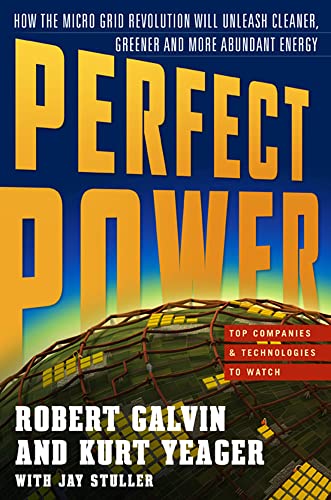
Synopsis
What's the solution to the world's growing energy problem?
PERFECT POWER
Electric usage is rising. Fuel costs are rocketing. Blackouts are happening more frequently. Why? Because our electrical power system--built on a vast network of resources including nuclear energy, natural gas, water, and coal--has become woefully outdated, increasingly expensive, and dangerously fragile. We need to change the current system, and we need to do it now.
Written by business visionary and former Motorola chairman Robert Galvin, Perfect Power shows us how to create a “perfect” system that can deliver power where needed, at an astonishing reliability standard of 99.9999999 percent. By super-charging the “Six Sigma” concepts that Galvin developed as the founder and CEO at Motorola, we can
- Meet the energy reliability and quality needs of the Digital Age
- Generate new goods and services that create jobs, empower consumers, and lower energy cost
- Eliminate wasteful spending on our electrical infrastructure that can be used for peak power needs
- Facilitate local, regional, and, ultimately, national energy independence
- Fundamentally reduce the impact of energy on the environment
- Invest in the microgrid revolution
Energy providers and policy makers will reinvent today's centralized power systems and integrate them with new, efficient “microgrids." Investors and entrepreneurs will spot tomorrow's hottest technologies. Consumers will demand change from “the powers that be.” And environmentalists will take advantage of cleaner, greener energy sources available.
We have the power to fulfill our energy needs, fix our old systems, forge ahead with new ideas, and fuel our dreams. It's Perfect Power.
"synopsis" may belong to another edition of this title.
About the Author
Robert Galvin is former Chairman and CEO of Motorola, Inc., where he pioneered the concept of “Six-Sigma Quality” and helped revolutionize telecommunications technology with government officials, regulators, and companies. He currently heads the Galvin Electricity Initiative, which supports “Perfect Power” innovations.
Kurt Yeager is former President and CEO of the Electric Power Research Institute, the electric power industry's leading think tank, which conducts research in the United States and forty countries.
Jay Stuller is the author of seven books and nearly a thousand articles. He has worked in public affairs and communications at Chevron Corporation.
From the Back Cover
The Book That Will Revolutionize and Electrify Our Energy Crisis
From Robert Galvin, Motorola's visionary leader and legendary former CEO, and Kurt Yeager, former CEO of the Electric Power Research Institute, comes a powerful wake-up call for the entire energy industry. A must-read for investors, entrepreneurs, homeowners, and environmentalists, Perfect Power offers bold new solutions, investments, and job opportunities that address the biggest energy problems we face today, including how to
- Meet the rising demands for more electricity
- Create “Perfect Power” that will withstand hurricanes, blackouts, terrorism, and technical malfunctions
- Implement clean, “green” alternatives by tapping the smart microgrid revolution
- Live “off the grid” and become energy self-sufficient
- Identify and invest in exciting new companies and technologies
“Reinventing our nation’s electric supply system is at the heart of solving our climate change and energy security problems. This book underscores the urgency of modernizing our grid and our business models to meet this challenge for our future generations.”
—James E. Rogers, Chairman, President, and Chief Executive Officer, Duke Energy
Excerpt. © Reprinted by permission. All rights reserved.
PERFECT POWER
HOW THE MICROGRID REVOLUTION WILL UNLEASH CLEANER, GREENER, AND MORE ABUNDANT ENERGYBy ROBERT GALVIN KURT YEAGER JAY STULLERThe McGraw-Hill Companies, Inc.
Copyright © 2009 McGraw-Hill, Inc.All right reserved.
ISBN: 978-0-07-154882-3
Contents
Chapter One
The Heat Is On
While largely unrecognized by the public and government officials, North America's aging, inefficient, and dangerously unreliable electrical infrastructure is crumbling. In an era of precise digital power demands and serious environmental concerns, this system is also needlessly wasteful, bleeding energy throughout the creation, delivery, and use of that electricity. In short, our electric power infrastructure is as incompatible with the future as horse trails were to automobiles. If not urgently renewed and literally reinvented, North America's electrical grid is rapidly approaching a crisis point for which we are already paying an exorbitant price. The future is now.
Abroad, swelling, and searing layer of atmospheric heat settled upon North America during the third week of July 2006, the stuff of an epic inquisition, a test of the continent's electrical grid and the will of its people. As the leading edge of the Digital Age met the Dark Ages, the damage stretched from coast to coast.
In temperatures exceeding 100 degrees F., New Yorkers desperate to cool off turned up air-conditioners and fans, putting an almost unprecedented load upon Consolidated Edison's electrical generation, transmission, and delivery systems. Under the strain, even heavy-duty circuits began to fail. At LaGuardia Airport, a power outage that shut down security screening in the morning grounded hundreds of outgoing passengers, and another nighttime blackout left travelers literally fumbling about in the pitch black restrooms of the main terminal.
A large portion of the borough of Queens went dark and remained so for nearly six days, through a series of electrical failures that left Consolidated Edison engineers flummoxed for an explanation. In other parts of the city, additional power outages brought subway trains to a halt. According to news reports, heavily sweating New Yorkers sat in the dark, whimpering.
Meanwhile on the West Coast, more than 5,000 Pacific Gas and Electric customers in Marin County were left in the dark overnight when, according to one early report, an owl "mis-landed" on a 60,000-volt transmission line near the coastal town of Bolinas. Crews later determined that an old lightening strike on a utility pole had caused it to eventually fall. And while relatively few people were directly inconvenienced by the blackout, the entire south-central portion of the county faced an indirect threat when the failure took down a key water plant for 14 hours, a period during which water levels in the 130 holding tanks in the district's 147-square-mile service area precipitously dropped. Consumers were asked to curtail their water use for at least 24 hours as water district crews scrambled to get this electricity-dependent service back online.
From the Midwest, the Associated Press reported that nearly 700 laboratory mice and rats died when a power failure at Ohio State University cut off air-conditioning to six buildings at the school's medical campus. Temperatures in the labs rose from 80 degrees to as high as 105 degrees Fahrenheit. Even worse, about 20 projects involving critical research into epilepsy, multiple sclerosis, cancer, and cardiovascular disease were affected, including studies that researchers had been working on for years.
In the high desert of southern California, near the city of Palmdale, sits the Federal Aviation Administration's Los Angeles Air Route Traffic Control Center, a facility from which controllers manage flights on long-distance routes at 38,000 feet or higher, covering parts of Arizona, Nevada, Utah, and much of the Golden State. At 5:30 p.m. on July 18, the Center's electrical supply went dead, shutting down radar and communications. For some 90 minutes—until an emergency generator that was supposed to automatically start finally kicked on—the Los Angeles International Airport (LAX), the world's fifth-busiest passenger complex, was, as an airport spokesperson explained, "pretty much shut down."
Less than a week later, the 18th consecutive day of triple-digit heat continued in California, triggering still more power outages that eventually swept through downtown Los Angeles. The most acute problem occurred at the prestigious Garland Building on Wilshire Ave., a data center designed to maintain operations even in an 8.3 magnitude earthquake. The Garland facility provides housing for some of the leading Web hosting and home page companies, including Media Temple and the ubiquitous MySpace.com. But when the main incoming electrical power failed and the backup system couldn't keep the chillers cold, the servers went down, producing what could have been the most agonizing 24-hour disconnection in the history of Teenage America.
As the shock from the Great Heat Wave of 2006 finally subsided, something weird and dissonant happened in the world of electricity. In late July, a consortium that includes all of the nation's regional electrical grid operators—known as independent system operators, or ISOs, entities that coordinate electrical transmission between utilities and across state lines—issued a press release, noting that each operator handled record electricity demands and "met the challenge of record temperatures without incident."
Huh?
Utility executives and industry representatives appeared on National Public Radio, praising their overall reliability. And herein we find the catch: System data appear to conflict with human events.
Indeed, the Electric Reliability Council of Texas, which serves about 85 percent of the load in that state, did reliably produce more electricity than it had in the past, meeting a peak demand of 62,396 megawatts on July 17, exceeding the previous peak of 60,274 megawatts during the previous August. The New York Independent System Operator, which serves 20 million people, met a record peak load of 32,624 megawatts, without enacting emergency procedures, breaking a record of 32,075 in July of 2005.
Moreover, the California Independent System Operator also handled a new record demand of 50,270 megawatts, up nearly 5,000 megawatts from the previous year's record peak, and a level that was not expected to be reached for another five years. "We plan operations for extreme scenarios and for a 1-in-10-year heat wave, but this was a 1-in-50-year heat storm," said California ISO President and CEO Yakout Mansour, in a press release. "Power plant operators responded to the challenge well ahead of the season and prepared their plants to withstand difficult conditions." The California ISO system, added the press release, held up throughout the heat wave.
In other words, virtually all of the nation's power outages during the summer of 2006 were localized—a fact that brings little comfort to the grounded airline passengers in the western United States, the people of Queens, and the many other cities that suffered blackouts. Apparently, anything less than a total power system collapse, such as California and the West Coast from British Columbia to Baja experienced in 1996, is considered a victory by the ISO. What didn't happen, and it's why utility operators were sounding a sigh of relief, was a reprise of the cascading and cataclysmic outage of August, 14, 2003, which blacked out more than 50 million people within eight minutes and conservatively cost the U.S. economy more than 10 billion dollars.
The Great Northeast Blackout began when an overheated and therefore sagging power line in Ohio made contact with a tree; tripping off more than 400 transmission lines and generating units at 261 power plants. The massive disruption threw most of New York and parts of Pennsylvania, Ohio, Michigan, and two Canadian provinces into darkness, an event that was the largest power loss in history. Considered a blunt wake-up call to the utility industry, this monumental power outage compelled grid operators to coordinate more closely, and spend more maintenance money on, not so ironically, trimming trees.
THE TRUTH AND NOTHING BUT THE TRUTH
So wherein lay the truth about the summer of 2006? Is it in the numbers compiled by the system operators? Are the anecdotes about outages just that, a random collection of isolated incidents? Perhaps a more important pair of questions follow: Was the heat wave of 2006 really just a 1-in-50-year event? Or, was it a portent of what North America faces in a climate that appears to be warming at an alarming rate?
In the wake of this failure, power system operators in the Northeast and Midwest made a number of changes in the way they monitor and control their related grids. And the grid's overall stalwart performance during the record heat wave was cited as a testament to the adaptations that were made. Just as all belief systems include a few bits of irrefutable fact, the same can be said of this somewhat self-serving operators' analysis of the nation's power system performance.
The independent system operators and their Canadian counterparts who manage regional electricity transmission throughout North America did prevent a cascading systemwide failure despite severe stress. But it also seems clear that even small blackouts and power interruptions have much greater health, social, and economic consequences than in decades past—simply because of our reliance on air conditioners, digital devices in hospital intensive care units, and the Internet. What should be apparent to grid operators, utility executives, government regulators, elected officials, business leaders, and even the public, is that the United States dodged a whole lot of bullets during a summer that in an age of a warming climate is very likely a harbinger of more to come.
The fragile condition of the U.S. power system was brought front-and-center again in February 2008 when a massive power outage in Florida suddenly left some three million people without electricity for several hours or more. The official cause of this major disruption was "human error." Because of the lack of electronic diagnostic capabilities, and associated automatic control systems, an engineer at Florida Power and Light, the state's largest utility, who was diagnosing a relatively minor substation problem inadvertently caused a short circuit that could not be contained. The problem instantly cascaded through 26 transmission lines and 38 substations. This forced the major Turkey Point nuclear power plant, as well as a number of other power plants across Florida, to shut down.
Indeed, the spotlight is now on a North American electricity system that is largely based on technologies developed prior to the 1950s. Most of its generation plants, millions of relays, controls, transformers, and power lines are 40 to 50 years old, nearing the end of their useful life. Even ordinary thunderstorms, much less blizzards, hurricanes, and heat waves, routinely bring down pieces of this increasingly precarious electrical infrastructure. Utilities that overlook the thousands of fragile points on the grid—while boasting about avoiding systemwide blackouts—suggest an industry in complete and utter denial.
The root cause of this denial can be traced to the fact that regulators for the most part remain unwilling to accept the reality that their short-sighted bureaucratic policies restricting electricity infrastructure investment have robbed the system of innovation and kept it on little more than a life-support level of infrastructure renewal and maintenance for several decades. This false economy has left the United States dependent on a dangerously vulnerable and highly obsolete power supply system to provide more than 40 percent of the nation's total energy needs (Figure 1–1). If even 10 percent of the $100 billion-plus national electricity reliability penalty we all pay each year were reinvested in revitalizing and modernizing the power delivery system, this penalty would soon be eliminated. Moreover, the productivity and global competitiveness advantages that would result would rapidly add thousands of dollars to every family's income. In spite of these achievable advantages, we continue to sustain the electrical equivalent of the "subprime mortgage" debacle in which a few are rewarded at the major long-term expense of the nation and the majority of its citizens.
The consequences of this unreliable electricity service grow greater with each passing day, since an electrical infrastructure inflection point is coming at a time when the very nature of electricity demand is undergoing a profound shift. While the current system was designed to serve analog devices such as lights, motors, pumps, and such—which work just fine despite varying electric loads—today's personal computers and other "smart" digital devices with microprocessors inside are highly sensitive to even the slightest disruption in power, as well as to variations in power quality due to voltage surges and sags and harmonic changes in the alternating electron flow. Such interruptions and disturbances—measuring less than one cycle, or less than 1/60th of a second—can crash assembly lines, computer servers, intensive care and life support machines, and other microprocessor-based equipment.
The electricity supply system's dangerous obsolescence is certainly not lost on the U.S. Defense Department. More than six years after the terrorist attacks on the Pentagon and World Trade Center, the Defense Science Board warns that the U.S. electricity grid remains alarmingly vulnerable to attack. In a 2008 Board report entitled "More Fight—Less Fuel," former Secretary of Defense and CIA Director Dr. James Schlesinger and General Michael Carns conclude that, the "almost complete dependence of military installations on a fragile and vulnerable commercial power grid places critical military and homeland defense missions at an unacceptably high risk of extended disruption." The report goes on to state that physical or cyber sabotage—or even a simple capacity overload—could devastate U.S. military and homeland security installations and have a frightening ripple effect across the country. In order to most quickly eliminate this threat, the Defense Department has become a leading proponent of installing self-sufficient microgrids on military installations in the United States and around the world.
BLEEDING AT THE SPEED OF LIGHT
The enormous economic cost of the system's unreliability is only part of the downside of today's electrical system. Another revolves around wasted energy that starts during the generation of electricity, bleeds at the speed of light from transmission lines, and also leaks from household devices left on standby 24 hours a day. For example, as shown in Figure 1–2, 98 percent of the energy needed to illuminate a lightbulb is lost along the way primarily as heat. Carbon dioxide (CO2) emissions and their implications for global warming are also a direct result of this wasted energy.
Simply start with coal-fired power plants, which produce about half of the electricity used in the United States. Some of these plants burn some 25 tons of pulverized coal per minute, blown into a box that contains a continuous fireball that superheats water that flows through a web of high-pressure steel tubes. As the water turns to steam, its pressure drives turbines that generate electricity. The thunderous sounds of such plants are an aural marvel, as is the product.
Alas, more than 60 percent of the energy in each and every ton of coal goes up into the atmosphere in smokestacks and cooling towers in the form of heat, emissions, or warm water that's ultimately discharged into a river, lake, or the ocean. These large power plants are also usually located a long way from where their electricity is ultimately used. The power must therefore travel over long- distance transmission wires, which creates another weak link in the chain of electricity reliability and efficiency losses.
Nearly all of the nation's transmission lines are made with copper cables, just as they have been for a hundred years. While these lines conduct electricity quite well, the electrons do meet resistance that causes at least some energy loss and always generates heat. When hot weather triggers an additional spike in electrical demand for air-conditioning, these steel core and copper wires heat up to an even greater degree, expand under the extra load, and start to sag. This thermal expansion is still limited by obsolete, slow, electromechanical controls that, as a result, seriously constrain the amount of electricity each transmission line can carry. The result creates the need for more and more lines in somebody's back yard.
The United States is hardly alone in this situation. Europe experiences periodic major blackouts that can be traced to obsolete controls on its transmission networks. Electrification in the developing world also is generally dependent on the same obsolete "low-cost" technology. For example, the surging economic powerhouse that is India has one of the weakest electrical grids in the world, with enormous infrastructure inefficiencies. Not surprisingly, its basic design is similar to that of North America's. According to India's Ministry of Power, transmission and distribution losses alone average 26 percent of total electricity production, and in some of India's states as much as 62 percent.
The inefficiencies continue right into the modern home, which is filled with what's known in the trade as vampires, or devices that leak electricity—again in the form of heat—without actually providing much service. These include phone chargers, instant-on televisions, computers that are left humming 24–7, and just about anything that can be observed as illuminated during the night. In fact, these electron-sucking vampires typically devour an average of nearly 7 percent of a home's total electricity consumption and in some cases as much as a quarter. In Europe, the International Energy Agency figures that about four major power plants are needed to supply the electricity that goes into the continent's so-called standby power. According to a piece in the Pittsburgh Post-Gazette, the agency also expects that the growth in such devices just here in the United States will require the power equivalent of eight major centralized plants by 2010.
(Continues...)
Excerpted from PERFECT POWERby ROBERT GALVIN KURT YEAGER JAY STULLER Copyright © 2009 by McGraw-Hill, Inc.. Excerpted by permission of The McGraw-Hill Companies, Inc.. All rights reserved. No part of this excerpt may be reproduced or reprinted without permission in writing from the publisher.
Excerpts are provided by Dial-A-Book Inc. solely for the personal use of visitors to this web site.
"About this title" may belong to another edition of this title.
Search results for PERFECT POWER: How the Microgrid Revolution Will Unleash...

Stock Image
PERFECT POWER: How the Microgrid Revolution Will Unleash Cleaner, Greener, More Abundant Energy
Published by
McGraw-Hill Education - Europe, 2008
ISBN 10: 0071548823
ISBN 13: 9780071548823
Used
Hardcover
Seller: World of Books (was SecondSale), Montgomery, IL, U.S.A.
Seller rating 5 out of 5 stars

Hardback. Condition: Very Good. The perfect solution to Americas energy problemfrom Motorolas legendary former chairman and CEO. Seller Inventory # 00097026258
Stock Image
PERFECT POWER: How the Microgrid Revolution Will Unleash Cleaner, Greener, More Abundant Energy
Published by
McGraw Hill (edition 1), 2008
ISBN 10: 0071548823
ISBN 13: 9780071548823
Used
Hardcover
Seller: BooksRun, Philadelphia, PA, U.S.A.
Seller rating 5 out of 5 stars
Hardcover. Condition: Very Good. 1. With dust jacket. It's a well-cared-for item that has seen limited use. The item may show minor signs of wear. All the text is legible, with all pages included. It may have slight markings and/or highlighting. Seller Inventory # 0071548823-11-1-29
Stock Image
PERFECT POWER: How the Microgrid Revolution Will Unleash Cleaner, Greener, More Abundant Energy
Seller: Better World Books: West, Reno, NV, U.S.A.
Seller rating 5 out of 5 stars
Condition: Very Good. 1 Edition. Pages intact with possible writing/highlighting. Binding strong with minor wear. Dust jackets/supplements may not be included. Stock photo provided. Product includes identifying sticker. Better World Books: Buy Books. Do Good. Seller Inventory # 248953-75
Stock Image
PERFECT POWER: How the Microgrid Revolution Will Unleash Cleaner, Greener, More Abundant Energy
Seller: Better World Books, Mishawaka, IN, U.S.A.
Seller rating 5 out of 5 stars
Condition: Very Good. 1 Edition. Pages intact with possible writing/highlighting. Binding strong with minor wear. Dust jackets/supplements may not be included. Stock photo provided. Product includes identifying sticker. Better World Books: Buy Books. Do Good. Seller Inventory # 248953-75
Stock Image
PERFECT POWER: How the Microgrid Revolution Will Unleash Cleaner, Greener, More Abundant Energy
Seller: Better World Books, Mishawaka, IN, U.S.A.
Seller rating 5 out of 5 stars
Condition: Very Good. 1 Edition. Former library copy. Pages intact with possible writing/highlighting. Binding strong with minor wear. Dust jackets/supplements may not be included. Includes library markings. Stock photo provided. Product includes identifying sticker. Better World Books: Buy Books. Do Good. Seller Inventory # 248954-6
Stock Image
Perfect Power: How the Microgrid Revolution Will Unleash Cleaner, Greener, More Abundant Energy
Seller: ThriftBooks-Atlanta, AUSTELL, GA, U.S.A.
Seller rating 5 out of 5 stars
Hardcover. Condition: Good. No Jacket. Missing dust jacket; Pages can have notes/highlighting. Spine may show signs of wear. ~ ThriftBooks: Read More, Spend Less. Seller Inventory # G0071548823I3N01
Stock Image
PERFECT POWER: How the Microgrid Revolution Will Unleash Cleaner, Greener, More Abundant Energy
Published by
McGraw-Hill Education - Europe, 2008
ISBN 10: 0071548823
ISBN 13: 9780071548823
Used
Hardcover
Seller: World of Books Inc, Montgomery, IL, U.S.A.
Seller rating 4 out of 5 stars

Hardback. Condition: Very Good. The perfect solution to Americas energy problemfrom Motorolas legendary former chairman and CEO. Seller Inventory # CIN0071548823VG
Seller Image
PERFECT POWER: How the Microgrid Revolution Will Unleash Cleaner, Greener, More Abundant Energy
Seller: Greenworld Books, Arlington, TX, U.S.A.
Seller rating 5 out of 5 stars
Condition: very_good. Fast Free Shipping â" Very Good condition book with a firm cover and clean pages. Shows normal use and some light wear or limited notes markings. A solid, nice copy to enjoy. Seller Inventory # GWV.0071548823.VG
Stock Image
PERFECT POWER: How the Microgrid Revolution Will Unleash Cleaner, Greener, More Abundant Energy
Seller: Bookoutlet1, Easley, SC, U.S.A.
Seller rating 5 out of 5 stars
Condition: Very Good. Great shape! Has a publisher remainder mark. hardcover Used - Very Good 2008. Seller Inventory # IM-10007767
Stock Image
PERFECT POWER: How the Microgrid Revolution Will Unleash Cleaner, Greener, More Abundant Energy
Published by
McGraw Hill, 2008
ISBN 10: 0071548823
ISBN 13: 9780071548823
Used
Hardcover
First Edition
Seller: Textbooks_Source, Columbia, MO, U.S.A.
Seller rating 5 out of 5 stars
hardcover. Condition: Good. 1st Edition. Ships in a BOX from Central Missouri! May not include working access code. Will not include dust jacket. Has used sticker(s) and some writing or highlighting. UPS shipping for most packages, (Priority Mail for AK/HI/APO/PO Boxes). Seller Inventory # 001026124U