
Items related to George Washington's Secret Navy: How the American...
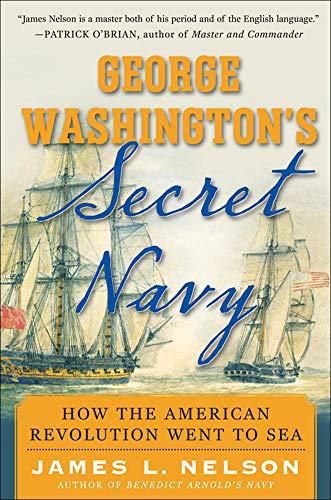
Synopsis
In 1775 General George Washington secretly armed a handful of small ships and sent them to sea against the world's mightiest navy.
From the author of the critically acclaimed Benedict Arnold's Navy, here is the story of how America's first commander-in-chief--whose previous military experience had been entirely on land--nursed the fledgling American Revolution through a season of stalemate by sending troops to sea. Mining previously overlooked sources, James L. Nelson's swiftly moving narrative shows that George Washington deliberately withheld knowledge of his tiny navy from the Continental Congress for more than two critical months, and that he did so precisely because he knew Congress would not approve.
Mr. Nelson has taken an episode that occupies no more than a few paragraphs in other histories of the Revolution and, with convincing research and vivid narrative style, turned it into an important, marvelously readable book."
--Thomas Fleming, author of The Perils of Peace: America's Struggle to Survive after Yorktown
"A gripping and fascinating book about the daring and heroic mariners who helped George Washington change the course of history and create a nation. Nelson wonderfully brings to life a largely forgotten but critically important piece of America's past."
--Eric Jay Dolin, author of Leviathan: The History of Whaling in America
"The political machinations are as exciting as the blood-stirring ship actions in this meticulously researched story of the shadowy beginnings of American might on the seas."
--John Druett, author of Island of the Lost: Shipwrecked at the Edge of the World
"synopsis" may belong to another edition of this title.
About the Author
James L. Nelson is the author of Benedict Arnold's Navy, as well as several novels that take place during the age of the sailing navies. His first book of nonfiction was Reign of Iron: The Story of the First Battling Ironclads.
From the Back Cover
"James Nelson is not the first historian to reveal this little-known albeit incredibly important aspect of our Revolution, but no one has done it more thoroughly or with greater literary grace."
--William M. Fowler, author of Empires at War
In July 1775, in his first inspection of the American encampment on the outskirts of Boston, the Continental Army's newly arrived commander-in-chief noted its haphazard design and shabby construction--clearly the work of men unprepared to face the world's most powerful fighting force. George Washington had inherited not only an army of woefully untrained and ill-equipped soldiers, but a daunting military prospect as well. To the east he could see the enemy's heavily fortified positions on Bunker Hill and a formidable naval presence on the river beyond. British-occupied Boston was defended by impressive redoubts that would easily repel any American assault, and Boston Harbor bristled with the masts of merchant ships delivering food, clothing, arms, ammunition, and other necessities to the British. Washington knew that the king's troops had all the arms and gunpowder they could want, whereas his own army lacked enough powder for even one hour of major combat. The Americans were in danger of losing a war before it had truly begun.
Despite his complete lack of naval experience, Washington recognized that harassing British merchant ships was his only means of carrying the fight to the enemy and sustaining an otherwise unsustainable stalemate. But he also knew that many in Congress still hoped for reconciliation with England, and in that climate Congressional approval for naval action was out of the question. So, without notifying Congress and with no real authority to do so, the general began arming small merchant schooners and sending them to sea to hunt down British transports "in the Service of the ministerial Army."
In George Washington's Secret Navy, award-winning author James L. Nelson tells the fascinating tale of how America's first commander-in-chief launched America's first navy. Nelson introduces us to another side of a general known for his unprecedented respect for civilian authority. Here we meet a man whose singular act of independence helped keep the Revolution alive in 1775.
Excerpt. © Reprinted by permission. All rights reserved.
GEORGE WASHINGTON'S Secret Navy
HOW THE AMERICAN REVOLUTION WENT TO SEABy JAMES L. NELSONThe McGraw-Hill Companies, Inc.
Copyright © 2008 James L. NelsonAll right reserved.
ISBN: 978-0-07-149389-5
Contents
Chapter One
The British Command
By the time George Washington arrived at Cambridge, the lines were all but drawn, the two sides settled into what would become nearly a year's stalemate. It would take Washington some time to understand exactly what sort of war he was fighting. That was not the case for the British commanders in Boston, who had been under siege for a month and a half before Washington's arrival. They understood already that the fight in the near term would not be for territory but for supplies and matériel.
George Washington's opposite number, the commander of the British forces in Boston, was General Thomas Gage. Gage and Washington had fought side by side during the French and Indian War, most notably in the disastrous battle under General Edward Braddock at the Monongahela River, in which Gage had been wounded. As happened often during the Revolution, the former companions in arms were now enemies.
Thomas Gage was fifty-four years old, a seasoned veteran with military experience that far exceeded Washington's. He had participated in some of the bloodiest fighting of the mid-eighteenth century, including the 1745 Battle of Fontenoy in Belgium, where the British suffered a bloody defeat at the hands of the French, and the Battle of Culloden in Scotland during the Jacobite Rebellion, when the highland clans under Bonnie Prince Charlie were smashed by British troops.
Like many of his fellow senior officers, Gage had spent a good portion of his career in America, nearly twenty years in all. He was a solid general but not a great one. He lacked the genius and drive of a James Wolfe, who had stormed Quebec in 1759, or the flash and political savvy of a John Burgoyne, who would ingratiate his way into a major command during the Revolution. Gage's reputation, borne out by his years of service, was for dependable, brave, reliable but uninspired soldiering.
After the French and Indian War Gage had remained in America as commander-in- chief of British forces there, a position he held through years marked by taxation issues and a growing revolutionary spirit. He returned briefly to England in 1773, his first visit home since leaving for America with Braddock, but the next year he sailed again for British America, arriving in Boston in May 1774. As punishment for the Boston Tea Party, Parliament had passed the Massachusetts Regulatory Act, which altered the royal charter of that colony and stripped the colonial government of much of its authority. Gage would now serve as both military commander-in-chief of the British army in America and as governor of Massachusetts. That act, along with the Boston Port Act, which closed Boston Harbor, and other coercive measures aimed at the rebellious citizenry of Massachusetts, had been prompted largely by suggestions from Gage.
Gage was a strong believer in the rule of law and the rights of Englishmen as understood to flow from King and Parliament, but he had no enthusiasm for New England–style democracy, which he felt was "too prevalent in America, and claims the greatest attention to prevent its increase." He probably knew more about America than any other general officer in the British army. Despite that, he made the mistake, common in England, of believing that the colonies would never band together in common cause but would remain thirteen independent states, jealous of one another.
One common mistake he did not make was to think that the colonists, once having risen in rebellion, would easily be put down. Concord and Lexington and Bunker Hill only confirmed his belief to the contrary. To Secretary of State Lord Barrington he wrote, "These People shew a Spirit and Conduct against us, they never shewed against the French."
It was the general consensus in England that the fighting that Americans had done during the French and Indian War had been halfhearted at best. Many assumed the same would be true in the brewing rebellion, and Gage felt that that miscalculation had already led to serious missteps. "They are now spirited up by a Rage and Enthousiasm, as great as ever People were possessd of." This was the difference between people fighting for their own liberty and those fighting for someone else's empire.
Gage was an early advocate of overwhelming force. In a letter to Barrington he advised, "If you think ten thousand Men sufficient, send twenty, if one million [in money] is thought enough, give two, you will save both Blood and Treasure in the end." Unfortunately for Gage, by the time there were men in office in England who agreed with him, he was gone.
Gage found himself in a political and military bind prior to the outbreak of fighting at Lexington and Concord. He understood that any decisive military action on his part would touch off open revolt, leaving his small force to face a great cohort of local militia who had been arming and training for a year or more. Even if the colonials could not match British regulars for martial ability, they could overwhelm them with numbers.
King George III and his ministers, far removed from the growing tensions in Massachusetts, did not understand this. By the early part of 1775 many in the king's cabinet were tired of what they perceived as Gage's inactivity and were determined to recall him to England. But despite his own irritation with Gage, the king still liked and respected the man and would not humiliate him with a summary dismissal. Instead he sent three major generals to assist Gage: William Howe, Henry Clinton, and John Burgoyne.
"A corrupt Admiral without any shadow of capacity"
While Gage was head of the land forces, the Royal Navy on the North American station came under the command of Vice Admiral Samuel Graves. Graves was sixty-three years old, having first attained flag rank thirteen years earlier. He claimed to have "rose to his present rank and obtained his late command without political interest." Certainly there was little of the refined gentleman about him. He was a lifelong sailor, described as "a tough, boisterous man."
As if to demonstrate those qualities, in August of 1775 Graves would go so far as to engage in the ungentlemanly act of brawling on the streets of Boston, an incident that caused quite a stir. "A curious Event has taken place here yesterday," wrote Hugh, Lord Percy, an officer stationed in Boston, to a friend. "Our Admiral has been boxing in the Street with one of the Commissioners of the Custom."
For some time, Graves and Commissioner Benjamin Hallowell had been involved in a running dispute concerning permission to harvest hay on one of the islands in Boston Harbor. When Hallowell encountered Graves on the street and asked why he had had no response to four letters he had written the admiral, Graves informed him that he simply chose not to respond. Tempers flared and Graves threw "both his fists in Mr. Hallowell's face."
As the altercation escalated, Graves twice drew his sword and twice sheathed it after being called "a rascal and a scoundrel" for drawing on an unarmed man. Punches were exchanged. Finally, "lest the Admiral Should again draw his sword Mr. Hallowell wrested it from him and broke it, and then they were parted." That at least was Hallowell's version, writing in the third person to General Gage, but the rumor that reached Lord Percy suggested that "the Admiral has had the worst of it in every respect," and other accounts seemed to verify as much. One person in Boston, writing to a friend in England, claimed that "In his own department, the Admiral is more hated and despised, if possible, than he is by the army and the rebels."
In the spring and summer of 1775, when not fighting with customs officials, Graves spent a good deal of time disagreeing with Gage. The two men disliked each other, each deeming the other incompetent. Of the two, Gage was more likely right. Undersecretary of State William Eden referred to the two men as "A worthy General, with parts inferior to his situation, and a corrupt Admiral without any shadow of capacity."
During the course of his career, Graves had managed to participate in a few major naval engagements, most notably the Battle of Quiberon Bay in 1759—the pivotal naval engagement of the Seven Years War with France and a resounding victory for Britain—but he was never one of those bold, visionary leaders who made the Royal Navy the most potent force on the sea. Rather, he was a mediocrity, a cautious and unimaginative man, frightened of taking action. He was happy to quarrel with his fellow officers and civilians, but he seemed to have no interest in fighting the rebellious Americans, relying on the absence of a formal declaration of war to justify inaction.
Not all of the problems with the navy were the admiral's fault. Graves faced any number of difficulties. One was the inadequate size of his fleet, which was sufficient for peacetime operations but not for waging war. In the summer of 1775 the squadron consisted of four ships of the line: the flagship Preston, of sixty guns; the Boyne, of seventy guns; and the Somerset and the Asia, both sixty-fours. They were not in the best condition. Soon after the Somerset's arrival, Graves wrote, "she was so leaky in her passage from England, that two hand pumps were kept continually working, and ... ever since, though lying still in the Harbor, it has required one hand pump constantly going to Keep her free." Even after substantial work was done in Boston, the Somerset still leaked prodigiously. The other capital ships were not much better.
The admiral also had under his command seven frigates and eighteen sloops and schooners. These smaller vessels were far more useful for the sorts of action the British navy was likely to see in the American theater. The larger ships of the line were cumbersome and unwieldy, a major handicap given the tricky navigation along the northeast coast from New York to the Canadian border, where tides, currents, numerous islands, and underwater hazards made simply getting underway a dangerous proposition. (Somerset was one of many ships of the Royal Navy that would end her career wrecked on the coast of New England.) Nor were the Americans likely to send to sea anything that would require the power of a sixty-four-gun man-of-war. Smaller ships that could chase lightly armed smugglers and privateers into shallow bays and rivers were what was needed on the North American station.
In April 1775, a week before the fighting at Lexington and Concord, Graves hired an additional sloop and a schooner from a shipowner in Massachusetts. A month later, after the shooting started, he managed to purchase two more schooners for the naval service. And that was the end of that. There would be no more buying ships or much of anything else from the Americans.
For more than a year the people of Massachusetts had taken every opportunity to make things as hard as possible for Graves. The previous fall, Graves had sent to New York for "a few Shipwrights, Sailmakers, caulkers and Ropemakers, for not withstanding Boston at that time abounded with artificers of all sorts necessary for Shipping, yet very few cared to work for Government."
Such passive resistance increased as time passed, and with the onset of fighting, the people of Massachusetts withdrew all remaining support. Shipowners put their vessels out of commission, removing and hiding the sails and rudders, rather than risk their being of service to the British military. "The Fears of a few well disposed people to risk their Vessels," Graves informed Philip Stevens, Secretary to the Admiralty, "and the determination of the rest to prevent the Army and Navy having Supplies of provisions and Fuel, have caused most of the Vessels in this province to be dismantled and laid up."
Realizing that he could acquire no more vessels in the colonies, Graves requested a few of the navy's old fifty-gun ships, which he thought "handy Ships, and from their easy Draught of Water can go in and out of Harbors without the great Risque and Delay which constantly attends the piloting of those now with me." He also requested that more boats be sent, because "the principal part of the Duty here is done in Boats," and there was no place left save Halifax, Nova Scotia, where boats could be built or repaired.
A shortage of vessels was less of a problem than a shortage of sailors to man them. The Preston had carried only three hundred men, her peacetime complement, when she arrived on station in July 1774, and the other ships were similarly undermanned for wartime duty. The following year Graves reported that through death and desertion the squadron was "upwards of 160 short," and that number would only increase.
By early 1775 Graves was sending his vessels to seaport towns to press sailors into the Royal Navy. "Necessity obliges me, contrary to my inclination, to use this method to man the Kings Ships," Graves informed the Admiralty, assuring them that impressment would be carried out "with all possible moderation." In pressing sailors from American towns, however, the navy introduced unreliable, bitter men into the service and further inflamed colonial anger and resentment. Morale was already a problem aboard many of the ships. In late May, a boat crew of six sailors, rowing guard duty in Newburyport, Massachusetts, mutinied against the two officers in the boat. "[T]he tars, not liking the employ," the Essex Journal reported, "tied their commanders, then run the boat ashore, and were so impolite as to wish the prisoners good night, and came off."
Like the army, the navy would eventually get the reinforcements it needed for war on a continental scale. Like Gates, however, Graves would be gone before those reinforcements could do him any good.
"Very great Pains have been taken to starve the Troops"
Despite the years of unrest in the colonies, despite the steady militarization of the people, and despite the training of militias and the organization of alarms and minutemen, the siege of Boston took the British completely by surprise. While King George, his ministers, and Parliament had anticipated some sort of fighting—violence having already flared up on more than one occasion—they had not envisioned a massive army rising up and trapping their troops in Boston. Even those with more insight, such as General Gage, were caught off guard by the speed with which events unfolded. "The whole country was assembled in arms with surprising expedition," was Gage's understated description to the Earl of Dartmouth.
To Gage and Graves, bottled up in Boston, it soon became clear what sort of war they would be fighting. Graves had good reason to be less concerned with the possibility of frontal attack than with the rebels' determination "to prevent the Army and Navy having Supplies of provisions and Fuel." The day after the shooting war started at Lexington and Concord, the war for matériel began.
During the French and Indian War, the British Department of Treasury had developed a system by which London firms were contracted to supply the troops in America, and those firms in turn subcontracted to colonial firms. When that war ended, the system had continued as a means to supply the peacetime garrisons that remained on the American continent.
As tensions began to mount through 1775, some in London understood that this supply system could be threatened. Even before Lexington and Concord, the chief contractor for supplies to the British army, the firm of Nesbitt, Drummond and Franks, warned the Treasury that the American colonies might prevent matériel from reaching Boston. Once the shooting started, the flow of supplies from colonial firms stopped. With the colonial army encircling the city, nothing could get through. As one British officer wrote, "In the course of two days, from a plentiful town, we are reduced to the disagreeable necessity of living on salt provisions, and were fairly blocked up in Boston."
That left only the sea lanes, but a majority of seaborne supplies arrived from other ports in America. There were still firms in the colonies that were willing to sell to the British, either out of loyalty to the Crown or simply for the profit to be had, but patriots in the port towns kept a careful eye on the cargo and destination of every ship preparing to get under way. Gage would soon write to Dartmouth:
Very great Pains have been taken to starve the Troops and the Friends of Government in Boston, for no Article Necessary for the Support of Life is Suffered to be Sent from any of the Provinces from New Hampshire to South Carolina, and in most of the Sea-Ports Persons are appointed to examine everything that is embarked and where it is going.
The amount of supplies required just to keep the army fed was staggering. The garrison in Boston, including the women and children attached to it, amounted to around forty-six hundred people, who consumed around eight tons of food per day at full rations.
The civilian population prior to the siege was around seventeen thousand. Gage at first agreed to let those sympathetic to the Revolution leave Boston and let Tories enter, but those in the city feared that once only loyalists and soldiers were left there would be nothing to stop the rebels from burning the place. After several tortured negotiations and agreements, during which some of the population left the city, all passage over Roxbury Neck was stopped. By mid-July there were around sixty-five hundred civilians left, and they, too, had to be fed.
(Continues...)
Excerpted from GEORGE WASHINGTON'S Secret Navyby JAMES L. NELSON Copyright © 2008 by James L. Nelson. Excerpted by permission of The McGraw-Hill Companies, Inc.. All rights reserved. No part of this excerpt may be reproduced or reprinted without permission in writing from the publisher.
Excerpts are provided by Dial-A-Book Inc. solely for the personal use of visitors to this web site.
"About this title" may belong to another edition of this title.
Search results for George Washington's Secret Navy: How the American...

Stock Image
George Washington's Secret Navy
Published by
McGraw-Hill Education - Europe, 2008
ISBN 10: 0071493891
ISBN 13: 9780071493895
Used
Hardcover
Seller: World of Books (was SecondSale), Montgomery, IL, U.S.A.
Seller rating 5 out of 5 stars

Hardback. Condition: Good. In 1775 General George Washington secretly armed a handful of small ships and sent them to sea against the world's mightiest navy. From the author of the critically acclaimed Benedict Arnold's Navy, here is the story of how America's first commander-in-chief--whose previous military experience had been entirely on land--nursed the fledgling American Revolution through a season of stalemate by sending troops to sea. Mining previously overlooked sources, James L. Nelson's swiftly moving narrative shows that George Washington deliberately withheld knowledge of his tiny navy from the Continental Congress for more than two critical months, and that he did so precisely because he knew Congress would not approve. Mr. Nelson has taken an episode that occupies no more than a few paragraphs in other histories of the Revolution and, with convincing research and vivid narrative style, turned it into an important, marvelously readable book." --Thomas Fleming, author of The Perils of Peace: America's Struggle to Survive after Yorktown "A gripping and fascinating book about the daring and heroic mariners who helped George Washington change the course of history and create a nation. Nelson wonderfully brings to life a largely forgotten but critically important piece of America's past." --Eric Jay Dolin, author of Leviathan: The History of Whaling in America "The political machinations are as exciting as the blood-stirring ship actions in this meticulously researched story of the shadowy beginnings of American might on the seas." --John Druett, author of Island of the Lost: Shipwrecked at the Edge of the World. Seller Inventory # 00105990198
Seller Image
George Washington's Secret Navy
Published by
International Marine/Ragged Mountain Press, 2008
ISBN 10: 0071493891
ISBN 13: 9780071493895
Used
Hardcover
Seller: Greenworld Books, Arlington, TX, U.S.A.
Seller rating 5 out of 5 stars
Condition: very_good. Fast Free Shipping â" Very Good condition book with a firm cover and clean pages. Shows normal use and some light wear or limited notes markings. A solid, nice copy to enjoy. Seller Inventory # GWV.0071493891.VG
Stock Image
George Washington's Secret Navy: How the American Revolution Went to Sea
Published by
International Marine Publishing, 2008
ISBN 10: 0071493891
ISBN 13: 9780071493895
Used
Hardcover
Seller: ThriftBooks-Atlanta, AUSTELL, GA, U.S.A.
Seller rating 5 out of 5 stars
Hardcover. Condition: Good. No Jacket. Former library book; Pages can have notes/highlighting. Spine may show signs of wear. ~ ThriftBooks: Read More, Spend Less. Seller Inventory # G0071493891I3N10
Stock Image
George Washington's Secret Navy: How the American Revolution Went to Sea
Published by
International Marine Publishing, 2008
ISBN 10: 0071493891
ISBN 13: 9780071493895
Used
Hardcover
Seller: ThriftBooks-Dallas, Dallas, TX, U.S.A.
Seller rating 5 out of 5 stars
Hardcover. Condition: Good. No Jacket. Pages can have notes/highlighting. Spine may show signs of wear. ~ ThriftBooks: Read More, Spend Less. Seller Inventory # G0071493891I3N00
Stock Image
George Washington's Secret Navy: How the American Revolution Went to Sea
Published by
International Marine Publishing, 2008
ISBN 10: 0071493891
ISBN 13: 9780071493895
Used
Hardcover
Seller: ThriftBooks-Phoenix, Phoenix, AZ, U.S.A.
Seller rating 5 out of 5 stars
Hardcover. Condition: Very Good. No Jacket. May have limited writing in cover pages. Pages are unmarked. ~ ThriftBooks: Read More, Spend Less. Seller Inventory # G0071493891I4N00
Stock Image
George Washington's Secret Navy: How the American Revolution Went to Sea
Published by
International Marine Publishing, 2008
ISBN 10: 0071493891
ISBN 13: 9780071493895
Used
Hardcover
Seller: ThriftBooks-Atlanta, AUSTELL, GA, U.S.A.
Seller rating 5 out of 5 stars
Hardcover. Condition: Very Good. No Jacket. May have limited writing in cover pages. Pages are unmarked. ~ ThriftBooks: Read More, Spend Less. Seller Inventory # G0071493891I4N00
Stock Image
George Washington's Secret Navy: How the American Revolution Went to Sea
Published by
International Marine Publishing, 2008
ISBN 10: 0071493891
ISBN 13: 9780071493895
Used
Hardcover
Seller: ThriftBooks-Dallas, Dallas, TX, U.S.A.
Seller rating 5 out of 5 stars
Hardcover. Condition: As New. No Jacket. Pages are clean and are not marred by notes or folds of any kind. ~ ThriftBooks: Read More, Spend Less. Seller Inventory # G0071493891I2N00
Stock Image
George Washington's Secret Navy: How the American Revolution Went to Sea
Published by
International Marine Publishing, 2008
ISBN 10: 0071493891
ISBN 13: 9780071493895
Used
Hardcover
Seller: ThriftBooks-Dallas, Dallas, TX, U.S.A.
Seller rating 5 out of 5 stars
Hardcover. Condition: Good. No Jacket. Former library book; Pages can have notes/highlighting. Spine may show signs of wear. ~ ThriftBooks: Read More, Spend Less. Seller Inventory # G0071493891I3N10
Stock Image
George Washington's Secret Navy
Published by
International Marine/Ragged Mountain Press, 2008
ISBN 10: 0071493891
ISBN 13: 9780071493895
Used
Hardcover
Seller: BookHolders, Towson, MD, U.S.A.
Seller rating 5 out of 5 stars
Condition: Fair. [ No Hassle 30 Day Returns ][ Ships Daily ] [ Underlining/Highlighting: NONE ] [ Writing: NONE ] [ Edition: first ] [ Water Damage: SLIGHT, doesn't affect use ] Water damage on dust cover. 1st printing. Publisher: International Marine/Ragged Mountain Press Pub Date: 4/21/2008 Binding: Hardcover Pages: 320 first edition. Seller Inventory # 6711455
Stock Image
George Washington's Secret Navy
Published by
International Marine/Ragged Mountain Press, 2008
ISBN 10: 0071493891
ISBN 13: 9780071493895
Used
Hardcover
Seller: Read&Dream, SAINT LOUIS, MO, U.S.A.
Seller rating 4 out of 5 stars

Condition: Good. The book may have minor cosmetic wear like creased spine, cover, scratches, curled corners, folded pages, minor sunburn, minor water damage, minor bent. The book may have some highlights, notes, underlined pages. Accessories such as CD, codes, toys, may not be included . Safe and Secure Mailer. No Hassle Return. Seller Inventory # 1.3M_MG_H0004QGY