
Items related to Unlock Behavior, Unleash Profits: Developing Leadership...
Unlock Behavior, Unleash Profits: Developing Leadership Behavior That Drives Profitability in Your Organization: Developing Leadership Behavior That ... in Your Organization (BUSINESS BOOKS) - Hardcover
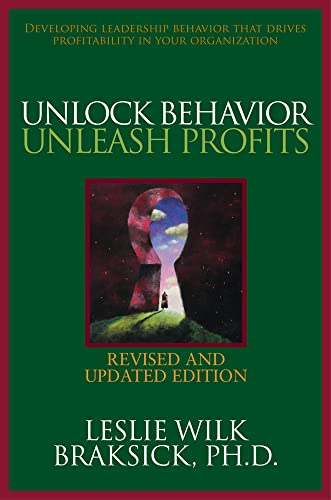
Synopsis
This book gives away tools and methods used by the largest behaviorally based management consulting firm in the world-CLG (www.clg.com). It is filled with client stories, case studies, testimonials, and-most importantly-the secrets to what has led to personal and organizational transformations in blue-chip companies: Behavioral Science applied to business.
Why is being a leader more challenging now than ever before?
Our world has never had greater threats, nor greater opportunities. So many of them come down to people...relationships...behavior.
It is up to you to engage the hearts and minds of your people-and to unleash discretionary performance through the systematic use of Behavioral Science. Nothing changes until behaviors change.
It's about your success
If you are a leader with an agenda for change, this is the book for you. It's not enough to have brilliant strategies, efficient processes, and agile people. Dr. Braksick shows how to make these ingredients work together so you can transform your organization's performance.
Using the clear guidance in this book, you can identify the behaviors needed in your organization to consistently produce desired results. You will learn how to arrange the work environment to encourage those behaviors up and down the organization. And you will learn how to change your own leadership behaviors to make things happen while engaging people's hearts and minds.
Refreshing candor
Dr. Braksick helps leaders tackle their toughest business challenges, using the science of human behavior, backed by more than 80 years of research. In her unique, engaging way, Dr. Braksick makes Behavioral Science accessible to leaders, translating it into usable tools you can apply immediately.Her directness, caring, and passion for improving performance and organizations is inspiring.
Be the leader for others that you seek other leaders to be for you
Make a difference through your words and actions-as these are your most powerful gifts. This book gives you the simple formula for unlocking success in yourself and in others.
"synopsis" may belong to another edition of this title.
About the Author
Leslie Wilk Braksick, Ph.D., is co-founder and President of The Continuous Learning Group, Inc. (CLG), the world's largest behaviorally based consulting organization, with a large roster of Fortune 500 clients. Dr. Braksick and her company provide guidance in business improvement, change, and profitability to more than 150 blue chip clients worldwide (www.clg-online.com, 888-254-5354). Dr. Braksick is an energetic practitioner of behavioral science, noted for her ability to walk into a company, quickly grasp its complex history and culture, and help its executives articulate business objectives and implement strategies that measurably improve the bottom line. Her unique blend of scientific knowledge, coaching skills, entrepreneurship, energy, personality, writing, public, speaking, and strong personal values will touch your professional and personal life.
From the Back Cover
"Unlock Behavior, Unleash Profits is about 21st-century leadership. The power of unlocking behavior in your organization starts with you, the leader. Dr. Braksick is herself a winner, and this book will create many more!"-Brian McNeill, President & CEO, Southco Corporation
"The behavioral approach has made a huge difference in our organization. The before/after is startling: tremendous gains in our ability to get things done; more effective executives; talent development; job satisfaction; cost effectiveness-I am convinced that it is because of applying Behavioral Science. We have more than tripled earnings in a very competitive industry-the proof is in the pudding."-Don Hamm, President & CEO, Assurant Health
"Inspiring the whole-hearted engagement of people may be the biggest challenge leaders face. Dr. Braksick has made a very valuable contribution to the science of human behavior and given leaders tools they need to get results they desire."-Patricia Woertz, Chairman & CEO, The Archer Daniels Midland Company
"Dr. Leslie Braksick shows you how to transform the behaviors and the culture of a company with practical and useful information and tools that can help any leader elevate to the next level. This is a remarkable book."-Tom DiDonato, EVP, Human Resources, American Eagle Outfitters, Inc.
"Ten years ago, Canadian National Railway started a massive culture change. In customer satisfaction, operating ratio, asset utilization-CN today is best-in-class, typically by a wide margin. At the center of our cultural change lies the 'ABCs' of leadership and organizational change in this book. Every member of management has been trained/coached to learn and apply these tools. The results speak for themselves."-Hunter Harrison, President & CEO, Canadian National Railway
"Behavior is a key enabler! This book is a must-read for leaders who want to increase their organization's capacity to execute well!"-Dave O'Reilly, Chairman & CEO, Chevron Corporation
"Setting strategy is the easy part. Successfully executing strategy is where great leaders are made. In Unlock Behavior, Unleash Profits, Dr. Braksick provides us with a science-based framework and practical, relevant examples for understanding how to do this."-William R. Johnson, Chairman & CEO, H.J. Heinz Company
"I have used the leadership tools in this book at the CDC and at the Gates Foundation. I draw on them daily as the new president of CARE, where I am introducing them to my entire management team. They are just as practical and powerful in the not-for-profit sector as in the for-profit."-Helene D. Gayle, MD, MPH, President & CEO, CARE
"Dr. Braksick, a noted authority on the behavior-profits link, pulls no punches and backs her success formula with solid research and relevant case examples. Her style is candid and refreshing. Unlock Behavior, Unleash Profits will be the book you'll turn to for counsel and guidance for years to come."-Jim Kouzes, Ph.D., Chairman Emeritus, The Tom Peters Group
"Dr. Braksick has advanced the business applications of social science a giant step in the right direction. She makes a convincing case for harnessing the power of human behavior to produce exceptional business results."-Larry K. Durham, CEO, National Express Corporation
Excerpt. © Reprinted by permission. All rights reserved.
Unlock Behavior, Unleash Profits
Developing Leadership Behavior That Drives Profitability in Your Organization
By LESLIE WILK BRAKSICKThe McGraw-Hill Companies, Inc.
Copyright © 2007 The McGraw-Hill Companies, Inc.
All rights reserved.
ISBN: 978-0-07-149067-2All rights reserved.
Contents
| Foreword to the Second Edition | |
| Preface to the Second Edition | |
| Acknowledgments | |
| Dedication | |
| 1 Great Execution Depends on—Behavior | |
| 2 Pinpointing the Right Behaviors | |
| 3 Managing Behavior: Know Your ABCs! | |
| 4 It's a Matter of Consequences | |
| 5 Feedback and Coaching: Putting Your "Secret Weapons" to Work! | |
| 6 Shaping Up the Right Stuff | |
| 7 Making Change Happen Consistently: The MAKE-IT MODEL | |
| 8 Creating the IMPACT Culture—Make It Last | |
| 9 Leading Through the Challenges of Today & Tomorrow | |
| Epilogue | |
| About the Author | |
| About CLG | |
| CLG and Intellectual Property in This Book | |
| Index |
Excerpt
CHAPTER 1
Great Execution Depends on—Behavior
"I was CEO almost three years before I really had my arms around the role. I hadbeen deluded into thinking I was doing a good job, because I was directingthings. I had no role model for the 'soft stuff' that the CEO was supposed todo.
"The biggest challenges were much less about business and strategy—butrather about providing leadership in the right way; knowing what to get involvedin and what not to; and understanding the implications of what I said and did. Igrossly underestimated the importance of my own leadership behaviors, and ofcoaching and encouraging other leaders.
"It became clear that, if I kept doing the same stuff, I would get the sameresults. I needed to change, to do things differently. It's hard to learn newbehaviors when you have a big ego and a strong track record of success!
"Four years ago, I would have called myself a good CEO, because back then, Ididn't know better. Today I know better—and can honestly say: I am a verygood CEO."
—Chairman & CEO, Fortune 100 Company
Leaders want to be successful—not just through their own eyes, but in theeyes of others. And by definition, the success of leaders is determined by theirability to get things done through others. In the opening quote, what the leaderlearned that made him a "very good CEO" was that his behavior was the catalystthat could either switch off or turn on the right behaviors in his organizationto achieve their key business goals.
If you're like most leaders, you want to make a difference in this world and inyour lifetime, and you are likely involved in a variety of important leadershiproles where what you do and say really matters. I also imagine that experiencehas taught you the hard realities of the workplace: leaders do not always leadwell. Good people do not always work hard. High performers do not always getpaid more. Angry people do not always quit their jobs and go elsewhere. Greatplaces to work may not be profitable and may not survive. And fairness seldomoperates at work.
Reading this book and mastering its contents will help you understand why peopledo what they do—and how to "unlock" and dramatically change your ownleadership behavior—to accelerate your progress to maximum effectiveness.This book will help demystify why others do what they do (or don't do what theyare supposed to). You will learn how to focus your own leadership behaviors andthose of others.
WHY IS THIS LEADERSHIP BOOK UNIQUE?
There are thousands of leadership books out there. What makes this onedifferent? Most leaders have never learned a practical approach to understandingwhy people do and say the things they do—and how to "unlock" theirbehaviors to bring out the best in everyone, which leads to superiorperformance—both individually and organizationally.
And in any organization, nothing can improve until people change their behavior.There is a science devoted to behavior, and that science underlies what istaught and described in this book. It will seem simple and it is easy to learn,but when put into practice it becomes a profound, life-changing approach toleadership.
THE SCIENCE OF BEHAVIOR—AND THE LINK TO RESULTS
The science of behavior relies on honest, direct, useful communication, based onobjective observation. It is very much a teaching and coaching approach, inwhich the leader's goal is the success of every employee. The science is easilylearned and is replicable.
While many leaders may find the idea of "soft" people skills too squishy, theempirical nature of Behavioral Science provides the tools to cut through manysoft factors, such as personality and motivation. For a so-called "soft" peopleskill, the science of behavior is really quite hard.
Part of the rigor of Behavioral Science is that it gives you an early indicator(leading indicator) of whether you are on target. When you select the rightbehaviors to measure, you gain the ability to predict—early—whetheryou will achieve results, and if not, Behavioral Science helps you correct thecourse.
When you implement an organizational change, you need measures of success. Inbusiness, the dominant measure is P&L, but P&L comes too late—you need theearly indicator that behavioral measurement enables. The unlocking of specificbehavior that is linked to end results clearly correlates to the unleashing ofprofits, as our company has shown in decades of client engagements.
SO, WHY THE TITLE: "UNLOCK BEHAVIOR, UNLEASH PROFITS"?
In so many organizations, people's behavior is "locked." This means that theirbehavior is constrained by cultural norms and people systems. These constraintsact to keep people doing their jobs at minimum acceptable levels of performance.People in such performance-constrained organizations—whether a team, adepartment, or the entire corporation—feel "locked" or stuck, and theirperformance is compromised as a result. Often, this minimum performance becomesacceptable and expected, and so the organization chugs along—adequately.
However, locked behavior becomes an insurmountable problem when the organizationgoes to implement a new strategy or to make a big change that requires people toalter how they work—to exhibit new behaviors to get new performance. Theselocked behaviors become big obstacles to implementation, keeping people fromembracing the new way.
But there is good news: anyone who heeds the lessons in this book can become oneof those great leaders who implements change well. You can help your peoplebecome completely engaged in "new ways" if you understand behavior, and careenough to lead your people well and coach others to success.
So, the purpose of this book is to reveal how to unlock behaviors in yourorganization, so you can unleash profits—not only monetary, but also thevast wealth of talent and capability that is trapped within the people in yourorganization.
HOW DOES "LOCKING" HAPPEN?
Behaviors become locked as the result of unintended consequences—despiteleaders' good intentions. Many organizations unwittingly reward the wrongbehaviors and discourage the right behaviors, thus undermining their hard workfor success. For example:
One client needed strong teamwork across salespeople in different business unitsto drive top-line growth, cross-selling, and meet the new purchasing anddistribution requirements of their largest customer. But, the company did notalter its sales incentive system—which was tied to individual performanceonly—thus discouraging any acts of teamwork or collaboration.
The results were competition between business units and finger-pointing amongindividuals. Top-line growth was negatively impacted, and customer requirementswere not met. What teamwork?
The company had unintentionally locked the employees' behavior and leashedprofits by not altering sales incentives (consequences) tied to their behavior.They expected people to do the right thing no matter what—but failed torealize that the company also had an obligation to align its reward structurewith what it was asking of its employees.
Often the conflict is more subtle: it is the experience employees have when theyobserve the difference between an organization's vision and stated values, andwhat they see actually practiced and encouraged every day. This clash betweenwords and actions weakens commitment and causes distrust of leaders and of thecompany as a whole.
This is where unintended consequences begin, driving performance down, not up.The organization gets less than what its individuals are capable ofgiving—and the employees experience less satisfaction from a workenvironment that has the potential to be so much better. When an organizationlocks its people's behaviors, everyone suffers—individual employees,managers, top leaders, customers, and shareholders.
The thing I want to inspire and excite you with is that employees' discretionaryperformance can be unlocked by leaders ...
... who understand the effect of unintended consequences on their people, andhow to change that ...
... and who understand how to positively motivate the behaviors of others to getthings accomplished.
You will get back from employees (and others) the very level of performance thatyour leadership actions produce. This cause-and-effect relationship between youractions and people's response is almost entirely under your control. You canbecome a great leader if you want to, and are willing to learn and use themethods in this book. The choice is yours.
"DISCRETIONARY PERFORMANCE"—TAPPING THE POWER WITHIN US ALL
Discretionary performance is that extra level of performance we exert when wewant to do something, as opposed to when we have to do something. Discretionaryperformance is happening when we perform above-and-beyond, "at our owndiscretion." It's the difference between compliance (do it only because we haveto) and commitment (do it because we really want to).
When you unlock behavior, you'll be a delighted witness to daily acts ofdiscretionary performance. You will have tapped into the deepest center ofhumans that leads them to want to do things, without any apparent incentive ormotivation.
Developing discretionary performance in employees is especially critical today.The unquestioning loyalty of past generations has all but vanished. Today'sworkforce seeks engaging work environments that are reciprocal and mutuallyrespectful. Unlocking behavior and tapping into the discretionary performance ofall employees is Job One for leaders who want their organizations to win.
A simple fact is that discretionary performance will occur only when the rightbehaviors are encouraged and people actually become "winners" because thosebehaviors lead to winning results. The following figure illustrates the threetypes of leadership and the impact each type has upon performance:
• Effective leadership, which earns discretionary performance. This top curve isthe one we all want: outstanding discretionary performance, where people performat peak levels for sustained periods. This is the result of effective leadershipthat truly "unlocks" employee behavior.
• Coercive leadership ("do it because I said so"), which earns minimalperformance. This leadership style may get improved performance in the shortterm, but ultimately creates a work place of fear-driven compliance. People dojust enough to get by. Either their performance is just acceptable enough toavoid getting fired, or they carefully achieve the goals set by leaders, butnever go beyond. Either way, coercive leadership cannot propel the organizationto greatness.
• Poor leadership, which earns unsatisfactory performance. Eventually, theunsatisfactory performance comes visible to all stakeholders, and the leaderexits or the organization collapses.
Effective leadership, superior execution, and engaging work environments alldepend on your leadership words and actions. Your behavior—everything youdo and say—is the key to tapping discretionary performance in yourself andyour people.
CASE EXAMPLE—HOW FOCUSING ON BEHAVIOR MADE THE DIFFERENCE
Here is a memorable experience retold by one of our clients, Brian, who retiredas President of a major oil company when it was acquired by a larger peerenterprise. Brian explains how some workers unintentionally taught him a greatlesson in leadership: about the impact that his leadership behavior has onresults, and about tapping into the discretionary performance of his people.
An experience changed my life some years ago. I ran a refinery in England. Timeswere tough, and the entire management team labored to save the plant fromclosing. We frantically bailed the boat.
It was the hundredth anniversary of our UK operations, and someone decided weshould celebrate. Our Board provided money for a celebration for a thousandpeople—£30 each (roughly USD$60)—so we had £30,000 to spend on thiscelebration.
Honestly, I was more interested in whether there was even going to be anorganization next week, than in a celebration! So, I delegated the celebrationplanning to a small group of blue-collar workers. I gave them the £30,000 andsaid, "Organize something—have a good time." And I went back to bailingthe ship.
So what did the celebration team do? They organized an event equivalent to acounty fair in the United States! About 50,000 people came. It was beyondbelief! They leveraged that £30,000 and probably got the value of about£1,000,000.
Frankly, we would not have put this little team in charge of £2.50 in theirdaily work. Yet, here was this group, left to their own devices without anyinterference or direction from management, and they ran this magnificent event.I mean, it was just incredible!
So my management team and I analyzed this experience to understand how thesepeople had accomplished this tremendous task. It was obvious that they succeededmore than we thought possible, because they were able to exercise their fullcapabilities. At work we had boxes and barriers all around them.
Ever since this experience, I've been trying to figure how I can tap people'scapabilities like that. Why was this team so successful?
• They succeeded because they owned the project, including the consequences oftheir decisions.
• They had encouraging feedback from their peers, who would evaluate theirsuccess using criteria they all understood. (You only celebrate a hundredthanniversary once, and their friends and their families were going to be veryrough on them if the event had fallen short!)
• I unwittingly encouraged their behaviors, by simply getting out of their way.I was too busy to deliver any discouraging consequences, intended or unintended!I am positive that if I'd had more time, I would have told them that their planswere unrealistic!
This team had put forth great discretionary performance—the effort peoplewant to contribute above and beyond what is normally required to keep theirjobs.
So: if we always were to manage this way, would it encourage people's continuingdiscretionary performance? If I were to ensure that employees saw the directlink between their efforts and what they could achieve, then either got out ofthe way or encouraged them, would it lead to more discretionary performance?
I believe the answer is unequivocally "yes." That's why I'm a leader committedto creating the conditions that encourage these behaviors! It's not always easy,because I have lots of old behaviors that I need to change myself. But I amcommitted to getting there—for the success of my organization, my people,and myself.
Takeaways from Brian's Story ...
1. People often have capabilities that are buried or hidden on the job. Our jobas leaders is to encourage them—and to create an environment where theircapabilities are brought out.
2. The work environment is primarily defined by management, and maintained bythe encouraging/discouraging consequences that people experience. Oftentimes,this work environment unintentionally inhibits discretionary performance and"locks in" minimally acceptable performance.
3. Brian's management instructions ("organize something—have a good time")were very general, compared to the highly specific consequences to the employeesof success or failure (expectations of their peers, family members, andcommunity members, Brian's evaluation of their performance, etc.). Thisdemonstrates the power of specific consequences.
4. Brian could have been an even more effective leader if he had pinpointed thebehaviors needed for success and created encouraging/desirable consequences. Inthis story, he did neither, so it's doubtful his people felt like they were"led" by Brian in any meaningful way as they pulled together the event.
5. The Bottom Line: You can unlock behavior and unleash profits in yourorganization by creating an environment that supports the right behaviors andremoves barriers to discretionary performance.
TAKEAWAYS FROM THIS BOOK
We are quite serious when we say that what you read in this book can change notonly your leadership but your life. Here are four "behavior facts" that arecrucial to every leader's success:
1. Your behavior—and everyone's—is a response to the environment youwork in. As a leader, you respond to what the corporate environment tells you todo. Your people respond exactly the same way. A truism is that "everyorganization is perfectly designed right now to produce the results it isgetting right now." If you like these results, then you don't need to change theenvironment. But if you don't like these results, you must change theenvironment—and you have the power to do so as the leader!
2. Your leadership behavior profoundly and directly affects everyone within yourorganization. You directly influence the environment of the many people belowyou. You do this primarily through your direct leadership behavior—whatpeople experience from you daily.
Executives in particular—but all leaders to some degree—oftenunderestimate the impact upon others of what they do and say (and of what theydon't do and say). People watch and listen to leaders very closely—everyword and nuance. Leaders need to be mindful of the behavior theydemonstrate—and the impact it has on everyone. You also influence howcorporate policies, procedures, recognition systems, etc. are used.
In short—you establish and drive your own "corporate culture," whicheither locks or unlocks behavior (more on corporate culture in Chapter 7).
(Continues...)
Excerpted from Unlock Behavior, Unleash Profits by LESLIE WILK BRAKSICK. Copyright © 2007 by The McGraw-Hill Companies, Inc.. Excerpted by permission of The McGraw-Hill Companies, Inc..
All rights reserved. No part of this excerpt may be reproduced or reprinted without permission in writing from the publisher.
Excerpts are provided by Dial-A-Book Inc. solely for the personal use of visitors to this web site.
"About this title" may belong to another edition of this title.
Search results for Unlock Behavior, Unleash Profits: Developing Leadership...

Stock Image
Unlock Behavior, Unleash Profits: Developing Leadership Behavior That Drives Profitability in Your Organization
Seller: Gulf Coast Books, Cypress, TX, U.S.A.
Seller rating 5 out of 5 stars

hardcover. Condition: Good. Seller Inventory # 0071490671-3-32011472
Stock Image
Unlock Behavior, Unleash Profits: Developing Leadership Behavior That Drives Profitability in Your Organization
Published by
McGraw-Hill Education - Europe, 2007
ISBN 10: 0071490671
ISBN 13: 9780071490672
Used
Hardcover
Seller: World of Books (was SecondSale), Montgomery, IL, U.S.A.
Seller rating 5 out of 5 stars
Hardback. Condition: Very Good. Presents tools to help you, whether you're an executive, entrepreneur, or manager to unlock behavior and profits. Seller Inventory # 00096745957
Stock Image
Unlock Behavior, Unleash Profits: Developing Leadership Behavior That Drives Profitability in Your Organization
Published by
McGraw-Hill Education - Europe, 2007
ISBN 10: 0071490671
ISBN 13: 9780071490672
Used
Hardcover
Seller: World of Books (was SecondSale), Montgomery, IL, U.S.A.
Seller rating 5 out of 5 stars
Hardback. Condition: Good. Presents tools to help you, whether you're an executive, entrepreneur, or manager to unlock behavior and profits. Seller Inventory # 00108013101
Seller Image
Unlock Behavior, Unleash Profits: Developing Leadership Behavior That Drives Profitability in Your Organization
Seller: Zoom Books East, Glendale Heights, IL, U.S.A.
Seller rating 5 out of 5 stars
Condition: like_new. Book is in like new condition with minimal signs of wear. Pages are clean and free from notes or highlighting. Dust cover is intact. May not contain miscellaneous items toys, dvds, etc. . We offer 100% money back guarantee and 24 7 customer service. Seller Inventory # ZEV.0071490671.LN
Seller Image
Unlock Behavior, Unleash Profits: Developing Leadership Behavior That Drives Profitability in Your Organization
Seller: Zoom Books Company, Lynden, WA, U.S.A.
Seller rating 5 out of 5 stars
Condition: very_good. Book is in very good condition and may include minimal underlining highlighting. The book can also include "From the library of" labels. May not contain miscellaneous items toys, dvds, etc. . We offer 100% money back guarantee and 24 7 customer service. Seller Inventory # ZBV.0071490671.VG
Seller Image
Unlock Behavior, Unleash Profits: Developing Leadership Behavior That Drives Profitability in Your Organization
Seller: ZBK Books, Carlstadt, NJ, U.S.A.
Seller rating 5 out of 5 stars
Condition: good. Fast & Free Shipping â" Good condition. It may show normal signs of use, such as light writing, highlighting, or library markings, but all pages are intact and the book is fully readable. A solid, complete copy that's ready to enjoy. Seller Inventory # ZWV.0071490671.G
Stock Image
Unlock Behavior, Unleash Profits: Developing Leadership Behavior That Drives Profitability in Your Organization
Published by
McGraw Hill (edition 2), 2007
ISBN 10: 0071490671
ISBN 13: 9780071490672
Used
Hardcover
Seller: BooksRun, Philadelphia, PA, U.S.A.
Seller rating 5 out of 5 stars
Hardcover. Condition: Very Good. 2. With dust jacket. It's a well-cared-for item that has seen limited use. The item may show minor signs of wear. All the text is legible, with all pages included. It may have slight markings and/or highlighting. Seller Inventory # 0071490671-8-1-29
Stock Image
Unlock Behavior, Unleash Profits: Developing Leadership Behavior That Drives Profitability in Your Organization
Published by
McGraw-Hill Education - Europe, 2007
ISBN 10: 0071490671
ISBN 13: 9780071490672
Used
Hardcover
Seller: World of Books Inc, Montgomery, IL, U.S.A.
Seller rating 4 out of 5 stars

Hardback. Condition: Very Good. Presents tools to help you, whether you're an executive, entrepreneur, or manager to unlock behavior and profits. Seller Inventory # CIN0071490671VG
Stock Image
Unlock Behavior, Unleash Profits: Developing Leadership Behavior That Drives Profitability in Your Organization
Seller: Better World Books: West, Reno, NV, U.S.A.
Seller rating 5 out of 5 stars
Condition: Good. 2nd Edition. Pages intact with minimal writing/highlighting. The binding may be loose and creased. Dust jackets/supplements are not included. Stock photo provided. Product includes identifying sticker. Better World Books: Buy Books. Do Good. Seller Inventory # 4359173-6
Stock Image
Unlock Behavior, Unleash Profits: Developing Leadership Behavior That Drives Profitability in Your Organization
Seller: Better World Books, Mishawaka, IN, U.S.A.
Seller rating 5 out of 5 stars
Condition: Good. 2nd Edition. Pages intact with minimal writing/highlighting. The binding may be loose and creased. Dust jackets/supplements are not included. Stock photo provided. Product includes identifying sticker. Better World Books: Buy Books. Do Good. Seller Inventory # 4359173-6