
Items related to Confessions of a Real Estate Entrepreneur: What It...
Confessions of a Real Estate Entrepreneur: What It Takes To Win In High-Stakes Commercial Real Estate - Softcover
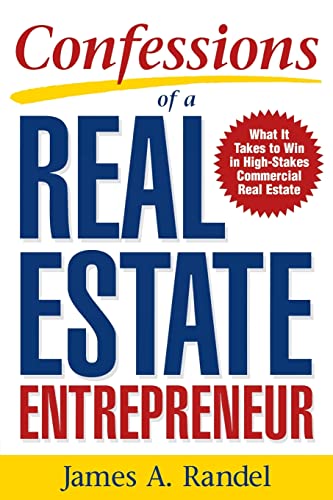
Synopsis
A front row seat into the world of high-stakes commercial real estate investing
“A must-read book … one of the best real estate investment books I have ever read. On my scale of 1 to 10, this unique book rates an off-the-charts 12.” ---Robert Bruss
Confessions of a Real Estate Entrepreneur is for the individual who is ready to get serious about investing. Not a rah-rah or get-rich-quick book, this book is for someone who is prepared to think about what he or she wants to accomplish. James Randel provides the how and why.
James Randel has been a successful investor and educator for 25 years. He teaches investing through stories and anecdotes – bringing to the limelight not just his successes (and there are some amazing stories of these) but also his mistakes. His candor is instructive and entertaining.
It is said that “those who can, do, and those who can’t, teach.” James Randel is a rare exception as he is both a highly successful investor as well as an excellent teacher. As said by Jeff Dunne, Vice Chairman of the largest real estate company in the world, CB Richard Ellis:
“I’ve tracked Jimmy’s incredible run of successful real estate investments for 20 years and more recently invested very profitably with him. His new book is a must read for anyone interested in real estate investing.”
If you are tired of the “same old, same old” and prepared to play in the big leagues, this book is calling your name.
"synopsis" may belong to another edition of this title.
About the Author
McGraw-Hill authors represent the leading experts in their fields and are dedicated to improving the lives, careers, and interests of readers worldwide
From the Back Cover
Insider Secrets to Better Ventures and Bigger Returns in Commercial Real Estate
If you're ready to move beyond basic buy-and-hold or fix-and-flip investing, Confessions of a Real Estate Entrepreneur is for you. Full of real-world wisdom from successful investor James Randel, this insider's guide is packed with detailed examples of real-life deals, demonstrating strategies to help you you avoid the mistakes that Randel and other investors learned the hard way. You'll learn about:
- Due diligence and researching properties
- Financing strategies that maximize your buying power
- Legal terms, issues, and conditions you should understand
- Profiting through option agreements
- The thirteen vital skills for real estate success
"Confessions of a Real Estate Entrepreneur provides all the tools for analyzing, buying, improving and profiting from the investment in income producing properties."--Jeff Dunne, Vice Chairman, CB Richard Ellis
"Jim's focus on the building blocks, the creativity, and the strategy of deal making gives readers a front row seat into this high stakes, and richly rewarding game."--Jim Fagan, Managing Director, Cushman & Wakefield
Excerpt. © Reprinted by permission. All rights reserved.
Confessions of a REAL ESTATE ENTREPRENEUR
What It Takes to Win in High-Stakes Commercial Real EstateBy James A. RandelThe McGraw-Hill Companies, Inc.
Copyright © 2006 James A. RandelAll right reserved.
ISBN: 978-0-07-146793-3
Contents
Chapter One
Introduction: Learning to Add Value
I graduated law school in 1974 and immediately started buying real estate (a two-family house in Los Angeles). I had no money and as "necessity is the mother of invention," I had to be very inventive. In the next 10 years I bought and sold 50 or so investment properties.
I also became an active real estate attorney and real estate broker. My assumption was that if real estate was involved, I should be able to figure out how to make money buying, selling, brokering, or lawyering it. I soon began to think of myself as a real estate entrepreneur, someone who took risks in an effort to turn time, information, and some capital into much, much more capital.
In 1985, I wrote a book titled The Real Estate Game (And How to Win It). That book advocated real estate as an investment but was limited to what I had learned up to that point in my life. In the 20 years since writing The Real Estate Game, I have continued to buy and sell. Only the deals got bigger and bigger. And I learned a lot about maximizing one's success with real estate entrepreneuring.
One of the points of The Real Estate Game was that you could use real estate to obtain wealth, simply by buying and holding. And that still is true. Notwithstanding a relatively low rate of inflation over the last five years, real estate appreciation has continued to clip along at double-digit numbers.
Over the last 20 years I have observed that whereas buying and holding is certainly a valid (fairly safe) strategy for making money with real estate, there are other—and I dare say better—ways for doing that. These are the strategies employed by the super-successful real estate players. These are techniques used by entrepreneurs who are not satisfied with a "reasonable" return on their investment. The Dow Jones may go up in a year by 10 percent, and equity investors are generally pleased with that. On the other hand, the real estate entrepreneurs I know would be quite disappointed with a 10 percent return on their equity. These people are looking for multiples many, many times a 10 percent return.
Now before we start down our path of learning, let me make one important point: real estate, as with most entrepreneurial endeavors, has a risk-reward quotient. If you are looking for risk-free ways to make a ton of money in real estate, toss this book. I have never seen such things. Certainly, risk can be quantified and minimized, but life in the real estate world is pretty simple: the greater the risk, the greater the potential reward.
In that regard, I am NOT A FAN of the real estate promoters who write books about making money in real estate with no or little cash invested. Or who hold seminars claiming to make their attendees instant millionaires. Sorry, guys, I just don't buy it.
Real estate investing is not some magic potion to riches. Yes, it's a means for making a lot of money. But it's no risk-free, lazy man's way to wealth. It's hard work. And there is definitely risk involved. But with information, diligence, determination, and calculated risk, there is plenty of opportunity to make A LOT of money.
One last disclaimer: I tell many stories in the pages to follow. All of them are actual deals that I was involved with (sometimes with names or numbers changed a little bit so as not to offend anyone) or are compilations of several similar deals in which I participated. Some of these deals make me look very smart. My intent is not chest-pounding. The point of these stories is to show you what can be done if you are a knowledgeable real estate entrepreneur. But as you will discover, I have also made my share of mistakes. And frankly, one of the reasons for writing this book 20 years after my last venture into publishing is that I wish I'd had a road map to follow that would have helped me avoid some of the real stupid stuff I have done. I hope that this book can be that kind of road map for you.
So, you in? Okay, then let's get going.
The General Premise
My belief is that in order to maximize your success in real estate investing you need to ADD VALUE to either the process by which you acquire property and/or the property itself.
The techniques that I write about in ensuing chapters are all about ADDING VALUE; in other words, finding some way to TIP A DEAL IN YOUR FAVOR. There are techniques for creative acquisition, for finding hidden wealth in a property, for using other people's money to generate disproportionate returns, for using information to create outsized commissions, and so on. Hopefully, you noticed the quotation at the beginning of this book ("Knowledge is power"). I am a great believer in that statement. With knowledge, you have the power to catapult your existing net worth to a level you may have only dreamed about. My goal is to impart some of that knowledge to you ... to get you familiar with the types of techniques that I have seen work time and again. To give you a good foundation in the basics of real estate investing so you can exercise your own creative muscles to find new, exciting, and lucrative ways to do deals. There is no one right way.
By the way, real estate entrepreneuring is gender neutral. Most of the time in this book I use the word "he" instead of "he or she" just to save space. And speaking of words, please note that at times I address real estate entrepreneurs as "players." I am using the terms synonymously.
The next chapter is a story—a true story—about friends of mine who made almost $3 million in two years on an investment of $100,000. I was their attorney, so I did not share in the upside, but that deal widened my eyes to the wondrous possibilities open to the creative and intelligent real estate entrepreneur. As such, I thought it would be a good starting point for you, as it was for me.
Chapter Two
Possibilities
I want to start my book with a story. A true story. It helped open my eyes to the possibilities of success with real estate once you know the principles of intelligent real estate entrepreneuring. In the storytelling, I may use terms that are not yet familiar to you; don't worry about that. We will learn about these concepts. For now just enjoy the "rags to riches" result.
Years ago two friends of mine were interested in buying a building in Shelton, Connecticut. I was their attorney. The building was 66,000 square feet, commonly called "flex" space, meaning that its style and configuration made it flexible, that is, usable for office, assemblage, light industrial, or Research and Development (R&D).
My two friends had done their homework, learning about the Shelton market and especially about flex buildings like the one they were interested in. They knew what type of companies would be interested in that type of space. They knew what rents the market was commanding. This homework had taken them no more than two weeks; they just talked to everyone in the business who would speak with them.
Although my friends have since both gone on to great things in the real estate world (making lots of money), at the time they did not have a lot of money. They were, however, both very entrepreneurial.
The owner of the building ("Owner") was prepared to sell for $5.5 million. There was a tenant ("Tenant") in the building occupying the entire 66,000 square feet. The Tenant was paying a rent of $660,000 (triple net, i.e., plus all expenses of ownership). The problem was, the Tenant was not a good credit risk and could go out of business at any time. And without the Tenant paying rent, the deal was problematic.
To complicate things, the Tenant also had a $1 million mortgage on the property. This mortgage was the result of a transaction between the Tenant and the Owner years earlier. It was "assumable" (see Chapter 3) and contained some very important language, known as a "subordination clause," which read something like this:
Tenant agrees to subordinate the lien of its mortgage to a subsequent lien if the amount of the said subsequent lien does not exceed 70 percent of the fair market value of the Property.
We'll learn all about subordination clauses later in the book. For now just understand that this clause allowed the Owner (or Purchaser) to get a new mortgage, which would be in first position—with the Tenant's mortgage moving to second position. As you'll see in Chapter 3, these distinctions are important to lenders.
My friends found a lender willing to loan them $4.5 million to buy the property. Still, they needed $1 million. Unfortunately, they did not have $1 million. So they took another look at the Tenant's mortgage. Could they buy, leaving that mortgage in place (assuming the debt), thereby needing only $4.5 million to close? And since they had an offer for a $4.5 million first mortgage ... well, keep reading.
My friends realized that this deal had NO CASH possibilities. If they could convince a lender to make a $4.5 million first mortgage loan, and leave the Tenant's mortgage in place, they could buy this property with no money. First my friends had to speak with the prospective $4.5 million lender, and here is how that discussion went:
Friend: As you know, there is an existing $1 million assumable mortgage on the property and we can subordinate that lien to your loan. So, you will be in first position.
Lender: Yes, well that's good, but if I'm doing my math correctly that means you buy with no cash in the deal. We want to see some of your skin in the game.
Friend: Well, we actually do have skin in the game. First of all we will have plus or minus $100,000 in closing costs. That's real money. But second and perhaps more important, don't punish us because we have created a great deal. We're buying this property for $5.5 million but if you capitalize the $660,000 of annual net income the Tenant is paying, the property is worth conservatively $6.6 million, and the extra $1.1 million over the purchase price is really our equity, albeit sweat equity.
Lender: That does make sense to me.
Note: Perhaps the lender had not done as much due diligence on the Tenant as it should have. One of the reasons that my friends were able to get the deal for $5.5 million was because of the dubious creditworthiness of the Tenant. And without the $660,000 per year of rent flowing in, the property was worth well below $5.5 million.
Anyway, the $4.5 million lender agreed to make the loan. Step #1. Now my friends had to remind the Tenant of its obligation to subordinate its mortgage to the lien of a new lender. But the Tenant was not without bargaining power because of the cap in the subordination clause: to a lien not in excess of 70 percent of market value. Fortunately, here again the creativity and persuasiveness of my friends prevailed.
Here's how that meeting went:
Tenant: Why should I subordinate to a new first mortgage of $4.5 million? That puts my mortgage in a much worse position than it is now. If you get into trouble with the building, I have a $4.5 million lien ahead of me. That's the reason for the 70 percent cap in the subordination language, and the new $4.5 million loan is well beyond 70 percent of the market value of the property.
Friend: Well, no, it really isn't. True, we are paying $5.5 million for the deal, but candidly, we got a good deal and we believe that the true market value of the building is $6.6 million. The reason we're getting the deal is that some people are worried about your company continuing to pay rent, and we've done our homework and concluded that you will not default on your lease. Am I right?
Tenant: Well, of course you're right. We are not going to default. We've been in business for 20 years and I'm sick of hearing about our shaky financial position.
Friend: Right. That's why the true market value of this building is $6.6 million or more and why the $4.5 million does not really exceed the 70 percent threshold.
Tenant: Hmmm ... (thinking)
Friend: But I am going to make your decision even easier. Here is what we're willing to do: Under your Lease Agreement you are paying rent of $55,000 per month. The debt service on our new mortgage is $30,000 per month. The debt service on your mortgage—which as you know is being amortized very quickly—is $20,000 per month. Instead of paying us rent every month of $55,000, we'll agree that you pay the first mortgage and your mortgage instead, and then just $5,000 per month to us. That way you don't have to worry about our ever defaulting on the mortgage ahead of you ... or on your mortgage, for that matter.
Tenant: Okay, that seems fair. I agree. Step #2.
Let's review what my friends have done so far. They were now able to buy a $5.5 million property with none of their own cash although they did have closing costs of about $100,000 (some portion of which went to me as the attorney—as you'll see, I wish I had a piece of the deal instead). As soon as they closed the purchase, they began to troll for opportunities to add value.
And, as things can happen, opportunity found them. A month or two after closing, we hear that the Tenant has decided to sublease its space and, in fact, has found a subtenant willing to take over the Lease. What's more, this subtenant is willing to pay the Tenant more rent than the Tenant is paying my friends.
As you will recall, the Tenant is paying my friends $660,000 per year in rent. There are about 9.5 years to go on the Lease Agreement. The rent is flat, that is, no increases over the remaining term. But the subtenant is willing to pay the Tenant $660,000 per year for the first 4.5 years of the sublease and then $850,000 per year for the next five years. Because the Lease Agreement does not have a clause requiring the Tenant to share the excess $190,000 a year (beginning in year six) with the Owner, none of that extra money goes to my friends. Still, it is a good thing to have additional revenue coming to the property, and my friends, being appreciative of the Tenant's willingness to subordinate its $1 million lien to the new $4.5 million mortgage (above), consent to the sublease.
The Tenant vacates and the subtenant moves in—and now things get interesting. It turns out that the subtenant is positioning itself to be bought (which is why it wanted much larger space, i.e., the 66,000 square feet, than it had been occupying), and one of the suitors is a AAA credit Fortune 100 company. This company decides it wants to buy the subtenant BUT wants to create a new entity to own the subtenant, so that the Fortune 100 company's credit is not exposed to the subtenant's obligations. My friends are against that. What they want is a AAA credit behind the subtenant's obligations. They know that is a good thing because as long as the subtenant is meeting its obligation to the Tenant, then the Tenant will meet its obligation to them. Having the AAA credit on the hook keeps the financial structure of this arrangement intact.
The Sublease and Assignment clause in the Lease reads as follows:
Tenant, or any Subtenant or assignee, may not sublease or assign this Lease, without the consent of the Landlord, which consent shall not be unreasonably withheld. In addition, should Tenant, Subtenant, or an assignee transfer a majority of its ownership interest, that act shall be considered an assignment hereunder, which shall require the Landlord's consent.
The Fortune 100 company takes the position that my friends would be unreasonable in withholding consent to an "assignment," that is, the purchase of the subtenant by the new entity they are forming. But again my friends' creativity and preparation carry the day:
Friend: Listen, the whole point of a Landlord consent clause is to give the Landlord some assurance that the assignment will not impact his property. We know the owner of the subtenant. He is a local man with lots of ties to the community. We know that he will meet his obligations under the Sublease if for no other reason than to keep his word to his employees, friends, and neighbors who have worked for him for many years. But once your new entity takes over, there is none of that local protection. In six months, a person in California could decide to collapse the new entity and stop paying the rent due under the Sublease. That will not work for us and we are not giving our consent.
Fortune 100 Company: You are being patently unreasonable.
Friend: Maybe so ... but you are talking about a multimillion-dollar acquisition that you want to get done, and fighting us in court will take a year or more. All we are asking you to do is give us a solid commitment to keeping your contractual obligations under the Sublease.
That point was hard to argue with, and the Fortune 100 company caved and guaranteed the Sublease. Step #3. The next day my friends and I meet to brainstorm:
Friend #1: Let's recap what we have. We have a good building in a good location with a flat rent for 9.5 years of $660,000 per year. But we also have a Sublease that increases the rent in 4.5 years to $850,000. And that Sub-lease rent is guaranteed by a AAA credit. We should be able to do something with this.
Friend #2: How about this? Suppose we go to the Tenant and offer to buy him out. We owe him about $950,000 on his mortgage. Suppose we offer him that amount plus something for the $190,000 in extra rent he will be receiving from the subtenant for five years beginning 4.5 years from now?
Me: Yes, good idea, but that additional rent is worth almost another million dollars: five times $190,000 per year.
Friend #2 (smiling): Randel, that's why you're the lawyer. You still do not understand present valuing.
Me: Huh?
Friend #1: Well, money in the future is not worth the same as money in the present. The fact is, the right to receive $190,000 4.5 years from now is worth much less than $190,000. And that decrease to present value is even more dramatic for the subsequent years.
(Continues...)
Excerpted from Confessions of a REAL ESTATE ENTREPRENEURby James A. Randel Copyright © 2006 by James A. Randel. Excerpted by permission of The McGraw-Hill Companies, Inc.. All rights reserved. No part of this excerpt may be reproduced or reprinted without permission in writing from the publisher.
Excerpts are provided by Dial-A-Book Inc. solely for the personal use of visitors to this web site.
"About this title" may belong to another edition of this title.
Search results for Confessions of a Real Estate Entrepreneur: What It...

Stock Image
Confessions of a Real Estate E
Seller: World of Books (was SecondSale), Montgomery, IL, U.S.A.
Seller rating 5 out of 5 stars

Condition: Acceptable. Item in acceptable condition! Textbooks may not include supplemental items i.e. CDs, access codes etc. Seller Inventory # 00100254819
Seller Image
Confessions of a Real Estate Entrepreneur: What It Takes to Win in High-Stakes Commercial Real Estate: What it Takes to Win in High-Stakes Commercial Real Estate
Seller: ZBK Books, Carlstadt, NJ, U.S.A.
Seller rating 5 out of 5 stars
Condition: very_good. Fast & Free Shipping â" Very Good condition book with a firm cover and clean pages. Shows normal use and some light wear or limited notes markings. A solid, nice copy to enjoy. Seller Inventory # ZWV.0071467939.VG
Stock Image
Confessions of a Real Estate Entrepreneur: What It Takes to Win in High-Stakes Commercial Real Estate: What it Takes to Win in High-Stakes Commercial Real Estate
Seller: Gulf Coast Books, Cypress, TX, U.S.A.
Seller rating 5 out of 5 stars
paperback. Condition: Good. Seller Inventory # 0071467939-3-37732595
Stock Image
Confessions of a Real Estate Entrepreneur: What It Takes to Win in High-Stakes Commercial Real Estate: What It Takes to Win in High-Stakes Commercial
Seller: ThriftBooks-Reno, Reno, NV, U.S.A.
Seller rating 5 out of 5 stars
Paperback. Condition: Fair. No Jacket. Readable copy. Pages may have considerable notes/highlighting. ~ ThriftBooks: Read More, Spend Less. Seller Inventory # G0071467939I5N00
Stock Image
Confessions of a Real Estate Entrepreneur: What It Takes to Win in High-Stakes Commercial Real Estate: What It Takes to Win in High-Stakes Commercial
Seller: ThriftBooks-Atlanta, AUSTELL, GA, U.S.A.
Seller rating 5 out of 5 stars
Paperback. Condition: Fair. No Jacket. Readable copy. Pages may have considerable notes/highlighting. ~ ThriftBooks: Read More, Spend Less. Seller Inventory # G0071467939I5N00
Stock Image
Confessions of a Real Estate Entrepreneur: What It Takes to Win in High-Stakes Commercial Real Estate: What It Takes to Win in High-Stakes Commercial
Seller: ThriftBooks-Atlanta, AUSTELL, GA, U.S.A.
Seller rating 5 out of 5 stars
Paperback. Condition: Good. No Jacket. Pages can have notes/highlighting. Spine may show signs of wear. ~ ThriftBooks: Read More, Spend Less. Seller Inventory # G0071467939I3N00
Stock Image
Confessions of a Real Estate Entrepreneur: What It Takes to Win in High-Stakes Commercial Real Estate: What It Takes to Win in High-Stakes Commercial
Seller: ThriftBooks-Dallas, Dallas, TX, U.S.A.
Seller rating 5 out of 5 stars
Paperback. Condition: Fair. No Jacket. Readable copy. Pages may have considerable notes/highlighting. ~ ThriftBooks: Read More, Spend Less. Seller Inventory # G0071467939I5N00
Stock Image
Confessions of a Real Estate Entrepreneur: What It Takes to Win in High-Stakes Commercial Real Estate: What It Takes to Win in High-Stakes Commercial
Seller: ThriftBooks-Phoenix, Phoenix, AZ, U.S.A.
Seller rating 5 out of 5 stars
Paperback. Condition: Good. No Jacket. Pages can have notes/highlighting. Spine may show signs of wear. ~ ThriftBooks: Read More, Spend Less. Seller Inventory # G0071467939I3N00
Stock Image
Confessions of a Real Estate Entrepreneur: What It Takes to Win in High-Stakes Commercial Real Estate: What It Takes to Win in High-Stakes Commercial
Seller: ThriftBooks-Atlanta, AUSTELL, GA, U.S.A.
Seller rating 5 out of 5 stars
Paperback. Condition: As New. No Jacket. Pages are clean and are not marred by notes or folds of any kind. ~ ThriftBooks: Read More, Spend Less. Seller Inventory # G0071467939I2N00
Seller Image
Confessions of a Real Estate Entrepreneur: What It Takes to Win in High-Stakes Commercial Real Estate: What it Takes to Win in High-Stakes Commercial Real Estate
Seller: Dream Books Co., Denver, CO, U.S.A.
Seller rating 5 out of 5 stars
Condition: acceptable. This copy has clearly been enjoyedâ"expect noticeable shelf wear and some minor creases to the cover. Binding is strong, and all pages are legible. May contain previous library markings or stamps. Seller Inventory # DBV.0071467939.A