
Items related to The Real Estate Coach (Instant Success Series)
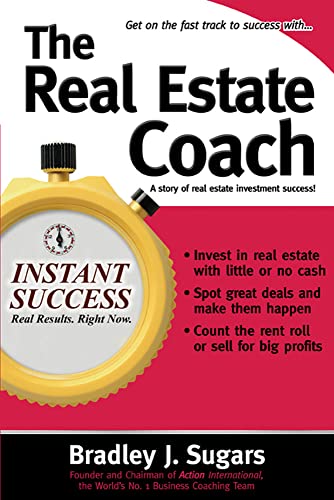
Synopsis
Stop working for someone else, and start living the dream!
It's a fact: you'll never get rich just working for a living. Theonly sure way to achieve real wealth and the freedom it buysis by letting your investments work for you. And, as self-mademultimillionaire Brad Sugars proves, the quickest and safestroute to the kind of “passive” income it takes to live the dreamis real estate investment.
In The Real Estate Coach he delivers the same easy-to-understand-and-use strategies that brought him and millions of his clientssuccess. Step by step he shows you how to:
- Find great investment opportunities
- Manage your properties for maximum profit
- Add value to your investments without breaking the bank
- Sell for a substantial profit
Get real results right now when you discover all that Instant Success has to offer!
Instant Advertising * Instant Cashflow * Instant Leads * Instant Profit * Instant Promotions * Instant Referrals Instant Repeat Business * Instant Sales * Instant Systems * Instant Team Building * The Business Coach * Successful Franchising * Billionaire in Training
"synopsis" may belong to another edition of this title.
About the Author
McGraw-Hill authors represent the leading experts in their fields and are dedicated to improving the lives, careers, and interests of readers worldwide
From the Back Cover
Stop working for someone else, and start living the dream!
It's a fact: you'll never get rich just working for a living. The only sure way to achieve real wealth and the freedom it buys is by letting your investments work for you. And, as self-made multimillionaire Brad Sugars proves, the quickest and safest route to the kind of "passive" income it takes to live the dream is real estate investment.
In The Real Estate Coach he delivers the same easy-to-understand-and-use strategies that brought him and millions of his clients success. Step by step he shows you how to:
- Find great investment opportunities
- Manage your properties for maximum profit
- Add value to your investments without breaking the bank
- Sell for a substantial profit
Get real results right now when you discover all that Instant Success has to offer!
Instant Advertising * Instant Cashflow * Instant Leads * Instant Profit * Instant Promotions * Instant Referrals Instant Repeat Business * Instant Sales * Instant Systems * Instant Team Building * The Business Coach * Successful Franchising * Billionaire in Training
Excerpt. © Reprinted by permission. All rights reserved.
The Real Estate Coach
By BRADLEY J. SUGARSThe McGraw-Hill Companies, Inc.
Copyright © 2006 Bradley J. Sugars
All rights reserved.
ISBN: 978-0-07-146662-2All rights reserved.
Contents
| Introduction | |
| Meet Brian and Sarah | |
| PART 1—Follow the Rules | |
| PART 2—Balance Your Portfolio | |
| PART 3—Buy Land Value, Not Houses | |
| PART 4—Buy Residential Real Estate | |
| PART 5—Buy, Reno, Redraw | |
| PART 6—Profit at Purchase | |
| PART 7—Buy on the Numbers | |
| PART 8—Cosmetic Only, No Structural | |
| PART 9—Buy Where You Are an Expert—50, 10, 3, 1 | |
| PART 10—Build a Great Team | |
| PART 11—Four Green Houses Become One Red Hotel | |
| PART 12—Catching Up | |
| Getting into Action | |
| About the Author | |
| Recommended Reading List | |
| The 18 Most Asked Questions about Working with an ActionCOACH Business Coach | |
| ActionCOACH Contact Details |
Excerpt
CHAPTER 1
Part 1Follow the Rules
As the clock struck 11:00, Brian pushed open the door to the Coach's office andgestured to his wife to walk in. As the door swung closed behind them, the Coachappeared from his inner office, smiling.
"Good to see you two," he said, hand outstretched. "Come on into my office andtake a seat."
Brian glanced over to Sarah as they entered; he clearly liked what he saw.
The Coach took a seat at the large round table that filled half of the ornateoffice. His new clients followed his cue and seated themselves. It was just aswell that it was a comfortable office, Brian thought. They were going to bespending a lot of time here.
Brian could immediately tell that the Coach was highly organized. He watched asthe Coach picked up a manila folder from a neatly stacked pile on the desk andhanded it to Sarah. Together they read the label on the front cover.
Follow the Rules
"You know," the Coach began, "it always amazes me how many people just divestraight in and buy their first investment property before they have stopped tothink about the big picture. I mean, most people seem to just want to get a footin the market before they even have a half reasonable idea of what theyultimately want to achieve, how they are going to achieve it, what structuresthey need to set up, and what principles they will use to guide them. And thereal scary thing is that most of them don't even seem worried that they haven'tgotten the basics in place first. If the truth be known, they probably wouldn'teven know what the basics are."
He stopped and cast a careful eye over his new students, eager to see whetherwhat he was saying was making an impression.
"If there's one thing I want to impress upon you today it's this: Don't,whatever you do, fall into this trap and make the same mistakes that the vastmajority of so-called investors do."
He paused to let that sink in.
"My main message today is to follow the rules. Follow the rules and you'll findit's really quite simple."
Sarah nodded as she glanced over to her husband.
"Now you both have good incomes, right?" the Coach paused as they both said yes.
"So, does a good income equal rich or even plain old wealthy?"
Sarah jumped in, "Probably not, but it helps."
"Great answer, income rich doesn't mean you have wealth behind you. You see,simply put, the aim of working is to not have to work."
The Coach went on before they could ask any questions.
"You make money from a job and should put some aside to invest over time; themore you put away and the better you invest determines how long you have to workbefore your investments will pay for your lifestyle."
"But Coach, we have no surplus; we are always paying our bills," Brian feltembarrassed as he said it.
"Brian, that's exactly why you need to start investing. Put simply, you don'tneed to be rich to invest, but you have to invest to be rich."
Sarah was busy taking notes but lifted her head to ask, "So, you're saying wecan retire early?"
"Great point, Sarah. Retirement is a function of money, not age. If you haveenough invested you can retire at any age; problem is people would rather buythe latest shoes or watch or perfume on a credit card than buy an investmentproperty. That, my friends, is going to have to change."
Brian knew that they could easily cut back in a few areas. In fact, he'd thoughtabout it before but really had no goals that meant he had to do it.
"The basic idea of becoming wealthy is to first develop your cashflow throughyour job or your own business, and then to turn it into physical assets that inturn produce a cashflow all of their own."
As Sarah turned the page in her folder she noticed the Coach had already printedsome notes for them.
"We all think we know what an investment is," the Coach began. "We use the termalmost every day. People talk about investing in property, shares, art, stamps,coins, antiques, and vintage cars. But which of these are really investments?"
Brian looked up quizzically.
"What do you mean, Coach? Surely if you buy something with a view to selling itsometime in the future for a profit, then that's an investment."
The Coach settled back in his chair and ran his fingers through his neatlygroomed hair.
"It really all comes down to what we do with these things we 'invest' in," hecontinued, emphasizing the word invest.
"What do you mean?" Sarah asked.
"Understand this: Most people focus on only the first part of my definition foran investment. As long as it appreciates in value, then they regard it as aninvestment. They are concerned only with the projected capital value of the itemthey have bought. But here's the real point. A true investment must also producecashflow along the way. It must produce an income stream while it's increasingin value. See, most investments only increase in capital value slowly. There areexceptions, of course, but in general, this is a longer, slower process."
Brian nodded; he could see where this was leading.
"One other thing: most people who regard themselves as fairly familiar withinvesting also make the mistake of believing it's just about a return oninvestment. They seem to think that as long as their investment is producing acashflow of, let's say, 11 percent a year, they are doing well. But I say youneed to ensure you get a return of investment first. You need to be sure yourinitial outlay is safe before you begin receiving a return on your investment.Far too many people have invested in dubious schemes based on a healthyprojected return on investment, only to find they lost their initial outlayafter they had banked the first few returns. Does that make sense?"
Both Brian and Sarah shook their heads. Again Sarah found the Coach's notefirst.
The Coach stopped Sarah from jumping ahead in their notes as they discussed thenext lesson.
"It's important to clearly understand why you want to invest in property in thefirst place," the Coach said. "If you don't, then you run the risk ofdisappointing yourself."
Sarah was thinking she knew what the Coach was talking about; it had been herone concern about entering the real estate market as an investor.
"Decide on your outcomes up front and then you will be in for no surprises. See,you buy an investment property for one of two reasons only: capital growth orcashflow."
"What do you mean by that, Coach?" Sarah asked.
"Either you go for the long-term value in the property—what you will beable to sell it for in years to come—or for the income it will produce foryou week in and week out from the time you bought it."
"But can't you have a property that is good for both, Coach?" Sarah asked.
"You'll find it's usually one or the other, Sarah. See, a good income-producingproperty will usually be found in a lower socioeconomic area, and theseproperties don't usually appreciate that much in price. Capital growthproperties, on the other hand, are those in more prosperous areas. They usuallydon't attract a great rent, but they will appreciate nicely in the long term.When we get to discussing building your property portfolio later on, I'll showyou how and why you need to buy both types of properties."
"Now, out of those two reasons for buying property, you've got to remember thatone of them is far more important than the other; can you guess which one?"
Brian had already turned the page and guessed right with capital growth, butthen the Coach asked him to explain why.
"Not really sure, Coach," he replied.
"Well, at its most fundamental, your job or business brings in the income, andyour property investing is where you get that money you make to grow over time."
Here's what Brian had read.
"Let's look at the rules that will guide you as you invest in the real estatemarket. The thing to bear in mind is that there is a difference between aninvestment and a speculation. A huge difference. So what is that difference?" heasked, and leaned back in his chair. His question was met with blank stares.
"Well, the difference is that when you invest, you do so in accordance with aset of rules. Remember, follow the rules."
Both Brian and Sarah nodded.
"You see, most investors are really gamblers, they have no set plan and no setof rules to follow, and they make investing choices based on quick decisions.This is nothing more than speculation at best, and I want you to becomeinvestors and high-quality ones at that.
"There are in fact three sets of rules you need to play by. These include theoverall rules of the game, your own rules of the game, and specific rules forthe specific game you are playing at the time."
Sarah got ready to take more notes. She knew the Coach was about to elaborate.
"The rules of the game are the general rules as laid down by the government,local authorities, banks, legal institutions, real estate agencies, and localconventions. You have basically no control over these rules."
Sarah was grateful she knew shorthand.
"Your overall vision, mission, goals, and objectives will determine your rulesof the game. They will be established according to your overall situation andcircumstances. They will reflect your modus operandi, ethics, morality, wishes,and desires. You set these rules, and you can change them. If you do decide tochange your rules, first check with a mentor or someone whose opinion yourespect, to see if it is really your rules you need to change, because theenvironment you operate in has changed, or if you are just becoming lazy orcareless."
Brian was writing as fast as he could but was thankful that he had Sarah to relyon if he fell behind.
"Your specific rules for the specific game you are playing at the time will varyaccording to which marketplace you are dealing in at that moment—whetheryou are dealing with an inner-city unit or an outer suburban refurbished house.They could also vary according to which city you are dealing in and whether youare buying a house to live in yourself or one that you are buying for capitalgrowth only. Again, these are your rules and you can change them to suit yoursituation."
Sarah was impressed.
"Now I understand the value of having a set of rules, Coach. I can appreciatehow important they are."
"And they become even more vital when you consider that you could be playingmany games at the same time," the Coach continued.
"You could be investing in different markets. Generally speaking, there will bedifferent rules for the following types of properties: inner city units, innercity houses, fringe city units, fringe city houses, outer city units, outer cityhouses, satellite units, and satellite houses."
"In addition, there are different rules governing new units, existing units, andrefurbished units as well as new houses, existing houses, and refurbishedhouses."
Brian whistled in surprise.
"Each market is different," the Coach went on.
"The investing rules for buying a new inner city unit are quite different fromthose that apply when buying an existing house in an outer city suburb. Thenthere are rules for property you intend living in yourself, property you intendrenting out, property you want to buy and then sell again quickly, property youintend holding onto long term, property you aim to get capital gain from,property you're buying for a rental purchase plan, and property you're buyingthrough vendor finance deals. In fact there are about 27 different types ofresidential real estate categories—I like to be involved in several ofthese at a time."
"Between now and next week, I want you to go and look at 11 houses at openhouses or such and start to see what's for sale and what's rented," added theCoach as he glanced at his watch indicating their hour was complete.
Both Brian and Sarah felt mentally exhausted by the time their first sessionended. They also felt strangely stimulated. The Coach smiled as he showed themto the door; he had seen this countless times before and knew they had themakings of great real estate investors.
As they got to the car, they saw the last page of today's notes.
Brian was amazed at how quickly the week had flown following their first sessionwith the Coach. Sarah had felt drained; such was her intensity in their session.She remarked to her husband that it had reminded her of the first time she hadsigned up with the gym all those years ago.
Brian, too, had felt the difference. He had never felt better; his stomach painsseemed to have become a thing of the past and that relieved him. He had stoppedbeginning to fear for the worst.
They found themselves looking forward to their next session so much so that itbegan to dominate their discussions. This, they agreed, was a good thing, as itdrew them closer together by giving them something in common to becomepassionate about.
They were discussing this when the Coach opened the door in response to theirknock.
"Hello, Coach, how are things?" Brian asked as the door opened.
"Good to see you two," he responded. "Come on in."
He led them to his office and beckoned them to their seats. He handed them theirfolders for the session, and outlined the main topic on the agenda for thesession.
"It's a strange thing, but the more you know, the better the decision you canmake," the Coach began. "It all comes down to the quality of your teacher ormentor. See, the better your teacher, the better the knowledge you will have.And the better your knowledge, the more informed you will be, which will enableyou to ask better questions and thus make better decisions. This will, in turn,have an impact on the actions you take and the results you get."
Brian nodded. This was, after all, quite logical, yet he could see right awaythat it was probably one of the main reasons he hadn't quite achieved all he haddreamed of.
"When you are investing in high-cost commodities like real estate, you reallywant to minimize your risks because mistakes here can be very costly. Mostpeople simply can't afford to make too many mistakes, can they?"
Sarah nodded. This was the major worry she had about becoming a real estateinvestor.
"So how do we ensure that we won't be taking too many risks then, Coach?" sheasked.
"By doing your homework well," he replied. "And by that I mean you need to begetting out in the market, becoming an expert in what is happening. You need toinspect at least 50 properties before you begin negotiating 10 of them. And ofthat 10, you'll only negotiate an agreed deal on 3 and probably receive financefor just 1. That's the level of activity you need to be aiming for."
Brian whistled in surprise, as he knew how hard it had been for them to get tosee just 11 properties that week.
"Think of it this way: If you inspected 50 properties, you'd soon get a goodgrasp on the market in that particular area, wouldn't you? You'd quickly get toknow what good value is and what isn't. You'd also get to know which agents aregood and which aren't."
"We'd be starting to minimize our risk," Brian responded.
"That's absolutely right," the Coach replied.
"As with any profession, job, or skill, the more you do of it the better youget. Buying real estate is no different; the more you see, the more you know.The more people you ask for ideas and advice, the better your decisions will be.And so on."
The Coach directed them to the first page of this week's notes.
"You'll remember from our last meeting that I refer to investing in property as'playing the game.' If you want to get into real estate investment, you have toabide by the rules of the game. Every game has rules, and playing the propertygame is no different."
Brian nodded and smiled. Sarah had always accused him of being more interestedin sports than business.
"The first thing you need to do is understand the rules of the game you areplaying. See, imagine what would happen if you went to watch a football game andonly one team knew the rules. The other team wouldn't stand a chance, wouldthey? They would be taken to the cleaners."
Brian nodded.
"It's the same with property investors, isn't it?" the Coach continued. "If theydon't know the rules of the game they are playing, they will lose big time,won't they? I have seen far too many people make expensive mistakes simplybecause they didn't know what they were doing."
He paused to let what he had just said sink in.
"And remember, there are different rules you need to know depending on whatmarket you are investing in. The rules can also be different in differentcountries and states. Local governments also have their own rules—forexample, when subdividing blocks of land and building townhouses, the rules candiffer from city to city."
Sarah completed her notes and asked: "So, Coach, it's up to us to find out whatthe rules are depending on what we want to do in real estate? I mean we need toreally do our homework well before we take the plunge and start buying."
The coach smiled. "You learn fast, Sarah."
"So how do we find out what the rules are, Coach?" Brian asked, beginning tofeel the slightest hint of that old stomachache once more. Must really beconnected to stress, he thought.
"That's where having a good team on your side comes in," the Coach replied."Talk to estate agents, lawyers, building contractors—anyone you think mayhave the information you are looking for. And even if you don't know what youare looking for, still go see your team. Show them what you are planning and askthem what you should take into consideration. Get talking—and reallylisten."
After a short pause to let them complete their notes, the Coach continued.
"Generally speaking, local government rules around the world are fairly similar.You pretty much need a permit for everything you want to do. It's important thateven as a novice investor you understand that you have to follow the rules,rather than try to beat the system. Remember, rules are made to be followed,"said the Coach with a wry smile as he had them turn to their notes.
"Now that we have discussed the rules of the game, we need to think about yetanother set of rules that you must obey if you are to win the real estate gamelong term," the Coach began. It didn't surprise him that both Brian and Sarahhad a look of astonishment in their eyes.
"What other rules can there possibly be, Coach?" Brian asked.
"Think back for a minute, Brian. Why are you doing this? What is yourmotivation? And what will ensure that you meet your goals?"
There was a short silence before he replied rather hesitantly: "You mean our ownrules?"
"That's right, Brian. Your own rules. See, you need to bear in mind that thereis a difference between investing and gambling, or as some refer to it,speculation. What's that difference, Sarah?"
(Continues...)
Excerpted from The Real Estate Coach by BRADLEY J. SUGARS. Copyright © 2006 by Bradley J. Sugars. Excerpted by permission of The McGraw-Hill Companies, Inc..
All rights reserved. No part of this excerpt may be reproduced or reprinted without permission in writing from the publisher.
Excerpts are provided by Dial-A-Book Inc. solely for the personal use of visitors to this web site.
"About this title" may belong to another edition of this title.
Search results for The Real Estate Coach (Instant Success Series)

Seller Image
The Real Estate Coach (Instant Success Series)
Seller: WeBuyBooks, Rossendale, LANCS, United Kingdom
Seller rating 5 out of 5 stars

paperback. Condition: Very Good. Most items will be dispatched the same or the next working day. A copy that has been read, but is in excellent condition. Pages are intact and not marred by notes or highlighting. The spine remains undamaged. Seller Inventory # rev1134019757
Buy Used
£ 1.38
£ 5.43 shipping
Ships from United Kingdom to U.S.A.
Ships from United Kingdom to U.S.A.
Quantity: 2 available
Stock Image
The Real Estate Coach
Published by
McGraw-Hill Education - Europe, 2006
ISBN 10: 0071466622
ISBN 13: 9780071466622
Used
Paperback
Seller: World of Books (was SecondSale), Montgomery, IL, U.S.A.
Seller rating 5 out of 5 stars
Paperback. Condition: Good. Arms hardworking independent business owners with the tools for success. This series tackles an array of business topics using strategies developed by Sugars and the crack business coaches at Action International. Seller Inventory # 00100054974
Stock Image
The Real Estate Coach
Seller: Better World Books, Mishawaka, IN, U.S.A.
Seller rating 5 out of 5 stars
Condition: Good. Pages intact with minimal writing/highlighting. The binding may be loose and creased. Dust jackets/supplements are not included. Stock photo provided. Product includes identifying sticker. Better World Books: Buy Books. Do Good. Seller Inventory # 5920786-6
Stock Image
The Real Estate Coach (Instant Success Series)
Published by
McGraw-Hill Education 09/01/2006, 2006
ISBN 10: 0071466622
ISBN 13: 9780071466622
Used
Softcover
Seller: AwesomeBooks, Wallingford, United Kingdom
Seller rating 5 out of 5 stars
Condition: Very Good. This book is in very good condition and will be shipped within 24 hours of ordering. The cover may have some limited signs of wear but the pages are clean, intact and the spine remains undamaged. This book has clearly been well maintained and looked after thus far. Money back guarantee if you are not satisfied. See all our books here, order more than 1 book and get discounted shipping. . Seller Inventory # 7719-9780071466622
Buy Used
£ 3.84
£ 4.12 shipping
Ships from United Kingdom to U.S.A.
Ships from United Kingdom to U.S.A.
Quantity: 2 available
Stock Image
The Real Estate Coach
Published by
McGraw-Hill Education - Europe, 2006
ISBN 10: 0071466622
ISBN 13: 9780071466622
Used
Paperback
Seller: World of Books Inc, Montgomery, IL, U.S.A.
Seller rating 4 out of 5 stars

Paperback. Condition: Good. Arms hardworking independent business owners with the tools for success. This series tackles an array of business topics using strategies developed by Sugars and the crack business coaches at Action International. Seller Inventory # CIN0071466622G
Seller Image
The Real Estate Coach (Instant Success Series)
Seller: Goodwill of Greater Milwaukee and Chicago, Racine, WI, U.S.A.
Seller rating 5 out of 5 stars
Condition: good. Book is considered to be in good or better condition. The actual cover image may not match the stock photo. Hard cover books may show signs of wear on the spine, cover or dust jacket. Paperback book may show signs of wear on spine or cover as well as having a slight bend, curve or creasing to it. Book should have minimal to no writing inside and no highlighting. Pages should be free of tears or creasing. Stickers should not be present on cover or elsewhere, and any CD or DVD expected with the book is included. Book is not a former library copy. Seller Inventory # SEWV.0071466622.G
Stock Image
The Real Estate Coach (Instant Success Series)
Published by
McGraw-Hill Education 09/01/2006, 2006
ISBN 10: 0071466622
ISBN 13: 9780071466622
Used
Softcover
Seller: Bahamut Media, Reading, United Kingdom
Seller rating 4 out of 5 stars
Condition: Very Good. Shipped within 24 hours from our UK warehouse. Clean, undamaged book with no damage to pages and minimal wear to the cover. Spine still tight, in very good condition. Remember if you are not happy, you are covered by our 100% money back guarantee. Seller Inventory # 6545-9780071466622
Buy Used
£ 3.34
£ 6.98 shipping
Ships from United Kingdom to U.S.A.
Ships from United Kingdom to U.S.A.
Quantity: 2 available
Stock Image
The Real Estate Coach (Instant Success Series)
Seller: Wonder Book, Frederick, MD, U.S.A.
Seller rating 5 out of 5 stars
Condition: Very Good. Very Good condition. A copy that may have a few cosmetic defects. May also contain light spine creasing or a few markings such as an owner's name, short gifter's inscription or light stamp. Seller Inventory # Q11Q-00563
Stock Image
The Real Estate Coach (Instant Success Series)
Seller: WorldofBooks, Goring-By-Sea, WS, United Kingdom
Seller rating 5 out of 5 stars
Paperback. Condition: Fine. Seller Inventory # GOR008455384
Buy Used
£ 6.42
£ 5.60 shipping
Ships from United Kingdom to U.S.A.
Ships from United Kingdom to U.S.A.
Quantity: 1 available
Stock Image
The Real Estate Coach (Instant Success Series)
Seller: WorldofBooks, Goring-By-Sea, WS, United Kingdom
Seller rating 5 out of 5 stars
Paperback. Condition: Very Good. The book has been read, but is in excellent condition. Pages are intact and not marred by notes or highlighting. The spine remains undamaged. Seller Inventory # GOR002663216
Buy Used
£ 6.42
£ 5.60 shipping
Ships from United Kingdom to U.S.A.
Ships from United Kingdom to U.S.A.
Quantity: 4 available