
Items related to Finding Your Focus: Practical Strategies for the Everyday...
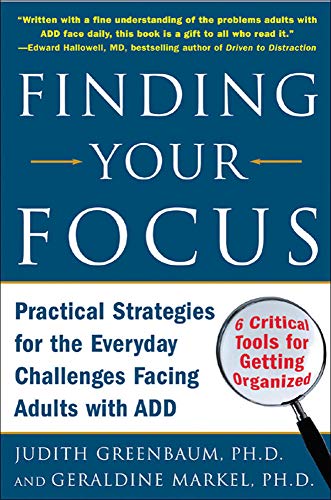
Finding Your Focus: Practical Strategies for the Everyday Challenges Facing Adults with ADD (NTC SELF-HELP) - Softcover
Synopsis
“Filled with tools, strategies, and checklists and written with a fine understanding of the problems adults with ADD face daily. This book is a gift to all who read it.” —Edward Hollowell, M.D., bestselling author of Driven to Distraction
Written by two expert ADD coaches with more than 30 years experience, this practical handbook offers adults with ADD practical techniques for coping with common everyday challenges. These simple proven strategies can help you focus attention, organize your thoughts, and manage time—so you can avoid missing appointments and deadlines, handle social situations, and improve memory skills. A safe alternative to prescription medications, it’s a complete home program that anyone can do.
"synopsis" may belong to another edition of this title.
About the Author
McGraw-Hill authors represent the leading experts in their fields and are dedicated to improving the lives, careers, and interests of readers worldwide
From the Back Cover
Your guide to dealing with the everyday challenges of life with ADD--filled with tools and strategies you can use for a lifetime!
With ADD, every day can be like running a maze of lost car keys, missing files, and forgotten commitments. Simple tasks that other people take for granted can become challenges that test the limits of your ingenuity and patience. Now, there is a wise and compassionate guide through the labyrinth of everyday life with ADD. This book shows you how to become more focused and organized, arming you with proven strategies and tools to help you:
- Meet deadlines
- Keep appointments
- Conquer clutter
- Keep track of your most valuable items
- Overcome procrastination
- Bring order to your chaotic life
- Stop ADD from interfering with your personal relationships
Dr. Judith Greenbaum and Dr. Geraldine Markel draw upon the latest research, as well as their thirty years of experience coaching people of all ages with ADD, to supply you with:
- Numerous checklists to help you manage time, organize and complete tasks, and solve specific problems at home and at work
- Research-based techniques, including self-talk, visualization, and routines
- Tips on how to become more self-aware and maximize your potential
"A wonderful and much needed addition to the books on adults with ADD. The personal and warm approach of the authors comes through loud and clear."
--Sari Solden, M.S., LMFT, author of Women with Attention Deficit Disorder and Journeys Through Adulthood
Excerpt. © Reprinted by permission. All rights reserved.
FINDING YOUR FOCUS
By JUDITH GREENBAUM, GERALDINE MARKELThe McGraw-Hill Companies, Inc.
Copyright © 2006 The McGraw-Hill Companies, Inc.
All rights reserved.
ISBN: 978-0-07-145396-7All rights reserved.
Contents
| Acknowledgments | |
| Introduction | |
| PART I Getting to Know Yourself | |
| 1 Understanding ADD | |
| 2 Identifying Your Strengths and Weaknesses | |
| 3 Your Personal Tool Box | |
| PART II Practical Strategies for Everyday Problems | |
| 4 Help, I Can't Find My Keys! | |
| 5 My House Is a Pigsty! | |
| 6 No Matter How Hard I Try, I'm Always Late | |
| 7 I Have Things to Do, but I Don't Know Where to Begin | |
| 8 People Get Irritated with Me and I Don't Know Why | |
| PART III Looking Ahead to the Future | |
| 9 Medication: Should I? Shouldn't I? | |
| 10 Making Decisions and Setting Goals | |
| Concluding Remarks | |
| Resources | |
| Index |
Excerpt
CHAPTER 1
Understanding ADD
ADD is in the news almost daily. Questions such as "Isn't ADD just a cop-out forsomeone who is lazy?" or "We all have problems with attention at one time oranother—so, what's the big deal?" or "Is there really such a thing asADD?" are bandied about on talk shows, in newspapers, and at cocktail parties.
The answer to the last question is yes, there is such a thing as ADD. It's notjust a cop-out for anyone who is lazy. In fact, people with ADD often workharder than anyone else to meet their responsibilities at home and at work.Although there is no blood test for ADD (as is also true for bipolar disorder orobsessive-compulsive disorder), you can find out whether you have it throughcareful neuropsychological evaluation.
ADD is considered a neurological disorder, and recent research on the brain hasidentified regions in the prefrontal cortex that are smaller or less active thannormal in people with ADD. There is also a tendency for ADD to be genetic. Infact, you may have discovered your ADD after your son or daughter was diagnosedwith it in school.
It is estimated that about 4 percent of the adult population of the UnitedStates, or 8 million people, have ADD. So, you are not the only one in the worldwho is distracted and/or disorganized! In addition, a large proportion of therest of us have had problems with attention and organization at one time oranother. Some of these problems are due to the crazy world in which we live,which demands so much of us. Often we are trying to do two (or more) things atonce (such as trying to be the best parents we can be while doing more thanwhat's required of us at work). We have even coined a new word for this:multitasking. However, the more we try to multitask, the more we will haveproblems with attention: focusing it, sustaining it, and screening outdistractions. If you have ADD, you may think you can multitask successfully, butit is essentially impossible.
In addition, the older we get, the more difficulty we have focusing ourattention. This begins to happen in our forties (about the same time we begin toneed glasses for reading). Problems with attention and organization are notunique to people with ADD, but if you have ADD, these problems will be greaterin intensity and can seriously interfere with your life. Many people with ADDare underemployed or unemployed, or frequently change jobs. They are more likelyto suffer from stress and depression, have low aspirations for themselves, andoften feel "dumb."
It's important to understand that having ADD does not make you any less smartthan other people. Most people with ADD have at least average intelligence, andothers are even gifted. However, it is often the tasks of daily living that cantrip you up.
For example, Hannah, an accomplished painter, totaled her last car because sheforgot to check the oil and the engine seized up (she also forgot to renew herdriver's license). Dwight, a respected teacher, keeps losing money because itoften falls out of his pocket, in which he shoves it without thinking. Dan, aplant manager, can't find his keys in the morning. Milly, who operates her ownbusiness, can't find her car. The stories from our coaching sessions areendless.
Recognizing Symptoms
Most of the world tends to think that having ADD means having problems withattention and distractibility, period. However, if you have ADD, you may alsoexperience many subtle problems of which you might not be aware. These includethe following:
• Acting or speaking impulsively, without thinking
• Difficulty making decisions
• Restlessness
• Difficulty solving problems and thinking clearly
• Disorganization at work and at home
• Frequently losing things
• Poor sense of time
• Easily becoming frustrated or angered
• Difficulty following rules or waiting in line
• Difficulty keeping a job
• Difficulty keeping friends
• Alcoholism and drug abuse
As if this were not enough, people with ADD often develop emotional problems dueto their history of school failure and/or under-achievement. Add to that thefrustration and anxiety that can come with constantly trying to be successful ina world that seems to often misunderstand you and not give you enough time tothink things through. The good news is that nobody has all of these problems, oreven most of them!
You need to understand which problems you do have, and when and in whatsituations they occur. Often problems with attention are situation specific. Forexample, you may have difficulty paying attention when you are bored, but, boy,when you are doing something that interests you, you can work on it for hours.
Many of us have problems with attention or organization. Does this mean we haveADD? Not necessarily. Unless these problems greatly interfere with your life,you probably don't have ADD.
Getting a Diagnosis: How to Tell If You Have ADD
Evaluations for ADD usually begin with a checklist in which you examine all thesymptoms you may be having. If your physician doesn't have such a checklist, goto a licensed psychologist or social worker who specializes in ADD. If theanswers on the checklist point to ADD, you may want to go one step further. Anin-depth neuropsychological evaluation can uncover what your specificdifficulties are—whether you have problems with working memory, or youprocess information slowly, or you have dyslexia. This type of evaluation cangive you a good picture of your-self—highlighting your strengths and yourweaknesses. ADD can make you feel confused and frustrated because your troublesdo not make sense to you. For example, you feel in your bones that you're smart,but you're not making the grade. Often it is only with a comprehensiveevaluation that the subtle yet complex problems underlying these difficultiescan be isolated.
In addition, you may want an official diagnosis of ADD in order to becomeeligible for support and accommodations under the Americans with DisabilitiesAct (ADA). Accommodations in the workplace can help you maximize your strengthswhile bypassing your weaknesses. Here are some examples of accommodations:
• Arranging for you to have a distraction-free workstation
• Requiring you to read less
• Providing you with someone to take notes while you talk
• Having someone help you organize your office
ADD Is Not the Only Cause of Attention Problems
Another reason for getting a diagnosis is that there could be many causes foryour having problems focusing your attention that have little to do with ADD.Here are some possibilities:
• A noisy and chaotic environment
• Work that is too difficult for you and not the right fit for your skills (Ifyou continue to be faced with this task and you don't receive any help, yourmind will eventually begin to wander.)
• Work that is boring and/or repetitive (Here too it is hard to keep your mind on the work.)
• Chronic stress that makes it difficult for you to concentrate
• Perfectionism (You think that nothing you do is ever good enough, so you workand rework something—often missing deadlines. Perfectionism can lead toprocrastination in some people with ADD, but it is also a common trait amongmany other people.)
• Anxiety or depression that interferes with your ability to concentrate
• Learning disabilities or dyslexia—without ADD—which can cause youto have such difficulty reading that you eventually stop paying attention whenyou are reading
• Side effects of certain medications that can make it difficult to concentrate
• Psychiatric or seizure disorders
In order to determine if your attention problems are caused by ADD or arerelated to something else, you should consult with a physician, psychologist, orpsychiatrist. It is often difficult to determine which problems are caused bydepression, anxiety, or a physical ailment such as diabetes, and which arecaused by ADD.
Some Treatment Options
There are essentially three approaches to treating ADD:
• Counseling with a psychiatrist, psychologist, or social worker
• Medication
• Coaching or retraining
Psychotherapy can help you understand ADD, how it affects you, and how to cometo terms with it. It can address such conditions as anxiety, depression, andfeelings of failure that may be either separate from ADD or caused by it.
We're coaches, so we're a little biased here, but coaching and retraining canprovide you with strategies you can use in your daily life to prevent or find away around your particular problem. A coach can also provide you with theencouragement to get back on track. This book contains the many strategies wehave used for more than thirty years in treating our clients with ADD.
While taking medications for ADD can allow you to profit from coaching andretraining, medication alone is rarely enough to get you back on track. We talkmore about the decision to take medication in Chapter 9.
Many people with ADD combine all three approaches for the best results.
The Role of Attention
Attention is the key to effective functioning. It is also the cornerstone ofmemory. If you don't or can't pay attention to a piece of new information, youwill not be able to remember it or use it. If you don't pay attention todirections, you will not be able to correctly finish a task or solve a problem.If you don't pay attention to where you are putting something, you probablywon't be able to find it when you want it.
We are not defining attention as passively glancing over a passage to be read orletting something "go in one ear and out the other." Many of us think we arepaying attention when we behave this way, but in fact, we are not. Rather,attention is an active process. It involves consciously focusing on newinformation long enough to incorporate it into your working memory. Researcherstend to agree that there are four types of attention:
• Selective attention helps us single out one important thing on which to focusand at the same time screen out unrelated or unimportant things.
• Sustained attention helps us maintain our focus until we complete a task.
• Shifting attention enables us to move smoothly from one selected thing toanother and back, as needed.
• Divided attention enables us to attend to more than one thing at a time.
If you have ADD, you may have trouble with one or more aspects of attention. Forexample, you can have difficulty in both focusing your attention and in decidingwhat aspect of a situation to focus on (and what to screen out). Screening outdistractions can be difficult for people with ADD. These distractions can beaudio (such as other people talking or a bird singing) or visual (such as anaccident on the highway or too many posters and notices on the wall of youroffice).
In addition, thoughts and emotions can be distractions. For example, if you aretrying to solve a problem when you are worried or depressed, you will havedifficulty focusing on what you are doing. It can be equally distracting if youare thinking of the vacation you are planning to take next week while trying tocomplete a project.
Sustaining attention can be a problem for anyone who is working on a boringtask. Most of us have to invent a few tricks in order keep ourselves working onsomething that doesn't interest us. However, with ADD, you often turn away fromboring tasks and even have considerable difficulty finishing a task about whichyou were initially enthusiastic. Shifting attention back and forth among severaltasks can also be difficult because the need to shift attention just compoundsthe problems you have in focusing your attention in the first place.
Divided attention is the most problematic. For example, it is relatively easy totalk on the telephone while washing the dishes. However, it is relativelyimpossible to listen to someone talk and to read at the same time—if wewant to get something out of either activity. A requirement to work on severalprojects simultaneously, shifting from task to task and back, is a recipe forfailure when you have ADD.
ADD and Organizational Abilities
ADD can affect both your attention and your organizational abilities. Theseorganizational abilities are called executive functions. Executive functions area group of coordinated skills that help us see a task through from beginning toend. In many cases, the most serious problems people have both at home and atwork are caused by faults in executive functioning.
To understand executive functions in action, think of an executive of a largecorporation, working in his wood-paneled corner office high on the sixtiethfloor. He is on the telephone. His secretary stands by his side, handing himletters to sign while his second-in-command waits impatiently in the outeroffice with an important contract to discuss. Think of all the things thisexecutive has to do in order to make his company run smoothly:
• Set production goals for the company
• Make plans for both the long term and short term
• Monitor the company's progress
• Conduct top-level meetings
• Make decisions affecting every part of the company
• Analyze a potential project to see what is required
• Develop policies and procedures
• Prioritize work to be done
• Set time lines for projects
• Change course if necessary
• Look back when a job is completed to determine what went right—or wrong
He does all of this while conducting a telephone conversation, talking toindividual staff members, and dictating and signing letters.
Not everyone can do all of this. There is a huge range of abilities when itcomes to executive functions. Fortunately, most of us do not need all or most ofthese abilities in order to function well in our daily lives. But, if you thinkabout it, we do need to be able to do many of these things. Good executivefunctioning is important for work, the tasks of daily living, and family/sociallife. Executive functions help us perform the following tasks:
• Get to work on time (and get to appointments on time)
• Begin and complete an important project in a timely fashion
• Manage money (and stop impulsive spending)
• Solve problems effectively and efficiently—weighing all alternatives
• Use good judgment (and not act impulsively)
• Overcome procrastination
• Interact appropriately with other people
• Remember where we've put things
• Organize our household or office
Throughout this book, you will find strategies to help you with these executivefunctions.
Is There an Upside to Having ADD?
Although people with ADD may have problems with attention, time management, andorganization, they can be very creative. Your daydreaming and "stream ofconsciousness" thinking can pay off in the form of new inventions, beautifulart, and novel solutions to sticky problems. You can often think "outside of thebox" and can serve as an "idea" person on a team working on a new product.
With ADD, you can often see the "big picture"—what something will looklike once it is accomplished. This is important when you're working on a newproject or inventing a new product. Conversely, you may often notice detailsthat others don't see: a small glitch in a plan or something out of place thatmust be rectified before progress can continue.
In addition, you can be a lot of fun to be around because you can be spontaneousand often have novel ways of entertaining yourself and other people. Some peoplewith ADD have an uncanny ability to hyper-focus on subjects they findinteresting, to the exclusion of everything else. This ability can be veryuseful, depending on what you are supposed to be doing at the moment. Inaddition, you may possess many fine traits that have nothing to do with ADD.Remember, ADD does not define who you are.
How This Book Can Help You
We hope that this chapter has helped you understand more about ADD. As you readthe next chapter, you will come to understand that ADD is only a part of who youare. It is important that you accept the fact that you have ADD and view it as achallenge to overcome.
In succeeding chapters, you will learn how to manage your attention and usenewly acquired time-management and organizational skills as you go through thetasks of daily living. Just by practicing the following three basic strategies,you will gain a greater sense of control over your life: Use routines to helpyou locate some of the things that are important to you—such as your keysand your wallet (Chapter 4); this will enable you to save yourself a great dealof time. Get into the habit of writing daily "to do" lists (Chapter 6); thiswill help you organize your day, and you will be able to accomplish muchmore—in less time! Learn how to make a plan to help you bring in your nextbig project at work on time; this will give you a great feeling ofaccomplishment, and maybe a raise.
In this book, we show you how to accomplish these important tasks as well asmany others to help you find your focus and get on the right track!
(Continues...)
Excerpted from FINDING YOUR FOCUS by JUDITH GREENBAUM. Copyright © 2006 by The McGraw-Hill Companies, Inc.. Excerpted by permission of The McGraw-Hill Companies, Inc..
All rights reserved. No part of this excerpt may be reproduced or reprinted without permission in writing from the publisher.
Excerpts are provided by Dial-A-Book Inc. solely for the personal use of visitors to this web site.
"About this title" may belong to another edition of this title.
Search results for Finding Your Focus: Practical Strategies for the Everyday...

Stock Image
Finding Your Focus
Published by
McGraw-Hill Education - Europe, 2006
ISBN 10: 0071453962
ISBN 13: 9780071453967
Used
Paperback
Seller: World of Books (was SecondSale), Montgomery, IL, U.S.A.
Seller rating 5 out of 5 stars

Paperback. Condition: Good. Offers adults with ADD techniques for coping with common everyday challenges. This book provides strategies that can help them focus attention, organize their thoughts, and manage time - so that they can avoid missing appointments and deadlines, handle social situations, and improve memory skills. Seller Inventory # 00101643917
Stock Image
Finding Your Focus
Published by
McGraw-Hill Education - Europe, 2006
ISBN 10: 0071453962
ISBN 13: 9780071453967
Used
Paperback
Seller: World of Books (was SecondSale), Montgomery, IL, U.S.A.
Seller rating 5 out of 5 stars
Paperback. Condition: Very Good. Offers adults with ADD techniques for coping with common everyday challenges. This book provides strategies that can help them focus attention, organize their thoughts, and manage time - so that they can avoid missing appointments and deadlines, handle social situations, and improve memory skills. Seller Inventory # 00104782975
Stock Image
Finding Your Focus: Practical Strategies for the Everyday Challenges Facing Adults with ADD
Published by
McGraw Hill (edition 1), 2005
ISBN 10: 0071453962
ISBN 13: 9780071453967
Used
Paperback
Seller: BooksRun, Philadelphia, PA, U.S.A.
Seller rating 5 out of 5 stars
Paperback. Condition: Fair. 1. The item might be beaten up but readable. May contain markings or highlighting, as well as stains, bent corners, or any other major defect, but the text is not obscured in any way. Seller Inventory # 0071453962-7-1
Stock Image
Finding Your Focus: Practical Strategies for the Everyday Challenges Facing Adults with ADD
Published by
McGraw Hill (edition 1), 2005
ISBN 10: 0071453962
ISBN 13: 9780071453967
Used
Paperback
Seller: BooksRun, Philadelphia, PA, U.S.A.
Seller rating 5 out of 5 stars
Paperback. Condition: Very Good. 1. It's a well-cared-for item that has seen limited use. The item may show minor signs of wear. All the text is legible, with all pages included. It may have slight markings and/or highlighting. Seller Inventory # 0071453962-8-18
Seller Image
Finding Your Focus: Practical Strategies for the Everyday Challenges Facing Adults with ADD
Seller: Greenworld Books, Arlington, TX, U.S.A.
Seller rating 5 out of 5 stars
Condition: very_good. Fast Free Shipping â" Very Good condition book with a firm cover and clean pages. Shows normal use and some light wear or limited notes markings. A solid, nice copy to enjoy. Seller Inventory # GWV.0071453962.VG
Seller Image
Finding Your Focus: Practical Strategies for the Everyday Challenges Facing Adults with ADD
Seller: Goodwill Books, Hillsboro, OR, U.S.A.
Seller rating 5 out of 5 stars
Condition: acceptable. Fairly worn, but readable and intact. If applicable: Dust jacket, disc or access code may not be included. Seller Inventory # GICWV.0071453962.A
Stock Image
Finding Your Focus: Practical Strategies for the Everyday Challenges Facing Adults with Add
Seller: ThriftBooks-Dallas, Dallas, TX, U.S.A.
Seller rating 5 out of 5 stars
Paperback. Condition: Good. No Jacket. Pages can have notes/highlighting. Spine may show signs of wear. ~ ThriftBooks: Read More, Spend Less. Seller Inventory # G0071453962I3N00
Stock Image
Finding Your Focus: Practical Strategies for the Everyday Challenges Facing Adults with Add
Seller: ThriftBooks-Phoenix, Phoenix, AZ, U.S.A.
Seller rating 5 out of 5 stars
Paperback. Condition: Very Good. No Jacket. May have limited writing in cover pages. Pages are unmarked. ~ ThriftBooks: Read More, Spend Less. Seller Inventory # G0071453962I4N00
Stock Image
Finding Your Focus: Practical Strategies for the Everyday Challenges Facing Adults with Add
Seller: ThriftBooks-Atlanta, AUSTELL, GA, U.S.A.
Seller rating 5 out of 5 stars
Paperback. Condition: Very Good. No Jacket. May have limited writing in cover pages. Pages are unmarked. ~ ThriftBooks: Read More, Spend Less. Seller Inventory # G0071453962I4N00
Stock Image
Finding Your Focus: Practical Strategies for the Everyday Challenges Facing Adults with Add
Seller: ThriftBooks-Dallas, Dallas, TX, U.S.A.
Seller rating 5 out of 5 stars
Paperback. Condition: Very Good. No Jacket. May have limited writing in cover pages. Pages are unmarked. ~ ThriftBooks: Read More, Spend Less. Seller Inventory # G0071453962I4N00