
Items related to The Color of Cities
Synopsis
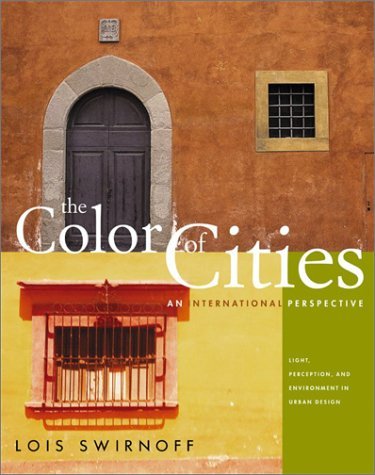
A unique colour dictionary of international urban design and phenomenal photographic reference, The Colour of Cities documents the distinctive colour characteristics of cities in the United States, Europe, the Middle East, Latin America and Asia. The book features beautiful original colour photographs by the author, who is an acclaimed artist and world authority on the three-dimensional use of colour and other noted architectural photographers. Topics covered include how cultural colour preferences are grounded in vision differences in different geographic locations and the similarities within diversity in streets, facades, plazas, boundaries and marketplaces. A reference section provides you with typical colour palettes for each country, complete with thumbnail photographic examples.
"synopsis" may belong to another edition of this title.
About the Author
Lois Swirnoff is a world-renowned authority on the three-dimensional use of color, and is the author of Dimensional Color. A student of Josef Albers at Yale University, she has taught at Harvard University in the Department of Visual and Environmental Studies; at the Cooper Union Art School in New York; and at UCLA, where she is a Professor Emerita. Swirnoff was a Fulbright Scholar to Italy and a Bunting Fellow in Mexico; her work is widely exhibited and is featured in many public and private collections worldwide.
From the Back Cover
THE FIRST MAJOR STUDY OF COLOR IN URBAN DESIGN
Architecture and urban design define a locale by giving it structure and form. But less obviously, and more fundamentally, color has a significant impact on the overall perception of an urban environment. The Color of Cities: An International Perspective is the first book to explore the complex interactions that inform and shape this perception. It documents the use of color in urban areas around the world, showing how color contributes to a city's unique character and appearance.
Over 500 full-color photographs support this ground-breaking work by noted color theorist Lois Swirnoff. Drawing on specific examples from cities in the United States, Europe, the Middle East, Latin America, and Asia, The Color of Cities demonstrates how local color selection is rooted in the geophysical, determined in large part by how colors originate in and are altered by the angle of the Sun's rays. And the book explains how the intensity of light differs globally, from the direct beam of the Equatorial regions to the angular glow of cities near the poles.
Using dimensional color as her premise, Swirnoff explores the links between a culture's distinctive character and its color choices, and describes how color plays a role in building the environment. You'll also see some unexpected similarities in different cities' use of color in standard urban features such as facades, streets and plazas, boundaries, and marketplaces. For easy reference, the book is organized according to these features, with abundant photographic examples for comparison. What's more, a photographic appendix offers a summary overview of the color palettes of cities and locales. It all adds up to the most in-depth, most complete look at the pivotal role of color in urban design and one you'll refer to again and again.
"About this title" may belong to another edition of this title.
Search results for The Color of Cities

Seller Image
The Color of Cities: An International Perspective: Light, Perception, and Environment in Urban Design
Published by
McGraw-Hill, New York, 2000
ISBN 10: 0071411720
ISBN 13: 9780071411721
Used
Hardcover
First Edition
Seller: Lectern Books, Brooklyn, NY, U.S.A.
Seller rating 5 out of 5 stars

Hardcover. Condition: Near Fine. Dust Jacket Condition: Near Fine. First Edition. Small 4to. 230 pp. Near Fine in Near Fine dust jacket. Slight shelfwear to boards. Subtle shelfwear and rubbing to jacket. Seller Inventory # c00557
Stock Image
The Color of Cities: An International Perspective
Seller: AwesomeBooks, Wallingford, United Kingdom
Seller rating 5 out of 5 stars
Paperback. Condition: Very Good. The Color of Cities: An International Perspective This book is in very good condition and will be shipped within 24 hours of ordering. The cover may have some limited signs of wear but the pages are clean, intact and the spine remains undamaged. This book has clearly been well maintained and looked after thus far. Money back guarantee if you are not satisfied. See all our books here, order more than 1 book and get discounted shipping. Seller Inventory # 7719-9780071411721
Buy Used
£ 37.59
£ 4.12 shipping
Ships from United Kingdom to U.S.A.
Ships from United Kingdom to U.S.A.
Quantity: 2 available
Stock Image
The Color of Cities: An International Perspective
Seller: Bahamut Media, Reading, United Kingdom
Seller rating 5 out of 5 stars
Paperback. Condition: Very Good. This book is in very good condition and will be shipped within 24 hours of ordering. The cover may have some limited signs of wear but the pages are clean, intact and the spine remains undamaged. This book has clearly been well maintained and looked after thus far. Money back guarantee if you are not satisfied. See all our books here, order more than 1 book and get discounted shipping. Seller Inventory # 6545-9780071411721
Buy Used
£ 36.84
£ 6.98 shipping
Ships from United Kingdom to U.S.A.
Ships from United Kingdom to U.S.A.
Quantity: 2 available