
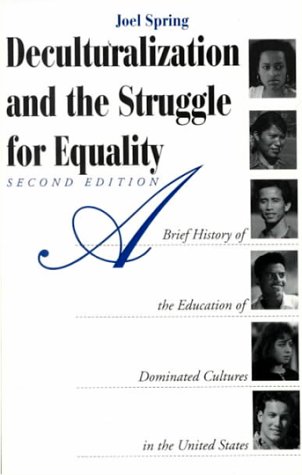
Deculturalization and the Struggle for Equality: Brief History of the Education of Dominated Cultures in the United States - Softcover
Synopsis
This text provides a brief history of the education of dominated cultures in the United States. The dominated groups that it discusses include: native Americans; African Americans; Mexican Americans; Puerto Ricans; and Asian Americans, while European-American culture is considered the dominant culture of the United States. The book's analysis centres around the following three concepts: deculturalization; segregation; and the civil rights movement.
"synopsis" may belong to another edition of this title.
From the Publisher
GROUPS: Chapters 2 and 3 discuss the dramatic effect deculturalization has had on the education of Native Americans and Puerto Ricans.
ECONOMIC EXPLOITATION: Spring discusses segregation in American education in terms of economic exploitation, where a sense of inferiority was created within the segregated group and a sense of superiority within the dominant group. For example, African, Mexican, and Asian Americans were segregated as part of the process of providing inexpensive labor in this country.
CONTEMPORARY: Current issues are discussed such as bilingual education, multicultural education, immigration, and the 'Culture Wars.'
ASIAN AMERICANS: A new Chapter 4 on Asian Americans explores the changing public images of Asian Americans from 'yellow peril' to 'model minority.'
HISPANIC/LATINO AMERICANS: A new Chapter 5 on Hispanic/Latino Americans discusses the difficulty of clearly defining 'Hispanic' and 'Latino' and explores the concept of La Raza and its implications for concepts of cultural identity.
ADDED CONTENT: Concepts of 'race' and 'racism' are based on US citizenship and education laws and court rulings, including the 'drop of blood' rule of Southern states during segregation. The text discusses why for some Americans racism and democracy are not conflicting beliefs but part of a general system of American values.
TIMELINES: Citizenship timelines indicate when each group considered gained full citizenship rights.
COMPING GUIDELINE: While this is a very brief (124 pp.), very focused, point-of-view History of Education text, it often is used in Foundations of and Introduction to Education courses to spur student critical thinking and expand their notions of what US education has been and is. Look for professors using a series of paperbacks.
BOOK'S POSITION: Joel Spring's concise history of Anglo American racism and school policies affecting dominated groups in the United States seeks to expand student notions of what American education has been and is. A pull-out of chapters from Spring's The American School 1642-2000 and very brief and affordable, Deculturalization is an ideal supplement for Introduction/Foundations of Education or Multicultural Education.
About the Author
Joel Spring, professor of education at the New School University, received his Ph.D. in educational policy studies from the University of Wisconsin. His father was born a citizen of the Choctaw Nation in Indian Territory prior to the abolishment of the Choctaw government and the creation of Oklahoma. Professor Spring’s current interest in Native American culture and history is a reflection of his Indian background. His major research interests are the history of education, multicultural education, Native American culture, and the politics of education. Professor Spring is the author of many books including The Cultural Transformation of a Native American Family and Its Tribe 1763-1995: A Basket of Apples; Images of American Life: A History of Ideological Management in Schools, Movies, Radio, and Television; and Political Agendas for Education: From the Christian Coalition to the Green Party. For McGraw-Hill Professor Spring has authored American Education; Wheels in the Head: Educational Philosophies of Authority, Freedom, and Culture from Socrates to Human Rights; The Intersection of Cultures: Multicultural Education in the United States and the Global Economy; Deculturalization and the Struggle for Equality: A Brief History of the Education of Dominated Cultures in the United States, and Conflict of Interests: The Politics of American Education.
"About this title" may belong to another edition of this title.
Other Popular Editions of the Same Title

Search results for Deculturalization and the Struggle for Equality: Brief...

Stock Image
Deculturalization and the Struggle for Equality : A Brief History of the Education of Dominated Cultures in the United States
Published by
McGraw-Hill Higher Education, 1996
ISBN 10: 0070605610
ISBN 13: 9780070605619
Used
Softcover
Seller: Better World Books, Mishawaka, IN, U.S.A.
Seller rating 5 out of 5 stars

Condition: Good. 2nd Edition. Pages intact with minimal writing/highlighting. The binding may be loose and creased. Dust jackets/supplements are not included. Stock photo provided. Product includes identifying sticker. Better World Books: Buy Books. Do Good. Seller Inventory # 244900-6
Stock Image
Deculturalization and the Stru
Seller: World of Books (was SecondSale), Montgomery, IL, U.S.A.
Seller rating 5 out of 5 stars
Condition: Good. Item in good condition. Textbooks may not include supplemental items i.e. CDs, access codes etc. Seller Inventory # 00083734774
Stock Image
Deculturalization and the Struggle for Equality: A Brief History of the Education of Dominated Cultures in the United States
Seller: ThriftBooks-Dallas, Dallas, TX, U.S.A.
Seller rating 5 out of 5 stars
Paperback. Condition: Good. No Jacket. Pages can have notes/highlighting. Spine may show signs of wear. ~ ThriftBooks: Read More, Spend Less. Seller Inventory # G0070605610I3N00
Stock Image
Deculturalization and the Struggle for Equality: A Brief History of the Education of Dominated Cultures in the United States
Seller: ThriftBooks-Atlanta, AUSTELL, GA, U.S.A.
Seller rating 5 out of 5 stars
Paperback. Condition: Very Good. No Jacket. May have limited writing in cover pages. Pages are unmarked. ~ ThriftBooks: Read More, Spend Less. Seller Inventory # G0070605610I4N00
Seller Image
Deculturalization and the Struggle for Equality: A Brief History of the Education of Dominated Cultures in the United States
Seller: Blue Vase Books, Interlochen, MI, U.S.A.
Seller rating 5 out of 5 stars
Condition: acceptable. The item is very worn but is perfectly usable. Signs of wear can include aesthetic issues such as scratches, dents, worn and creased covers, folded page corners and minor liquid stains. All pages and the cover are intact, but the dust cover may be missing. Pages may include moderate to heavy amount of notes and highlighting, but the text is not obscured or unreadable. Page edges may have foxing age related spots and browning . May NOT include discs, access code or other supplemental materials. Seller Inventory # BVV.0070605610.A
Seller Image
Deculturalization and the Struggle for Equality: Brief History of the Education of Dominated Cultures in the United States
Seller: WeBuyBooks, Rossendale, LANCS, United Kingdom
Seller rating 5 out of 5 stars
Condition: Very Good. Most items will be dispatched the same or the next working day. A copy that has been read, but is in excellent condition. Pages are intact and not marred by notes or highlighting. The spine remains undamaged. Seller Inventory # wbs4649178954
Buy Used
£ 10.57
£ 5.81 shipping
Ships from United Kingdom to U.S.A.
Ships from United Kingdom to U.S.A.
Quantity: 1 available