
Items related to Marvel Comics: The Untold Story
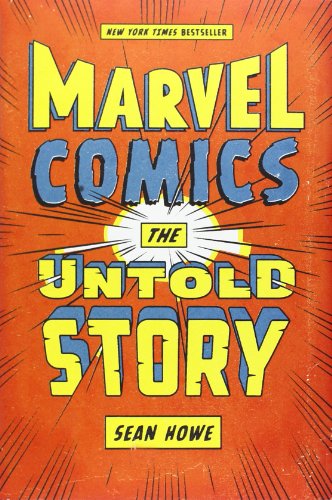
Synopsis
The defining, behind-the-scenes chronicle of one of the most extraordinary, beloved, and dominant pop cultural entities in America’s history -- Marvel Comics – and the outsized personalities who made Marvel including Martin Goodman, Stan Lee, and Jack Kirby.
“Sean Howe’s history of Marvel makes a compulsively readable, riotous and heartbreaking version of my favorite story, that of how a bunch of weirdoes changed the world…That it’s all true is just frosting on the cake.”
—Jonathan Lethem
For the first time, Marvel Comics tells the stories of the men who made Marvel: Martin Goodman, the self-made publisher who forayed into comics after a get-rich-quick tip in 1939, Stan Lee, the energetic editor who would shepherd the company through thick and thin for decades and Jack Kirby, the WWII veteran who would co-create Captain America in 1940 and, twenty years later, developed with Lee the bulk of the company’s marquee characters in a three-year frenzy. Incorporating more than one hundred original interviews with those who worked behind the scenes at Marvel over a seventy-year-span, Marvel Comics packs anecdotes and analysis into a gripping narrative of how a small group of people on the cusp of failure created one of the most enduring pop cultural forces in contemporary America.
"synopsis" may belong to another edition of this title.
About the Author
Sean Howe is the editor of Give Our Regards to the Atomsmashers!: Writers on Comics and the Deep Focus series of film books. He is a former editor and critic at Entertainment Weekly, and his writing has appeared in New York, The Los Angeles Times, Slate, Spin, and The Village Voice. He lives in Brooklyn, New York.
From the Back Cover
An unvarnished, unauthorized, behind-the-scenes account of one of the most dominant pop cultural forces in contemporary America
Operating out of a tiny office on Madison Avenue in the early 1960s, a struggling company called Marvel Comics presented a cast of brightly costumed characters distinguished by smart banter and compellingly human flaws. Spider-Man, the Fantastic Four, Captain America, the Incredible Hulk, the Avengers, Iron Man, Thor, the X-Men, Daredevil—these superheroes quickly won children's hearts and sparked the imaginations of pop artists, public intellectuals, and campus radicals. Over the course of a half century, Marvel's epic universe would become the most elaborate fictional narrative in history and serve as a modern American mythology for millions of readers.
Throughout this decades-long journey to becoming a multibillion-dollar enterprise, Marvel's identity has continually shifted, careening between scrappy underdog and corporate behemoth. As the company has weathered Wall Street machinations, Hollywood failures, and the collapse of the comic book market, its characters have been passed along among generations of editors, artists, and writers—also known as the celebrated Marvel "Bullpen." Entrusted to carry on tradition, Marvel's contributors—impoverished child prodigies, hallucinating peaceniks, and mercenary careerists among them—struggled with commercial mandates, a fickle audience, and, over matters of credit and control, one another.
For the first time, Marvel Comics reveals the outsized personalities behind the scenes, including Martin Goodman, the self-made publisher who forayed into comics after a get-rich-quick tip in 1939; Stan Lee, the energetic editor who would shepherd the company through thick and thin for decades; and Jack Kirby, the World War II veteran who'd co-created Captain America in 1940 and, twenty years later, developed with Lee the bulk of the company's marquee characters in a three-year frenzy of creativity that would be the grounds for future legal battles and endless debates.
Drawing on more than one hundred original interviews with Marvel insiders then and now, Marvel Comics is a story of fertile imaginations, lifelong friendships, action-packed fistfights, reformed criminals, unlikely alliances, and third-act betrayals— a narrative of one of the most extraordinary, beloved, and beleaguered pop cultural entities in America's history.
Excerpt. © Reprinted by permission. All rights reserved.
Marvel Comics
The Untold Story
By Sean HoweHarperCollins Publishers
Copyright ©2012 Sean Howe
All rights reserved.
ISBN: 978-0-06-199210-0All rights reserved.
Excerpt
CHAPTER 1
Long before there was Marvel Comics, there was Martin Goodman.Born in Brooklyn in 1908 to Russian immigrants, the ninth of thirteenchildren, Goodman was such an avid reader as a youth that he would cutup pieces of old magazines and paste them into new creations. But a lifeof leisurely imagination was not an option: his father's construction jobsended with a backbreaking rooftop fall and Isaac Goodman became apeddler. The fifteen members of the Goodman family constantly movedaround Brooklyn, trying to stay one step ahead of their landlords. Martinwas forced to drop out of school in the fifth grade and worked a series ofjobs that failed to excite him. Finally, as he reached the end of his teenyears, he resolved to make a bid for freedom: he set out to travel the countryby train. By the time the Great Depression hit America, he'd alreadyracked up journals detailing his coast to coast experiences on railroadsand in hobo camps.
It was his childhood love of magazines that eventually called himhome. Returning to New York, he found work singing the praises of pulpsas a publisher's representative for Eastern Distributing. Eastern soon fellapart, but Goodman's fortune only rose: he and his coworker LouisSilberkleit joined forces to form Newsstand Publications. From a dingyoffice in lower Manhattan, they turned out westerns, detective stories,and romance tales at fifteen cents an issue.
Lone Ranger rip-offs may not have been high art, but, somewhatimprobably, Martin Goodman had ascended from poor immigrant torail hopper to magazine editor. Slight, quiet, his arched eyebrowsoverwhelming his wire- frame eyeglasses and a bow tie punctuatingone of his many crisp pink shirts, Goodman even had prematurelywhitened hair that neatly completed his transformation from street kidto businessman.
He was twenty-five.
In 1934, Newsstand Publications' distributor went under, costing Goodmanand Silberkleit several thousand dollars in lost payments. Newstandwas unable to meet payments to its printer; its assets were seized.
Silberkleit abandoned the company, but an eager Goodman convincedthe printer that it stood to make back its money if it allowed him to continuepublishing some of the titles. Goodman's cunning instincts quickly carriedthe company back into profitability; within a couple years, he'd moved intothe considerably more elegant RKO Building uptown. He'd devised a simpleformula for success: "If you get a title that catches on, then add a few more,"he told Literary Digest, "you're in for a nice profit."
It was all about staying on top of trends, not providing anything more thandisposable literature. "Fans," he decreed, "are not interested in quality."When the market crashed again, Goodman stayed afloat: he simply filledout his magazines with unlabeled reprints of other publishers' stories.Now he was in a financial position to set his parents up in a little housein the Crown Heights section of Brooklyn. He could also afford to relax.On a cruise ship to Bermuda, he approached two young women playingPing Pong and asked to play the winner. Jean Davis - also a New Yorker,but from a more cultured and sophisticated New York - soon becamethe apple of Goodman's eye. Back in America, Jean was on-again, off-againabout having a serious relationship, but Goodman threw everythinghe could into the courtship. Once, scraping into his bank account, heflew her to Philadelphia for a dinner and a concert performance. Eventually,he won her over, and she became his bride. They honeymooned inEurope, with plans to return on the fashionable Hindenburg - but therewere no two seats together, so they changed their plans at the last momentand caught a plane. Martin Goodman's luck just kept improving.Goodman was publishing more than two dozen magazines by 1939,with names like Two Gun Western, Sex Health, and Marvel Science Stories.(The latter didn't sell especially well, but there was something Goodmanliked about that word, Marvel. He'd remember that one.) He movedhis business into the fashionable McGraw-Hill Building on Forty SecondStreet, where he set about providing steady work for his brothers. Goodman'soperation was, in the words of one editor, a "little beehive of nepotism":
one brother did bookkeeping; one worked in production; one keptan office where he photographed aspiring starlets for the pulps. EvenJean's uncle Robbie got in on the action. Furthermore, the flood of companynames that Goodman shuffled around - advantageous for tax purposesand for quick maneuvering in the event of legal trouble - wereoften derived from family members: there was the Margood PublishingCorp., the Marjean Magazine Corp., and soon, when Jean gave birth tosons Chip and Iden, there would be Chipiden.
The company name that stuck, though, was "Timely," taken fromGoodman's Timely magazine. It was no longer racking up debt, but neitherwas it setting the world on fire. Pulp sales, crowded by the increasedpopularity of radio serials, were starting to go flat. Martin Goodmanneeded a hit.
The American comic book, meanwhile, was beginning to take form. In1933, the Eastern Color Printing Company used its idle presses at nighttime to publish Funnies on Parade, a book of reprints of Sunday newspaperstrips. The strips were printed side by side on a single tabloid page,folded in half and stapled, and sold to Procter & Gamble to give away aspromotional items. The following year, Eastern Color slapped a ten centprice on the cover of Famous Funnies #1, and sold more than 200,000copies through newsstands; soon that title was seeing a profit of $30,000a month. Other publishers gave it a shot. The biggest sellers were repackagedSunday newspaper comic strips like Tarzan, Flash Gordon, and Popeye,but New Fun, a black and white, ten by fifteen inch anthology ofunpublished strips, became the first comic book of all new material. By1937, a few enterprising men set up packaging services in which comicbooks were produced by efficient assembly lines, in the tradition of garmentfactories. A writer would hand his script off to an efficient assemblyline of out of work veteran illustrators and young art school graduatesarmed with fourteen by twenty-one inch Bristol board. In turn, theywould break the action down into a series of simply rendered panels, fleshout the drawings in pencil, add backgrounds, embellish the artwork withink, letter the dialogue, and provide color guides for the printer. It wasn'ta way to get rich, but in the throes of the Depression, it was steady work.And then, in 1938, Jerry Siegel and Joe Shuster, two twenty-three yearolds from Cleveland, sold a thirteen page story called "Superman" toNational Allied Publications for $130. The character was a mix of everythingkids liked - pulp heroes, science fiction stories, classical myths - rolledup into one glorious, primary colored package. The "champion of theoppressed, the physical marvel who had sworn to devote his existence tohelping those in need" fought corporate greed and crooked politicians,and preached for social reform at every turn, a perfect fantasy for theNew Deal era. But Superman was more than just a symbol; his secretidentity as the mewling Clark Kent offered even the loneliest readers afellow outsider with whom to identify. Premiering in the cover feature ofAction Comics #1, Superman became a surprise runaway success, and byits seventh issue, Action was selling half a million copies per issue.
National's sister company Detective Comics (they'd soon merge and cometo be known as DC Comics) introduced Batman, another caped avenger,and gave Superman his own title - just as competitors rolled out a waveof colorfully costumed knockoffs. (Legend claimed that the publisher ofWonder Man, one of the earliest and most blatant imitations, had beenan accountant for the head of National until he saw the numbers onAction and quickly set up his own company.)
Lloyd Jacquet, a soft spoken, pipe smoking ex-colonel, decampedfrom his position as art director of Centaur Comics and, following theleads of others, went into business as a comic book packager, churningout stories for trend hopping publishers. Chief among the artists Jacquetgrabbed from Centaur and assigned to develop new superheroes for hisnew concern - Funnies, Inc. - were Carl Burgos and Bill Everett. Bothwere twenty-one years old and restless. Burgos had quit the NationalAcademy of Design, impatient with the speed at which he was beingtaught; Everett, a three pack a day smoker and already a decade intoserious drinking, had bounced between Boston, Phoenix, Los Angeles,and Chicago. Now they sat down at a Manhattan bar called the Websterand hammered out their plans for superheroes. They kept it simple: fireand water.
Burgos came up with the idea of a brilliant but avaricious scientist,Professor Phineas T. Horton, who creates a synthetic man within a gianttest tube, only to see him burst into flames upon contact with oxygen.The "Human Torch" needs no costume: his featureless face and vagueanatomy, both reddened and obscured by wisps of fire, are surrounded bystray, tear shaped bursts that fly off him like nervous crimson sweat, andthe flares at the top of his head suggest demonic intent. He is, in otherwords, a creature flickering with fear and anger. Upon his inevitableescape, he sets about shooting fireballs from his hands and scaring thebejeezus out of cops and criminals alike; Burgos's low budget primitiviststyle only increased the sense that the flimsy buildings, cars, and peoplethe Torch encountered were hastily constructed only to be destroyed inshort measure. By the end of his first adventure, the Human Torch learnsto control his powers, but he's a man on the run.
Everett's contribution, which borrowed from Jack London's maritimeadventure tales, Coleridge's "Rime of the Ancient Mariner," andGiambologna's Mercury, was Prince Namor, the Sub-Mariner. After an arcticexpedition unknowingly causes destruction to the underwater settlementof an aquatic race, the amphibious emperor sends his daughter to spy onthe humans. The princess marries the expedition's commander, gathersintelligence for her homeland, and, before returning to the ocean, conceivesa son. Nineteen years later, the pointy-eared, pointy-eyebrowed,widow-peaked Namor, clad only in swimming trunks (and graced withwinged feet), is "an ultra- man of the deep ... flies in the air ... has thestrength of a thousand men" - and he seeks revenge on America. Puttinghis powers to scary use, he murders two deep sea divers (one via viciousstabbings, the other via head crushing) and then shoves their ship into areef. The faint horizontal lines, lonely bubbles, and levitating objects thatEverett administered in ink wash to convey the sub-aquatic world gave theproceedings an eerie, theremin-ready ambiance, although such subtletiesof mood were necessarily temporary. Pages later, the creepy languor ofthe saltwater battles gives way to pure action, as Namor hurls a pilot froma biplane and "dives into the ocean again - on his way to further adventuresin his crusade against the white men!" Unredeemingly violent andwillfully unassimilated, the sneering Sub-Mariner was the reverse negativeof the alien-as-immigrant hero Superman.
The Sub-Mariner strip was marked for inclusion in Motion PicturesFunnies Weekly, a giveaway comic that movie theaters would distributeto movie going kids, in hopes that they'd be hooked enough to show up forthe following week. But Motion Pictures Funnies stalled out, never goingto press except for a handful of sample copies that were handed out totheater owners.
Luckily, the Funnies, Inc. sales agent, a compact and balding Irishmannamed Frank Torpey, had connections, and one of them was MartinGoodman, with whom he'd worked at Eastern Distributing. Torpeygrabbed copies of Superman and Amazing Man (a title that Everett hadrecently done for Centaur), walked three blocks north from the shabbybuilding that housed the Funnies, Inc. loft, and entered the pristine blue-greenArt Deco skyscraper headquarters of Timely, where he made thepitch to his old friend Goodman. Comics, Torpey said, were easy money.They made a deal for Goodman to publish the Human Torch and Sub-Marinerstrips in a new comic book anthology. Goodman already had aperfect idea for a title.
Marvel Comics #1, produced entirely by Jacquet's team, covered allthe popular bases in its sixty-four pages: Paul Gustavson's mustachioed,Saint-like Angel, Ben Thompson's jungle adventurer – Ka-Zar(a Tarzan knockoff, resurrected from one of Goodman's pulps),Al Anders's cowboy the Masked Raider, and gag cartoons to fill it out.Goodman commissioned a cover from veteran pulp illustrator Frank R. Pauland Timely's first comic book was published on August 31, 1939. Hours later,halfway around the world, Nazi Germany invaded Poland. World WarII was in motion.
Marvel Comics #1 sold 80,000 copies in September 1939, and soGoodman went back to press. Eventually it sold 800,000 - better than theaverage DC Comics title. In the years to come, Timely staffers wouldtalk about seeing Frank Torpey darting in and out of Goodman's office,moving so fast they thought he was a messenger. The truth was that hewas just collecting twenty-five dollars, a weekly thank you from MartinGoodman for pulling him into the comic book industry.
(Continues...)
Excerpted from Marvel Comics by Sean Howe. Copyright © 2012 by Sean Howe. Excerpted by permission of HarperCollins Publishers.
All rights reserved. No part of this excerpt may be reproduced or reprinted without permission in writing from the publisher.
Excerpts are provided by Dial-A-Book Inc. solely for the personal use of visitors to this web site.
"About this title" may belong to another edition of this title.
Search results for Marvel Comics: The Untold Story

Stock Image
Marvel Comics: The Untold Stor
Seller: World of Books (was SecondSale), Montgomery, IL, U.S.A.
Seller rating 5 out of 5 stars

Condition: Good. Good condition ex-library book with usual library markings and stickers. Seller Inventory # 00105409147
Stock Image
Marvel Comics: The Untold Stor
Seller: World of Books (was SecondSale), Montgomery, IL, U.S.A.
Seller rating 5 out of 5 stars
Condition: Very Good. Item in very good condition! Textbooks may not include supplemental items i.e. CDs, access codes etc. Seller Inventory # 00110399051
Stock Image
Marvel Comics: The Untold Stor
Seller: World of Books (was SecondSale), Montgomery, IL, U.S.A.
Seller rating 5 out of 5 stars
Condition: Acceptable. Item in acceptable condition! Textbooks may not include supplemental items i.e. CDs, access codes etc. Seller Inventory # 00106320241
Stock Image
Marvel Comics: The Untold Story
Seller: ThriftBooks-Atlanta, AUSTELL, GA, U.S.A.
Seller rating 5 out of 5 stars
Hardcover. Condition: Fair. No Jacket. Former library book; Readable copy. Pages may have considerable notes/highlighting. ~ ThriftBooks: Read More, Spend Less. Seller Inventory # G0061992100I5N10
Stock Image
Marvel Comics : The Untold Story
Published by
HarperCollins Publishers, 2012
ISBN 10: 0061992100
ISBN 13: 9780061992100
Used
Hardcover
Seller: Better World Books, Mishawaka, IN, U.S.A.
Seller rating 5 out of 5 stars
Condition: Good. Pages intact with minimal writing/highlighting. The binding may be loose and creased. Dust jackets/supplements are not included. Stock photo provided. Product includes identifying sticker. Better World Books: Buy Books. Do Good. Seller Inventory # 4609821-6
Stock Image
Marvel Comics : The Untold Story
Published by
HarperCollins Publishers, 2012
ISBN 10: 0061992100
ISBN 13: 9780061992100
Used
Hardcover
Seller: Better World Books, Mishawaka, IN, U.S.A.
Seller rating 5 out of 5 stars
Condition: Good. Former library copy. Pages intact with minimal writing/highlighting. The binding may be loose and creased. Dust jackets/supplements are not included. Includes library markings. Stock photo provided. Product includes identifying sticker. Better World Books: Buy Books. Do Good. Seller Inventory # 4368637-6
Seller Image
Marvel Comics: The Untold Story
Seller: 2nd Life Books, Burlington, NJ, U.S.A.
Seller rating 5 out of 5 stars
Condition: very_good. Used book in very good condition. May have some minor wear. May NOT include discs, or access code or other supplemental material. Ships directly from Amazon and is eligible for Prime or super saver FREE shipping. We ship Monday-Saturday and respond to inquiries within 24 hours. Seller Inventory # BXM.ELOW
Stock Image
Marvel Comics: The Untold Story
Published by
HarperCollins Publishers Inc, 2012
ISBN 10: 0061992100
ISBN 13: 9780061992100
Used
Hardcover
Seller: World of Books Inc, Montgomery, IL, U.S.A.
Seller rating 4 out of 5 stars

Hardback. Condition: Very Good. Shows how Marvel's identity has continually shifted, careening between scrappy underdog and corporate behemoth. The author also introduces the men behind the magic, including self-made publisher Martin Goodman, energetic editor Stan Lee, and Jack Kirby, the WWII veteran and co-creator of many of the company's marquee characters. Seller Inventory # CIN0061992100VG
Stock Image
Marvel Comics: The Untold Story
Published by
HarperCollins Publishers Inc, 2012
ISBN 10: 0061992100
ISBN 13: 9780061992100
Used
Hardcover
Seller: World of Books Inc, Montgomery, IL, U.S.A.
Seller rating 2 out of 5 stars

Hardback. Condition: Good. Shows how Marvel's identity has continually shifted, careening between scrappy underdog and corporate behemoth. The author also introduces the men behind the magic, including self-made publisher Martin Goodman, energetic editor Stan Lee, and Jack Kirby, the WWII veteran and co-creator of many of the company's marquee characters. Seller Inventory # CIN0061992100G
Stock Image
Marvel Comics: The Untold Story
Seller: HPB Inc., Dallas, TX, U.S.A.
Seller rating 5 out of 5 stars
Hardcover. Condition: Very Good. Connecting readers with great books since 1972! Used books may not include companion materials, and may have some shelf wear or limited writing. We ship orders daily and Customer Service is our top priority! Seller Inventory # S_475106539