
Items related to Can Capitalism Survive?: Creative Destruction and the...
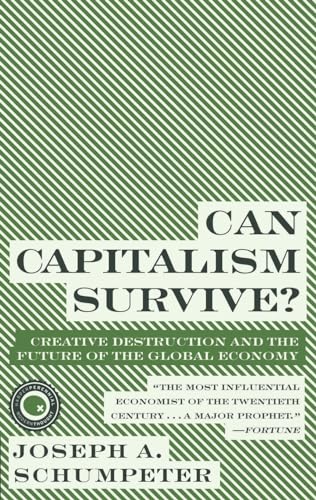
Can Capitalism Survive?: Creative Destruction and the Future of the Glob (Harper Perennial Modern Thought) - Softcover
Synopsis
"Schumpeter was the most farsighted of twentieth-century economists. His focus on capitalism and creative destruction made him the prophet of globalization." -- The Nation
In this new addition to the Harper Perennial Modern Thought series, preeminent economist Joseph Schumpeter, author of Capitalism, Socialism, and Democracy, offers his celebrated answer to question everyone is now asking: Can Capitalism Survive? His answer: "No. I do not think it can." Learn his fascinating reason why in this book of philosophy, considered by many economists to be the finest analysis of capitalism ever written.
"synopsis" may belong to another edition of this title.
About the Author
Joseph A. Schumpeter (1883-1950) served as Austria's first finance minister, made and lost a fortune as an investment banker, and taught economics for many years at Harvard. Capitalism, Socialism and Democracy is his best-known work.
From the Back Cover
Considered by many economists to be the finest analysis of capitalism ever written, Can Capitalism Survive? introduces Joseph A. Schumpeter's theory of "creative destruction," stating that in capitalist economies new innovations erode the position of established firms while also providing new and previously unforeseen avenues of economic growth. Today the effects of such advancements as Mp3s--replacing CDs, which in turn had replaced cassettes and vinyl records--have proven his ideas correct. Prophetically arguing that capitalist societies are also subject to "perennial gales" of destruction that wipe away fortunes, this great economist revealed the vast, often chaotic economic landscape of world capitalism. First published in Schumpeter's classic Capitalism, Socialism and Democracy, here is an invaluable guide the global economy.
"About this title" may belong to another edition of this title.
Search results for Can Capitalism Survive?: Creative Destruction and the...

Seller Image
Can Capitalism Survive?: Creative Destruction and the Future of the Global Economy â" The Essential Work on Creative Destruction and Economic Growth (Harper Perennial Modern Thought, 29)
Published by
Harper Perennial Modern Classics, 2009
ISBN 10: 0061928011
ISBN 13: 9780061928017
Used
Softcover
Seller: clickgoodwillbooks, Indianapolis, IN, U.S.A.
Seller rating 4 out of 5 stars

Condition: acceptable. Used - Acceptable: All pages and the cover are intact, but shrink wrap, dust covers, or boxed set case may be missing. Pages may include limited notes, highlighting, or minor water damage but the text is readable. Item may be missing bundled media. Seller Inventory # CSIV.0061928011.A
Stock Image
Can Capitalism Survive?: Creative Destruction and the Future of the Glob
Published by
HarperCollins Publishers Inc, 2009
ISBN 10: 0061928011
ISBN 13: 9780061928017
Used
Paperback
Seller: World of Books (was SecondSale), Montgomery, IL, U.S.A.
Seller rating 5 out of 5 stars

Paperback. Condition: Fair. 2011 Reprint of 1947 Second Edition. Full facsimile of the original edition, not reproduced with Optical Recognition Software. Originally Published as Part I of Capitalism, Socialism and Democracy 1947]. Can capitalism survive? No. I do not think it can. Thus opens Schumpeter's prologue to a section of his 1947 book, Capitalism, Socialism and Democracy. One might think, on the basis of the quote, that Schumpeter was a Marxist. But the analysis that led Schumpeter to his conclusion differed totally from Karl Marx's. Marx believed that capitalism would be destroyed by its enemies (the proletariat), whom capitalism had purportedly exploited, and he relished the prospect. Schumpeter believed that capitalism would be destroyed by its successes, that it would spawn a large intellectual class that made its living by attacking the very bourgeois system of private property and freedom so necessary for the intellectual class's existence. And unlike Marx, Schumpeter did not relish the destruction of capitalism. If a doctor predicts that his patient will die presently, he wrote, this does not mean that he desires it. Seller Inventory # 00110349770
Stock Image
Can Capitalism Survive?: Creative Destruction and the Future of the Glob
Published by
HarperCollins Publishers Inc, 2009
ISBN 10: 0061928011
ISBN 13: 9780061928017
Used
Paperback
Seller: World of Books (was SecondSale), Montgomery, IL, U.S.A.
Seller rating 5 out of 5 stars
Paperback. Condition: Very Good. 2011 Reprint of 1947 Second Edition. Full facsimile of the original edition, not reproduced with Optical Recognition Software. Originally Published as Part I of Capitalism, Socialism and Democracy 1947]. Can capitalism survive? No. I do not think it can. Thus opens Schumpeter's prologue to a section of his 1947 book, Capitalism, Socialism and Democracy. One might think, on the basis of the quote, that Schumpeter was a Marxist. But the analysis that led Schumpeter to his conclusion differed totally from Karl Marx's. Marx believed that capitalism would be destroyed by its enemies (the proletariat), whom capitalism had purportedly exploited, and he relished the prospect. Schumpeter believed that capitalism would be destroyed by its successes, that it would spawn a large intellectual class that made its living by attacking the very bourgeois system of private property and freedom so necessary for the intellectual class's existence. And unlike Marx, Schumpeter did not relish the destruction of capitalism. If a doctor predicts that his patient will die presently, he wrote, this does not mean that he desires it. Seller Inventory # 00109569869
Stock Image
Can Capitalism Survive?: Creative Destruction and the Future of the Global Economy (Harper Perennial Modern Thought)
Published by
Harper Perennial Modern Classics, 2009
ISBN 10: 0061928011
ISBN 13: 9780061928017
Used
Paperback
Seller: HPB-Emerald, Dallas, TX, U.S.A.
Seller rating 5 out of 5 stars
Paperback. Condition: Very Good. Connecting readers with great books since 1972! Used books may not include companion materials, and may have some shelf wear or limited writing. We ship orders daily and Customer Service is our top priority! Seller Inventory # S_485543502
Stock Image
Can Capitalism Survive?: Creative Destruction and the Future of the Global Economy
Published by
Harper Perennial Modern Classics, 2009
ISBN 10: 0061928011
ISBN 13: 9780061928017
Used
Paperback
Seller: Books From California, Simi Valley, CA, U.S.A.
Seller rating 4 out of 5 stars
Paperback. Condition: Fine. Seller Inventory # mon0004142246
Stock Image
Can Capitalism Survive?: Creative Destruction and the Future of the Glob
Published by
HarperCollins Publishers Inc, 2009
ISBN 10: 0061928011
ISBN 13: 9780061928017
Used
Paperback
Seller: World of Books Inc, Montgomery, IL, U.S.A.
Seller rating 4 out of 5 stars
Paperback. Condition: Very Good. 2011 Reprint of 1947 Second Edition. Full facsimile of the original edition, not reproduced with Optical Recognition Software. Originally Published as Part I of Capitalism, Socialism and Democracy 1947]. Can capitalism survive? No. I do not think it can. Thus opens Schumpeter's prologue to a section of his 1947 book, Capitalism, Socialism and Democracy. One might think, on the basis of the quote, that Schumpeter was a Marxist. But the analysis that led Schumpeter to his conclusion differed totally from Karl Marx's. Marx believed that capitalism would be destroyed by its enemies (the proletariat), whom capitalism had purportedly exploited, and he relished the prospect. Schumpeter believed that capitalism would be destroyed by its successes, that it would spawn a large intellectual class that made its living by attacking the very bourgeois system of private property and freedom so necessary for the intellectual class's existence. And unlike Marx, Schumpeter did not relish the destruction of capitalism. If a doctor predicts that his patient will die presently, he wrote, this does not mean that he desires it. Seller Inventory # CIN0061928011VG
Stock Image
Can Capitalism Survive?: Creative Destruction and the Future of the Glob
Published by
HarperCollins Publishers Inc, 2009
ISBN 10: 0061928011
ISBN 13: 9780061928017
Used
Paperback
Seller: World of Books Inc, Montgomery, IL, U.S.A.
Seller rating 4 out of 5 stars
Paperback. Condition: Fair. 2011 Reprint of 1947 Second Edition. Full facsimile of the original edition, not reproduced with Optical Recognition Software. Originally Published as Part I of Capitalism, Socialism and Democracy 1947]. Can capitalism survive? No. I do not think it can. Thus opens Schumpeter's prologue to a section of his 1947 book, Capitalism, Socialism and Democracy. One might think, on the basis of the quote, that Schumpeter was a Marxist. But the analysis that led Schumpeter to his conclusion differed totally from Karl Marx's. Marx believed that capitalism would be destroyed by its enemies (the proletariat), whom capitalism had purportedly exploited, and he relished the prospect. Schumpeter believed that capitalism would be destroyed by its successes, that it would spawn a large intellectual class that made its living by attacking the very bourgeois system of private property and freedom so necessary for the intellectual class's existence. And unlike Marx, Schumpeter did not relish the destruction of capitalism. If a doctor predicts that his patient will die presently, he wrote, this does not mean that he desires it. Seller Inventory # CIN0061928011A
Stock Image
Can Capitalism Survive? Format: Paperback
Published by
Harper Collins Publishers, 2009
ISBN 10: 0061928011
ISBN 13: 9780061928017
New
Softcover
Seller: INDOO, Avenel, NJ, U.S.A.
Seller rating 5 out of 5 stars
Condition: New. Seller Inventory # 9780061928017
Stock Image
Can Capitalism Survive? Format: Paperback
Published by
Harper Collins Publishers, 2009
ISBN 10: 0061928011
ISBN 13: 9780061928017
Used
Softcover
Seller: INDOO, Avenel, NJ, U.S.A.
Seller rating 5 out of 5 stars
Condition: As New. Unread copy in mint condition. Seller Inventory # TN9780061928017
Seller Image
Can Capitalism Survive?: Creative Destruction and the Future of the Glob
Published by
HarperCollins Publishers Inc, US, 2009
ISBN 10: 0061928011
ISBN 13: 9780061928017
New
Paperback
Seller: Rarewaves USA, HEBRON, KY, U.S.A.
Seller rating 5 out of 5 stars
Paperback. Condition: New. Seller Inventory # LU-9780061928017