
Items related to Making Toast: A Family Story
Synopsis
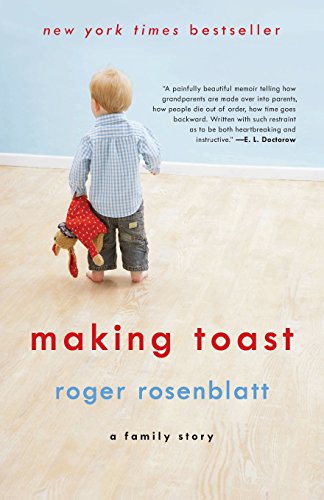
"A painfully beautiful memoir....Written with such restraint as to be both heartbreaking and instructive."
--E. L. Doctorow
A revered, many times honored (George Polk, Peabody, and Emmy Award winner, to name but a few) journalist, novelist, and playwright, Roger Rosenblatt shares the unforgettable story of the tragedy that changed his life and his family. A book that grew out of his popular December 2008 essay in The New Yorker, Making Toast is a moving account of unexpected loss and recovery in the powerful tradition of About Alice and The Year of Magical Thinking. Writer Ann Beattie offers high praise to the acclaimed author of Lapham Rising and Beet for a memoir that is, "written so forthrightly, but so delicately, that you feel you're a part of this family."
"synopsis" may belong to another edition of this title.
About the Author
Roger Rosenblatt's essays for Time and The NewsHour on PBS have won two George Polk Awards, the Peabody, and the Emmy. He is the author of six off- Broadway plays and seventeen books, including New York Times Notable Books Kayak Morning and The Boy Detective, as well as other national bestsellers Unless It Moves the Human Heart, Making Toast, Rules for Aging, and Children of War, which won the Robert F. Kennedy Book Prize and was a finalist for the National Book Critics Circle Award.
From the Back Cover
From O magazine to the New York Times, from authors such as E. L. Doctorow to Ann Beattie, critics and writers across the country have hailed Roger Rosenblatt's Making Toast as an evocative, moving testament to the enduring power of a parent's love and the bonds of family.
When Roger's daughter, Amy--a gifted doctor, mother, and wife--collapses and dies from an asymptomatic heart condition at age thirty-eight, Roger and his wife, Ginny, leave their home on the South Shore of Long Island to move in with their son-in-law, Harris, and their three young grandchildren: six-year-old Jessica, four-year-old Sammy, and one-year-old James, known as Bubbies.
Long past the years of diapers, homework, and recitals, Roger and Ginny--Boppo and Mimi to the kids--quickly reaccustom themselves to the world of small children: bedtime stories, talking toys, play-dates, nonstop questions, and nonsequential thought. Though reeling from Amy's death, they carry on, reconstructing a family, sustaining one another, and guiding three lively, alert, and tenderhearted children through the pains and confusions of grief. As he marvels at the strength of his son-in-law and the tenacity and skill of his wife, Roger attends each day to "the one household duty I have mastered"--preparing the morning toast perfectly to each child's liking.
Luminous, precise, and utterly unsentimental, Making Toast is both a tribute to the singular Amy and a brave exploration of the human capacity to move through and live with grief.
Excerpt. © Reprinted by permission. All rights reserved.
Making Toast
A Family Story
By Roger RosenblattHarperCollins Publishers
Copyright © 2011 Roger Rosenblatt
All rights reserved.
ISBN: 978-0-06-182595-8All rights reserved.
Excerpt
CHAPTER 1
The trick when foraging for a tooth lost in coffeegrounds is not to be misled by the clumps. The onlyway to be sure is to rub each clump between your thumband index finger, which makes a mess of your hands. Forsome twenty minutes this morning, Ginny and I havebeen hunting in the kitchen trash can for the top frontleft tooth of our seven-year-old granddaughter, Jessica.Loose for days but not yet dislodged, the tooth finallydropped into a bowl of Apple Jacks. I wrapped it forsafekeeping in a paper napkin and put it on the kitchen counter,but it was mistaken for trash by Ligaya, Bubbies'snanny. Bubbies (James) is twenty months and theyoungest of our daughter Amy's three children. Sammy,who is five, is uninterested in the tooth search, and Jessieis unaware of it. We hope to find the tooth so that Jessiewon't worry about the Tooth Fairy not showing up.This sort of activity has constituted our life sinceAmy died, on December 8, 2007, at 2:30 p.m., six monthsago. Today is June 9, 2008. The day of her death, Ginnyand I drove from our home in Quogue, on the south shoreof Long Island, to Bethesda, Maryland, where Amy and herhusband, Harris, lived. With Harris's encouragement,we have been there ever since. "How long are you staying?"Jessie asked the next morning. "Forever," I said.Amy Elizabeth Rosenblatt Solomon, thirty-eight years old,pediatrician, wife of hand surgeon Harrison Solomon, and motherof three, collapsed on her treadmill in the downstairs playroom at home."Jessie and Sammy discovered her," our oldest son, Carl,told us on the phone. Carl lives in Fairfax, Virginia, not far fromAmy and Harris, with his wife, Wendy, and their two boys,Andrew and Ryan. Jessie had run upstairs to Harris."Mommy isn't talking," she said. Harris got to Amy withinseconds, and tried CPR, but her heart had stopped and shecould not be revived.
Amy's was ruled a "sudden death due to an anomalousright coronary artery"- meaning that her two coronaryarteries fed her heart from the same side. Normally, thearteries are located on both sides of the heart so that ifone fails, the other can do the work. In Amy's heart, theyran alongside each other. They could have been squeezedbetween the aorta and the pulmonary artery, which canexpand during physical exercise. The blood flow was cutoff . Her condition, affecting less than two thousandthsof one percent of the population, was asymptomatic; shemight have died at any time in her life.
She would have appreciated the clarity of the verdict.Amy was a very clear person, even as a small child,knowing intuitively what plain good sense a particularsituation required. She had a broad expanse of forehead,dark, nearly black hair, and hazel eyes. Both self-confidentand selfless, when she faced you there could be no doubtyou were the only thing on her mind.
Her clarity could make her severe with her family,especially her two brothers. Carl and John, our youngest,withered when she excoriated them for such offensesas invading her room. She could also poke you gentlywith her wit. When she was about to graduate from theNYU School of Medicine, her class had asked me to bethe speaker. A tradition of the school allows a past graduateto place the hood of the gown on a current graduate.Harris, who had graduated the previous year, was set to"hood" Amy. At dinner the night before the ceremony,a friend remarked, "Amy, isn't it great? Your dad is givingthe graduation speech, and your fiancé is doing thehood." Amy said, "It is. And it's also pretty great thatI'm graduating."
Yet her clarity also contributed to her kindness.When she was six, I was driving her and three friends toa birthday party. One of the girls got carsick. The othertwo backed away, understandably, with cries of "Ooh!"and "Yuck!" Amy drew closer to the stricken child, tocomfort her.
Ginny and I moved from a five bedroom house, with aden and a large kitchen, to a bedroom with a connectedbath - the in-law apartment in an alcove off the downstairsplayroom that we used to occupy whenever we visited.We put in a dresser and a desk, and Harris added aTV and a rug. It may have appeared that we were rreducing our comforts, but the older one gets the less spaceone needs, and the less one wants. And we still have ourhouse in Quogue.
I found I could not write and didn't want to. I couldteach, however, and it helped me feel useful. I drive fromBethesda to Quogue on Sundays, and meet my Englishliterature classes and MFA writing workshops atStony Brook University early in the week, then back toBethesda. The drive takes about five hours and a tankof gas each way. But it is easier and faster than flying ortaking a train.
Road rage was a danger those early weeks. I pickedfights with store clerks for no reason. I lost my temperwith a student who phoned me too frequently about herwork. I seethed at those who spoke of Amy's death in the clichésof modern usage, such as "passing" and "closure."
I cursed God. In a way, believing in God made Amy'sdeath more, not less, comprehensible, since the God Ibelieve in is not beneficent. He doesn't care. A friend wasvisiting Jerusalem when he got the news about Amy. Hekicked the Wailing Wall, and said, "Fuck you, God!" Mysentiments exactly.
What's Jessie's favorite winter jacket? The bluenot the pink, though pink is her favorite color. Sammy preferswhole milk in his Fruit Loops or MultiGrain Cheerios.He calls it "cow milk." Jessie drinks only Silksoy milk. She likes a glass of it at breakfast. Sammy preferswater. Such information had to be absorbed quickly.Sammy sees himself as the silver Power Ranger, Jessieis the pink. Sammy's friends are Nico, Carlos, andKipper. Jessie's are Ally, Danielle, and Kristie. Therewere play-dates to arrange, birthday party invitationsto respond to, school forms to fill out. Sammy goes toa private preschool, the Geneva Day School; Jessie toBurning Tree, the local public school. We had to mastertheir schedules.
I re-accustomed myself to things about small childrenI'd forgotten. Talking toys came back into my life. Iwill be walking with the family through an airport, andthe voice of a ventriloquist's dummy in a horror moviewill seep through the suitcase. Buzz Lightyear says, "Toinfinity and beyond!" A talking phone says, "Help me!"Another toy says, "I'm a pig. Can we stop?"
In all this, two things were of immeasurable use tous. First, Leslie Adelman, a friend of Amy's and Harris's,and the mother of friends of the children, createda Web site inviting others to prepare dinners for ourfamily. Emails were sent by Leslie, our daughter-in-law Wendy,Laura Gwyn, another friend and school mother, andBetsy Mencher, who had gone to college with Amy.Soon one hundred people - school families, friends andcolleagues of Amy's and Harris's, neighbors - comprisedthe list. Participants deposited dinners in a blue cooleroutside our front door. Food was provided every otherevening, with enough for the nights in between, frommid-December to the beginning of June.
The second was a piece of straightforward wisdom thatBubbies's nanny gave Harris. Ligaya is a small, lithewoman in her early fifties. I know little of her life exceptthat she is from the Philippines, with a daughterthere and a grown son here who is a supervisor in arestaurant, and that she has a work ethic of steel and theflexibility to deal with any contingency. She also showsa sense of practical formality by calling Bubbies Jamesand not by the nickname Amy had coined, to ensure the morerespectable name for his future. Ligaya alteredher schedule to be with us twelve hours a day, five daysa week - an indispensable gift, especially to her smallcharge, who giggles with delight when he hears her keyin the front door. No one outside the family could havefelt Amy's death more acutely. Yet what she said to Harris,and to the rest of us, was dispassionate: "You are notthe first to go through such a thing, and you are betterable to handle it than most."
Bubbies looks around for Amy, says "Mama" when hesees her pictures, and clings to his father. Bubbies hasblond hair and a face usually occupied by observantsilences. When I am alone with him, he plays happilyenough. I've taught him to give a high five, and whenhe does, I stagger across the room to show him howstrong he is. He likes to take a pot from one kitchencabinet and Zone bars from another, deposit the bars inthe pot, and put back the lid. He'll do this contentedlyfor quite a while. When Harris enters the kitchen, Bubbiesdrops everything, runs to him, and holds him tightat the knees.
Jessie is tall, also blond, with an expression foreveron the brink of enthusiasm. Amy used to say shewas the most optimistic person she'd ever known. Sheis excited about her hip-hop dance class; about a concerther school is giving in Amy's name, to raise moneyfor a memorial scholarship set up at the NYU Schoolof Medicine; about going to the Nutcracker. "Do yourNutcracker dance, Boppo," Jessie says. (Ginny is Mimi, Iam Boppo.) I swing into my improvised ballet, the highpoint of which is when I wiggle my ass like the dancingmice. Jessie is also excited about our trip to DisneyWorld in January, the adventure that Amy and Harrishad planned for themselves and the three childrenmonths before Amy died. We speak of distant summerplans in Quogue. Jessie is excited.
Sammy is tall, too, with dark hair and wide-set,ruminative eyes. He brings me a book to read, about acaterpillar. He brings another, which just happened to be inthe house, called Lifetimes: The Beautiful Way to ExplainDeath to Children. The book says, "There's a beginningand an end for everything that is alive. In between isliving." The book illustrates its lessons with pictures ofbirds, fish, plants, and people. I lean back on the couchwith Sammy tucked in the crook of my arm, and read tohim about the beauty of death.
Like other nonreligious families, ours tends to cherry-pickamong the holidays, adopting those features thatmost appeal to children - eggs and the Bunny at Easter,the tree and Santa at Christmas. Characteristically,Amy had prepared for Christmas long in advance.Unwrapped gifts for Jessie, Sammy, and Bubbies lay hiddenin the house. Traditional ornaments and ones she madeherself had been taken out of their annual storage. Therewere little painted clay like figures representing a familystanding in a row and singing carols, and pictures of herown family as it had grown every year, along with olderornaments that Ginny and I had given her. Amy andHarris had picked out their tree the morning of the dayshe died. It remained on the deck during our first daysof mourning, leaning against a post at a forty-degreeangle, the trunk soaking in a bucket of water. Eventuallywe brought it indoors, and concentrated on making theholiday appear as normal as possible.
On Christmas Eve, Ginny cooked a turkey for Harris,me, and John, who was down from New York fora few days. I read Jessie and Sammy The Night BeforeChristmas as I had done with our own three children,adding nonsense exigeses and pretending to take issuewith words such as "coursers" in an effort to hold theirattention. Last year they had become restive by the timeI got to " ... and all through the house." This year theylistened to the whole thing. When the children wereasleep, Ginny, Harris, and I opened some of the toys thatSanta was about to bring. Jessie still believes, becauseshe wants to. She got an American Girl doll; Sammy,Power Ranger outfits and DVDs; Bubbies, a remote controldog like a beagle puppy, that walked, sat, and yipped.Harris set up the some assembly-required toys.
It took him half an hour to put together an electric racetrack that would have taken me half a day when I was ayoung father. And his structure did not collapse. He andthe children had decorated the tree as well. He strungthe white lights.
Carl and Wendy and their boys usually spend Christmaswith Wendy's family in Pittsburgh, so they came overthe day before Christmas Eve to exchange presents. Carland I gave Harris tickets to the Masters golf tournamentcoming up in April. He had always wanted to go. We gothim two tickets so that he could take a friend. As we laterlearned, he had planned to go with Amy the followingyear to celebrate his fortieth birthday. Because it was alast minute thought, we were not able to get the actualtickets, which we'd reserved, so Carl made up an elegantpresentation of the gift, worded like the announcementof a prize. The lettering stood out against a backgroundof the Masters course in Augusta. We wanted to hide thegift in a bright green sports jacket like the ones Masterswinners are awarded, but we couldn't find one. We hadto settle for an olive-green windbreaker. When we presentedit to Harris, he thought the windbreaker was his gift and washappy with it.
We told him to look in the inside pocket.
He held the piece of paper in his hands, stood, and burst into tears.
(Continues...)
Excerpted from Making Toast by Roger Rosenblatt. Copyright © 2011 by Roger Rosenblatt. Excerpted by permission of HarperCollins Publishers.
All rights reserved. No part of this excerpt may be reproduced or reprinted without permission in writing from the publisher.
Excerpts are provided by Dial-A-Book Inc. solely for the personal use of visitors to this web site.
"About this title" may belong to another edition of this title.
Search results for Making Toast: A Family Story

Seller Image
Making Toast: A Family Story â" A Moving Memoir of Grief and Recovery
Seller: Dream Books Co., Denver, CO, U.S.A.
Seller rating 5 out of 5 stars

Condition: good. Gently used with minimal wear on the corners and cover. A few pages may contain light highlighting or writing, but the text remains fully legible. Dust jacket may be missing, and supplemental materials like CDs or codes may not be included. May be ex-library with library markings. Ships promptly! Seller Inventory # DBV.0061825956.G
Stock Image
Making Toast: A Family Story
Seller: World of Books (was SecondSale), Montgomery, IL, U.S.A.
Seller rating 5 out of 5 stars
Condition: Good. Item in good condition. Textbooks may not include supplemental items i.e. CDs, access codes etc. Seller Inventory # 00091897097
Stock Image
Making Toast: A Family Story
Seller: World of Books (was SecondSale), Montgomery, IL, U.S.A.
Seller rating 5 out of 5 stars
Condition: Acceptable. Item in acceptable condition! Textbooks may not include supplemental items i.e. CDs, access codes etc. Seller Inventory # 00098160519
Stock Image
Making Toast: A Family Story
Seller: World of Books (was SecondSale), Montgomery, IL, U.S.A.
Seller rating 5 out of 5 stars
Condition: Very Good. Item in very good condition! Textbooks may not include supplemental items i.e. CDs, access codes etc. Seller Inventory # 00110385231
Seller Image
Making Toast: A Family Story
Seller: Zoom Books East, Glendale Heights, IL, U.S.A.
Seller rating 5 out of 5 stars
Condition: good. Book is in good condition and may include underlining highlighting and minimal wear. The book can also include "From the library of" labels. May not contain miscellaneous items toys, dvds, etc. . We offer 100% money back guarantee and 24 7 customer service. Seller Inventory # ZEV.0061825956.G
Seller Image
Making Toast: A Family Story
Seller: Reliant Bookstore, El Dorado, KS, U.S.A.
Seller rating 5 out of 5 stars
Condition: good. This book is in good condition with very minimal damage. Pages may have minimal notes or highlighting. Cover image on the book may vary from photo. Ships out quickly in a secure plastic mailer. Seller Inventory # RDV.0061825956.G
Seller Image
Making Toast: A Family Story
Seller: Greenworld Books, Arlington, TX, U.S.A.
Seller rating 5 out of 5 stars
Condition: acceptable. Fast Free Shipping â" A well-loved copy with text fully readable and cover pages intact. May display wear such as writing, highlighting, bends, folds or library marks. Still a complete and usable book. Seller Inventory # GWV.0061825956.A
Seller Image
Making Toast: A Family Story â" A Moving Memoir of Grief and Recovery
Seller: Greenworld Books, Arlington, TX, U.S.A.
Seller rating 5 out of 5 stars
Condition: very_good. Fast Free Shipping â" Very Good condition book with a firm cover and clean pages. Shows normal use and some light wear or limited notes markings. A solid, nice copy to enjoy. Seller Inventory # GWV.0061825956.VG
Stock Image
Making Toast
Published by
HarperCollins Publishers Inc, 2011
ISBN 10: 0061825956
ISBN 13: 9780061825958
Used
Paperback
Seller: World of Books Inc, Montgomery, IL, U.S.A.
Seller rating 2 out of 5 stars

Paperback. Condition: Fair. "A painfully beautiful memoir.Written with such restraint as to be both heartbreaking and instructive." --E. L. Doctorow A revered, many times honored (George Polk, Peabody, and Emmy Award winner, to name but a few) journalist, novelist, and playwright, Roger Rosenblatt shares the unforgettable story of the tragedy that changed his life and his family. A book that grew out of his popular December 2008 essay in The New Yorker, Making Toast is a moving account of unexpected loss and recovery in the powerful tradition of About Alice and The Year of Magical Thinking. Writer Ann Beattie offers high praise to the acclaimed author of Lapham Rising and Beet for a memoir that is, "written so forthrightly, but so delicately, that you feel you're a part of this family.". Seller Inventory # CIN0061825956A
Stock Image
Making Toast
Published by
HarperCollins Publishers Inc, 2011
ISBN 10: 0061825956
ISBN 13: 9780061825958
Used
Paperback
Seller: World of Books Inc, Montgomery, IL, U.S.A.
Seller rating 2 out of 5 stars
Paperback. Condition: Good. "A painfully beautiful memoir.Written with such restraint as to be both heartbreaking and instructive." --E. L. Doctorow A revered, many times honored (George Polk, Peabody, and Emmy Award winner, to name but a few) journalist, novelist, and playwright, Roger Rosenblatt shares the unforgettable story of the tragedy that changed his life and his family. A book that grew out of his popular December 2008 essay in The New Yorker, Making Toast is a moving account of unexpected loss and recovery in the powerful tradition of About Alice and The Year of Magical Thinking. Writer Ann Beattie offers high praise to the acclaimed author of Lapham Rising and Beet for a memoir that is, "written so forthrightly, but so delicately, that you feel you're a part of this family.". Seller Inventory # CIN0061825956G