
Items related to Lincoln's Assassins: Their Trial and Execution
Synopsis
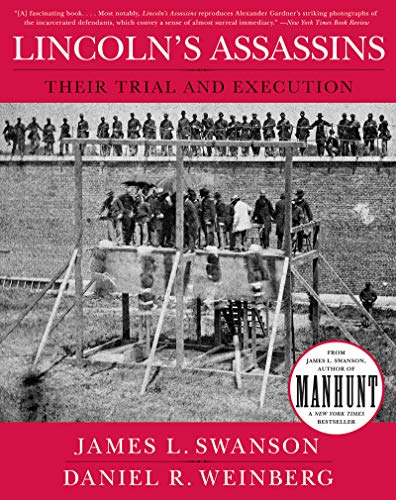
This definitive illustrated history of Abraham Lincoln's assassination follows the shocking events from the tragic scene at Ford's Theatre to the trial and execution of John Wilkes Booth's coconspirators. Few remember them today, but once the names Mary Surratt, Lewis Powell, David Herold, George Atzerodt, Edman Spangler, Samuel Arnold, Michael O'Laughlin, and Dr. Samuel Mudd were the most reviled and notorious in America.
In Lincoln's Assassins, James L. Swanson and Daniel R. Weinberg present an unprecedented visual record of almost three hundred contemporary photographs, letters, documents, prints, woodcuts, newspapers, pamphlets, books, and artifacts, many hitherto unpublished. These rare materials evoke the popular culture of the time, record the origins of the Lincoln myth, take the reader into the courtroom and the cells of the accused, document the beginning of American photojournalism, and memorialize the fates of the eight conspirators.
"synopsis" may belong to another edition of this title.
About the Authors
James L. Swanson (1959-2025) is the author of the New York Times bestseller Manhunt: The 12-Day Chase for Lincoln's Killer, which won an Edgar Award and was adapted into an acclaimed Apple TV+ series. His other books include Bloody Crimes: The Funeral of Abraham Lincoln and the Chase for Jefferson Davis. Swanson served on the advisory council of the Ford's Theatre Abraham Lincoln Bicentennial Campaign and was a member of the advisory committee of the Abraham Lincoln Bicentennial Commission.
Daniel R. Weinberg has been the owner since 1971 of the Abraham Lincoln Book Shop in Chicago, which for the past sixty years has bought, sold, authenticated, and appraised original autographs, books, photographs, artwork, and ephemera related to Abraham Lincoln, the Civil War, and American history. Besides being an advisor to the Abraham Lincoln Bicentennial Commission, Weinberg is a director of the Lincoln Forum, the Abraham Lincoln Association, and the Manuscript Society. He is on the executive board of the Professional Autograph Dealers Association and is a past president of the Civil War Round Table. He has helped build some of the major collections in the United States and gives lectures to numerous historical groups.
Excerpt. © Reprinted by permission. All rights reserved.
Lincoln's Assassins
Their Trial and ExecutionBy James SwansonHarperCollins Publishers, Inc.
Copyright © 2008 James SwansonAll right reserved.
ISBN: 9780061237621
Chapter One
The Great Crime—The Assassination of the President
O powerful western fallen star!
O shades of night—O moody, tearful night!
—Walt Whitman
"When Lilacs Last in the Dooryard Bloom'd"
On April 14, 1865, the president of the United States went to the theater. Five days earlier Lee had surrendered to Grant. The Civil War was over and the North held a jubilee. Cannons boomed, People sang in the streets of Washington, and bonfires flamed. On April 14, Good Friday, Abraham Lincoln sought relief from the exhilaration of victory by attending the play Our American Cousin at Ford's Theatre.
The afternoon papers, the Evening Star and the Daily National Republican, published notices that General Grant would be Lincoln's theater guest that night. Grant had spent most of the war at the front and was an unfamiliar sight in the capital. The promise of his appearance guaranteed a full house. But then the Grants decided to leave Washington on an early train to visit their children. The Lincolns had trouble replacing them; several people declined their invitation. Finally, Clara Harris, daughter of U.S. Senator Ira Harris and her fiancé, Major Henry Rathbone, accepted the invitation.
When the curtain rose at 8:00 P.M., theatergoers who glanced up at the president's box were disappointed to find it empty. Perhaps Lincoln had changed his mind and was not coming. In fact, the president's carriage arrived late, at about 8:15. The Lincoln party entered Ford's, ascended the stairs, walked across the back of the theater, and stepped into their box, which was festooned with flags. The performance was suspended so that the orchestra could play "Hail to the Chief." As the audience cheered, the Lincolns took their seats.
During the performance, at about 10:15 P.M., a lone figure slipped into the box and fired a bullet into the back of the president's head. Simultaneously, several blocks away, a man forced his way into the home of Secretary of State William Seward and nearly stabbed him to death in his bed. At the theater, Lincoln slumped forward in his rocking chair. He lapsed into unconsciousness without uttering a sound. The assassin swung over the balustrade, ran across the stage, fled out a back door, and galloped away on a waiting horse. Several witnesses said the assassin looked just like John Wilkes Booth, the famous actor.
They were right. Booth, the twenty-six-year-old scion of America's most celebrated theatrical family, had just assassinated the president of the United States. One of the great actors of his day, Booth used his fame and wealth to support a conspiracy against Lincoln. A longtime Confederate sympathizer, he hated Lincoln and his polices. In 1864 he and his loosely organized band of followers plotted to kidnap the president and hold him hostage for the Confederacy. He scheme failed, the war ended, and the South lay in ruins. To avenge that defeat, Booth turned to assassination.
Surgeons at Ford's Theatre pronounced the president mortally wounded and warned that he could not be moved far. Soldiers carried him across the street to the Peterson house and laid him diagonally across a spindle bed that was too short for his tall frame. Mary Lincoln sobbed uncontrollably in the front parlor. At the back of the house, Secretary of War Edwin M. Stanton interviewed witnesses, sent telegrams to army posts, and commanded troops to hunt for the assassin. Abraham Lincoln lingered until morning, when he died at 7:22.
Continues...
Excerpted from Lincoln's Assassinsby James Swanson Copyright © 2008 by James Swanson. Excerpted by permission.
All rights reserved. No part of this excerpt may be reproduced or reprinted without permission in writing from the publisher.
Excerpts are provided by Dial-A-Book Inc. solely for the personal use of visitors to this web site.
"About this title" may belong to another edition of this title.
Search results for Lincoln's Assassins: Their Trial and Execution

Stock Image
Lincoln's Assassins: Their Trial and Execution â" An Illustrated History of the Notorious Conspirators with Unprecedented Photographs from Ford's Theatre
Published by
Mariner Books (edition Reprint), 2008
ISBN 10: 0061237620
ISBN 13: 9780061237621
Used
Paperback
Seller: BooksRun, Philadelphia, PA, U.S.A.
Seller rating 5 out of 5 stars

Paperback. Condition: Very Good. Reprint. It's a well-cared-for item that has seen limited use. The item may show minor signs of wear. All the text is legible, with all pages included. It may have slight markings and/or highlighting. Seller Inventory # 0061237620-11-1
Stock Image
Lincoln's Assassins: Their Trial and Execution
Published by
HarperCollins Publishers Inc, 2008
ISBN 10: 0061237620
ISBN 13: 9780061237621
Used
Paperback
Seller: World of Books (was SecondSale), Montgomery, IL, U.S.A.
Seller rating 5 out of 5 stars
Paperback. Condition: Very Good. This definitive illustrated history of Abraham Lincoln's assassination follows the shocking events from the tragic scene at Ford's Theatre to the trial and execution of John Wilkes Booth's coconspirators. Few remember them today, but once the names Mary Surratt, Lewis Powell, David Herold, George Atzerodt, Edman Spangler, Samuel Arnold, Michael O'Laughlin, and Dr. Samuel Mudd were the most reviled and notorious in America. In Lincoln's Assassins, James L. Swanson and Daniel R. Weinberg present an unprecedented visual record of almost three hundred contemporary photographs, letters, documents, prints, woodcuts, newspapers, pamphlets, books, and artifacts, many hitherto unpublished. These rare materials evoke the popular culture of the time, record the origins of the Lincoln myth, take the reader into the courtroom and the cells of the accused, document the beginning of American photojournalism, and memorialize the fates of the eight conspirators. Seller Inventory # 00110093129
Stock Image
Lincoln's Assassins: Their Trial and Execution
Published by
HarperCollins Publishers Inc, 2008
ISBN 10: 0061237620
ISBN 13: 9780061237621
Used
Paperback
Seller: World of Books (was SecondSale), Montgomery, IL, U.S.A.
Seller rating 5 out of 5 stars
Paperback. Condition: Good. This definitive illustrated history of Abraham Lincoln's assassination follows the shocking events from the tragic scene at Ford's Theatre to the trial and execution of John Wilkes Booth's coconspirators. Few remember them today, but once the names Mary Surratt, Lewis Powell, David Herold, George Atzerodt, Edman Spangler, Samuel Arnold, Michael O'Laughlin, and Dr. Samuel Mudd were the most reviled and notorious in America. In Lincoln's Assassins, James L. Swanson and Daniel R. Weinberg present an unprecedented visual record of almost three hundred contemporary photographs, letters, documents, prints, woodcuts, newspapers, pamphlets, books, and artifacts, many hitherto unpublished. These rare materials evoke the popular culture of the time, record the origins of the Lincoln myth, take the reader into the courtroom and the cells of the accused, document the beginning of American photojournalism, and memorialize the fates of the eight conspirators. Seller Inventory # 00109855055
Stock Image
Lincoln's Assassins: Their Trial and Execution
Seller: ThriftBooks-Atlanta, AUSTELL, GA, U.S.A.
Seller rating 5 out of 5 stars
Paperback. Condition: As New. No Jacket. Pages are clean and are not marred by notes or folds of any kind. ~ ThriftBooks: Read More, Spend Less. Seller Inventory # G0061237620I2N00
Stock Image
Lincoln's Assassins: Their Trial and Execution
Seller: ThriftBooks-Atlanta, AUSTELL, GA, U.S.A.
Seller rating 5 out of 5 stars
Paperback. Condition: Fair. No Jacket. Readable copy. Pages may have considerable notes/highlighting. ~ ThriftBooks: Read More, Spend Less. Seller Inventory # G0061237620I5N00
Stock Image
Lincoln's Assassins: Their Trial and Execution
Seller: ThriftBooks-Dallas, Dallas, TX, U.S.A.
Seller rating 5 out of 5 stars
Paperback. Condition: Very Good. No Jacket. May have limited writing in cover pages. Pages are unmarked. ~ ThriftBooks: Read More, Spend Less. Seller Inventory # G0061237620I4N00
Stock Image
Lincoln's Assassins: Their Trial and Execution
Seller: ThriftBooks-Dallas, Dallas, TX, U.S.A.
Seller rating 5 out of 5 stars
Paperback. Condition: Fair. No Jacket. Readable copy. Pages may have considerable notes/highlighting. ~ ThriftBooks: Read More, Spend Less. Seller Inventory # G0061237620I5N00
Stock Image
Lincoln's Assassins: Their Trial and Execution
Seller: Wonder Book, Frederick, MD, U.S.A.
Seller rating 5 out of 5 stars
Condition: Very Good. Very Good condition. A copy that may have a few cosmetic defects. May also contain light spine creasing or a few markings such as an owner's name, short gifter's inscription or light stamp. Seller Inventory # G04L-00537
Stock Image
Lincoln's Assassins : Their Trial and Execution
Published by
HarperCollins Publishers, 2008
ISBN 10: 0061237620
ISBN 13: 9780061237621
Used
Softcover
Seller: Better World Books, Mishawaka, IN, U.S.A.
Seller rating 5 out of 5 stars
Condition: Good. Reprint. Pages intact with minimal writing/highlighting. The binding may be loose and creased. Dust jackets/supplements are not included. Stock photo provided. Product includes identifying sticker. Better World Books: Buy Books. Do Good. Seller Inventory # 229001-6
Stock Image
Lincoln's Assassins : Their Trial and Execution
Published by
HarperCollins Publishers, 2008
ISBN 10: 0061237620
ISBN 13: 9780061237621
Used
Softcover
Seller: Better World Books, Mishawaka, IN, U.S.A.
Seller rating 5 out of 5 stars
Condition: Good. Reprint. Former library copy. Pages intact with minimal writing/highlighting. The binding may be loose and creased. Dust jackets/supplements are not included. Includes library markings. Stock photo provided. Product includes identifying sticker. Better World Books: Buy Books. Do Good. Seller Inventory # 10605464-6