
Items related to CHOICE THEORY CLASSROOM
Synopsis
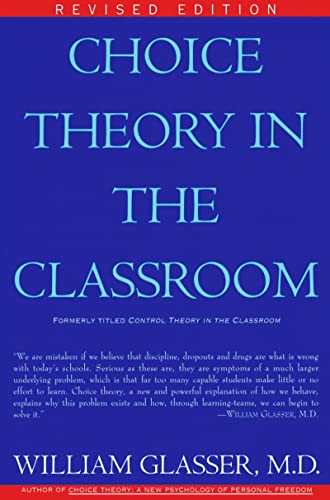
William Glasser, M.D., puts his successful choice theory to work in our schools--with a new approach in increasing student motivation.
"Dr. Glasser translates choice theory into a productive, classroom model of team learning with emphasis on satisfaction and excitement. Working in small teams, students find that knowledge contributes to power, friendship and fun. Because content and the necessary student collaboration skills must be taught, teachers need to develop skills if they are to use this model successfully. The dividends are 'turned-on ' students and satisfied teachers."
--Madeline Hunter, University of California at Los Angeles"Choice Theory in the Classroom is a landmark book, without question one of the most important and useful books for teachers to appear in a long while. Written with rare lucidity and grace, the book has numerous instantly usable ideas that will contribute fundamentally to the success of classroom teachers. William Glasser combines his extensive theoretical expertise and wide practical experience to provide a practical and illuminating guide for teachers [that] should be required reading in every college of education in the country."
--David and Roger Johnson, University of Minnesota"Choice Theory in the Classroom presents an insightful analysis of what is wrong with traditional school and what need to be done about it. Dr. Glasser gives a compelling rationale for the use of learning-teams in schools to capture the excitement and commitment students display in sports but rarely in the classroom. The book is well written and persuasive. I hope every teacher in America buys it, believes it, and behaves accordingly."
--Robert Slavin, John Hopkins University
"synopsis" may belong to another edition of this title.
About the Author
William Glasser, M.D., is a world-renowned psychiatrist who lectures widely. His numerous books have sold 1.7 million copies, and he has trained thousands of counselors in his Choice Theory and Reality Therapy approaches. He is also the president of the William Glasser Institute in Los Angeles.
From the Back Cover
William Glasser, M.D., puts his successful choice theory to work in our schools--with a new approach in increasing student motivation.
"Dr. Glasser translates choice theory into a productive, classroom model of team learning with emphasis on satisfaction and excitement. Working in small teams, students find that knowledge contributes to power, friendship and fun. Because content and the necessary student collaboration skills must be taught, teachers need to develop skills if they are to use this model successfully. The dividends are 'turned-on ' students and satisfied teachers."
--Madeline Hunter, University of California at Los Angeles"Choice Theory in the Classroom is a landmark book, without question one of the most important and useful books for teachers to appear in a long while. Written with rare lucidity and grace, the book has numerous instantly usable ideas that will contribute fundamentally to the success of classroom teachers. William Glasser combines his extensive theoretical expertise and wide practical experience to provide a practical and illuminating guide for teachers [that] should be required reading in every college of education in the country."
--David and Roger Johnson, University of Minnesota"Choice Theory in the Classroom presents an insightful analysis of what is wrong with traditional school and what need to be done about it. Dr. Glasser gives a compelling rationale for the use of learning-teams in schools to capture the excitement and commitment students display in sports but rarely in the classroom. The book is well written and persuasive. I hope every teacher in America buys it, believes it, and behaves accordingly."
--Robert Slavin, John Hopkins University
Excerpt. © Reprinted by permission. All rights reserved.
Choice Theory in the Classroom
By Glasser, WilliamQuill
Copyright © 2004 William GlasserAll right reserved.
ISBN: 0060952873
Chapter One
A New Approach
Is Needed If More
Students Are to
Work in School
Teaching is a hard job when students make an effort to learn. When they make no effort, it is an impossible one. This simple fact, well known to all teachers, is the reason so many students are learning so little in school. Despite their hard work, teachers are confronted daily with increasing numbers of students who make little or no effort to learn. This problem is not new. Criticism of the schools for low student achievement and recommendations to improve it have been offered more or less continuously since the end of World War II. For example, in a 1984 report to the President carrying the dramatic title A Nation at Risk, the National Commission on Excellence in Education recommended that our schools need to lengthen both the school day and year, make courses harder and give more homework.
While no one knows better than teachers that our schools are not functioning well, to say that the nation is at risk is untrue. At present, we have no shortage of educated people in any field, except, paradoxically, in the poorly compensated field of teaching. There are no good colleges short of well-qualified students (UCLA continues to turn away qualified freshmen), and while there seems to be some truth to the contention that many of these hardworking high school graduates seem less than proficient in English, math and science, this deficiency is hardly a peril to our nation.
If reports like A Nation at Risk were the only criticism of the schools, they would be easy to dismiss. The language may be new but they offer nothing that has not been said many times before with little good effect. What cannot and should not be dismissed is that today many people, even teachers who in the past would not have thought of doing so, are taking their children out of public schools and sending them to private schools at great financial hardship. They are doing this not only because they have lost confidence in the schools, but because they have little confidence that the simplistic work-them-harder-and-longer critiques like A Nation at Risk will do anything to make their local schools better places for their children.
While the number of families who are doing this is still relatively small, it is a growing cancer gnawing at our vital system of public education. The public schools are not only losing students, they are losing the family-motivated students whom they can least afford to lose. If public education is weakened in this way, we will all lose, but the greatest losers will be the dedicated teachers who are the backbone of the system. It is to these hardworking teachers who are looking for a way to get more students to work hard in school that this book is addressed.
What is true about our schools, and has been true since the end of World War 11 when we first began to make a real effort to pursue universal education through to high school graduation, is that many students (my very conservative estimate is at least 50 percent by the eighth grade) who are intelligent enough to do well, many even brilliantly, do poorly. Many of these do not even finish the tenth grade Most do not learn enough to become proficient in the basic skills at a sixth grade level, a significant group do not ever learn to read and all hate school.
But the educational reforms suggested by the National Commission on Excellence in Education do not address this group. Their recommendations for longer hours, more homework and more emphasis on science, math and writing may help some of the half who are now making an effort to learn. But even in that group many will give up f the work gets harder, and all in the half who are doing little now will do less and hate school more. The burden of teachers, already overwhelmed by students who make little or no effort to learn, will become unbearable. The gap between the school haves and have-nots, already a major source of disruption, will grow wider.
Unfortunately, most school failures, especially those in the white majority culture, have little interest in low-pay jobs. Unable to do what they would like because they lack education and unsatisfied with what they can do with the little education they have, too many of these young people turn to drugs, delinquency and procreation in an effort to satisfy whatever it is they want. Many, however, when the 11 escape" from their unhappy school experience, do put their brains to work on the menial jobs they can get Finding that hard work does lead to some success, the buckle down and learn (either in or out of school) what it takes to become even more successful.
When no more than half of our secondary school students are willing to make an effort to learn, and therefore (cannot be taught, what we have is not so much a risk to the nation as an enormous waste of human and financial resources. It is no wonder that teachers grow discouraged and taxpayers who look at test results grow restless, and, wanting to assess blame, accuse teachers of not being able to do the impossible. The critics refuse to face the fact that when we talk about our secondary schools, we are really talking about two very different systems within each school. In the first, both teachers and students are functioning well and filling our good colleges with qualified applicants. In the second, the students, many of whom drop out well before the twelfth grade, are nonfunctioning, and the teachers, despite hard work and the best intentions, are able to do little more than serve as custodians.
Continues...Excerpted from Choice Theory in the Classroomby Glasser, William Copyright © 2004 by William Glasser. Excerpted by permission.
All rights reserved. No part of this excerpt may be reproduced or reprinted without permission in writing from the publisher.
Excerpts are provided by Dial-A-Book Inc. solely for the personal use of visitors to this web site.
"About this title" may belong to another edition of this title.
Search results for CHOICE THEORY CLASSROOM

Stock Image
Choice Theory in the Classroom
Published by
HarperCollins Publishers Inc, 2012
ISBN 10: 0060952873
ISBN 13: 9780060952877
Used
Paperback
Seller: World of Books (was SecondSale), Montgomery, IL, U.S.A.
Seller rating 5 out of 5 stars

Paperback. Condition: Very Good. Argues that schools, and children, can only be saved by radically retooling teaching methods. Based on his work on choice theory, this work offers teaching techniques which emphasize co-operation and creativity. It provides ideas for improving the success of teachers and the enthusiasm of students. Seller Inventory # 00099208846
Stock Image
Choice Theory in the Classroom
Published by
HarperCollins Publishers Inc, 2012
ISBN 10: 0060952873
ISBN 13: 9780060952877
Used
Paperback
Seller: World of Books (was SecondSale), Montgomery, IL, U.S.A.
Seller rating 5 out of 5 stars
Paperback. Condition: Good. Argues that schools, and children, can only be saved by radically retooling teaching methods. Based on his work on choice theory, this work offers teaching techniques which emphasize co-operation and creativity. It provides ideas for improving the success of teachers and the enthusiasm of students. Seller Inventory # 00084363379
Stock Image
Choice Theory in the Classroom
Published by
HarperCollins Publishers Inc, 2012
ISBN 10: 0060952873
ISBN 13: 9780060952877
Used
Paperback
Seller: World of Books (was SecondSale), Montgomery, IL, U.S.A.
Seller rating 5 out of 5 stars
Paperback. Condition: Fair. Argues that schools, and children, can only be saved by radically retooling teaching methods. Based on his work on choice theory, this work offers teaching techniques which emphasize co-operation and creativity. It provides ideas for improving the success of teachers and the enthusiasm of students. Seller Inventory # 00106437932
Stock Image
Choice Theory in the Classroom
Published by
HarperCollins Publishers, 1998
ISBN 10: 0060952873
ISBN 13: 9780060952877
Used
Paperback
Seller: Gulf Coast Books, Cypress, TX, U.S.A.
Seller rating 5 out of 5 stars
Paperback. Condition: Good. Seller Inventory # 0060952873-3-24510837
Seller Image
CHOICE THEORY CLASSROOM
Published by
HarperCollins Publishers, 1998
ISBN 10: 0060952873
ISBN 13: 9780060952877
Used
Softcover
Seller: Zoom Books East, Glendale Heights, IL, U.S.A.
Seller rating 5 out of 5 stars
Condition: good. Book is in good condition and may include underlining highlighting and minimal wear. The book can also include "From the library of" labels. May not contain miscellaneous items toys, dvds, etc. . We offer 100% money back guarantee and 24 7 customer service. Seller Inventory # ZEV.0060952873.G
Stock Image
Choice Theory in the Classroom: A Practical Guide to Team Learning and Student Motivation for Teachers
Published by
HarperCollins Publishers (edition Revised), 1998
ISBN 10: 0060952873
ISBN 13: 9780060952877
Used
Paperback
Seller: BooksRun, Philadelphia, PA, U.S.A.
Seller rating 5 out of 5 stars
Paperback. Condition: Very Good. Revised. It's a well-cared-for item that has seen limited use. The item may show minor signs of wear. All the text is legible, with all pages included. It may have slight markings and/or highlighting. Seller Inventory # 0060952873-11-1
Seller Image
Choice Theory in the Classroom: A Practical Guide to Team Learning and Student Motivation for Teachers
Published by
HarperCollins Publishers, 1998
ISBN 10: 0060952873
ISBN 13: 9780060952877
Used
Softcover
Seller: Greenworld Books, Arlington, TX, U.S.A.
Seller rating 5 out of 5 stars
Condition: good. Fast Free Shipping â" Good condition. It may show normal signs of use, such as light writing, highlighting, or library markings, but all pages are intact and the book is fully readable. A solid, complete copy that's ready to enjoy. Seller Inventory # GWV.0060952873.G
Seller Image
Choice Theory in the Classroom: A Practical Guide to Team Learning and Student Motivation for Teachers
Published by
HarperCollins Publishers, 1998
ISBN 10: 0060952873
ISBN 13: 9780060952877
Used
Softcover
Seller: Greenworld Books, Arlington, TX, U.S.A.
Seller rating 5 out of 5 stars
Condition: very_good. Fast Free Shipping â" Very Good condition book with a firm cover and clean pages. Shows normal use and some light wear or limited notes markings. A solid, nice copy to enjoy. Seller Inventory # GWV.0060952873.VG
Seller Image
Choice Theory in the Classroom: A Practical Guide to Team Learning and Student Motivation for Teachers
Published by
HarperCollins Publishers, 1998
ISBN 10: 0060952873
ISBN 13: 9780060952877
Used
Softcover
Seller: ZBK Books, Carlstadt, NJ, U.S.A.
Seller rating 5 out of 5 stars
Condition: very_good. Fast & Free Shipping â" Very Good condition book with a firm cover and clean pages. Shows normal use and some light wear or limited notes markings. A solid, nice copy to enjoy. Seller Inventory # ZWV.0060952873.VG
Stock Image
Choice Theory in the Classroom
Published by
HarperCollins Publishers Inc, 2012
ISBN 10: 0060952873
ISBN 13: 9780060952877
Used
Paperback
Seller: World of Books Inc, Montgomery, IL, U.S.A.
Seller rating 4 out of 5 stars

Paperback. Condition: Good. Argues that schools, and children, can only be saved by radically retooling teaching methods. Based on his work on choice theory, this work offers teaching techniques which emphasize co-operation and creativity. It provides ideas for improving the success of teachers and the enthusiasm of students. Seller Inventory # CIN0060952873G