
Items related to The Last Lone Inventor: A Tale of Genius, Deceit, and...
Synopsis
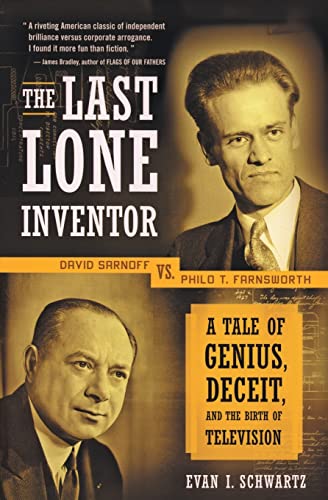
In a story that is both of its time and timeless, Evan I. Schwartz tells a tale of genius versus greed, innocence versus deceit, and independent brilliance versus corporate arrogance. Many men have laid claim to the title "father of television," but Philo T. Farnsworth is the true genius behind what may be the most influential invention of our time.
Driven by his obsession to demonstrate his idea,by the age of twenty Farnsworth was operating his own laboratory above a garage in San Francisco and filing for patents. The resulting publicity caught the attention of RCA tycoon David Sarnoff, who became determined to control television in the same way he monopolized radio.
Based on original research, including interviews with Farnsworth family members, The Last Lone Inventor is the story of the epic struggle between two equally passionate adversaries whose clash symbolized a turning point in the culture of creativity.
"synopsis" may belong to another edition of this title.
About the Author
To write THE LAST LONE INVENTOR, Evan I. Schwartz spent two years researching the life stories of Philo T. Farnsworth and David Sarnoff. He interviewed surviving Farnsworth family members, including Farnsworth's 93-year-old widow, and he visited document archives in six states.
As a journalist, Evan has been covering information technology for 15 years. He is a former editor at BusinessWeek, where he covered software and digital media and was part of teams that produced 12 cover stories and won a National Magazine Award and a Computer Press Award. In recent years, he has written for The New York Times, WIRED, and MIT's Technology Review.
Evan's first book, titled WEBONOMICS, published by Broadway Books, a division of Random House, has ranked as Amazon.com's #1 bestselling business book and was chosen as a finalist for two major awards: The Global Business Book Award as well as the Computer Press Award. International editions have been published in eight countries.
Evan's second book, DIGITAL DARWINISM, from the same publisher, also hit #1 on Amazon's business list shortly after its release, in June 1999. Now in its twelfth hardcover and first paperback printing in the U.S., it is available in the U.K., from Penguin, and has been translated into eight other languages. It too was named a finalist for the Computer Press Award for Non-Fiction Book of the Year.
Evan holds a B.S. in computer science from Union College in Schenectady, New York, and lives with his family in Brookline, Mass.
Excerpt. © Reprinted by permission. All rights reserved.
The Last Lone Inventor
A Tale of Genius, Deceit, and the Birth of TelevisionBy Schwartz, Evan I.Perennial
Copyright © 2004 Evan SchwartzAll right reserved.
ISBN: 0060935596
Chapter One
Fields of Vision
From clear across the potato field, Lewis Farnsworth could see that his son was in danger. It was an early spring morning in 1921, and fourteen-year-old Philo was in his usual trance during one of his many repetitive chores. The kid was sitting on top of a three-disk plow that engraved three parallel furrows in the soil at once. The apparatus was being pulled up and down the field by a team of three horses. Philo was supposed to be holding three sets of reins, but his mind was somewhere else. He grasped only two, inadvertently dropping the third. The sight of the stray leather strap dragging on the ground alarmed the elder Farnsworth.
The plow's rotating metal blades could shred a man to pieces in a few moments. Lewis Farnsworth had heard that it happened to a farmer back in their home state of Utah. A startled horse dragged the sharp edges of the disks into his back, and the man died of his wounds before any medical help could arrive. Without control of the harness, Philo might meet the same fate. He wouldn't be able to halt a rampaging horse, and Lewis Farnsworth knew this particular horse to be especially skittish.
He also knew that he couldn't shout across the field or surprise the horses in any way. With steady strides, he walked toward the end of the row that Philo was finishing. As he stooped to lift the rein, Philo leaped from his seat, shouting, "Papa! Papa! I've got it!"
The horse, irritated by the boy's sudden exclamation, let out a loud neigh. But Lewis Farnsworth was now clutching the third strap, and he reined in the beast just in time.
What on Earth could this boy be yelling about?
"I got the idea that will win the prize money!" Philo exclaimed.
"Philo," he growled back, "You could have been killed!"
His father's anger snapped Philo out of his daze. When he became aware of what had just occurred, he apologized and promised never to let it happen again. Then he started to explain what was preoccupying his mind. He'd been working on an idea.
The Farnsworths lived on a ranch in Idaho's Snake River Valley, where granite-faced mountains peered over pine-green forests. True to its name, the river snaked through the valley, irrigating the fields of potatoes and sugar beets through a network of diversion dams and canals. Hundreds of rural acres separated the homesteads, but the nearby town of Rigby had its own schools and churches, plus a bustling Main Street with a savings and loan, a telegraph office, a newspaper publisher, a general store, a furniture shop, and a bar.
Philo was a good-looking but skinny boy with a serious gaze and a square jaw. He detested the drudgery of farmwork, and he was constantly searching for ideas that could enable the family to escape their dependence on the land. He desperately sought his father's approval of these ideas. He knew his father was upset over what had happened that morning, but he needed to explain himself. After dinner that night, he brought his dad a recent copy of Science and Invention magazine. There was something special inside, and he needed to show him.
The cover of the magazine featured a painting of a bright red monorail bullet train suspended above the bustling streets of Chicago. No train like it actually existed. This particular edition was important because the magazine was now renaming itself. It had previously been known as the Electrical Experimenter. Inside, the editor, Hugo Gernsback, explained that the original title had too narrow an appeal given the sudden rush of new technology into the mainstream of society. But he assured readers that the periodical would remain true to its roots as the monthly for experimenters and inventors, "that vast horde of intellectual Americans, in whom the physical progress of the country is centered." He said the goal was to build the circulation from the current 200,000 households up to 500,000.
The magazine was chock-full of ads for electrical training institutes: Earn Up to $175 a Week! Be a Certified Electrician! Be an Expert in 31/2 Months! Electricity Is the Biggest Force in the World Today! The Very Existence of the World Depends on the Electrician! Get into It as Quick as You Can! Choose Your Future Now!
What had caught Philo's eye was a monthly contest that the magazine was sponsoring, offering a twenty-five-dollar first prize, a fifteen-dollar second prize, and a ten-dollar third prize for the best invention to improve the automobile in any way. The Farnsworths did not own a car, but they knew people in town who did. From watching them sputter up hills and careen down roads, Philo could see that the popular Model-T Fords were rather crude affairs. They could certainly use all the help they could get. Any improvements, so far, seemed as primitive as the cars themselves. The second prize in the previous installment of the contest went to an idea for starting a car in damp weather: simply stuff a handkerchief into the air intake pipe. That idea fetched fifteen dollars.
First prize, meanwhile, went to the idea of attaching a horn beneath the rear fender. If the horn was not first switched off by the owner, a stranger stepping onto the running board would complete an electric circuit, setting off an obnoxious wail that would alert neighbors. It was said to be the first electric "thief alarm" for automobiles. And for that, the magazine revealed, a woman named Edna Purdy would collect twenty-five dollars.
Philo had an idea that would even top Edna Purdy's. Instead of an alarm, why not have a lock on the steering column? All the keys that started the Model-Ts were the same -- a piece of flat...
Continues...Excerpted from The Last Lone Inventorby Schwartz, Evan I. Copyright © 2004 by Evan Schwartz. Excerpted by permission.
All rights reserved. No part of this excerpt may be reproduced or reprinted without permission in writing from the publisher.
Excerpts are provided by Dial-A-Book Inc. solely for the personal use of visitors to this web site.
"About this title" may belong to another edition of this title.
Search results for The Last Lone Inventor: A Tale of Genius, Deceit, and...

Stock Image
The Last Lone Inventor: A Tale of Genius, Deceit, and the Birth of Television - The True Story of Philo T. Farnsworth vs. RCA's Monopoly
Seller: World of Books (was SecondSale), Montgomery, IL, U.S.A.
Seller rating 5 out of 5 stars

Condition: Good. Item in good condition. Textbooks may not include supplemental items i.e. CDs, access codes etc. Seller Inventory # 00100887148
Seller Image
The Last Lone Inventor: A Tale of Genius, Deceit, and the Birth of Television â" The True Story of Philo T. Farnsworth vs. RCA's Monopoly
Seller: Dream Books Co., Denver, CO, U.S.A.
Seller rating 5 out of 5 stars
Condition: good. Gently used with minimal wear on the corners and cover. A few pages may contain light highlighting or writing, but the text remains fully legible. Dust jacket may be missing, and supplemental materials like CDs or codes may not be included. May be ex-library with library markings. Ships promptly! Seller Inventory # DBV.0060935596.G
Stock Image
The Last Lone Inventor : A Tale of Genius, Deceit, and the Birth of Television
Published by
HarperCollins Publishers, 2003
ISBN 10: 0060935596
ISBN 13: 9780060935597
Used
Softcover
Seller: Better World Books: West, Reno, NV, U.S.A.
Seller rating 5 out of 5 stars
Condition: Very Good. Reprint. Former library copy. Pages intact with possible writing/highlighting. Binding strong with minor wear. Dust jackets/supplements may not be included. Includes library markings. Stock photo provided. Product includes identifying sticker. Better World Books: Buy Books. Do Good. Seller Inventory # 14992221-75
Stock Image
The Last Lone Inventor : A Tale of Genius, Deceit, and the Birth of Television
Published by
HarperCollins Publishers, 2003
ISBN 10: 0060935596
ISBN 13: 9780060935597
Used
Softcover
Seller: Better World Books, Mishawaka, IN, U.S.A.
Seller rating 5 out of 5 stars
Condition: Good. Reprint. Pages intact with minimal writing/highlighting. The binding may be loose and creased. Dust jackets/supplements are not included. Stock photo provided. Product includes identifying sticker. Better World Books: Buy Books. Do Good. Seller Inventory # 4702419-6
Stock Image
The Last Lone Inventor : A Tale of Genius, Deceit, and the Birth of Television
Published by
HarperCollins Publishers, 2003
ISBN 10: 0060935596
ISBN 13: 9780060935597
Used
Softcover
Seller: Better World Books: West, Reno, NV, U.S.A.
Seller rating 5 out of 5 stars
Condition: Good. Reprint. Pages intact with minimal writing/highlighting. The binding may be loose and creased. Dust jackets/supplements are not included. Stock photo provided. Product includes identifying sticker. Better World Books: Buy Books. Do Good. Seller Inventory # 4702419-6
Stock Image
The Last Lone Inventor : A Tale of Genius, Deceit, and the Birth of Television
Published by
HarperCollins Publishers, 2003
ISBN 10: 0060935596
ISBN 13: 9780060935597
Used
Softcover
Seller: Better World Books, Mishawaka, IN, U.S.A.
Seller rating 5 out of 5 stars
Condition: Very Good. Reprint. Pages intact with possible writing/highlighting. Binding strong with minor wear. Dust jackets/supplements may not be included. Stock photo provided. Product includes identifying sticker. Better World Books: Buy Books. Do Good. Seller Inventory # 13692378-6
Stock Image
The Last Lone Inventor: A Tale of Genius, Deceit, and the Birth of Television
Published by
HarperCollins Publishers Inc, 2003
ISBN 10: 0060935596
ISBN 13: 9780060935597
Used
Paperback
Seller: World of Books Inc, Montgomery, IL, U.S.A.
Seller rating 2 out of 5 stars

Paperback. Condition: Good. In a story that is both of its time and timeless, Evan I. Schwartz tells a tale of genius versus greed, innocence versus deceit, and independent brilliance versus corporate arrogance. Many men have laid claim to the title "father of television," but Philo T. Farnsworth is the true genius behind what may be the most influential invention of our time. Driven by his obsession to demonstrate his idea,by the age of twenty Farnsworth was operating his own laboratory above a garage in San Francisco and filing for patents. The resulting publicity caught the attention of RCA tycoon David Sarnoff, who became determined to control television in the same way he monopolized radio. Based on original research, including interviews with Farnsworth family members, The Last Lone Inventor is the story of the epic struggle between two equally passionate adversaries whose clash symbolized a turning point in the culture of creativity. Seller Inventory # CIN0060935596G
Seller Image
The Last Lone Inventor: A Tale of Genius, Deceit, and the Birth of Television â" The True Story of Philo T. Farnsworth vs. RCA's Monopoly
Seller: Goodwill, Brooklyn Park, MN, U.S.A.
Seller rating 4 out of 5 stars

Condition: good. All pages and cover are intact including the dust cover, if applicable . Spine may show signs of wear. Pages may include limited notes and highlighting. May include "From the library of" labels. Shrink wrap, dust covers, or boxed set case may be missing. Item may be missing bundled media. Seller Inventory # MINV.0060935596.G
Stock Image
The Last Lone Inventor: A Tale of Genius, Deceit, and the Birth of Television
Seller: ThriftBooks-Dallas, Dallas, TX, U.S.A.
Seller rating 5 out of 5 stars
Paperback. Condition: Fair. No Jacket. Former library book; Readable copy. Pages may have considerable notes/highlighting. ~ ThriftBooks: Read More, Spend Less. Seller Inventory # G0060935596I5N10
Stock Image
The Last Lone Inventor: Tale of Genius, Deceit, and the Birth of Television
Seller: Price-less Books, Urbana, IL, U.S.A.
Seller rating 4 out of 5 stars
Paperback. Condition: VG-. 323pp. Index. Wear and creasing wraps, yellowing interior. Seller Inventory # 205872