
Items related to An Uncertain Inheritance: Writers on Caring for Family
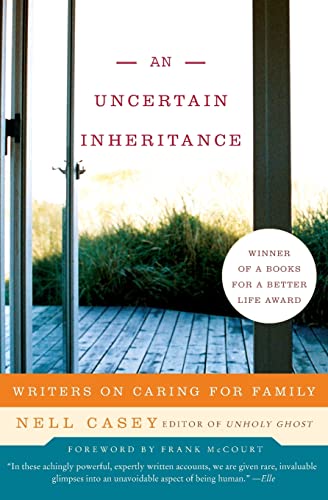
Synopsis
Thirty million people today care for ailing family members in their own homes--a number that will increase dramatically over the next decade as baby boomers enter old age, as soldiers return home from war mentally and physically wounded, as medical advances extend lives and health insurance fails to cover them.
Offering both companionship and guidance to the people who find themselves caring for their intimates, An Uncertain Inheritance is a collection of essays from some of the country's most accomplished writers. Poignant, honest, sometimes heartbreaking, often wry, and funny, here is a book that examines caregiving from every angle, revealing the pain, intimacy, and grace inherent in this meaningful relationship.
"synopsis" may belong to another edition of this title.
About the Author
The editor of the national bestseller Unholy Ghost, Nell Caseyhas written for Slate, the New York Times, Salon, Elle, and Glamour, among other publications. She lives in Brooklyn, New York, with her husband and son.
Excerpt. © Reprinted by permission. All rights reserved.
Uncertain Inheritance, An
Writers on Caring for FamilyBy Nell CaseyHarperCollins Publishers, Inc.
Copyright © 2008 Nell CaseyAll right reserved.
ISBN: 9780060875312
Chapter One
My father the garbage head
Helen Schulman
My father started dying twenty years before he actually died. He had a heart attack and bypass surgery while I was still in college. From that point on, although my mother had three different cancers in the intervening years and a host of other medical problems, it was the specter of my father's death that floated above us at all times, perhaps because he himself feared it so. He was an atheist; he was terrified of his own nothingness, the inevitable empty void that he could not rationalize away. And for years, as his child, my father's death was the thing I too was most afraid of—until it wasn't anymore, until the quality of his life, his unfathomable suffering became the most frighteningly real of nightmares and then I had more pressing things to be afraid of, like that he might, against all odds, continue to live.
The last ten years of my father's life were hard. The last five were horrific. It was during this long final phase, when his many illnesses became acute—swirling around in his body like some toxic murky stew, leaving him virtually paralyzed and as mindless as any late-stage Alzheimer patient—that I vowed to stay by his side, to help take care of him as long as he needed. I was married by then. I had first one, then two small children, a household to run, a career to manage, but my father had always stood by me, he'd loved me and cared for me my whole life, and in turn, I loved him without reservation. So I made a pledge.
"I will help him as long as he needs it."
I remember the moment I said this to myself outside his hospital-room door. It was a promise I lived to regret.
In the sexy, wild seventies, when I was a teenager, if anyone were to hold out a handful of assorted pills in the schoolyard of my high school and some kid was eager to randomly pop them, that kid was called a "garbage head." No drug of choice, just a messy indiscriminate addiction to all of it. During the last years of his life, my father—physician, professor, chief of two medical departments—was what I always thought of as a neurological garbage head, not just because he downed a hodgepodge of pills daily, but because he was afflicted with so many diseases that I pictured his brain itself as a myriad array of garbage. People would ask me what was wrong with him and I didn't know exactly how to answer them. What was right with him? He had coronary artery disease, had had numerous ministrokes (TIAs) and several larger ones. Until his autopsy, which concluded that he died of advanced arteriosclerosis, we thought he had Parkinson's; when he still could walk, he took those little mincing steps that Tim Conway made famous on the old Carol Burnett Show.
Five years before his death and about a week before the birth of my second child, my little boy, my father had one of those many strokes followed by an angioplasty and ended up in the same hospital where I was scheduled to give birth, the same hospital where he had practiced medicine for forty years.
"Hey, Dad, maybe I could take that bed over there and we could share a room," I teased, "and then you could stop stealing all of the attention."
Truth be told, I wouldn't have minded sharing a room with my father. I'd never had enough time with him—he worked endlessly when I was a kid, he was preoccupied with his own inner life, and while we were very close, he had a more natural affinity for my brother. Still, I always liked to be with him. Even after he was hopelessly brain-damaged I would often lie down on the bed next to him, in the hospital or at home in front of the television, and hold his hand.So back then, when he'd only had his second real stroke—the "salad days," I call them now—I suggested sharing a room with my dad, but he didn't respond to me. He kept saying, "It's like I'm two, it's like I'm two," because, in the salad days, he still had the cognitive powers to know exactly what bad shape he was in: that he had the reasoning capabilities of a toddler.
On the phone a few weeks prior, when my father was bemoaning the collapsing state of his memory, I'd said, "I know that this is very hard for you, Dad, but we all love you, we still can have fun together, we still can enjoy one another, does any of that help at all?"
He said, "No, you and your love don't help me."
How his words stung me. At first they felt almost coldhearted, cruel. I was offering him the best of myself, but that seemed to mean nothing to him. My father was in many ways an insightful and responsive man, a generous man, but he also had this extraordinary allegiance to honesty; he could be candid to the point of insensitivity and at times, even selfishness. At the moment that he gave me his response, he was not thinking about my feelings, but rather solely about what he knew to be the truth about himself. My love wasn't going to ease his pain, and it certainly wasn't going to save him. How could this be? I wondered. How could this endless reservoir of affection and attachment and respect that I felt for this man prove so powerless, so worthless?
I did not believe him then, but I believe him now.
Ten days after that second stroke I was home with a newborn baby and a two-year-old daughter. A friend taught several of my classes for me, and then I went back to work, resuming my usual schedule of teaching and writing. Night after night . . .
Continues...
Excerpted from Uncertain Inheritance, Anby Nell Casey Copyright © 2008 by Nell Casey. Excerpted by permission.
All rights reserved. No part of this excerpt may be reproduced or reprinted without permission in writing from the publisher.
Excerpts are provided by Dial-A-Book Inc. solely for the personal use of visitors to this web site.
"About this title" may belong to another edition of this title.
Search results for An Uncertain Inheritance: Writers on Caring for Family

Stock Image
Uncertain Inheritance, An: Writers on Caring for Family
Seller: More Than Words, Waltham, MA, U.S.A.
Seller rating 5 out of 5 stars

Condition: Good. A sound copy with only light wear. Overall a solid copy at a great price! Seller Inventory # BOS-H-02i-01876
Stock Image
An Uncertain Inheritance : Writers on Caring for Family
Published by
HarperCollins Publishers, 2008
ISBN 10: 0060875313
ISBN 13: 9780060875312
Used
Softcover
Seller: Better World Books, Mishawaka, IN, U.S.A.
Seller rating 5 out of 5 stars
Condition: Very Good. Reprint. Pages intact with possible writing/highlighting. Binding strong with minor wear. Dust jackets/supplements may not be included. Stock photo provided. Product includes identifying sticker. Better World Books: Buy Books. Do Good. Seller Inventory # 6350442-6
Stock Image
An Uncertain Inheritance : Writers on Caring for Family
Published by
HarperCollins Publishers, 2008
ISBN 10: 0060875313
ISBN 13: 9780060875312
Used
Softcover
Seller: Better World Books, Mishawaka, IN, U.S.A.
Seller rating 5 out of 5 stars
Condition: Good. Reprint. Pages intact with minimal writing/highlighting. The binding may be loose and creased. Dust jackets/supplements are not included. Stock photo provided. Product includes identifying sticker. Better World Books: Buy Books. Do Good. Seller Inventory # 6165831-6
Stock Image
Uncertain Inheritance, An: Writers on Caring for Family
Seller: HPB-Diamond, Dallas, TX, U.S.A.
Seller rating 5 out of 5 stars
paperback. Condition: Very Good. Connecting readers with great books since 1972! Used books may not include companion materials, and may have some shelf wear or limited writing. We ship orders daily and Customer Service is our top priority! Seller Inventory # S_423699335
Stock Image
Uncertain Inheritance, An: Writers on Caring for Family
Seller: Campus Bookstore, Denton, TX, U.S.A.
Seller rating 4 out of 5 stars

Paperback. Condition: Good. ARRIVES IN 2-4 BUSINESS DAYS if you choose Expedited Shipping! May contain highlighting/underlining/notes/etc. May have used stickers on cover. Access codes and supplements are not guaranteed to be included with used books. Ships same or next day. Expedited shipping: 3-5 business days, Standard shipping: 4-14 business days. Seller Inventory # mon0000021758
Stock Image
An Uncertain Inheritance: Writers on Caring for Family
Seller: ThriftBooks-Atlanta, AUSTELL, GA, U.S.A.
Seller rating 5 out of 5 stars
Paperback. Condition: Good. No Jacket. Pages can have notes/highlighting. Spine may show signs of wear. ~ ThriftBooks: Read More, Spend Less. Seller Inventory # G0060875313I3N00
Stock Image
Uncertain Inheritance: Writers on Caring for Family
Published by
Harper Perennial December 2008, 2008
ISBN 10: 0060875313
ISBN 13: 9780060875312
Used
Soft cover
Seller: Dunaway Books, St. Louis, MO, U.S.A.
Seller rating 4 out of 5 stars
Soft cover. Condition: Fine. Pages are very clean and bright with no markings. Binding is tight and square. Trivial shelving wear. Overall in excellent condition. Seller Inventory # 333087
Stock Image
An Uncertain Inheritance : Writers on Caring for Family
Published by
HarperCollins Publishers, 2008
ISBN 10: 0060875313
ISBN 13: 9780060875312
Used
Softcover
Seller: Better World Books Ltd, Dunfermline, United Kingdom
Seller rating 5 out of 5 stars
Condition: Very Good. Reprint. Former library copy. Pages intact with possible writing/highlighting. Binding strong with minor wear. Dust jackets/supplements may not be included. Includes library markings. Stock photo provided. Product includes identifying sticker. Better World Books: Buy Books. Do Good. Seller Inventory # 8654323-6
Buy Used
£ 7.16
£ 5 shipping
Ships from United Kingdom to U.S.A.
Ships from United Kingdom to U.S.A.
Quantity: 1 available
Seller Image
Uncertain Inheritance : Writers on Caring for Family
Seller: GreatBookPrices, Columbia, MD, U.S.A.
Seller rating 5 out of 5 stars
Condition: New. Seller Inventory # 5524142-n
Seller Image
An Uncertain Inheritance: Writers on Caring for Family (Paperback or Softback)
Published by
Harper Perennial 12/2/2008, 2008
ISBN 10: 0060875313
ISBN 13: 9780060875312
New
Paperback or Softback
Seller: BargainBookStores, Grand Rapids, MI, U.S.A.
Seller rating 5 out of 5 stars
Paperback or Softback. Condition: New. An Uncertain Inheritance: Writers on Caring for Family. Book. Seller Inventory # BBS-9780060875312