
Items related to Unspeakable: Facing Up To Evil In An Age Of Genocide...
Synopsis
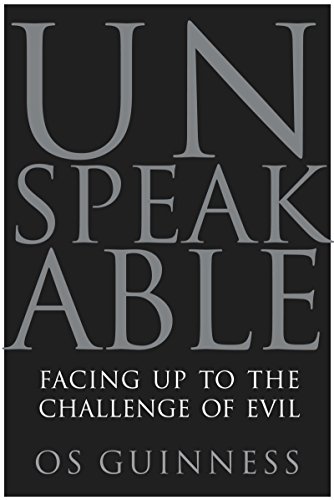
A leading public intellectual confronts America's inability to understand--let alone effectively respond to--evil, providing both a language and a strategy for a way forward.
There are no words to express the pain, anguish, and despair that sear the human heart in the face of suffering. From wars to car accidents, birth defects to genocide, the realities of life on earth are sometimes . . . unspeakable. Yet no matter how hard we try to avoid or ignore these tragedies, they are facts of life that we must face. In Unspeakable, now available in paperback, leading public intellectual Os Guinness guides us through an exploration of evil and suffering, seeking to illuminate the nagging questions of the inhumanity of humanity as well as the place of God in human suffering. This honest and thoughtful exploration provides a roadmap to help us think through evil intelligently and respond to it courageously.
"synopsis" may belong to another edition of this title.
About the Author
Os Guinness is an author and speaker living in the Washington, D.C., area. Born in China during World War II, Guinness left in 1951, after the Chinese Revolution. A graduate of the University of London and Oxford, Guinness is a former visiting fellow of the Brookings Institution. He has written or edited more than twenty books, including The Call, Invitation to the Classics, and Long Journey Home.
From the Back Cover
There are no words to express the pain, anguish, and despair that sear the human heart in the face of suffering. From wars to car accidents, birth defects to genocide, the realities of life on earth are sometimes . . . unspeakable. Yet no matter how hard we try to avoid or ignore these tragedies, they are facts of life that we must face. In Unspeakable, now available in paperback, leading public intellectual Os Guinness guides us through an exploration of evil and suffering, seeking to illuminate the nagging questions of the inhumanity of humanity as well as the place of God in human suffering. This honest and thoughtful exploration provides a roadmap to help us think through evil intelligently and respond to it courageously.
Excerpt. © Reprinted by permission. All rights reserved.
Unspeakable
Facing Up to the Challenge of EvilBy Os GuinnessHarperCollins Publishers, Inc.
Copyright © 2006 Os GuinnessAll right reserved.
ISBN: 0060833009
Chapter One
Evil and the Examined Life
"Where was God when the towers fell?" The ABC reporter's question to me, only two days after the horrific slaughter of the innocent thousands in the World Trade Center on September 11, 2001, went straight for the jugular, and it was meant to. Or as a National Public Radio interviewer asked me the same day, "I saw a woman running through the acrid smoke crying, 'God, are you here?' What should I have said to her?"
With television making the atrocity a local event for untold millions around the world, questions like that must have been asked in countless ways that day -- sometimes with heartbreak, sometimes with anger, and sometimes with mute incomprehension. But the concern was surely the same. On a clear blue, peaceful Tuesday morning, the deadly terrorist strike laid bare the two deepest issues of human life: the raw evil of the inhumanity of humanity and the agonizing question of the place of God in human suffering.
These two issues, and the piercing questions they raise, are the central theme of this book. Together they lie at the heart of our human existence. Each requires the other for an adequate response, and both are surrounded by a dangerous ignorance and confusion today. The first can be expressed as: "Why do bad things happen to good people?" And the second: "What does it say of us as human beings that the worst atrocities on planet earth are done by our own species -- in other words, by people like us?"
Needless to say, these issues and questions are far older and have far wider application than the events of September 11. For one thing, while thousands died at Ground Zero, thousands of others across New York and hundreds of thousands across the world also died that day -- of cancer, stroke, hunger, accidents, murder, AIDS, suicide, and for many other tragic reasons, not to mention old age. Each of these deaths was accompanied by its own grieving family and friends, and each was a dire event that, for them as individuals, was as bad as the terrorist strike was for the United States as a whole.
A basic fact of life is that any of us may suffer and all of us will die.
For another thing, while a televised attack on two of the world's most famous buildings was shockingly extraordinary, and designed to be so, far more people in the world suffer today under the heel of grinding evils that are numbingly ordinary and will never make the newspaper headlines or the television news. Few of us, for instance, give serious thought to the millions of young girls forced into prostitution, to the women abused by their husbands, to the widows driven from their homes and their rightful lands, to the men convicted and imprisoned without justice, or to the millions of families kept for a lifetime in bonded slavery.
Another basic fact of life is that countless human beings live in abject daily fear of evil and the brutal people who abuse power and oppress them. For much of the world, evil is -- and always has been -- a daily fact of life.
The Lisbon Earthquake of Our Time
These two ancient issues are dark and difficult enough in themselves. But there is a modern twist to the discussion that makes it harder still. The events of September 11 hit America and the West at large at a time when intellectual and moral responses to evil are weaker, more controversial, and more confused than they have been for centuries. Put simply, we no longer have a shared understanding about whether there is any such thing as evil. Some even question whether it is proper to speak of anyone as our enemy. The consequences of our uncertainty damage us on all sorts of levels.
Thus, whether September 11 was viewed as a disaster, a tragedy, a crime, an act of war, or a symbolic spectacle on the grandest scale -- "the greatest work of art of all time," as the German composer Karlheinz Stockhausen put it -- the force of the hijacked planes hit the Western intellectual world as damagingly as it did the World Trade Center. The lethal challenge of evil at the beginning of the twenty-first century exposes the core confusion of modern thinking just as the Great Lisbon earthquake in 1755 challenged traditional European views in the eighteenth century -- but in the opposite direction.
In the mid-eighteenth century Lisbon was the capital of the far-flung Portuguese empire and one of the most powerful and beautiful cities in the world. But on November 1, 1755, it was devastated by a triple shock: an offshore earthquake lasting ten minutes that was felt as far away as France, Italy, Switzerland, and North Africa; a gigantic killer wave that unleashed a fifty-foot wall of water pounding across the city; and a series of fires, set off by the tremors, which devastated what was left of the city. The combined death toll of all three disasters was more than 60,000 people, and the shock and horror were felt right across Europe. To the eighteenth century the mention of "Lisbon" was the equivalent of the mention of "Auschwitz" today.
The parallels between New York 2001 and Lisbon 1755 are evident at once: an autumn day; sudden, total, and appalling devastation; buildings destroyed; skies dark and thick with dust; thousands hideously slaughtered; heroic human responses; civilized life drastically disrupted; weeks following filled with a lifetime's worth of grief and funerals; and intense intellectual debates set off around the centers of the educated world.
But the difference between 1755 and 2001 is crucial too. The outcome of the Lisbon earthquake, as interpreted by Voltaire and others, was to weaken traditional faith in God and providence and strengthen the new confidence in Enlightenment progress -- God is dead and the future of humankind is one of our own making ...
Continues...
Excerpted from Unspeakableby Os Guinness Copyright © 2006 by Os Guinness. Excerpted by permission.
All rights reserved. No part of this excerpt may be reproduced or reprinted without permission in writing from the publisher.
Excerpts are provided by Dial-A-Book Inc. solely for the personal use of visitors to this web site.
"About this title" may belong to another edition of this title.
Search results for Unspeakable: Facing Up To Evil In An Age Of Genocide...

Stock Image
Unspeakable: Facing Up to the Challenge of Evil
Seller: HPB-Emerald, Dallas, TX, U.S.A.
Seller rating 5 out of 5 stars

Paperback. Condition: Very Good. Connecting readers with great books since 1972! Used books may not include companion materials, and may have some shelf wear or limited writing. We ship orders daily and Customer Service is our top priority! Seller Inventory # S_472455606
Stock Image
Unspeakable: Facing Up To Evil In An Age Of Genocide And Terror
Seller: World of Books (was SecondSale), Montgomery, IL, U.S.A.
Seller rating 5 out of 5 stars
Paperback. Condition: Good. We are still surprised by evil. From Auschwitz to the events of September 11, we have been shocked into recognizing the startling capacity for evil within the human heart. We now know 9/11 revealed that our country was unprepared in terms of national security, but it also showed we were intellectually and morally unprepared to deal with such a barbaric act. Our language to describe evil and our ethical will to resist it have grown uncertain and confused. Many who speak unabashedly of evil are dismissed as simplistic, old-fashioned, and out of tune with the realities of modern life. Yet we must have some kind of language to help us understand the pain and suffering at the heart of human experience. Author and speaker Os Guinness confronts our inability to understand evil - let alone respond to it effectively - by providing both a lexicon and a strategy for finding a way forward. Since 9/11, much public discussion has centered on the destructiveness of extremist religion. Guinness provocatively argues that this is far from an accurate picture and too easy an explanation. In this expansive exploration of both the causes of modern evil and solutions for the future, he faces our tragic recent past and our disturbing present with courageous honesty. In order to live an "examined life," Guinness writes, we must come to terms with our beliefs regarding evil and ultimately join the fight against it. Addressing individuals as well as a traumatized culture, Unspeakable is an invitation to explore the challenge of contemporary evil, a call to confront our culture of fear, and a journey to find words to come to terms with the unspeakable so that it will no longer leave us mute. Seller Inventory # 00102231395
Stock Image
Unspeakable: Facing Up to the Challenge of Evil
Seller: ThriftBooks-Phoenix, Phoenix, AZ, U.S.A.
Seller rating 5 out of 5 stars
Paperback. Condition: Good. No Jacket. Pages can have notes/highlighting. Spine may show signs of wear. ~ ThriftBooks: Read More, Spend Less. Seller Inventory # G0060833009I3N00
Stock Image
Unspeakable: Facing Up to the Challenge of Evil
Seller: ThriftBooks-Reno, Reno, NV, U.S.A.
Seller rating 5 out of 5 stars
Paperback. Condition: Very Good. No Jacket. May have limited writing in cover pages. Pages are unmarked. ~ ThriftBooks: Read More, Spend Less. Seller Inventory # G0060833009I4N00
Stock Image
Unspeakable: Facing Up to the Challenge of Evil
Seller: ThriftBooks-Reno, Reno, NV, U.S.A.
Seller rating 5 out of 5 stars
Paperback. Condition: Good. No Jacket. Pages can have notes/highlighting. Spine may show signs of wear. ~ ThriftBooks: Read More, Spend Less. Seller Inventory # G0060833009I3N00
Stock Image
Unspeakable: Facing Up to the Challenge of Evil
Seller: ThriftBooks-Dallas, Dallas, TX, U.S.A.
Seller rating 5 out of 5 stars
Paperback. Condition: Very Good. No Jacket. May have limited writing in cover pages. Pages are unmarked. ~ ThriftBooks: Read More, Spend Less. Seller Inventory # G0060833009I4N00
Stock Image
Unspeakable: Facing Up to the Challenge of Evil
Seller: ThriftBooks-Atlanta, AUSTELL, GA, U.S.A.
Seller rating 5 out of 5 stars
Paperback. Condition: Good. No Jacket. Pages can have notes/highlighting. Spine may show signs of wear. ~ ThriftBooks: Read More, Spend Less. Seller Inventory # G0060833009I3N00
Stock Image
Unspeakable: Facing Up to the Challenge of Evil
Seller: ThriftBooks-Atlanta, AUSTELL, GA, U.S.A.
Seller rating 5 out of 5 stars
Paperback. Condition: Very Good. No Jacket. May have limited writing in cover pages. Pages are unmarked. ~ ThriftBooks: Read More, Spend Less. Seller Inventory # G0060833009I4N00
Stock Image
Unspeakable: Facing Up to the Challenge of Evil
Seller: ThriftBooks-Dallas, Dallas, TX, U.S.A.
Seller rating 5 out of 5 stars
Paperback. Condition: Good. No Jacket. Pages can have notes/highlighting. Spine may show signs of wear. ~ ThriftBooks: Read More, Spend Less. Seller Inventory # G0060833009I3N00
Stock Image
Unspeakable: Facing Up to the Challenge of Evil
Seller: Wonder Book, Frederick, MD, U.S.A.
Seller rating 5 out of 5 stars
Condition: Good. Good condition. With remainder mark. A copy that has been read but remains intact. May contain markings such as bookplates, stamps, limited notes and highlighting, or a few light stains. Seller Inventory # U10Q-01203