
Mental Floss Presents Forbidden Knowledge: Wickedly Smart Guide To Histo ry's Naughtiest Bits - Softcover
Book 1 of 6: Mental Floss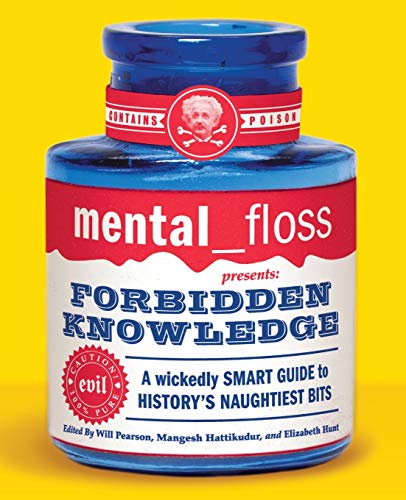
Synopsis
Think of anything bad, from art heists to Genghis Kahn, and it's likely to be included in this wickedly smart and humorous guide to the seedy underbelly of basically everything. The brainiac team at "mental_floss", creators of the hit magazine and last year's Condensed Knowledge, have scoured the darkest, dirtiest corners of history and the globe to gather this ultimate collection of the bad stuff you're not supposed to know and you certainly never learned in school.
Organized by theme, with chapters for each of the seven deadly sins, the book includes feuds, plagiarists, hoaxes, lies, schemes, scandals, evil dictators, mob bosses, acts of revenge, angry queens, cannibals and much more, all organized into bite-sized--albeit foul-tasting--lists (i.e."The Fascist Style Guide: Five Dictator Grooming Tips", "Four Biblical Girls Gone Wild" and "Three Delicious Animals We Charbroiled Into Extinction."). It's the perfect way to add some spice to a dull conversation and proves that learning can be not only easy, but exquisitely sinful.
"synopsis" may belong to another edition of this title.
About the Author
Will Pearson and Mangesh Hattikudur met as first year students at Duke University. Ignoring the lures of law school and investment banking, the pair co-founded mental_floss and have been grinning ever since. Maggie Koerth-Baker is a freelance journalist and a former assistant editor at mental_floss magazine, where she consistently astounded Will and Mangesh with her amazingness.
Excerpt. © Reprinted by permission. All rights reserved.
mental floss presents Forbidden Knowledge
A Wickedly Smart Guide to History's Naughtiest BitsBy Steve Editors of Mental FlossHarperCollins Publishers, Inc.
Copyright © 2005 Steve Editors of Mental FlossAll right reserved.
ISBN: 006078475X
Talk of the Town:
Utopian Communities
(That Bombed Miserably)
Every once in a while a proud little community will sprout up just to let the world know how Utopia should be run. With chins raised almost as high as ideals, the community marches forth to be an example of perfection. But in most cases, all that harmonious marching gets tripped up pretty quickly. Here are four ?perfect? communities that whizzed and sputtered thanks to human nature.
01: Brook Farm, or Ripley's Follow Me or Not
Probably the best-known utopian community in America, Brook Farm was founded in 1841 in West Roxbury, Massachusetts, by George and Sophia Ripley. The commune was built on a 200-acre farm with four buildings and centered on the ideals of radical social reform and self-reliance. For free tuition in the community school and one year's worth of room and board, the residents were asked to complete 300 days of labor by either farming, working in the manufacturing shops, performing domestic chores or grounds maintenance, or planning the community's recreation projects. The community prospered in 1842-1843 and was visited by numerous dignitaries and utopian writers. However, Ripley joined the unpopular Fourierism movement, which meant that soon the young people (out of a ?sense of honor?) had to do all the dirty work like repairing roads, cleaning stables, and slaughtering the animals. This caused many residents, especially the younger ones, to leave. Things went downhill from there. The community was hit by an outbreak of smallpox followed by fire and finally collapsed in 1847.
02: Fruitlands: A Utopian Community (for Six Months Anyway)
After visiting Brook Farm and finding it almost too worldly by their standards, Bronson Alcott (the father of Louisa May) and Charles Lane founded the Fruitlands Commune in June 1843, in Harvard, Massachusetts. Structured around the British reformist model, the commune's members were against the ownership of property, were political anarchists, believed in free love, and were vegetarians. The group of 11 adults and a small number of children were forbidden to eat meat or use any animal products such as honey, wool, beeswax, or manure. They were also not allowed to use animals for labor and only planted produce that grew up out of the soil so as not to disturb worms and other organisms living in the soil. Many in the group of residents saw manual labor as spiritually inhibiting and soon it became evident that the commune could not provide enough food to sustain its members. The strict diet of grains and fruits left many of the members malnourished and sick. Given this situation, many of the members left and the community collapsed in January 1844.
03: The Shakers
Officially known as the United Society of Believers in Christ's Second Appearing, the Shakers were founded in Manchester, England, in 1747. As a group of dissenting Quakers under the charismatic leadership of Mother Ann Lee, the Shakers came to America in 1774. Like most reformist movements of the time, the Shakers were agriculturally based, and believed in common ownership of all property and the confession of sins. Unlike most of the other groups, the Shakers practiced celibacy, or the lack of procreation. Membership came via converts or by adopting children. Shaker families consisted of ?brothers? and ?sisters? who lived in gender-segregated communal homes of up to 100 individuals. During the required Sunday community meetings it was not uncommon for members to break into a spontaneous dance, thus giving them the Shaker label. As pacifists they were exempted from military service and became the United States' first conscientious objectors during the Civil War. Currently, however, there isn't a whole lot of Shaking going on. As the younger members left the community, converts quit coming, and the older ones died off, many of the communities were forced to close. Of the original 19 communities, most had closed by the early 1900s, with only one in existence today.
04: Pullman's Capitalist Utopia
Located 15 miles south of Chicago, the town of Pullman was founded in the 1880s by George Pullman (of luxury railway car fame) as a utopian community based on the notion that capitalism was the best way to meet all material and spiritual needs. According to Pullman's creed, the community was built to provide Pullman's employees with a place where they could exercise proper moral values and where each resident had to adhere to the strict tenets of capitalism under the direction and leadership of Pullman. The community was run on a for-profit basis -- the town had to return a profit of 7% annually. This was done by giving the employees two paychecks, one for rent, which was automatically turned back in to Pullman, and one for everything else. Interestingly, the utopian community had very rigid social class barriers, with the management and skilled workers living in stately homes and the unskilled laborers living in tenements. Within 20 years the experiment failed miserably. Pullman began demanding more and more rent to offset company losses, while union sentiment grew among the employee residents.
The Totalitarian Style Guide:
Dictator Grooming Tips
So, you wanna be a dictator? Sure, you've got the well-equipped, fanatically loyal army, you've selected a country for conquering, and you're ready to murder anyone who stands in the way (what commitment!). But if you want to be taken seriously in the Dictator Game, you'll need to look the part. Lucky for you, we've assembled a handy guide to get you started.
01: The Mustache
From Hitler to Mussolini to Saddam Hussein, dictators have long relied on the mustache to give them the illusion of stiff upper lips. And they're touchy about 'em, to boot! In 1923, Hitler's friend Ernst Hanfstaengl encouraged the future Führer to grow his mustache across the entire length of his lip. Hitler, naturally, later tried to have Hanfstaengl killed. Critics of Stalin's 'stache fared even worse. In a poem intended only for a small circle of friends, Osip Mandelstam compared Stalin's mustache to a cockroach. Thereafter, Mandelstam was repeatedly arrested and sent to deadly Soviet work camps -- he died, probably in 1939, in one of the gulags. So whether you go pencil-thin or Selleck-thick, remember the mustache -- and to crush any who question it.
Continues...
Excerpted from mental floss presents Forbidden Knowledgeby Steve Editors of Mental Floss Copyright © 2005 by Steve Editors of Mental Floss. Excerpted by permission.
All rights reserved. No part of this excerpt may be reproduced or reprinted without permission in writing from the publisher.
Excerpts are provided by Dial-A-Book Inc. solely for the personal use of visitors to this web site.
"About this title" may belong to another edition of this title.
Search results for Mental Floss Presents Forbidden Knowledge: Wickedly...

Stock Image
mental floss presents Forbidde
Published by
William Morrow Paperbacks, 2005
ISBN 10: 006078475X
ISBN 13: 9780060784751
Used
Softcover
Seller: World of Books (was SecondSale), Montgomery, IL, U.S.A.
Seller rating 5 out of 5 stars

Condition: Good. Item in good condition. Textbooks may not include supplemental items i.e. CDs, access codes etc. Seller Inventory # 00090466723
Stock Image
mental floss presents Forbidde
Published by
William Morrow Paperbacks, 2005
ISBN 10: 006078475X
ISBN 13: 9780060784751
Used
Softcover
Seller: World of Books (was SecondSale), Montgomery, IL, U.S.A.
Seller rating 5 out of 5 stars
Condition: Very Good. Item in very good condition! Textbooks may not include supplemental items i.e. CDs, access codes etc. Seller Inventory # 00090666149
Seller Image
mental floss presents Forbidden Knowledge: A Wickedly Smart Guide to History's Naughtiest Bits
Seller: 3Brothers Bookstore, Egg harbor township, NJ, U.S.A.
Seller rating 5 out of 5 stars
Condition: very_good. Cover may have light wear, pages in very good condition and binding is sturdy; may have other light shelf wear or creases. May have notes or highlighting. Seller Inventory # EVV.006078475X.VG
Stock Image
mental floss presents Forbidden Knowledge: A Wickedly Smart Guide to History's Naughtiest Bits
Seller: More Than Words, Waltham, MA, U.S.A.
Seller rating 5 out of 5 stars
Condition: Good. . . All orders guaranteed and ship within 24 hours. Before placing your order for please contact us for confirmation on the book's binding. Check out our other listings to add to your order for discounted shipping. Seller Inventory # WAL-B-7a-001932
Seller Image
mental floss presents Forbidden Knowledge: A Wickedly Smart Guide to History's Naughtiest Bits
Seller: Greenworld Books, Arlington, TX, U.S.A.
Seller rating 5 out of 5 stars
Condition: very_good. Fast Free Shipping â" Very Good condition book with a firm cover and clean pages. Shows normal use and some light wear or limited notes markings. A solid, nice copy to enjoy. Seller Inventory # GWV.006078475X.VG
Seller Image
mental floss presents Forbidden Knowledge: A Wickedly Smart Guide to History's Naughtiest Bits
Seller: Off The Shelf, Antonia, MO, U.S.A.
Seller rating 5 out of 5 stars
Condition: good. The item shows wear from consistent use, but it remains in good condition and works perfectly. All pages and cover are intact including the dust cover, if applicable . Spine may show signs of wear. Pages may include limited notes and highlighting. May NOT include discs, access code or other supplemental materials. Seller Inventory # 4WILKM00M57A
Stock Image
mental floss presents Forbidden Knowledge: A Wickedly Smart Guide to History's Naughtiest Bits
Published by
William Morrow Paperbacks, 2005
ISBN 10: 006078475X
ISBN 13: 9780060784751
Used
Paperback
Seller: Half Price Books Inc., Dallas, TX, U.S.A.
Seller rating 5 out of 5 stars
Paperback. Condition: Very Good. Connecting readers with great books since 1972! Used books may not include companion materials, and may have some shelf wear or limited writing. We ship orders daily and Customer Service is our top priority! Seller Inventory # S_451686669
Stock Image
mental floss presents Forbidden Knowledge
Published by
William Morrow & Company, 2005
ISBN 10: 006078475X
ISBN 13: 9780060784751
Used
Paperback
Seller: ThriftBooks-Reno, Reno, NV, U.S.A.
Seller rating 5 out of 5 stars
Paperback. Condition: Very Good. No Jacket. May have limited writing in cover pages. Pages are unmarked. ~ ThriftBooks: Read More, Spend Less. Seller Inventory # G006078475XI4N00
Stock Image
mental floss presents Forbidden Knowledge
Published by
William Morrow & Company, 2005
ISBN 10: 006078475X
ISBN 13: 9780060784751
Used
Paperback
Seller: ThriftBooks-Dallas, Dallas, TX, U.S.A.
Seller rating 5 out of 5 stars
Paperback. Condition: Good. No Jacket. Pages can have notes/highlighting. Spine may show signs of wear. ~ ThriftBooks: Read More, Spend Less. Seller Inventory # G006078475XI3N00
Stock Image
mental floss presents Forbidden Knowledge
Published by
William Morrow & Company, 2005
ISBN 10: 006078475X
ISBN 13: 9780060784751
Used
Paperback
Seller: ThriftBooks-Reno, Reno, NV, U.S.A.
Seller rating 5 out of 5 stars
Paperback. Condition: Fair. No Jacket. Readable copy. Pages may have considerable notes/highlighting. ~ ThriftBooks: Read More, Spend Less. Seller Inventory # G006078475XI5N00