
Items related to The Sins of Scripture: Exposing the Bible's Texts...
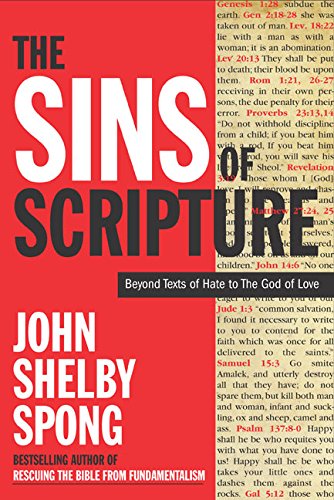
Synopsis
In the history of the Western World, the Bible has been a perpetual source of inspiration and guidance for countless Christians. However, this Bible has also left a trail of pain. It is undeniable that the Bible is not always used for good. Sometimes the Bible can seem overtly evil. Sometimes its texts are terrible.
Bishop John Shelby Spong boldly approaches those texts that have been used through history to justify the denigration or persecution of others while carrying with them the implied and imposed authority of the claim that they were the "Word of God." As he exposes and challenges what he calls the "terrible texts of the Bible", laying bare the evil done by these texts in the name of God, he also seeks to redeem these texts, hoping to recover their ultimate depth and purpose. Spong looks specifically at texts used to justify homophobia, anti-Semitism, treating women as second-class humans, corporal punishment, and environmental degradation, but he also delivers a new picture of how Christians can use the Bible today. As Spong battles against the way the Bible has been used throughout history, he provides a new framework, introducing people to a proper way to engage this holy book of the Judeo-Christian tradition.
"synopsis" may belong to another edition of this title.
From the Back Cover
In the history of the Western World, the Bible has been a perpetual source of inspiration and guidance for countless Christians. However, this Bible has also left a trail of pain. It is undeniable that the Bible is not always used for good. Sometimes the Bible can seem overtly evil. Sometimes its texts are terrible.
Bishop John Shelby Spong boldly approaches those texts that have been used through history to justify the denigration or persecution of others while carrying with them the implied and imposed authority of the claim that they were the "Word of God." As he exposes and challenges what he calls the "terrible texts of the Bible", laying bare the evil done by these texts in the name of God, he also seeks to redeem these texts, hoping to recover their ultimate depth and purpose. Spong looks specifically at texts used to justify homophobia, anti-Semitism, treating women as second-class humans, corporal punishment, and environmental degradation, but he also delivers a new picture of how Christians can use the Bible today. As Spong battles against the way the Bible has been used throughout history, he provides a new framework, introducing people to a proper way to engage this holy book of the Judeo-Christian tradition.
Excerpt. © Reprinted by permission. All rights reserved.
The Sins of Scripture
Exposing the Bible's Texts of Hate to Reveal the God of LoveBy John Shelby SpongHarperCollins Publishers, Inc.
Copyright ©2006 John Shelby SpongAll right reserved.
ISBN: 0060762055
Chapter One
Why This Book,
This Theme,
This Author
The Bible is a subject of interpretation: there is no doctrine,
no prophet, no priest, no power, which has not claimed
biblical sanctions for itself.
Paul Tillich
It is a mysterious book, this Bible. It possesses a strange kind of power.It has been the best-selling book in the world every year since printingbegan. It comes as no surprise to recall that when the Gutenberg presswas invented, it was the Bible that first bore the imprint of its metal letters.There is hardly a language or a dialect in the world today into which thewords of the Bible have not been translated. Its stories, its words and itsphrases have permeated our culture, infiltrating even our subconsciousminds. One thinks of motion picture titles that are direct quotations fromscripture: Lilies of the Field (Matt. 6:28), a 1968 film that earned SidneyPoitier an Oscar for best actor; Inherit the Wind (Prov. 11:29), the classic filmabout the Scopes trial set in the Tennessee of 1925 with Spencer Tracy starring as Clarence Darrow and Fredric March as William Jennings Bryan; andThrough a Glass Darkly (1 Cor. 13:12), an Ingmar Bergman masterpiece. Beyond these titles there have also been motion pictures dramatizing biblicalepics, frequently in overblown Hollywood style: The Ten Commandments, Samson and Delilah, David and Bathsheba, Barabbas and in more recentdays The Passion of the Christ.
Beyond overt references, biblical allusions are constantly used in literature.Without some knowledge of the sacred text, many expressions in our languagewould be meaningless. John Steinbeck's novel East of Eden comes to mind,along with Exodus by Leon Uris, The Green Pastures by Marc Connelly andThe Four Horsemen of the Apocalypse by Vicente Blasco Ibanez, which becamea motion picture directed by Vincent Minnelli.
The words of the Bible enrich our everyday speech whether we are awareof it or not: "for crying out loud," which refers to Jesus on the cross; "land ofGoshen," a reference to that section of Egypt which housed the Jewish slaves;"sour grapes," a phrase which derives from Jeremiah 31:39 that is widely usedto explain behavior; and "the olive branch" as a sign of peace, which comesfrom the story of Noah. Far more than anyone realizes, all of Western life hasbeen deeply shaped by the fact that the content of this Bible has washed overour civilization for more than two thousand years. Biblical concepts are sodeeply written into our individual and corporate psyches that even nonbelieversaccept them as both inevitable and simply a part of the way life is.
In the history of the Western world, however, this Bible has also left a trailof pain, horror, blood and death that is undeniable. Yet this fact is not oftenallowed to rise to consciousness. Biblical words have been used not only tokill, but even to justify that killing. This book has been relentlessly employedby those who say they believe it to be God's Word, to oppress others who havebeen, according to these believers, defined in the "hallowed" pages of thistext as somehow subhuman. Quotations from the Bible have been cited tobless the bloodiest of wars. People committed to the Bible have not refrainedfrom using the cruelest forms of torture on those whom they believe to havebeen revealed as the enemies of God in these "sacred" scriptures. A museumdisplay that premiered in Florence in 1983, and later traveled to the SanDiego Museum of Man in 2003, featured the instruments used on hereticsby Christians during the Inquisition. They included stretching machines designedliterally to pull a person apart, iron collars with spikes to penetrate thethroat, and instruments that were used to impale the victims. The Bible hasbeen quoted throughout Western history to justify the violence done to racialminorities, women, Jews and homosexuals. It might be difficult for some Christians to understand, but it is not difficult to document the terror enactedby believers in the name of the Bible.
How is it possible, we must ultimately wonder, that this book, which is almostuniversally revered in Western religious circles, could also be the sourceof so much evil? Can that use of the Bible be turned around and brought toan end? Can the Bible once again be viewed as a source -- even an ultimatesource -- of life? Or is it too late and the Bible too stained? Those are thethemes I will seek to address in this volume.
My qualifications for telling this story are twofold: first, I have had a lifetimelove affair with this Bible; and second, I am a church insider, whoyearns to see the church become what it was meant to be. I will not give upon the Bible or the church easily, but I will insist that the Bible be looked athonestly in the light of the best scholarship available and that the churchconsciously own its historical destructiveness.
I do not know exactly when my love affair with the Bible began. Perhapsits first seeds were planted when I was a child and began to notice that thefamily Bible was displayed prominently on the coffee table in our modest livingroom. I do not recall my parents ever reading it, but there was no questionthat it was revered. I did see it used to record the family's history in aspecial section that bore titles like "Births," "Deaths" and "Marriages." Nothingwas ever to be placed on top of that holy volume -- not another book, nota glass or a bottle, not even a piece of mail. This sanctified book could brookno cover, nor could it be seen as secondary in any way to any other entity ...
Continues...
Excerpted from The Sins of Scriptureby John Shelby Spong Copyright ©2006 by John Shelby Spong. Excerpted by permission.
All rights reserved. No part of this excerpt may be reproduced or reprinted without permission in writing from the publisher.
Excerpts are provided by Dial-A-Book Inc. solely for the personal use of visitors to this web site.
"About this title" may belong to another edition of this title.
Search results for The Sins of Scripture: Exposing the Bible's Texts...

Stock Image
Sins of Scripture Beyond Texts
Published by
HarperCollins Publishers Inc, 2005
ISBN 10: 0060762055
ISBN 13: 9780060762056
Used
Hardcover
Seller: World of Books (was SecondSale), Montgomery, IL, U.S.A.
Seller rating 5 out of 5 stars

Hardback. Condition: Good. In the history of the Western World, the Bible has been a perpetual source of inspiration and guidance for countless Christians. However, this Bible has also left a trail of pain. Controversial bishop and champion of liberal Christianity John Shelby Spong explores those passages that have been used to justify oppression, violence, discrimination against women and homosexuals, and murder. As he exposes and challenges what he calls the "terrible texts of the Bible," laying bare the evil done in the name of God, he also seeks to redeem them, hoping to recover their ultimate depth and purpose. As Spong battles against the way the Bible has been used throughout history, he provides a new framework for interpretation, explaining how the Bible's overall good news overcomes these "terrible texts," and delivering a fresh, inspiring message of how Christians can use the Bible today.John Shelby Spong was the Episcopal Bishop of Newark before his retirement in 2000. As a visiting lecturer at Harvard and at universities and churches throughout North America and the English-speaking world, he is one of the leading spokespersons for liberal Christianity. His books include A New Christianity for a New World, Rescuing the Bible from Fundamentalism, Resurrection: Myth or Reality?, Why Christianity Must Change or Die, and his autobiography, Here I Stand."A valuable modernist manifesto for progressive readers seeking a response to the conservative theology dominating the news these days." -Boston Globe. Seller Inventory # 00091265259
Stock Image
The Sins of Scripture: Exposing the Bible's Texts of Hate to Reveal the God of Love
Seller: Orion Tech, Kingwood, TX, U.S.A.
Seller rating 5 out of 5 stars
hardcover. Condition: Very Good. Seller Inventory # 0060762055-2-37083206
Stock Image
The Sins of Scripture: Exposing the Bible's Texts of Hate to Reveal the God of Love
Seller: Your Online Bookstore, Houston, TX, U.S.A.
Seller rating 5 out of 5 stars
Hardcover. Condition: Very Good. Seller Inventory # 0060762055-2-22288502
Seller Image
The Sins of Scripture: Exposing the Bible's Texts of Hate to Reveal the God of Love
Seller: Greenworld Books, Arlington, TX, U.S.A.
Seller rating 5 out of 5 stars
Condition: very_good. Fast Free Shipping â" Very Good condition book with a firm cover and clean pages. Shows normal use and some light wear or limited notes markings. A solid, nice copy to enjoy. Seller Inventory # GWV.0060762055.VG
Seller Image
The Sins of Scripture: Exposing the Bible's Texts of Hate to Reveal the God of Love
Seller: ZBK Books, Carlstadt, NJ, U.S.A.
Seller rating 5 out of 5 stars
Condition: like_new. Fast & Free Shipping â" Excellent condition book with clean cover and pages. Barely handled, with minimal wear. An outstanding copy, close to enjoy! Seller Inventory # ZWV.0060762055.LN
Stock Image
The Sins of Scripture: Exposing the Bible's Texts of Hate to Reveal the God of Love
Published by
HarperOne (edition First Edition), 2005
ISBN 10: 0060762055
ISBN 13: 9780060762056
Used
Hardcover
First Edition
Seller: BooksRun, Philadelphia, PA, U.S.A.
Seller rating 5 out of 5 stars
Hardcover. Condition: Very Good. First Edition. With dust jacket. It's a well-cared-for item that has seen limited use. The item may show minor signs of wear. All the text is legible, with all pages included. It may have slight markings and/or highlighting. Seller Inventory # 0060762055-8-1-29
Stock Image
The Sins of Scripture: Exposing the Bible's Texts of Hate to Reveal the God of Love
Seller: HPB-Emerald, Dallas, TX, U.S.A.
Seller rating 5 out of 5 stars
Hardcover. Condition: Very Good. Connecting readers with great books since 1972! Used books may not include companion materials, and may have some shelf wear or limited writing. We ship orders daily and Customer Service is our top priority! Seller Inventory # S_479332070
Stock Image
The Sins of Scripture: Exposing the Bible's Texts of Hate to Reveal the God of Love
Seller: ThriftBooks-Atlanta, AUSTELL, GA, U.S.A.
Seller rating 5 out of 5 stars
Hardcover. Condition: Very Good. No Jacket. Missing dust jacket; May have limited writing in cover pages. Pages are unmarked. ~ ThriftBooks: Read More, Spend Less. Seller Inventory # G0060762055I4N01
Stock Image
The Sins of Scripture: Exposing the Bible's Texts of Hate to Reveal the God of Love
Seller: ThriftBooks-Reno, Reno, NV, U.S.A.
Seller rating 5 out of 5 stars
Hardcover. Condition: Very Good. No Jacket. May have limited writing in cover pages. Pages are unmarked. ~ ThriftBooks: Read More, Spend Less. Seller Inventory # G0060762055I4N00
Stock Image
The Sins of Scripture: Exposing the Bible's Texts of Hate to Reveal the God of Love
Seller: ThriftBooks-Atlanta, AUSTELL, GA, U.S.A.
Seller rating 5 out of 5 stars
Hardcover. Condition: Very Good. No Jacket. May have limited writing in cover pages. Pages are unmarked. ~ ThriftBooks: Read More, Spend Less. Seller Inventory # G0060762055I4N00