
Items related to Countdown to Victory: The Final European Campaigns...
Synopsis
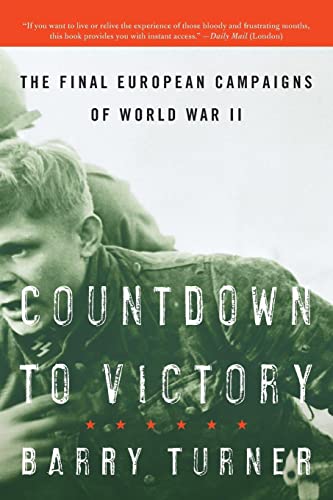
In most accounts of World War II, the last six months of fighting in Europe are tucked into an epilogue. After the Battle of the Bulge, the Nazis are assumed to be as good as defeated. In fact, they fought to their last breath. In the Hürtgen Forest, in the Po Valley of Italy, and in the German industrial heartland of the Ruhr, the Allies suffered horrific losses.
Drawing on never-before-published sources, Barry Turner captures the thrill of victory, the despair of defeat, and the staggering human costs of war. From the grunts on the ground to the machinations of generals and statesmen and the daily miseries of civilians caught in the crossfire, Turner brings this critical chapter of World War II searingly and indelibly to life.
"synopsis" may belong to another edition of this title.
About the Author
Barry Turner was educated at the London School of Economics and London Institute of Education. He has been a full-time writer for twenty years, and has been a regular guest on television and radio programs in the UK, mainly for commentary on the arts and education.
Excerpt. © Reprinted by permission. All rights reserved.
Countdown to Victory
The Final European Campaigns of World War IIBy Barry TurnerHarperCollins Publishers, Inc.
Copyright © 2005 Barry TurnerAll right reserved.
ISBN: 0060742828
Chapter One
Misreading Hitler
The party was over almost before it started. In August 1944 there were short odds on the war being over by Christmas. A month later, all bets were off. That the Third Reich would fall, few doubted. But when? It could take weeks or months; maybe even years?
The success of the Normandy landings, by no means a foregone conclusion, had been a great morale booster. In June the biggest ever invasion force had broken through German defences to sweep across France and Belgium. Caught in a pincer movement between American forces curving round from their advance south and Canadian and British troops moving down from Caen, the German Fifth and Seventh Armies had been trapped and destroyed. On August 20th, General George S. Patton led his Third Army on an assault across the Seine, creating a bridgehead at Mantes-Gassicourt nearly thirty miles to the northwest of Paris. Four days later, the French Second Armoured Division entered the capital. Meanwhile, to the east, the Soviet summer offensive had annihilated three Germany army groups to forge bridgeheads over the Narew River, north of Warsaw and the Vistula, south of the Polish capital.
But an advance of such speed and ferocity could not be sustained. On both fronts supply lines were dangerously extended. There was a desperate shortage of fuel and an equally desperate shortage of human energy. Battle-weary troops were in need of a respite. On the Polish frontier, Soviet forces dug themselves in at the river barriers, secure against Panzer counter-attacks. At the other side of Europe, the forward rush of three US armies was halted some sixty-four miles short of the Rhine. The Fifth Armoured Division of Patton's Third Army liberated Luxembourg, penetrating over ten miles into Germany. But then, in early September, even Patton's battle express ran out of steam.
Hopes of an early breakthrough were not easily abandoned. Operation Market Garden, a combined ground and airborne attack across sixty miles of enemy-held territory, was conceived by Field Marshal Sir Bernard Montgomery as a speedy conclusion to the war. The airborne troops would be dropped at Arnhem where they would secure a Rhine crossing. An infantry follow-up by Thirty Corps, led by General Brian Horrocks, was scheduled within fortyeight hours of the first landings. After that it should have been full speed to the great industrial cities of the Ruhr. In the event, the tanks of Thirty Corps fell easy victim to German gunners and Allied supplies failed to get through. The plan foundered. After nine days of close fighting, which virtually wiped out the British First Airborne Division and inflicted heavy casualties on the American parachutists, the operation was called off.
The ability of the Wehrmacht to challenge the odds was proved again eighty miles south of Arnhem, at Aachen, the first German city to fall to the Allies but at terrible cost to American forces. It had all seemed so easy. As the US Seventh Corps, led by General 'Lightning Joe' Collins, crossed open country towards Aachen, the defences showed every sign of crumbling. While Nazi officials were packing their bags, the commander of the 116th Panzer Division was also preparing to move out. He left behind him a letter to his American opposite number asking him to 'take care of the unfortunate people [of Aachen] in a humane way'. But then an altogether tougher commander took over. Determined to fight to the last man, Colonel Gerhardt Wilck forced Collins to abandon his plan to take Aachen 'on the run'. Instead, while the First Infantry, the 'Big Red One', America's finest infantry division, was fighting from house to house in the city suburbs, Collins' main force bypassed Aachen to enter what became known as the Hurtgen Forest or, as the GIs called it, the 'Green Hell of Hurtgen'. The objective was to achieve a pincer that would cut off the defenders of Aachen from the rest of the Wehrmacht. It worked but few would argue that it was worth the effort and the death toll. By mid-October, when Aachen finally passed to the attackers, American losses were close to 60,000 or, to put it another way, a casualty rate over six months higher than that for the six years in Vietnam. This was no way to win a war.
It was the same story in Italy, the only other front where progress might reasonably have been expected. After the capture of Rome in June, the Allied forces moving north had bumped up against a stubborn German defence of the Po Valley. As winter approached it was clear that the stalemate would not be broken easily. Everywhere the Allied advance was on hold. The emphasis now was on the build-up to a massive winter or spring offensive carrying the war well into 1945.
Preparation for a full-scale assault on the formidable West Wall or Siegfried Line defences along the German frontier were hampered by the destruction of past battles. The French railway system had been devastated first by Allied bombing and then by the Germans in retreat, while many of the Channel ports had been shelled or sabotaged beyond immediate use. Nonetheless, American and British forces captured Gelsenkirchen on the edge of the Ruhr conurbation, the heartland of German industrial power, and overran the outer defences of the Siegfried Line without much difficulty. It was when they struck at the main defences with networks of pillboxes and minefields that had to be cleared step by step, that the real horror started. Reporting for the BBC, Frank Gillard spoke of mile after mile of trenches across the countryside.
They zigzag along the edges of the roads and behind the embankments, and I saw one particularly well-prepared system alongside a sunken railway track. Most of these trench systems had culs-de-sac branching out at right angles, leading across fields, up to little bumps of rising ground or out towards other tracks ...
Continues...
Excerpted from Countdown to Victoryby Barry Turner Copyright © 2005 by Barry Turner. Excerpted by permission.
All rights reserved. No part of this excerpt may be reproduced or reprinted without permission in writing from the publisher.
Excerpts are provided by Dial-A-Book Inc. solely for the personal use of visitors to this web site.
"About this title" may belong to another edition of this title.
Search results for Countdown to Victory: The Final European Campaigns...

Stock Image
Countdown to Victory : The Final European Campaigns of World War II
Published by
HarperCollins Publishers, 2005
ISBN 10: 0060742828
ISBN 13: 9780060742829
Used
Softcover
Seller: Better World Books, Mishawaka, IN, U.S.A.
Seller rating 5 out of 5 stars

Condition: Good. Pages intact with minimal writing/highlighting. The binding may be loose and creased. Dust jackets/supplements are not included. Stock photo provided. Product includes identifying sticker. Better World Books: Buy Books. Do Good. Seller Inventory # 53983183-6
Stock Image
Countdown to Victory: The Final European Campaigns of World War II
Seller: HPB-Emerald, Dallas, TX, U.S.A.
Seller rating 5 out of 5 stars
paperback. Condition: Very Good. Connecting readers with great books since 1972! Used books may not include companion materials, and may have some shelf wear or limited writing. We ship orders daily and Customer Service is our top priority! Seller Inventory # S_442572909
Stock Image
Countdown to Victory
Published by
Harper Perennial June 2021, 2021
ISBN 10: 0060742828
ISBN 13: 9780060742829
Used
Paper Back
Seller: A Cappella Books, Inc., Atlanta, GA, U.S.A.
Seller rating 5 out of 5 stars
Paper Back. Condition: Good. Seller Inventory # 402076
Stock Image
Countdown to Victory: The Final European Campaigns of World War II - The Staggering Human Costs and Horrific Allied Losses in the War's Last Six Months
Seller: Housing Works Online Bookstore, New York, NY, U.S.A.
Seller rating 5 out of 5 stars
Paperback. Condition: Very Good. Reprint. Minimal wear to cover. Pages clean and binding tight. shelf wear. bumped edges. Paperback. Seller Inventory # GS3-01140-IN
Stock Image
Countdown to Victory: The Final European Campaigns of World War II.
Published by
Harper Perennial, 2005., 2005
ISBN 10: 0060742828
ISBN 13: 9780060742829
Used
Paperback
First Edition
Seller: Military Books, Washington, DC, U.S.A.
Seller rating 5 out of 5 stars
Paperback. Condition: As New. 1st. 1st thus. 207p. b/w Photos. Maps. Large Wraps. As New Copy. Book. Seller Inventory # 82-1034
Stock Image
Countdown to Victory: The Final European Campaigns of World War II
Seller: Lakeside Books, Benton Harbor, MI, U.S.A.
Seller rating 5 out of 5 stars
Condition: New. Brand New! Not Overstocks or Low Quality Book Club Editions! Direct From the Publisher! We're not a giant, faceless warehouse organization! We're a small town bookstore that loves books and loves it's customers! Buy from Lakeside Books! Seller Inventory # OTF-S-9780060742829
Seller Image
Countdown to Victory The Final European Campaigns of World War II
Published by
Harper Perennial, New York, NY, 2005
ISBN 10: 0060742828
ISBN 13: 9780060742829
Used
Paperback
First Edition
Seller: True Oak Books, Highland, NY, U.S.A.
Seller rating 5 out of 5 stars
Paperback. Condition: Very Good. First US Edition; First Printing. 494 pages; B&W photographs. Maps. Light rubbing to the bottom exterior edge of textblock. Minor rubbing to the covers. Very Good condition otherwise. No other noteworthy defects. No markings. ; - We offer free returns for any reason and respond promptly to all inquiries. Your order will be packaged with care and ship on the same or next business day. Buy with confidence. Seller Inventory # HVD-53103-A-0
Seller Image
Countdown to Victory: The Final European Campaigns of World War II (Paperback or Softback)
Published by
Harper Perennial 11/8/2005, 2005
ISBN 10: 0060742828
ISBN 13: 9780060742829
New
Paperback or Softback
Seller: BargainBookStores, Grand Rapids, MI, U.S.A.
Seller rating 5 out of 5 stars
Paperback or Softback. Condition: New. Countdown to Victory: The Final European Campaigns of World War II. Book. Seller Inventory # BBS-9780060742829
Stock Image
Countdown to Victory: The Final European Campaigns of World War II - The Staggering Human Costs and Horrific Allied Losses in the War's Last Six Months
Seller: California Books, Miami, FL, U.S.A.
Seller rating 5 out of 5 stars
Condition: New. Seller Inventory # I-9780060742829
Stock Image
Countdown to Victory (Paperback)
Published by
HarperCollins Publishers Inc, New York, 2021
ISBN 10: 0060742828
ISBN 13: 9780060742829
New
Paperback
Seller: Grand Eagle Retail, Bensenville, IL, U.S.A.
Seller rating 5 out of 5 stars
Paperback. Condition: new. Paperback. In most accounts of World War II, the last six months of fighting in Europe are tucked into an epilogue. After the Battle of the Bulge, the Nazis are assumed to be as good as defeated. In fact, they fought to their last breath. In the Huertgen Forest, in the Po Valley of Italy, and in the German industrial heartland of the Ruhr, the Allies suffered horrific losses.Drawing on never-before-published sources, Barry Turner captures the thrill of victory, the despair of defeat, and the staggering human costs of war. From the grunts on the ground to the machinations of generals and statesmen and the daily miseries of civilians caught in the crossfire, Turner brings this critical chapter of World War II searingly and indelibly to life. In most accounts of World War II, the last six months of fighting in Europe are tucked into an epilogue. After the Battle of the Bulge, the Nazis are assumed to be as good as defeated. In fact, they fought to their last breath. In the Hurtgen Forest, in the Po Valley of Italy, and in the German industrial heartland of the Ruhr, the Allies suffered horrific losses. Drawing on never-before-published sources, Barry Turner captures the thrill of victory, the despair of defeat, and the staggering human costs of war. From the grunts on the ground to the machinations of generals and statesmen and the daily miseries of civilians caught in the crossfire, Turner brings this critical chapter of World War II searingly and indelibly to life. Shipping may be from multiple locations in the US or from the UK, depending on stock availability. Seller Inventory # 9780060742829