
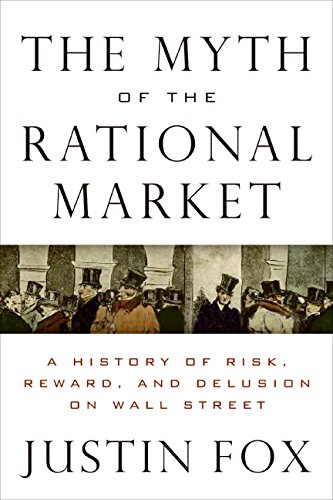
Items related to The Myth of the Rational Market: A History of Risk,...
Synopsis
“Do we really need yet another book about the financial crisis? Yes, we do—because this one is different….A must-read for anyone who wants to understand the mess we’re in.”
—Paul Krugman, New York Times Book Review
“Fox makes business history thrilling.”
—St. Louis Post-Dispatch
A lively history of ideas, The Myth of the Rational Market by former Time Magazine economics columnist Justin Fox, describes with insight and wit the rise and fall of the world’s most influential investing idea: the efficient markets theory. Both a New York Times bestseller and Notable Book of the Year—longlisted for the Financial Times Business Book of the Year Award and named one of Library Journal Best Business Books of the Year—The Myth of the Rational Market carries readers from the earliest days of Wall Street to the current financial crisis, debunking the long-held myth that the stock market is always right in the process while intelligently exploring the replacement theory of behavioral economics.
"synopsis" may belong to another edition of this title.
From the Back Cover
Chronicling the rise and fall of the efficient market theory and the century-long making of the modern financial industry, Justin Fox's The Myth of the Rational Market is as much an intellectual whodunit as a cultural history of the perils and possibilities of risk. The book brings to life the people and ideas that forged modern finance and investing, from the formative days of Wall Street through the Great Depression and into the financial calamity of today. It's a tale that features professors who made and lost fortunes, battled fiercely over ideas, beat the house in blackjack, wrote bestselling books, and played major roles on the world stage. It's also a tale of Wall Street's evolution, the power of the market to generate wealth and wreak havoc, and free market capitalism's war with itself.
The efficient market hypothesis'long part of academic folklore but codified in the 1960s at the University of Chicago'has evolved into a powerful myth. It has been the maker and loser of fortunes, the driver of trillions of dollars, the inspiration for index funds and vast new derivatives markets, and the guidepost for thousands of careers. The theory holds that the market is always right, and that the decisions of millions of rational investors, all acting on information to outsmart one another, always provide the best judge of a stock's value. That myth is crumbling.
Celebrated journalist and columnist Fox introduces a new wave of economists and scholars who no longer teach that investors are rational or that the markets are always right. Many of them now agree with Yale professor Robert Shiller that the efficient markets theory 'represents one of the most remarkable errors in the history of economic thought.' Today the theory has given way to counterintuitive hypotheses about human behavior, psychological models of decision making, and the irrationality of the markets. Investors overreact, underreact, and make irrational decisions based on imperfect data. In his landmark treatment of the history of the world's markets, Fox uncovers the new ideas that may come to drive the market in the century ahead.
Excerpt. © Reprinted by permission. All rights reserved.
The Myth of the Rational Market
A History of Risk, Reward, and Delusion on Wall StreetBy Justin FoxCollins Business
Copyright © 2009 Justin FoxAll right reserved.
ISBN: 978-0-06-059899-0
Chapter One
Irving Fisher Loses His Briefcase, and Then His FortuneThe first serious try to impose reason and science upon the market comes in the early decades of the twentieth century. It doesn't work out so well.
It is 1905. A well-dressed man in his late thirties talks intently into a pay phone at Grand Central Depot in New York. Between his legs is a leather valise. The doors of the phone booth are open, and a thief makes off with the bag. It is, given what we know of its owner, of excellent quality. Finding a willing buyer will not be a problem.
The contents of the valise are another matter. Stuffed inside is an almost-completed manuscript that brings together economics, probability theory, and real-world business practice in ways never seen before. It is part economics treatise, part primer on what rational, scientific stock market investing ought to look like. It is a glimpse into Wall Street's distant future.
That science and reason might be applied to the stock exchange was still a radical notion in 1905. "Wall Street and its captains ran the stock market, and they and their friends either owned or controlled the speculative pools," recalled one journalist of the time. "The speculative public hardly had a chance. The right stockholders knew when to buy and sell. The others groped."
Times, though, were changing. Good information about stocks and bonds was getting easier for the "speculative public" to obtain. Corporations had become too big and too interested in respectability to be controlled by just a few cronies. The dark corners of Wall Street were being illuminated. Maybe the investing world was ready for a more scientific approach.
The stolen manuscript was never seen again, but its author, Yale University economics professor Irving Fisher, had a habit of overcoming setbacks that might cause a lesser (or more realistic) individual to despair. As he prepared to set off for college in 1884, his father died of tuberculosis, leaving the undergraduate to support his mother and younger siblings. Just as his academic career began to take off in the late 1890s, Fisher himself came down with TB, which incapacitated him for years. In 1904, finally healthy and working again, he watched as fire consumed the house just north of Yale's campus where he lived with his wife and two children.
And then the theft of his manuscript. Afterward, inured by then to disaster, Fisher went right back to work. He resolved always to close the door when he entered a phone booth, and he rewrote his book, this time making copies of each chapter as he went along. Published in 1906 as The Nature of Capital and Income, it cemented his international reputation among economists. It became, as one biographer wrote, "one of the principal building blocks of all present-day economic theory."
Its impact on Wall Street was less immediately obvious. Stockbrokers and speculators did not rush out to buy the book. There's no evidence that investors began making probability calculations before they bought stocks, as Fisher recommended. But Fisher was at least as persistent as he was lacking in street smarts. His ideas began to have some impact in his lifetime, and after his death in 1947, they took off.
Books directly or indirectly descended from Fisher's work now adorn the desks of hedge fund managers, pension consultants, financial advisers, and do-it-yourself investors. The increasingly dominant quantitative side of the financial world-that strange wonderland of portfolio optimization software, enhanced indexing, asset allocators, credit default swaps, betas, alphas, and "model-derived" valuations-is a territory where Professor Fisher would feel intellectually right at home. He is perhaps not the father, but certainly a father of modern Wall Street.
Hardly anyone calls him that, though. Economists honor Fisher for his theoretical breakthroughs, but outside the discipline his chief claim to lasting fame is the horrendous stock market advice he proffered in the late 1920s. Read almost any history of the years leading up to the great crash of October 1929, and the famous Professor Fisher serves as a sort of idiot Greek chorus, popping up every few pages to assert that stock prices had reached a "permanently high plateau." He wasn't just talking the talk. Fisher blew his entire fortune (acquired through marriage, then increased through entrepreneurial success) in the bear market of late 1929 and the early 1930s.
Fisher's two historical personas-buffoon of the great crash and architect of financial modernity-are not as alien to each other as they might at first appear. In the early years of the twentieth century Fisher outlined a course of rational, scientific behavior for stock market players. In the late 1920s, blinded in part by his own spectacular financial success, he became convinced that America's masses of speculators and investors (not to mention its central bankers) were in fact following his advice. Nothing, therefore, could go wrong. Irving Fisher had succumbed to the myth of the rational market. It is a myth of great power-one that, much of the time, explains reality pretty well. But it is nonetheless a myth, an oversimplification that, when taken too literally, can lead to all sorts of trouble. Fisher was just the first in a line of distinguished scholars who saw reason and scientific order in the market and made fools of themselves on the basis of this conviction. Most of the others came along much later, though. Irving Fisher was ahead of his time.
He was not, however, alone in his advanced thoughts about financial markets. In Paris, mathematics student Louis Bachelier studied the price fluctuations on the Paris Bourse (exchange) in a similar spirit. The result was a doctoral thesis that, when unearthed more than half a century after its completion in 1900, would help to relaunch the study of financial markets.
Bachelier undertook his investigation at a time when scientists had begun to embrace the idea that while there could be no absolute certainty about anything, uncertainty itself could be a powerful tool. Instead of trying to track down the cause of every last jiggling of a molecule or movement of a planet, one could simply assume that the causes were many and randomness the result. "It is thanks to chance-that is to say, thanks to our ignorance, that we can arrive at conclusions," wrote the great French mathematician and physicist Henri Poincar in 1908.
(Continues...)
Excerpted from The Myth of the Rational Marketby Justin Fox Copyright © 2009 by Justin Fox. Excerpted by permission.
All rights reserved. No part of this excerpt may be reproduced or reprinted without permission in writing from the publisher.
Excerpts are provided by Dial-A-Book Inc. solely for the personal use of visitors to this web site.
"About this title" may belong to another edition of this title.
Search results for The Myth of the Rational Market: A History of Risk,...

Stock Image
The Myth of the Rational Market: A History of Risk, Reward, and Delusion on Wall Street
Published by
HarperCollins Publishers Inc, 2009
ISBN 10: 0060598999
ISBN 13: 9780060598990
Used
Hardcover
Seller: World of Books (was SecondSale), Montgomery, IL, U.S.A.
Seller rating 5 out of 5 stars

Hardback. Condition: Good. "Do we really need yet another book about the financial crisis? Yes, we do--because this one is different.A must-read for anyone who wants to understand the mess we're in." --Paul Krugman, New York Times Book Review "Fox makes business history thrilling." --St. Louis Post-Dispatch A lively history of ideas, The Myth of the Rational Market by former Time Magazine economics columnist Justin Fox, describes with insight and wit the rise and fall of the world's most influential investing idea: the efficient markets theory. Both a New York Times bestseller and Notable Book of the Year--longlisted for the Financial Times Business Book of the Year Award and named one of Library Journal Best Business Books of the Year--The Myth of the Rational Market carries readers from the earliest days of Wall Street to the current financial crisis, debunking the long-held myth that the stock market is always right in the process while intelligently exploring the replacement theory of behavioral economics. Seller Inventory # 00109625816
Stock Image
The Myth of the Rational Market: A History of Risk, Reward, and Delusion on Wall Street
Published by
HarperCollins Publishers Inc, 2009
ISBN 10: 0060598999
ISBN 13: 9780060598990
Used
Hardcover
Seller: World of Books (was SecondSale), Montgomery, IL, U.S.A.
Seller rating 5 out of 5 stars
Hardback. Condition: Very Good. "Do we really need yet another book about the financial crisis? Yes, we do--because this one is different.A must-read for anyone who wants to understand the mess we're in." --Paul Krugman, New York Times Book Review "Fox makes business history thrilling." --St. Louis Post-Dispatch A lively history of ideas, The Myth of the Rational Market by former Time Magazine economics columnist Justin Fox, describes with insight and wit the rise and fall of the world's most influential investing idea: the efficient markets theory. Both a New York Times bestseller and Notable Book of the Year--longlisted for the Financial Times Business Book of the Year Award and named one of Library Journal Best Business Books of the Year--The Myth of the Rational Market carries readers from the earliest days of Wall Street to the current financial crisis, debunking the long-held myth that the stock market is always right in the process while intelligently exploring the replacement theory of behavioral economics. Seller Inventory # 00110311310
Seller Image
The Myth of the Rational Market: A History of Risk, Reward, and Delusion on Wall Street
Seller: Zoom Books East, Glendale Heights, IL, U.S.A.
Seller rating 5 out of 5 stars
Condition: good. Book is in good condition and may include underlining highlighting and minimal wear. The book can also include "From the library of" labels. May not contain miscellaneous items toys, dvds, etc. . We offer 100% money back guarantee and 24 7 customer service. Seller Inventory # ZEV.0060598999.G
Stock Image
The Myth of the Rational Market: A History of Risk, Reward, and Delusion on Wall Street
Published by
HarperCollins Publishers Inc, 2009
ISBN 10: 0060598999
ISBN 13: 9780060598990
Used
Hardcover
Seller: World of Books (was SecondSale), Montgomery, IL, U.S.A.
Seller rating 5 out of 5 stars
Hardback. Condition: Fair. "Do we really need yet another book about the financial crisis? Yes, we do--because this one is different.A must-read for anyone who wants to understand the mess we're in." --Paul Krugman, New York Times Book Review "Fox makes business history thrilling." --St. Louis Post-Dispatch A lively history of ideas, The Myth of the Rational Market by former Time Magazine economics columnist Justin Fox, describes with insight and wit the rise and fall of the world's most influential investing idea: the efficient markets theory. Both a New York Times bestseller and Notable Book of the Year--longlisted for the Financial Times Business Book of the Year Award and named one of Library Journal Best Business Books of the Year--The Myth of the Rational Market carries readers from the earliest days of Wall Street to the current financial crisis, debunking the long-held myth that the stock market is always right in the process while intelligently exploring the replacement theory of behavioral economics. Seller Inventory # 00110668260
Seller Image
The Myth of the Rational Market: A History of Risk, Reward, and Delusion on Wall Street
Seller: Used Book Company, Egg Harbor Township, NJ, U.S.A.
Seller rating 5 out of 5 stars
Condition: As New. Shows minimal signs of wear and previous use. Can include minimal notes/highlighting. A portion of your purchase benefits nonprofits! - Note: Edition & format may differ from what is shown in stock photo & item details. May not include supplementary material (toys, access code, dvds, etc). Seller Inventory # UBCV.0060598999.LN
Seller Image
The Myth of the Rational Market: A History of Risk, Reward, and Delusion on Wall Street
Seller: Greenworld Books, Arlington, TX, U.S.A.
Seller rating 5 out of 5 stars
Condition: good. Fast Free Shipping â" Good condition. It may show normal signs of use, such as light writing, highlighting, or library markings, but all pages are intact and the book is fully readable. A solid, complete copy that's ready to enjoy. Seller Inventory # GWV.0060598999.G
Stock Image
The Myth of the Rational Market: A History of Risk, Reward, and Delusion on Wall Street
Published by
HarperCollins Publishers Inc, 2009
ISBN 10: 0060598999
ISBN 13: 9780060598990
Used
Hardcover
Seller: World of Books Inc, Montgomery, IL, U.S.A.
Seller rating 4 out of 5 stars

Hardback. Condition: Good. "Do we really need yet another book about the financial crisis? Yes, we do--because this one is different.A must-read for anyone who wants to understand the mess we're in." --Paul Krugman, New York Times Book Review "Fox makes business history thrilling." --St. Louis Post-Dispatch A lively history of ideas, The Myth of the Rational Market by former Time Magazine economics columnist Justin Fox, describes with insight and wit the rise and fall of the world's most influential investing idea: the efficient markets theory. Both a New York Times bestseller and Notable Book of the Year--longlisted for the Financial Times Business Book of the Year Award and named one of Library Journal Best Business Books of the Year--The Myth of the Rational Market carries readers from the earliest days of Wall Street to the current financial crisis, debunking the long-held myth that the stock market is always right in the process while intelligently exploring the replacement theory of behavioral economics. Seller Inventory # CIN0060598999G
Stock Image
The Myth of the Rational Market: A History of Risk, Reward, and Delusion on Wall Street
Published by
HarperCollins Publishers Inc, 2009
ISBN 10: 0060598999
ISBN 13: 9780060598990
Used
Hardcover
Seller: World of Books Inc, Montgomery, IL, U.S.A.
Seller rating 4 out of 5 stars
Hardback. Condition: Very Good. "Do we really need yet another book about the financial crisis? Yes, we do--because this one is different.A must-read for anyone who wants to understand the mess we're in." --Paul Krugman, New York Times Book Review "Fox makes business history thrilling." --St. Louis Post-Dispatch A lively history of ideas, The Myth of the Rational Market by former Time Magazine economics columnist Justin Fox, describes with insight and wit the rise and fall of the world's most influential investing idea: the efficient markets theory. Both a New York Times bestseller and Notable Book of the Year--longlisted for the Financial Times Business Book of the Year Award and named one of Library Journal Best Business Books of the Year--The Myth of the Rational Market carries readers from the earliest days of Wall Street to the current financial crisis, debunking the long-held myth that the stock market is always right in the process while intelligently exploring the replacement theory of behavioral economics. Seller Inventory # CIN0060598999VG
Stock Image
The Myth of the Rational Market: A History of Risk, Reward, and Delusion on Wall Street
Published by
Harper Business (edition ), 2009
ISBN 10: 0060598999
ISBN 13: 9780060598990
Used
Hardcover
Seller: BooksRun, Philadelphia, PA, U.S.A.
Seller rating 5 out of 5 stars
Hardcover. Condition: Fair. With dust jacket. The item might be beaten up but readable. May contain markings or highlighting, as well as stains, bent corners, or any other major defect, but the text is not obscured in any way. Ex-Library. Seller Inventory # 0060598999-7-1-12_13_29
Stock Image
The Myth of the Rational Market: A History of Risk, Reward, and Delusion on Wall Street
Seller: BookHolders, Towson, MD, U.S.A.
Seller rating 5 out of 5 stars
Condition: Good. [ No Hassle 30 Day Returns ][ Ships Daily ] [ Underlining/Highlighting: NONE ] [ Writing: NONE ] [ Edition: Reprint ] Publisher: HarperBusiness Pub Date: 6/9/2009 Binding: Hardcover Pages: 400 Reprint edition. Seller Inventory # 6642192