
Items related to Foundations of General Linguistics
Foundations of General Linguistics - Hardcover
Book 2 of 43: Routledge Library Editions: Linguistics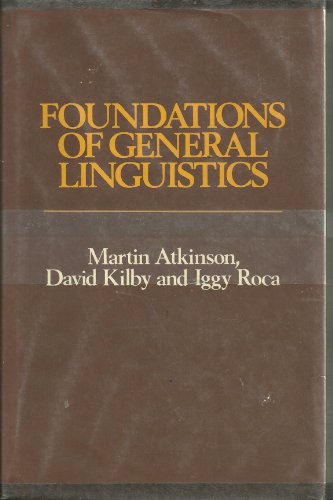
Synopsis
The first edition of this major introduction to linguistics rapidly established itself as an important student textbook, and a reference tool for those who already have some acquaintance with linguistics. This second edition has been updated and revised and includes new chapters on syntax and on current developments in generative grammar, as well as new material on the nature of language and on morphology.
This book first provides a comprehensive critical review of the analytic tools and theories of linguistics and systematically surveys major concepts in phonetics, phonology, morphology, syntax and semantics. Having established the basic nature and structure of language, the final part of the book engages some of the wider issues concerning the use of language in speaking and understanding (psycholinguistics), language development in children, social aspects of language (sociolinguistics), and historical language choice.
"synopsis" may belong to another edition of this title.
Search results for Foundations of General Linguistics

Stock Image
Foundations of General Linguistics
Seller: Anybook.com, Lincoln, United Kingdom
Seller rating 5 out of 5 stars

Condition: Fair. This is an ex-library book and may have the usual library/used-book markings inside.This book has hardback covers. Book contains pencil markings. In fair condition, suitable as a study copy. No dust jacket. Please note the Image in this listing is a stock photo and may not match the covers of the actual item,650grams, ISBN:0044100035. Seller Inventory # 8975558
Buy Used
£ 4.93
£ 13.04 shipping
Ships from United Kingdom to U.S.A.
Ships from United Kingdom to U.S.A.
Quantity: 1 available
Seller Image
Foundations of General Linguistics.
Published by
London, Boston, Sydney: George Allen & Unwin, 1982
ISBN 10: 0044100035
ISBN 13: 9780044100034
Used
Hardcover
Seller: Borkert, Schwarz und Zerfaß GbR, Berlin, Germany
Seller rating 5 out of 5 stars
Hardcover with dustjacket. Condition: Gut. XIII, 388 p. Aus der Bibliothek von Prof. Wolfgang Haase, langjährigem Herausgeber der ANRW und des International Journal of the Classical Tradition (IJCT) / From the library of Prof. Wolfgang Haase, long-time editor of ANRW and the International Journal of the Classical Tradition (IJCT). - Schutzumschlag berieben, leichte Randläsuren, Sticker auf Buchrücken, Kopfschnitt fleckig, Bleistiftanmerkung auf Vorsatz, sonst guter Zustand / dust jacket rubbed, light edge wear, sticker on spine, top edge stained, pencil annotation on endpaper, otherwise good condition. - Introductory books raise problems which often beg complex answers, but the authors of Foundations of General Linguistics do not shy away from such questions, even when they do not lead on to straightforward answers. The discipline of linguistics opens up a vast range of unsolved problems and the authors have seen their task in this book as being to provide readers with the techniques and terminology for beginning to think about them for themselves. This is an introduction which does not presuppose that the reader has any prior knowledge of linguistics, or of any of the other disciplines on which it touches. Divided into three parts, on the nature, the structure and the use of language, it will be invaluable to every serious student of linguistics and very useful to undergraduates following a linguistics course as part of a broadly based scheme of study. Each chapter offers a helpful introduction to its subjectmatter and concludes with a set of exercises, some providing a basis for class discussion, some for students to work on individually and some involving the collection and analysis of data. The annotated bibliographies for each chapter, which direct the reader to more advanced and comprehensive texts and offer references to original articles which are relevant to the arguments developed, are a valuable adjunct. / Contents Preface Acknowledgements International Phonetic Alphabet PART ONE THE NATURE OF LANGUAGE Chapter 1 Are Humans Unique? 1.1 On origins 1.2 Rules and creativity 1.3 Animal communication and the design features of language 1.4 Genetic transmission of language 1.5 Human-like language in chimpanzees? 1.6 The functional significance of Hocketts design features 1.7 Structure and function in language 1.8 Saussures structuralist linguistics Exercises Bibliography Chapter 2 The Data of Linguistics and the Nature of Learning 2.1 Structuralist linguistics and behaviourist psychology 2.2 Objections to a corpus-based approach 2.3 Rules and intuitions - mentalist linguistics 2.4 Objections to mentalist linguistics 2.5 Native language learning; empiricism versus rationalism 2.6 External evidence for language innateness 2.7 An internal argument for innateness Exercises Bibliography PART TWO THE STRUCTURE OF LANGUAGE Chapter 3 Phonetics 3.1 Primacy of spoken language 3.2 Sound waves 3.3 Air vibration 3.4 Voice production 3.5 Respiration and speech airstream mechanism 3.6 Analysis and classification of vowels 3.7 Liquids and fricatives 3.8 Places of articulation 3.9 Stops and affricates 3.10 Voicing and nasalisation 3.11 Suprasegmentals Exercises Bibliography Chapter 4 Phonology 4.1 Physical sound and linguistic sound 4.2 Contextual variation of sound 4.3 Criteria of analysis 4.4 Daniel Jones and the phoneme 4.5 Sapirs psychological approach 4.6 Discovery procedures 4.7 Classification of phonemes 4.8 Distinctive features 4.9 Rules and formalism Exercises Bibliography Chapter 5 Morphology 5.1 The morpheme as the basic unit 5.2 Phonologically conditioned morphological variation 5.3 Boundaries between morphemes - the morph 5.4 The word - definitional criteria 5.5 Morphological classification of languages 5.6 Approaches to morphological description Exercises Bibliography Chapter 6 Syntax 6.1 The subject-matter of syntax 6.2 Parts of speech and syntactic relations 6.3 The constituency approach 6.4 Evaluating alternative approaches 6.5 Motivating a transformational approac. Seller Inventory # 1195363
Stock Image
Foundations of General Linguistics
Published by
HarperCollins Publishers Ltd, 1982
ISBN 10: 0044100035
ISBN 13: 9780044100034
Used
Hardcover
Seller: Goodbooks-Wien, Schleinbach, AT, Austria
Seller rating 5 out of 5 stars
Kein Einband. Condition: Gut. Hardcover, Ex-Bibliotheksexemplar mit üblichen Markierungen, Einband gebrauchsspurig ansonsten im guten Zustand, HarperCollins 1982, Versand weltweit / international shipping. Seller Inventory # b175-1201275p-11
Stock Image
Foundations of general linguistics
Published by
HarperCollins Publishers Ltd, 1982
ISBN 10: 0044100035
ISBN 13: 9780044100034
Used
Hardcover
Seller: Mispah books, Redhill, SURRE, United Kingdom
Seller rating 4 out of 5 stars

hardcover. Condition: Acceptable. Acceptable. Dust Jacket NOT present. CD WILL BE MISSING. SHIPS FROM MULTIPLE LOCATIONS. book. Seller Inventory # ERICA82900441000353
Buy Used
£ 227
£ 25 shipping
Ships from United Kingdom to U.S.A.
Ships from United Kingdom to U.S.A.
Quantity: 1 available