
Items related to The Lexus and the Olive Tree
Synopsis
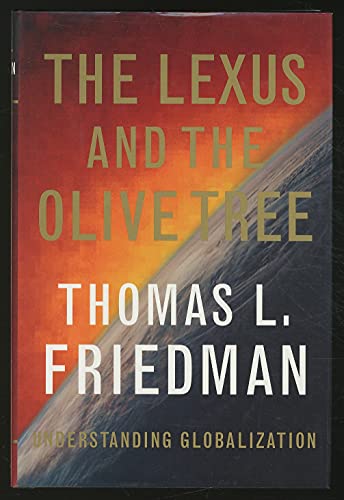
A powerful account of the state of the world today – where fast food and fanaticism, shopping and civil war go hand in hand.
Half of this new, post-cold-war world is intent on building a better Lexus, on streamlining their societies and economies for the global marketplace, while the other half is locked in elemental struggles over who owns which olive tree, which strip of land.
FACT: no two countries with a McDonald’s have been at war.
FACT: Welsh football club Llansantffraid changed its name to ‘Total Network Solutions’ in exchange for $400,000
FACT: betting on the yen lost George Soros $600 million in a day and altered the course of international diplomacy
No power is strong enough to resist the global markets – the key question, addressed in this book, is how best to accomodate them, how to retain national identity and control over our lives while still linking up to the soulless, faceless global institutions in order to survive economically. There is no bigger or more urgent question facing the world
From the devastation of the Mexican economy to the biscuit that helped alter the course of an election, including jungle fighters, Russian gangsters, Japanese burger chain owners and Middle Eastern spies, to name but a few, Friedman brings the human side of his analysis vividly to life.
"synopsis" may belong to another edition of this title.
About the Author
THOMAS FRIEDMAN was born in Minneapolis in 1943. He completed his post-graduate Middle-Eastern Studies at St Antony’s College, Oxford, before becoming a journalist. From 1979 to 1981, he was UPI’s Beirut correspondent. In 1982, he became the New York Times’ Beirut bureau chief, moving south to Jerusalem in 1984 to become bureau chief there. In January 1989, he became the New York Times’ chief diplomatic correspondent in Washington, where he now lives with his wife and two daughters. Friedman has twice won a Pulitzer Prize for his reporting from the Middle East.
From the Back Cover
Globalization is the single most powerful force at work in the world today. Whoever we are, wherever we live, there is no escaping its profound effects.
It takes diverse and sometimes bizarre forms , from a shopper in Hong Kong trying to choose between a Michael Jordan baseball cap and one emblazoned with the Red Flag of Communist China, to the downfall of Barings Bank, where a British derivatives trader, based in Singapore, speculating in Japanese paper, destroyed an old English bank, which was then acquired by ING, a Dutch bank, with the help of American bankers.
One half of the world has embraced this new world order and is intent on building a better Lexus, modernizing and streamlining societies for the global economy, while the other half is locked into bitter struggle over the primordial elements of human existence: families, tribe religion and community – the olive tree. Countries where an industrial, multinationally owned future is obliterating the past – Japan, Taiwan, Brazil, Argentina – exist side by side with those where old hatreds are rising up to destroy the future, as in Rwanda and Afghanistan.
As national barriers are ripped down by the forces of free market capitalism, and the world moves seemingly irresistibly towards a global homogeneity, there is a renewed yearning to resist that monoculture and to create borders based on personal history, religion, nationalism and culture.
The conflict between the Lexus and the olive tree, between globalization and the powerful, often violent forces of local identity, and the need to find a balance between the two, is the defining theme of this provocative and challenging book.
PRAISE FOR 'FROM BEIRUT TO JERUSALEM:'
“Jubilantly intelligent – a dashing hybrid of autobiography and journalism. Friedman’s book is a lifeline to the sane, a beacon to the hopeful.”
MICHAEL COREN, 'Sunday Times '
“Friedman fills the yawning gap between verbiage and understanding with grace, precision and insight.”
ECONOMIST
“Friedman’s approach is both original and thought-provoking. His analysis of the changing shape of relations between Israel and the American Jewish community is masterful … a striking achievement .”
ANDREW GOWERS, 'Financial Times'
“ A sparkling intellectual guidebook … an engrossing journey not to be missed.”
WALL STREET JOURNAL
"About this title" may belong to another edition of this title.
Search results for The Lexus and the Olive Tree

Stock Image
The Lexus and the Olive Tree
Published by
HarperCollins 17/05/1999, 1999
ISBN 10: 0002570149
ISBN 13: 9780002570145
Used
Hardcover
Seller: AwesomeBooks, Wallingford, United Kingdom
Seller rating 5 out of 5 stars

Condition: Very Good. This book is in very good condition and will be shipped within 24 hours of ordering. The cover may have some limited signs of wear but the pages are clean, intact and the spine remains undamaged. This book has clearly been well maintained and looked after thus far. Money back guarantee if you are not satisfied. See all our books here, order more than 1 book and get discounted shipping. . Seller Inventory # 7719-9780002570145
Buy Used
£ 3.52
£ 4.12 shipping
Ships from United Kingdom to U.S.A.
Ships from United Kingdom to U.S.A.
Quantity: 1 available
Stock Image
The Lexus and the Olive Tree : Understanding Globalization
Published by
HarperCollins Publishers Limited, 1999
ISBN 10: 0002570149
ISBN 13: 9780002570145
Used
Hardcover
Seller: Better World Books Ltd, Dunfermline, United Kingdom
Seller rating 5 out of 5 stars
Condition: Good. Former library copy. Pages intact with minimal writing/highlighting. The binding may be loose and creased. Dust jackets/supplements are not included. Includes library markings. Stock photo provided. Product includes identifying sticker. Better World Books: Buy Books. Do Good. Seller Inventory # 18876019-20
Buy Used
£ 4.87
£ 5 shipping
Ships from United Kingdom to U.S.A.
Ships from United Kingdom to U.S.A.
Quantity: 1 available
Stock Image
The Lexus and the Olive Tree
Seller: Reuseabook, Gloucester, GLOS, United Kingdom
Seller rating 5 out of 5 stars
Hardcover. Condition: Used; Good. Dispatched, from the UK, within 48 hours of ordering. This book is in good condition but will show signs of previous ownership. Please expect some creasing to the spine and/or minor damage to the cover. Aged book. Tanned pages and age spots, however, this will not interfere with reading. Name in front of book. Seller Inventory # CHL10714051
Buy Used
£ 2.95
£ 7 shipping
Ships from United Kingdom to U.S.A.
Ships from United Kingdom to U.S.A.
Quantity: 1 available
Stock Image
The Lexus and the Olive Tree
Published by
HarperCollins 17/05/1999, 1999
ISBN 10: 0002570149
ISBN 13: 9780002570145
Used
Hardcover
Seller: Bahamut Media, Reading, United Kingdom
Seller rating 4 out of 5 stars

Condition: Very Good. Shipped within 24 hours from our UK warehouse. Clean, undamaged book with no damage to pages and minimal wear to the cover. Spine still tight, in very good condition. Remember if you are not happy, you are covered by our 100% money back guarantee. Seller Inventory # 6545-9780002570145
Buy Used
£ 3.29
£ 6.98 shipping
Ships from United Kingdom to U.S.A.
Ships from United Kingdom to U.S.A.
Quantity: 1 available
Stock Image
THE LEXUS AND THE OLIVE TREE: Understanding Globalization.
Seller: WorldofBooks, Goring-By-Sea, WS, United Kingdom
Seller rating 5 out of 5 stars
Hardback. Condition: Very Good. The book has been read, but is in excellent condition. Pages are intact and not marred by notes or highlighting. The spine remains undamaged. Seller Inventory # GOR003884816
Buy Used
£ 4.88
£ 5.60 shipping
Ships from United Kingdom to U.S.A.
Ships from United Kingdom to U.S.A.
Quantity: 3 available
Stock Image
The Lexus and the Olive Tree
Seller: Anybook.com, Lincoln, United Kingdom
Seller rating 5 out of 5 stars
Condition: Fair. This is an ex-library book and may have the usual library/used-book markings inside.This book has hardback covers. Book contains pencil markings. In fair condition, suitable as a study copy. No dust jacket. Please note the Image in this listing is a stock photo and may not match the covers of the actual item,800grams, ISBN:0002570149. Seller Inventory # 9980086
Buy Used
£ 3.56
£ 13.60 shipping
Ships from United Kingdom to U.S.A.
Ships from United Kingdom to U.S.A.
Quantity: 1 available
Stock Image
The Lexus and the Olive Tree
Seller: Brit Books, Milton Keynes, United Kingdom
Seller rating 4 out of 5 stars
Hardcover. Condition: Used; Very Good. ***Simply Brit*** Welcome to our online used book store, where affordability meets great quality. Dive into a world of captivating reads without breaking the bank. We take pride in offering a wide selection of used books, from classics to hidden gems, ensuring there is something for every literary palate. All orders are shipped within 24 hours and our lightning fast-delivery within 48 hours coupled with our prompt customer service ensures a smooth journey from ordering to delivery. Discover the joy of reading with us, your trusted source for affordable books that do not compromise on quality. Seller Inventory # 4230193
Buy Used
£ 3.67
£ 15.99 shipping
Ships from United Kingdom to U.S.A.
Ships from United Kingdom to U.S.A.
Quantity: 1 available
Stock Image
The Lexus and the Olive Tree
Published by
HarperCollins Publishers Ltd, 1999
ISBN 10: 0002570149
ISBN 13: 9780002570145
Used
Hardcover
Seller: Greener Books, London, United Kingdom
Seller rating 4 out of 5 stars
Hardcover. Condition: Used; Very Good. **SHIPPED FROM UK** We believe you will be completely satisfied with our quick and reliable service. All orders are dispatched as swiftly as possible! Buy with confidence! Greener Books. Seller Inventory # 2960624
Buy Used
£ 3.67
£ 20 shipping
Ships from United Kingdom to U.S.A.
Ships from United Kingdom to U.S.A.
Quantity: 2 available
Stock Image
THE LEXUS AND THE OLIVE TREE.
Published by
HarperCollins, 1999., 1999
ISBN 10: 0002570149
ISBN 13: 9780002570145
Used
Hardcover
First Edition
Seller: Hay Cinema Bookshop Limited, Hay on Wye, United Kingdom
Seller rating 5 out of 5 stars
1st edition. 8vo. xix + 394pp. Pages slightly browned, original boards, some minor rubbing to d/w. ISBN 0002570149 US$9. Seller Inventory # 158161
Buy Used
£ 6.60
£ 20 shipping
Ships from United Kingdom to U.S.A.
Ships from United Kingdom to U.S.A.
Quantity: 1 available