An Introduction to Mathematical Cognition (International Texts in Developmental Psychology) - Softcover
Book 8 of 11: International Texts in Developmental Psychology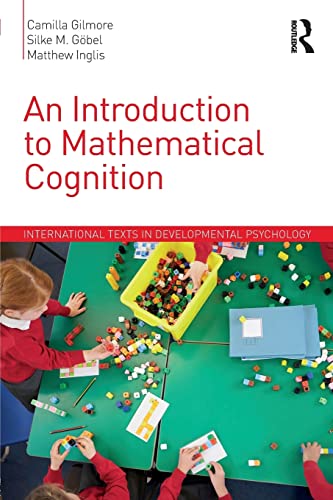
Synopsis
The last decade has seen a rapid growth in our understanding of the cognitive systems that underlie mathematical learning and performance, and an increased recognition of the importance of this topic. This book showcases international research on the most important cognitive issues that affect mathematical performance across a wide age range, from early childhood to adulthood. The book considers the foundational competencies of nonsymbolic and symbolic number processing before discussing arithmetic, conceptual understanding, individual differences and dyscalculia, algebra, number systems, reasoning and higher-level mathematics such as formal proof. Drawing on diverse methodology from behavioural experiments to brain imaging, each chapter discusses key theories and empirical findings and introduces key tasks used by researchers. The final chapter discusses challenges facing the future development of the field of mathematical cognition and reviews a set of open questions that mathematical cognition researchers should address to move the field forward. This book is ideal for undergraduate or graduate students of psychology, education, cognitive sciences, cognitive neuroscience and other academic and clinical audiences including mathematics educators and educational psychologists.
"synopsis" may belong to another edition of this title.
About the Author
Camilla Gilmore is a Reader in Mathematical Cognition in the Mathematics Education Centre at Loughborough University. Her research explores the development of numerical skills in children and adults.
Silke Göbel is a Senior Lecturer in Psychology at the University of York. She teaches courses on Numerical Cognition, Dyscalculia, Mathematics Anxiety and Neuroscience of Numbers and Arithmetic. Her current research focuses on predictors of mathematical development.
Matthew Inglis is a Reader in Mathematical Cognition in the Mathematics Education Centre at Loughborough University. He is interested in understanding the processes involved in numerical and mathematical reasoning, and how these can be promoted through education.
"About this title" may belong to another edition of this title.
Other Popular Editions of the Same Title

Search results for An Introduction to Mathematical Cognition (International...

Seller Image
Introduction to Mathematical Cognition
Seller: GreatBookPrices, Columbia, MD, U.S.A.
Seller rating 5 out of 5 stars

Condition: New. Seller Inventory # 26016750-n
Stock Image
An Introduction to Mathematical Cognition (Paperback)
Published by
Taylor & Francis Ltd, London, 2018
ISBN 10: 1138923958
ISBN 13: 9781138923959
New
Paperback
Seller: Grand Eagle Retail, Bensenville, IL, U.S.A.
Seller rating 5 out of 5 stars
Paperback. Condition: new. Paperback. The last decade has seen a rapid growth in our understanding of the cognitive systems that underlie mathematical learning and performance, and an increased recognition of the importance of this topic. This book showcases international research on the most important cognitive issues that affect mathematical performance across a wide age range, from early childhood to adulthood. The book considers the foundational competencies of nonsymbolic and symbolic number processing before discussing arithmetic, conceptual understanding, individual differences and dyscalculia, algebra, number systems, reasoning and higher-level mathematics such as formal proof. Drawing on diverse methodology from behavioural experiments to brain imaging, each chapter discusses key theories and empirical findings and introduces key tasks used by researchers. The final chapter discusses challenges facing the future development of the field of mathematical cognition and reviews a set of open questions that mathematical cognition researchers should address to move the field forward. This book is ideal for undergraduate or graduate students of psychology, education, cognitive sciences, cognitive neuroscience and other academic and clinical audiences including mathematics educators and educational psychologists. The book traces the development of mathematical skills from basic number concepts to mathematical proofs, emphasising the hierarchical nature of mathematical development from early childhood to research-level mathematics. This item is printed on demand. Shipping may be from multiple locations in the US or from the UK, depending on stock availability. Seller Inventory # 9781138923959
Stock Image
An Introduction to Mathematical Cognition
Seller: PBShop.store US, Wood Dale, IL, U.S.A.
Seller rating 5 out of 5 stars
PAP. Condition: New. New Book. Shipped from UK. Established seller since 2000. Seller Inventory # GB-9781138923959
Stock Image
An Introduction to Mathematical Cognition
Seller: PBShop.store UK, Fairford, GLOS, United Kingdom
Seller rating 5 out of 5 stars
PAP. Condition: New. New Book. Shipped from UK. Established seller since 2000. Seller Inventory # GB-9781138923959
Stock Image
An Introduction to Mathematical Cognition (International Texts in Developmental Psychology)
Seller: Chiron Media, Wallingford, United Kingdom
Seller rating 4 out of 5 stars

Paperback. Condition: New. Seller Inventory # 6666-TNFPD-9781138923959
Seller Image
Introduction to Mathematical Cognition
Seller: GreatBookPrices, Columbia, MD, U.S.A.
Seller rating 5 out of 5 stars
Condition: As New. Unread book in perfect condition. Seller Inventory # 26016750
Stock Image
An Introduction to Mathematical Cognition (International Texts in Developmental Psychology)
Seller: Lucky's Textbooks, Dallas, TX, U.S.A.
Seller rating 5 out of 5 stars
Condition: New. Seller Inventory # ABLIING23Mar2317530329609
Stock Image
An Introduction to Mathematical Cognition (International Texts in Developmental Psychology)
Seller: California Books, Miami, FL, U.S.A.
Seller rating 5 out of 5 stars
Condition: New. Seller Inventory # I-9781138923959
Seller Image
Introduction to Mathematical Cognition
Seller: GreatBookPricesUK, Woodford Green, United Kingdom
Seller rating 5 out of 5 stars
Condition: New. Seller Inventory # 26016750-n
Buy New
£ 37.04
Shipping:
£ 15
From United Kingdom to U.S.A.
Quantity: Over 20 available
Seller Image
An Introduction to Mathematical Cognition
Published by
Taylor and Francis Ltd, GB, 2018
ISBN 10: 1138923958
ISBN 13: 9781138923959
New
Paperback
Seller: Rarewaves.com USA, London, LONDO, United Kingdom
Seller rating 5 out of 5 stars
Paperback. Condition: New. The last decade has seen a rapid growth in our understanding of the cognitive systems that underlie mathematical learning and performance, and an increased recognition of the importance of this topic. This book showcases international research on the most important cognitive issues that affect mathematical performance across a wide age range, from early childhood to adulthood. The book considers the foundational competencies of nonsymbolic and symbolic number processing before discussing arithmetic, conceptual understanding, individual differences and dyscalculia, algebra, number systems, reasoning and higher-level mathematics such as formal proof. Drawing on diverse methodology from behavioural experiments to brain imaging, each chapter discusses key theories and empirical findings and introduces key tasks used by researchers. The final chapter discusses challenges facing the future development of the field of mathematical cognition and reviews a set of open questions that mathematical cognition researchers should address to move the field forward. This book is ideal for undergraduate or graduate students of psychology, education, cognitive sciences, cognitive neuroscience and other academic and clinical audiences including mathematics educators and educational psychologists. Seller Inventory # LU-9781138923959