
Items related to Inquiry-Based Learning - Undergraduate Research: The...
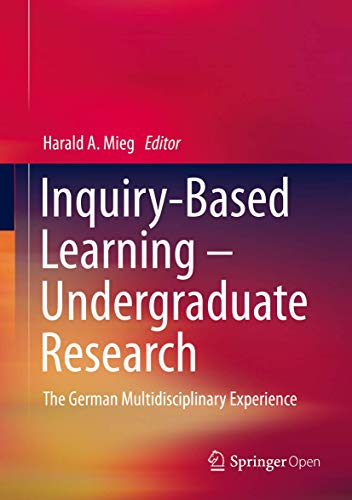
Inquiry-Based Learning - Undergraduate Research: The German Multidisciplinary Experience - Hardcover
Synopsis
This open access book provides a systematic overview of experiences with Inquiry-Based Learning (IBL) and undergraduate research (UR) in German universities, covering both research universities (Universitäten) and universities of applied sciences (Fachhochschulen). Divided into three parts, the book starts with the principles and common practices of IBL/UR at all universities. Part Two discusses the implementation of IBL/UR for twenty-one individual disciplines, ranging from architecture to theology. Part Three discusses the potential of IBL/UR in relation to several topics including diversity, digitalisation, different forms of universities, and the national job market. The book summarises the project of the German network of UR, comprising approximately 50 universities, and results of a national initiative called Qualitätspakt Lehre which is intended to improve teaching at German universities.
Today IBL and UR are essential parts of high-impact education strategies for universities around the world. In his university reform plans of the early 19th century, Wilhelm von Humboldt introduced Inquiry-Based Teaching and Learning as the core principle of the modern research university in Germany, as well as worldwide. IBL was re-discovered in the German university reform initiatives of the 1960s. Since then, IBL has been applied in teachers' education in German universities. The book presents IBL/UR experience as complementary to what is usually presented in English-speaking academia. In Germany, IBL/UR is applied broadly throughout the social sciences and planning, but not in the core sciences, whereas in the US undergraduate research is common in the sciences but less so in the social sciences. Moreover, in Germany, IBL/UR is often linked to applied and community-oriented research ― something that is just emerging in the US.
"synopsis" may belong to another edition of this title.
About the Author
Harald A. Mieg is (honorary) professor of Metropolitan Studies at the Humboldt-Universität zu Berlin and also affiliated to the Swiss Federal Institute of Technology, Zurich. The focus of his research is on planning processes in cities and research methodologies. He was the initiator and coordinator of a German national research project on undergraduate research in Germany ("ForschenLernen," lasting 2014-2018, 15 universities involved). In this context, he coordinated the edition of a series of books on undergraduate research and inquiry-based learning in Germany.
From the Back Cover
This open access book provides a systematic overview of experiences with Inquiry-Based Learning (IBL) and undergraduate research (UR) in German universities, covering both research universities (Universitäten) and universities of applied sciences (Fachhochschulen). Divided into three parts, the book starts with the principles and common practices of IBL/UR at all universities. Part Two discusses the implementation of IBL/UR for twenty-one individual disciplines, ranging from architecture to theology. Part Three discusses the potential of IBL/UR in relation to several topics including diversity, digitalisation, different forms of universities, and the national job market. The book summarises the project of the German network of UR, comprising approximately 50 universities, and results of a national initiative called Qualitätspakt Lehre which is intended to improve teaching at German universities.
Today IBL and UR are essential parts of high-impact education strategies for universities around the world. In his university reform plans of the early 19th century, Wilhelm von Humboldt introduced Inquiry-Based Teaching and Learning as the core principle of the modern research university in Germany, as well as worldwide. IBL was re-discovered in the German university reform initiatives of the 1960s. Since then, IBL has been applied in teachers' education in German universities. The book presents IBL/UR experience as complementary to what is usually presented in English-speaking academia. In Germany, IBL/UR is applied broadly throughout the social sciences and planning, but not in the core sciences, whereas in the US undergraduate research is common in the sciences but less so in the social sciences. Moreover, in Germany, IBL/UR is often linked to applied and community-oriented research ― something that is just emerging in the US.
"About this title" may belong to another edition of this title.
Search results for Inquiry-Based Learning - Undergraduate Research: The...

Stock Image
Inquiry-Based Learning - Undergraduate Research. The German Multidisciplinary Experience.
Published by
Cham, Switzerland, Springer Open., 2019
ISBN 10: 3030142221
ISBN 13: 9783030142223
Used
Hardcover
Seller: Universitätsbuchhandlung Herta Hold GmbH, Berlin, Germany
Seller rating 3 out of 5 stars

XVI, 406 p. Hardcover. Versand aus Deutschland / We dispatch from Germany via Air Mail. Einband bestoßen, daher Mängelexemplar gestempelt, sonst sehr guter Zustand. Imperfect copy due to slightly bumped cover, apart from this in very good condition. Stamped. Sprache: Englisch. Seller Inventory # 2267LB
Stock Image
Mieg:Inquiry-Based Learning - Undergrad (eng)
Print on DemandSeller: Brook Bookstore On Demand, Napoli, NA, Italy
Seller rating 5 out of 5 stars

Condition: new. Questo è un articolo print on demand. Seller Inventory # 0c0a7c848bb2635eb676b471779b1999
Buy New
£ 39.93
£ 9.23 shipping
Ships from Italy to U.S.A.
Ships from Italy to U.S.A.
Quantity: Over 20 available
Seller Image
Inquiry-Based Learning - Undergraduate Research
Published by
Springer International Publishing Mai 2019, 2019
ISBN 10: 3030142221
ISBN 13: 9783030142223
New
Hardcover
Seller: BuchWeltWeit Ludwig Meier e.K., Bergisch Gladbach, Germany
Seller rating 5 out of 5 stars
Buch. Condition: Neu. This item is printed on demand - it takes 3-4 days longer - Neuware -This open access book provides a systematic overview of experiences with Inquiry-Based Learning (IBL) and undergraduate research (UR) in German universities, covering both research universities (Universitäten) and universities of applied sciences (Fachhochschulen). Divided into three parts, the book starts with the principles and common practices of IBL/UR at all universities. Part Two discusses the implementation of IBL/UR for twenty-one individual disciplines, ranging from architecture to theology. Part Three discusses the potential of IBL/UR in relation to several topics including diversity, digitalisation, different forms of universities, and the national job market. The book summarises the project of the German network of UR, comprising approximately 50 universities, and results of a national initiative called Qualitätspakt Lehre which is intended to improve teaching at German universities. Today IBL and UR are essential parts of high-impact education strategies for universities around the world. In his university reform plans of the early 19th century, Wilhelm von Humboldt introduced Inquiry-Based Teaching and Learning as the core principle of the modern research university in Germany, as well as worldwide. IBL was re-discovered in the German university reform initiatives of the 1960s. Since then, IBL has been applied in teachers' education in German universities. The book presents IBL/UR experience as complementary to what is usually presented in English-speaking academia. In Germany, IBL/UR is applied broadly throughout the social sciences and planning, but not in the core sciences, whereas in the US undergraduate research is common in the sciences but less so in the social sciences. Moreover, in Germany, IBL/UR is often linked to applied and community-oriented research - something that is just emerging in the US. 424 pp. Englisch. Seller Inventory # 9783030142223
Seller Image
Inquiry-Based Learning - Undergraduate Research
Published by
Springer International Publishing, 2019
ISBN 10: 3030142221
ISBN 13: 9783030142223
New
Hardcover
Seller: moluna, Greven, Germany
Seller rating 5 out of 5 stars
Condition: New. Dieser Artikel ist ein Print on Demand Artikel und wird nach Ihrer Bestellung fuer Sie gedruckt. Is truly multidisciplinary, presenting IBL and UR in over 20 disciplines Systematically introduces principles and provides an overview of evidenceBrings together all major scholars in Germany working in the field of IBL/UR. Seller Inventory # 268493133
Buy New
£ 41.78
£ 41.09 shipping
Ships from Germany to U.S.A.
Ships from Germany to U.S.A.
Quantity: Over 20 available
Stock Image
Inquiry-Based Learning - Undergraduate Research: The German Multidisciplinary Experience
Seller: Books Puddle, Woodside, NY, U.S.A.
Seller rating 4 out of 5 stars

Condition: New. pp. 406. Seller Inventory # 26376403936
Stock Image
Inquiry-Based Learning - Undergraduate Research: The German Multidisciplinary Experience
Print on DemandSeller: Majestic Books, Hounslow, United Kingdom
Seller rating 4 out of 5 stars
Condition: New. Print on Demand pp. 406. Seller Inventory # 370722879
Buy New
£ 80.04
£ 6.50 shipping
Ships from United Kingdom to U.S.A.
Ships from United Kingdom to U.S.A.
Quantity: 4 available
Seller Image
Inquiry-Based Learning - Undergraduate Research : The German Multidisciplinary Experience
Seller: AHA-BUCH GmbH, Einbeck, Germany
Seller rating 5 out of 5 stars
Buch. Condition: Neu. Druck auf Anfrage Neuware - Printed after ordering - This open access book provides a systematic overview of experiences with Inquiry-Based Learning (IBL) and undergraduate research (UR) in German universities, covering both research universities (Universitäten) and universities of applied sciences (Fachhochschulen). Divided into three parts, the book starts with the principles and common practices of IBL/UR at all universities. Part Two discusses the implementation of IBL/UR for twenty-one individual disciplines, ranging from architecture to theology. Part Three discusses the potential of IBL/UR in relation to several topics including diversity, digitalisation, different forms of universities, and the national job market. The book summarises the project of the German network of UR, comprising approximately 50 universities, and results of a national initiative called Qualitätspakt Lehre which is intended to improve teaching at German universities. Today IBL and UR are essential parts of high-impact education strategies for universities around the world. In his university reform plans of the early 19th century, Wilhelm von Humboldt introduced Inquiry-Based Teaching and Learning as the core principle of the modern research university in Germany, as well as worldwide. IBL was re-discovered in the German university reform initiatives of the 1960s. Since then, IBL has been applied in teachers' education in German universities. The book presents IBL/UR experience as complementary to what is usually presented in English-speaking academia. In Germany, IBL/UR is applied broadly throughout the social sciences and planning, but not in the core sciences, whereas in the US undergraduate research is common in the sciences but less so in the social sciences. Moreover, in Germany, IBL/UR is often linked to applied and community-oriented research - something that is just emerging in the US. Seller Inventory # 9783030142223
Stock Image
Inquiry-Based Learning - Undergraduate Research: The German Multidisciplinary Experience
Print on DemandSeller: Biblios, Frankfurt am main, HESSE, Germany
Seller rating 4 out of 5 stars
Condition: New. PRINT ON DEMAND pp. 406. Seller Inventory # 18376403946
Seller Image
Inquiry-Based Learning - Undergraduate Research
Published by
Springer, Springer Mai 2019, 2019
ISBN 10: 3030142221
ISBN 13: 9783030142223
New
Hardcover
Seller: buchversandmimpf2000, Emtmannsberg, BAYE, Germany
Seller rating 5 out of 5 stars
Buch. Condition: Neu. This item is printed on demand - Print on Demand Titel. Neuware -This open access book provides a systematic overview of experiences with Inquiry-Based Learning (IBL) and undergraduate research (UR) in German universities, covering both research universities (Universitäten) and universities of applied sciences (Fachhochschulen). Divided into three parts, the book starts with the principles and common practices of IBL/UR at all universities. Part Two discusses the implementation of IBL/UR for twenty-one individual disciplines, ranging from architecture to theology. Part Three discusses the potential of IBL/UR in relation to several topics including diversity, digitalisation, different forms of universities, and the national job market. The book summarises the project of the German network of UR, comprising approximately 50 universities, and results of a national initiative called Qualitätspakt Lehre which is intended to improve teaching at German universities.Today IBL and UR are essential parts of high-impact education strategies for universities around the world. In his university reform plans of the early 19th century, Wilhelm von Humboldt introduced Inquiry-Based Teaching and Learning as the core principle of the modern research university in Germany, as well as worldwide. IBL was re-discovered in the German university reform initiatives of the 1960s. Since then, IBL has been applied in teachers' education in German universities. The book presents IBL/UR experience as complementary to what is usually presented in English-speaking academia. In Germany, IBL/UR is applied broadly throughout the social sciences and planning, but not in the core sciences, whereas in the US undergraduate research is common in the sciences but less so in the social sciences. Moreover, in Germany, IBL/UR is often linked to applied and community-oriented research - something that is just emerging in the US.Springer-Verlag KG, Sachsenplatz 4-6, 1201 Wien 424 pp. Englisch. Seller Inventory # 9783030142223