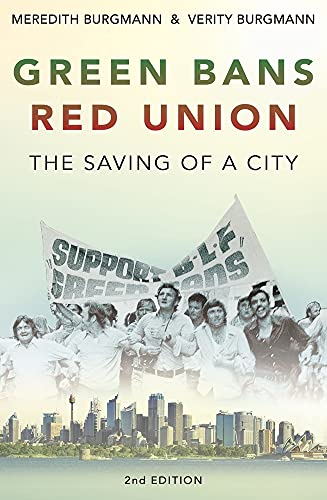
Revised edition of a landmark book. At the height of the building boom in the 1970s, a remarkable campaign stopped billions of dollars worth of indiscriminate development that was turning Australian cities into concrete jungles. Enraging employers and politicians but delighting many in the wider community, the members of the NSW Builders Labourers' Federation risked their jobs to preserve buildings, bush and parkland. The direct impact of this green bans movement can be seen all over Sydney. Green Bans, Red Union documents the development of a union that took a stand. Apart from the green bans movement, union members also used industrial power to defend women's rights, gay rights and indigenous rights. In telling the colourful story that inspired many environmentalists and ordinary citizens - and gave the word 'green' an entirely new meaning - Meredith Burgmann and Verity Burgmann open a window on a period when Australian workers led the world in innovative and stunningly effective forms of environmental protest. A new introduction reconsiders the impact of the now iconic green bans movement at a time when workers' organisations around the world are looking to fight back against overdevelopment and global warming more strongly than ever before.
"synopsis" may belong to another edition of this title.
Meredith Burgmann was a Member of the Legislative Council of NSW (Labor) from 1991 and President from 1999 until 2007. She was then elected as a councillor for the City of Sydney. Previously a Senior Lecturer in Politics at Macquarie University, she was the first woman President of the Academics’ Union in NSW (now NTEU). She was actively involved in the green ban movement and was arrested many times, including for defending the Victoria Street green ban. She wrote her PhD on the Green Bans and has written extensively on industrial relations and women’s issues including as editor of Dirty Secrets: Our ASIO files published by NewSouth in 2014.
Verity Burgmann is Adjunct Professor of Political Science in the School of Social Sciences at Monash University. She is the author of numerous studies of labour and social movements, including In Our Time (1985), Power and Protest (1993), Revolutionary Industrial Unionism (1995), Power, Profit and Protest (2003), Climate Politics and the Climate Movement (2012) and Globalization and Labour in the Twenty-First Century (2016).
List of illustrations,
Abbreviations,
Preface and acknowledgments to the 1998 edition,
Introduction to the new edition,
PART 1: PEOPLE BEFORE PROFITS,
The world's first green bans,
The preconditions for radical unionism,
The greening of the union,
PART 2: A NEW CONCEPT OF UNIONISM,
Organisational principles and practices,
Industrial relations strategies,
Civilising the industry,
Pioneering social movement unionism,
Feminism and machismo: women as builders labourers,
PART 3: PREVENTING THE PLUNDER,
Defending the open spaces,
Preserving the built environment,
Saving the national estate,
Breaking the bans, breaking the union,
Green bans forever?,
Endnotes,
Sources,
Index,
THE WORLD'S FIRST GREEN BANS
Green bans', 'builders labourers' and 'Jack Mundey' were household terms for millions of Australians during the 1970s. Sydneysiders in particular were polarised on the questions surrounding green bans and those who imposed them. To many, the New South Wales Builders Labourers' Federation (NSWBLF) represented the hideous spectre of working-class power maliciously halting progress, and restraining the liberty of property owners to undertake development, from which the public would benefit. To many others the builders labourers (or BLs) articulated the general interest of all except the greediest developers in preserving the built and natural environment from wanton destruction.
The union's guiding principle, which aroused such strong emotions and which underpinned its environmental activism, was the concept of the social responsibility of labour: that workers had a right to insist that their labour not be used in harmful ways. Strongly associated with this principle was a conviction that the organised labour movement should concern itself with all manner of social and political issues, to contest exploitation and oppression in the wider society and not just in the workplace. The union did not merely impose green bans – refusing to work on environmentally injurious constructions – it also insisted upon the right of women to work in the industry on an equal basis with men, and frequently used its power to aid groups such as prisoners, homosexuals, Aborigines, students, the women's movement, and poorer home-buyers, even imposing a range of non-environmental bans in defence of these oppressed, marginalised or vulnerable people.
The NSWBLF was one of Australia's oldest unions. It was formed in the 1870s and registered under the New South Wales Trade Union Act of 1881 as the United Labourers. In 1912 it became the Builders Labourers' Union; and in 1926 it joined with labourers' unions in other states to form the Australian Builders' Labourers' Federation (ABLF). By the early 1970s the ABLF had a national membership of around 30,000 and covered all unskilled labourers and certain categories of skilled labourers employed on building sites: dogmen, riggers, scaffolders, powder monkeys, hoist drivers and steel fixers. Between 1970 and 1974 the New South Wales branch, with about 11,000 members, operated outside the traditional confines of the trade union movement, guided by many capable and committed officials but in particular by three outstanding union leaders: Jack Mundey, Joe Owens and Bob Pringle. Strongly influenced by New Left ideology (which emphasised equality, personal liberation, participatory democracy, environmentalism and direct action) the unskilled manual labourers of the NSWBLF used their industrial muscle to put their union's advanced policies into action.
Above all, the union is remembered for its most spectacular application of the concept of the social responsibility of labour: the green bans. By October 1973, these bans had halted projects worth 'easily $3000 million' (at mid-1970s prices) according to the Master Builders Association (MBA). By 1975 bans had halted $5000 million of development, saving New South Wales from much of the cultural and environmental destruction it would otherwise have suffered. The bans were a deliberate confrontation with the power of capital. In the absence of sufficiently sensitive planning and conservation regulations, the builders labourers took it upon themselves to dispute employers' rights to build what they liked where they liked, and they were prepared to defend their bans on picket lines and at demonstrations.
Their action was the first of its type in the world. The international Dictionary of the Environment entry on 'green bans' comments they were 'very effective in Australia, where they were first attempted' and the Australian National Dictionary notes that the use of the term, now international, was recorded earliest in Australia. The green bans were an entirely home-grown contribution to international environmental politics and radical practice, constituting 'one of the most exciting chapters in trade unionism world wide'. Indeed the NSWBLF in this period can be seen as a prototype for the 'social-movement unionism' of the 1990s, which is characterised internationally by militancy, internal democracy, an agenda for radical social and economic change, a determination to embrace the diversity of the working class in order to overcome its fragmentation, and a capacity to appeal beyond their memberships by using union power to 'lead the fight for everything that affects working people in their communities and the country'. Social-movement unionism constitutes, in short, a rehearsal for self-emancipation from below.
The union was extraordinarily outward-looking, even enduring negative consequences for themselves in the form of foregone employment over the imposition of bans: 'Green bans were altruistic' as Mackie noted. The Australian black movement was gratified by the degree of the union's commitment to Aboriginal rights. Homosexual liberationists found the stereotype of the homophobic building worker confounded by the union's practical support for their cause. Women who entered the building industry appreciated the genuine egalitarianism of many of their new work mates. However, the union did not engage in such actions for purely altruistic reasons: because its class consciousness and radical awareness were especially strong, it saw itself as expressing the real collective self-interest of most people in confronting all manner of oppressions and preventing environmental degradation. In doing so it impressed and inspired constituencies far beyond its membership and even beyond the working class. Many New Left academics decided, on the basis of their interaction with the union, that the proletariat might be the midwife of history after all. The 'middle-class matrons' of Hunters Hill discovered this union of manual labourers was more sensitive to the natural beauty of Kelly's Bush and more aware of the need for its preservation than conservative politicians and newspaper editors, and they were radicalised permanently by their experience. Justice Rodney Madgwick remarked at the time on their 'moral force'. While the union's many activities on the part of oppressed groups undoubtedly contributed to this force, the central moral question the union posed for the wider public was whether the pursuit of profit, invariably presented as 'progress', should override all other claims.
Jurgen Habermas's account of the development of the 'bourgeois public sphere' considers the way in which the rhetoric of economic 'privacy' protects some interests from public challenge. Thus issues seen as private ownership prerogatives are shielded from broader debate. It was precisely such private ownership prerogatives that the green ban movement most notably contested, and herein lay the glorious temerity of the NSWBLF. In challenging employers' prerogatives, and successfully showing these traditional rights to be harmful to others and detrimental to the environment, the union confronted the very basis of the power and class relations that the public sphere habitually protects.
In denying and thereby contesting employers' longstanding perceived right to employ others to build whatever and wherever the profit motive dictated, the NSWBLF and its thousands of active members and supporters formed an alternative public sphere, or what Nancy Fraser has described as a 'subaltern counterpublic': an arena 'where members of subordinated social groups invent and circulate counterdiscourses to formulate oppositional interpretations of their identities, interests, and needs'. Subaltern counterpublics have a dual function in stratified societies: as spaces of withdrawal and regroupment; and as bases and training grounds for agitational activities directed towards the wider public. It is precisely in the dialectic between these two functions, she writes, that their emancipatory potential resides, for this dialectic enables subaltern counterpublics to offset the advantages enjoyed by members of dominant social groups in stratified societies.
The union and its supporters clearly constituted such an alternative public sphere, attracting the support of disparate elements such as union activists, inner-city pensioners, Marxist academics, hippies, housewives, and acclaimed writers and intellectuals. Kay Anderson and Jane Jacobs note in their criticism of narratives about the green bans (which privilege a tale of class-based resistance led by male unionists) that the green ban movement had a scope extending well beyond a narrowly defined class struggle. They also stress the degree to which the movement not only transcended class boundaries, but gendered constructions of urban space that provide spatial expressions of the way women are consigned to the private sphere of the home and men to the public sphere of paid work. With women so prominent amongst the resident action groups, whose requests for assistance were the rationale for most green bans, Anderson and Jacobs argue that the green bans constituted a repositioning of 'the flexible terrain upon which geographies of "publicity" and "privacy" are negotiated', because such urban activism took these 'community mothers' beyond domestic concerns into 'a framework of broader citizenry in which the orbits of publicity and privacy are under constant negotiation'.
The green ban movement, by transcending class and gender divisions in a most dramatic way, yet being based on the power wielded by those engaged in productive labour, can be seen to function as a space of withdrawal and regroupment, and as a base for agitation directed towards the general public. However, while Anderson and Jacobs understandably take issue with the depiction of the builders labourers' involvement with the resident activists as 'a kind of heroic, rescue operation' (whereby the women are 'escorted into the public sphere of politics' by the builders labourers) there would have been no green bans without the NSWBLF.
This is the crucial difference between an alternative public sphere and social-movement unionism. Social-movement unionism often includes the formation of a subaltern counterpublic (because its constituencies are wider than its membership) but it directs this agitated and agitating public towards specific goals through actions undertaken primarily by a union. It was because the green ban movement constituted a subaltern counterpublic mobilised by social-movement unionism that it was not merely challenging and popular but also – through the power of that union to withdraw its labour – extremely effective.
A new phrase was needed for such a significant new action. Precisely because these bans were not imposed in any direct sense in the interests of the workers concerned, who were even denying themselves work in the process, the usual terminology of 'black ban' seemed inappropriate. Indeed, the altruistic and ecologically aware nature of the action demanded a completely new nomenclature. In February 1973, more than eighteen months after the movement had started, Mundey coined the term 'green ban' to distinguish it from the traditional union black ban imposed by workers 'to push their own issues'. He argued that the term was 'more applicable as they are in defence of the environment'. A greater sensitivity about racist language had also made use of 'black' less attractive. One of the Battlers for Kelly's Bush refers to Mundey's 'brilliance' in coining the term, reckoning it 'a turning point in public support', removing as it did the 'ugly connotation' of black ban. Mundey realised the imposition of a green ban had 'much more positivesocial and political implications' than those associated in the public mind with black bans. Affirmative rather than negative, the neologism helped the message behind the action to be heard. Green bans, unlike black bans, contained both an environmental element and a social element: they expressed the union's determination to save open space or valued buildings and to ensure that people in any community had some say in what affected their lives.
By mid-1973 'green ban' was being used regularly to describe the union's actions. The Canberra News was possibly the first to use the term when it reported on 23 May 1973: 'Mr Mundey said today that the "green" ban on Black Mountain had the backing of most Canberra people'. The Adelaide News commented on the new term on 20 August 1973. By this stage the eastern states' media were playing with a range of colours to describe the activities of the NSWBLF: on 28 October 1973 the Sunday Mirror claimed 'Jack (Green Ban) Mundey' was threatening to place an 'amber ban' on a city hotel; and the NSWBLF's unsuccessful attempt to persuade Tasmanian unionists to ban the damming of Lake Pedder was touted as a 'blue ban'. At this time, press use of the term 'greenies' designated supporters of the NSWBLF green bans, from which point it later broadened to embrace environmentally concerned people in general.
The power of the term was acknowledged by those against whom the bans were directed. During the 1973 New South Wales state election campaign, when the green bans were a hotly contested issue, both employer and state government authorities attempted, with little effect, to rename them 'red bans' to stress the dangerously radical orientation of the union and the revolutionary implications of the bans. The union's other main opponent, the federal organisation of its own union – whose employer-sponsored Intervention against its New South Wales branch late in 1974 was to bring this remarkable period to a close – declined to use the term 'green bans' precisely because it was associated with the New South Wales branch and emblematic of its wide cross-class support. The federal BLF insisted on the longwinded 'environmental bans' or persisted with the negative designation of 'black bans'.
The modern European green movement has its origins, at least etymologically, in the activities of the NSWBLF. Speaking in the Senate on 21 March 1997, Senator Bob Brown of the Australian Greens recalled:
Petra Kelly the feisty, intelligent, indefatigable German Green came to Australia in the mid-l970s. She saw the green bans which the unions, not least Jack Mundey, were then imposing on untoward developments in Sydney at the behest of a whole range of citizens who were being ignored by parliaments. Thank glory that, because of their action in the mid-1970s, such places as the Rocks, one of the most attractive parts of Sydney, still exist. She took back with her to Germany this idea of Greens' bans, or the terminology. As best we can track it down, that is where the word 'green' as applied to the emerging Greens in Europe came from.
Bob Brown and Peter Singer claim the significance of the green bans movement was more than etymological, that Kelly did not merely import vocabulary into Germany: but was so inspired by the green ban movement that it was mainly responsible for her launching the German Green Party; that she would often speak about the impact that the green bans had upon her and her philosophy; and that she was especially impressed with the linkage achieved between environmentalists and a progressive trade union movement.
Similarly, when Paul Ehrlich visited Australia during the green bans period, he considered the phenomenon of workers uniting with resident action groups and conservationists in direct action to protect the environment 'the most exciting ecological happening, not only in Australia, but overseas as well'. In the light of the failure of green politics in the past two decades to achieve similar spectacular alliances between trade unionists and, in Mundey's words, 'enlightened middle-class people', the success of the green bans has continuing implications for green political practice today and in the future.
Because the union's activism was concerned not merely with the environment, but a wide range of social issues, the subject matter of this book raises many currently fashionable concerns about the rights of women, indigenous Australians and homosexuals, while confounding many of the paradigms within which these concerns are expressed. New social movement theory has tended to view these matters as lying beyond the parameters of trade union action and has effectively discounted the role of the labour movement in achieving broader social changes. The NSWBLF's achievements in precisely the areas dear to new social movement activists contradict the assertions of many theorists who dispute the efficacy or even possibility of organised working-class action in pursuit of such aims. Only a certain sort of union could initiate, develop and maintain green bans. The NSWBLF sponsored the green bans, not simply because the environmental consciousness of its leading ideologues was especially high, but because it was a dramatically different kind of union. The NSWBLF's philosophy and practice challenged not just developers but employers, governments and traditional trade union structures. To comprehend the green bans, the union that produced them must be understood: a union that developed what Mundey described as a 'new concept of unionism'. The publicity accorded the green bans has obscured the other ways in which this union was remarkably different from other unions, even those generally regarded as being left-wing. If the circumstances that prompted the bans had not arisen, the innovative organisational forms and the peculiarly militant strategies pursued by the union would still deserve their place in history for the very real challenge they represented to customary labour movement and industrial relations practices.
Excerpted from Green Bans, Red Union by Meredith Burgmann, Verity Burgmann. Copyright © 2017 Meredith Burgmann and Verity Burgmann. Excerpted by permission of University of New South Wales Press Ltd.
All rights reserved. No part of this excerpt may be reproduced or reprinted without permission in writing from the publisher.
Excerpts are provided by Dial-A-Book Inc. solely for the personal use of visitors to this web site.
"About this title" may belong to another edition of this title.
Seller: GreatBookPrices, Columbia, MD, U.S.A.
Condition: New. Seller Inventory # 29545887-n
Seller: PBShop.store UK, Fairford, GLOS, United Kingdom
PAP. Condition: New. New Book. Shipped from UK. Established seller since 2000. Seller Inventory # FW-9781742235400
Quantity: 15 available
Seller: Grand Eagle Retail, Bensenville, IL, U.S.A.
Paperback. Condition: new. Paperback. Revised edition of a landmark bookAt the height of the building boom in the 1970s, a remarkable campaign stopped billions of dollars worth of indiscriminate development that was turning Australian cities into concrete jungles. Enraging employers and politicians but delighting many in the wider community, the members of the NSW Builders Labourers' Federation risked their jobs to preserve buildings, bush and parkland. The direct impact of this green bans movement can be seen all over Sydney.Green Bans, Red Union documents the development of a union that took a stand. Apart from the green bans movement, union members also used industrial power to defend women's rights, gay rights and indigenous rights. In telling the colourful story that inspired many environmentalists and ordinary citizens and gave the word 'green' an entirely new meaning Meredith Burgmann and Verity Burgmann open a window on a period when Australian workers led the world in innovative and stunningly effective forms of environmental protest.A new introduction reconsiders the impact of the now iconic green bans movement at a time when workers' organisations around the world are looking to fight back against overdevelopment and global warming more strongly than ever before.'The definitive account of the glory days of the NSW Builders Labourers'Federation and the green bans.' Australian Society for the Study of Labour History'The authors throwabundant light on the diverse aspects of the revolutionary direction taken bythe NSW BLF in these years.' RebelWorker Revised edition of a landmark book Green Bans , Red Union Shipping may be from multiple locations in the US or from the UK, depending on stock availability. Seller Inventory # 9781742235400
Seller: GreatBookPrices, Columbia, MD, U.S.A.
Condition: As New. Unread book in perfect condition. Seller Inventory # 29545887
Seller: Rarewaves.com USA, London, LONDO, United Kingdom
Paperback. Condition: New. Second Edition. At the height of the building boom in the 1970s, a remarkable campaign stopped billions of dollars worth of indiscriminate development that was turning Australian cities into concrete jungles. Enraging employers and politicians but delighting many in the wider community, the members of the NSW Builders Labourers' Federation risked their jobs to preserve buildings, bush and parkland. The direct impact of this green bans movement can be seen all over Sydney.Green Bans, Red Union documents the development of a union that took a stand. Apart from the green bans movement, union members also used industrial power to defend women's rights, gay rights and indigenous rights. In telling the colourful story that inspired many environmentalists and ordinary citizens - and gave the word 'green' an entirely new meaning - Meredith Burgmann and Verity Burgmann open a window on a period when Australian workers led the world in innovative and stunningly effective forms of environmental protest.A new introduction reconsiders the impact of the now iconic green bans movement at a time when workers' organisations around the world are looking to fight back against overdevelopment and global warming more strongly than ever before. Seller Inventory # LU-9781742235400
Quantity: 2 available
Seller: Brook Bookstore On Demand, Napoli, NA, Italy
Condition: new. Seller Inventory # 4174e33c49ed199130384151920f8b9f
Quantity: Over 20 available
Seller: Majestic Books, Hounslow, United Kingdom
Condition: New. pp. 320. Seller Inventory # 385623048
Quantity: 3 available
Seller: Kennys Bookshop and Art Galleries Ltd., Galway, GY, Ireland
Condition: New. 2017. 2nd Edition. paperback. . . . . . Seller Inventory # V9781742235400
Quantity: Over 20 available
Seller: Revaluation Books, Exeter, United Kingdom
Paperback. Condition: Brand New. 2nd edition. 320 pages. 9.00x6.00x1.25 inches. In Stock. This item is printed on demand. Seller Inventory # __1742235409
Quantity: 2 available
Seller: Ria Christie Collections, Uxbridge, United Kingdom
Condition: New. In. Seller Inventory # ria9781742235400_new
Quantity: Over 20 available