
Items related to Refugee Roulette: Disparities in Asylum Adjudication...
Synopsis
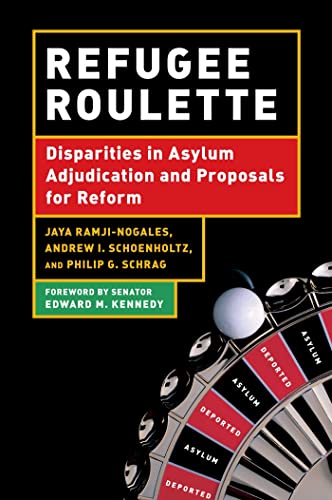
Through the Refugee Act of 1980, the United States offers the prospect of safety to people who flee to America to escape rape, torture, and even death in their native countries. In order to be granted asylum, however, an applicant must prove to an asylum officer or immigration judge that she has a well-founded fear of persecution in her homeland. The chance of winning asylum should have little if anything to do with the personality of the official to whom a case is randomly assigned, but in a ground-breaking and shocking study, Jaya Ramji-Nogales, Andrew I. Schoenholtz, and Philip G. Schrag learned that life-or-death asylum decisions are too frequently influenced by random factors relating to the decision makers. In many cases, the most important moment in an asylum case is the instant in which a clerk randomly assigns the application to an adjudicator. The system, in its current state, is like a game of chance.
Refugee Roulette is the first analysis of decisions at all four levels of the asylum adjudication process: the Department of Homeland Security, the immigration courts, the Board of Immigration Appeals, and the United States Courts of Appeals. The data reveal tremendous disparities in asylum approval rates, even when different adjudicators in the same office each considered large numbers of applications from nationals of the same country. After providing a thorough empirical analysis, the authors make recommendations for future reform. Original essays by eight scholars and policy makers then discuss the authors’ research and recommendations
Contributors: Bruce Einhorn, Steven Legomsky, Audrey Macklin, M. Margaret McKeown, Allegra McLeod, Carrie Menkel-Meadow, Margaret Taylor, and Robert Thomas.
"synopsis" may belong to another edition of this title.
About the Authors
Philip G. Schrag is the Delaney Family Professor of Public Interest Law and Director of the Center for Applied Legal Studies at Georgetown University Law Center.
Andrew I. Schoenholtz is Visiting Professor, Director of the Human Rights Institute, and Director of the Center for Applied Legal Studies at Georgetown University Law Center. He is Deputy Director of the Institute for the Study of International Migration at Georgetown University School of Foreign Service.
Jaya Ramji-Nogales is Associate Professor of Law and Co-Director of the Institute for International Law and Public Policy at Temple University’s Beasley School of Law.
"About this title" may belong to another edition of this title.
Search results for Refugee Roulette: Disparities in Asylum Adjudication...

Stock Image
Refugee Roulette: Disparities in Asylum Adjudication and Proposals for Reform
Published by
New York University Press, 2009
ISBN 10: 081474074X
ISBN 13: 9780814740743
Used
Hardcover
Seller: THE SAINT BOOKSTORE, Southport, United Kingdom
Seller rating 5 out of 5 stars

Hardback. Condition: Good. Used copy in good condition - Usually dispatched within 3 working days. Seller Inventory # D9780814740743
Buy Used
£ 32.59
£ 20.74 shipping
Ships from United Kingdom to U.S.A.
Ships from United Kingdom to U.S.A.
Quantity: 1 available
Stock Image
Refugee Roulette (Hardcover)
Published by
New York University Press, New York, 2009
ISBN 10: 081474074X
ISBN 13: 9780814740743
New
Hardcover
Seller: Grand Eagle Retail, Bensenville, IL, U.S.A.
Seller rating 5 out of 5 stars
Hardcover. Condition: new. Hardcover. Through the Refugee Act of 1980, the United States offers the prospect of safety to people who flee to America to escape rape, torture, and even death in their native countries. In order to be granted asylum, however, an applicant must prove to an asylum officer or immigration judge that she has a well-founded fear of persecution in her homeland. The chance of winning asylum should have little if anything to do with the personality of the official to whom a case is randomly assigned, but in a ground-breaking and shocking study, Jaya Ramji-Nogales, Andrew I. Schoenholtz, and Philip G. Schrag learned that life-or-death asylum decisions are too frequently influenced by random factors relating to the decision makers. In many cases, the most important moment in an asylum case is the instant in which a clerk randomly assigns the application to an adjudicator. The system, in its current state, is like a game of chance. Refugee Roulette is the first analysis of decisions at all four levels of the asylum adjudication process: the Department of Homeland Security, the immigration courts, the Board of Immigration Appeals, and the United States Courts of Appeals. The data reveal tremendous disparities in asylum approval rates, even when different adjudicators in the same office each considered large numbers of applications from nationals of the same country. After providing a thorough empirical analysis, the authors make recommendations for future reform. Original essays by eight scholars and policy makers then discuss the authors' research and recommendations Contributors: Bruce Einhorn, Steven Legomsky, Audrey Macklin, M. Margaret McKeown, Allegra McLeod, Carrie Menkel-Meadow, Margaret Taylor, and Robert Thomas. A disturbing look at how asylum seekers fare in America Shipping may be from multiple locations in the US or from the UK, depending on stock availability. Seller Inventory # 9780814740743
Seller Image
Refugee Roulette
Published by
New York University Press, US, 2009
ISBN 10: 081474074X
ISBN 13: 9780814740743
New
Hardcover
Seller: Rarewaves.com USA, London, LONDO, United Kingdom
Seller rating 5 out of 5 stars
Hardback. Condition: New. Through the Refugee Act of 1980, the United States offers the prospect of safety to people who flee to America to escape rape, torture, and even death in their native countries. In order to be granted asylum, however, an applicant must prove to an asylum officer or immigration judge that she has a well-founded fear of persecution in her homeland. The chance of winning asylum should have little if anything to do with the personality of the official to whom a case is randomly assigned, but in a ground-breaking and shocking study, Jaya Ramji-Nogales, Andrew I. Schoenholtz, and Philip G. Schrag learned that life-or-death asylum decisions are too frequently influenced by random factors relating to the decision makers. In many cases, the most important moment in an asylum case is the instant in which a clerk randomly assigns the application to an adjudicator. The system, in its current state, is like a game of chance. Refugee Roulette is the first analysis of decisions at all four levels of the asylum adjudication process: the Department of Homeland Security, the immigration courts, the Board of Immigration Appeals, and the United States Courts of Appeals. The data reveal tremendous disparities in asylum approval rates, even when different adjudicators in the same office each considered large numbers of applications from nationals of the same country. After providing a thorough empirical analysis, the authors make recommendations for future reform. Original essays by eight scholars and policy makers then discuss the authors' research and recommendations Contributors: Bruce Einhorn, Steven Legomsky, Audrey Macklin, M. Margaret McKeown, Allegra McLeod, Carrie Menkel-Meadow, Margaret Taylor, and Robert Thomas. Seller Inventory # LU-9780814740743
Buy New
£ 65.90
Free Shipping
Ships from United Kingdom to U.S.A.
Ships from United Kingdom to U.S.A.
Quantity: 3 available
Stock Image
Refugee Roulette
Published by
MI - New York University, 2009
ISBN 10: 081474074X
ISBN 13: 9780814740743
New
Hardcover
Seller: PBShop.store UK, Fairford, GLOS, United Kingdom
Seller rating 5 out of 5 stars
HRD. Condition: New. New Book. Shipped from UK. Established seller since 2000. Seller Inventory # C8-9780814740743
Buy New
£ 66.35
£ 5.02 shipping
Ships from United Kingdom to U.S.A.
Ships from United Kingdom to U.S.A.
Quantity: 2 available
Stock Image
Refugee Roulette: Disparities in Asylum Adjudication and Proposals for Reform
Published by
New York University Press, 2009
ISBN 10: 081474074X
ISBN 13: 9780814740743
New
Hardcover
Seller: THE SAINT BOOKSTORE, Southport, United Kingdom
Seller rating 5 out of 5 stars
Hardback. Condition: New. New copy - Usually dispatched within 3 working days. Seller Inventory # B9780814740743
Buy New
£ 66.31
£ 17.55 shipping
Ships from United Kingdom to U.S.A.
Ships from United Kingdom to U.S.A.
Quantity: 5 available
Seller Image
Refugee Roulette
Published by
New York University Press, US, 2009
ISBN 10: 081474074X
ISBN 13: 9780814740743
New
Hardcover
Seller: Rarewaves USA, HEBRON, KY, U.S.A.
Seller rating 5 out of 5 stars
Hardback. Condition: New. Through the Refugee Act of 1980, the United States offers the prospect of safety to people who flee to America to escape rape, torture, and even death in their native countries. In order to be granted asylum, however, an applicant must prove to an asylum officer or immigration judge that she has a well-founded fear of persecution in her homeland. The chance of winning asylum should have little if anything to do with the personality of the official to whom a case is randomly assigned, but in a ground-breaking and shocking study, Jaya Ramji-Nogales, Andrew I. Schoenholtz, and Philip G. Schrag learned that life-or-death asylum decisions are too frequently influenced by random factors relating to the decision makers. In many cases, the most important moment in an asylum case is the instant in which a clerk randomly assigns the application to an adjudicator. The system, in its current state, is like a game of chance. Refugee Roulette is the first analysis of decisions at all four levels of the asylum adjudication process: the Department of Homeland Security, the immigration courts, the Board of Immigration Appeals, and the United States Courts of Appeals. The data reveal tremendous disparities in asylum approval rates, even when different adjudicators in the same office each considered large numbers of applications from nationals of the same country. After providing a thorough empirical analysis, the authors make recommendations for future reform. Original essays by eight scholars and policy makers then discuss the authors' research and recommendations Contributors: Bruce Einhorn, Steven Legomsky, Audrey Macklin, M. Margaret McKeown, Allegra McLeod, Carrie Menkel-Meadow, Margaret Taylor, and Robert Thomas. Seller Inventory # LU-9780814740743
Stock Image
Refugee Roulette Disparities in Asylum Adjudication and Proposals for Reform
Print on DemandSeller: Revaluation Books, Exeter, United Kingdom
Seller rating 5 out of 5 stars
Hardcover. Condition: Brand New. 368 pages. 9.00x6.00x1.20 inches. In Stock. This item is printed on demand. Seller Inventory # __081474074X
Buy New
£ 89.20
£ 12.50 shipping
Ships from United Kingdom to U.S.A.
Ships from United Kingdom to U.S.A.
Quantity: 1 available
Stock Image
Refugee Roulette
Published by
New York University Press NYU Press, 2009
ISBN 10: 081474074X
ISBN 13: 9780814740743
New
Hardcover
Seller: Books Puddle, Woodside, NY, U.S.A.
Seller rating 4 out of 5 stars

Condition: New. pp. xix + 335 Index. Seller Inventory # 26963652
Stock Image
Refugee Roulette (Hardcover)
Published by
New York University Press, New York, 2009
ISBN 10: 081474074X
ISBN 13: 9780814740743
New
Hardcover
Seller: AussieBookSeller, Truganina, VIC, Australia
Seller rating 5 out of 5 stars
Hardcover. Condition: new. Hardcover. Through the Refugee Act of 1980, the United States offers the prospect of safety to people who flee to America to escape rape, torture, and even death in their native countries. In order to be granted asylum, however, an applicant must prove to an asylum officer or immigration judge that she has a well-founded fear of persecution in her homeland. The chance of winning asylum should have little if anything to do with the personality of the official to whom a case is randomly assigned, but in a ground-breaking and shocking study, Jaya Ramji-Nogales, Andrew I. Schoenholtz, and Philip G. Schrag learned that life-or-death asylum decisions are too frequently influenced by random factors relating to the decision makers. In many cases, the most important moment in an asylum case is the instant in which a clerk randomly assigns the application to an adjudicator. The system, in its current state, is like a game of chance. Refugee Roulette is the first analysis of decisions at all four levels of the asylum adjudication process: the Department of Homeland Security, the immigration courts, the Board of Immigration Appeals, and the United States Courts of Appeals. The data reveal tremendous disparities in asylum approval rates, even when different adjudicators in the same office each considered large numbers of applications from nationals of the same country. After providing a thorough empirical analysis, the authors make recommendations for future reform. Original essays by eight scholars and policy makers then discuss the authors' research and recommendations Contributors: Bruce Einhorn, Steven Legomsky, Audrey Macklin, M. Margaret McKeown, Allegra McLeod, Carrie Menkel-Meadow, Margaret Taylor, and Robert Thomas. A disturbing look at how asylum seekers fare in America Shipping may be from our Sydney, NSW warehouse or from our UK or US warehouse, depending on stock availability. Seller Inventory # 9780814740743
Seller Image
Refugee Roulette
Seller: moluna, Greven, Germany
Seller rating 5 out of 5 stars
Gebunden. Condition: New. A disturbing look at how asylum seekers fare in AmericaInhaltsverzeichnisFigures and Tables vii Acknowledgments xi Foreword xiii Senator Edward Kennedy Introduction 1 Part I: Refugee Roulette 1 - The Asylum Process 17 2 - The . Seller Inventory # 595047846