
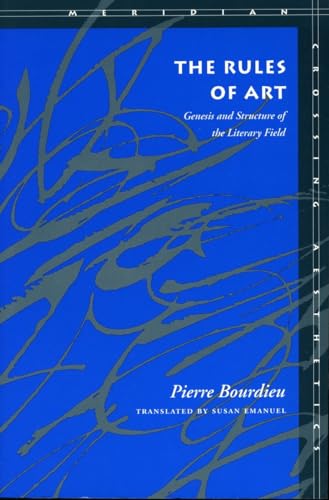
The Rules of Art: Genesis and Structure of the Literary Field (Meridian: Crossing Aesthetics) - Softcover
Synopsis
Written with verve and intensity (and a good bit of wordplay), this is the long-awaited study of Flaubert and the modern literary field that constitutes the definitive work on the sociology of art by one of the world’s leading social theorists. Drawing upon the history of literature and art from the mid-nineteenth century to the present, Bourdieu develops an original theory of art conceived as an autonomous value. He argues powerfully against those who refuse to acknowledge the interconnection between art and the structures of social relations within which it is produced and received. As Bourdieu shows, art’s new autonomy is one such structure, which complicates but does not eliminate the interconnection.
The literary universe as we know it today took shape in the nineteenth century as a space set apart from the approved academies of the state. No one could any longer dictate what ought to be written or decree the canons of good taste. Recognition and consecration were produced in and through the struggle in which writers, critics, and publishers confronted one another.
"synopsis" may belong to another edition of this title.
About the Author
Pierre Bourdieu is Professor of Sociology at the Collège de France. Stanford University Press has published eight other books by Bourdieu, most recently Free Exchange, with Hans Haacke (Stanford, 1995).
From the Back Cover
Written with verve and intensity (and a good bit of wordplay), this is the long-awaited study of Flaubert and the modern literary field that constitutes the definitive work on the sociology of art by one of the world's leading social theorists. Drawing upon the history of literature and art from the mid-nineteenth century to the present, Bourdieu develops an original theory of art conceived as an autonomous value. He argues powerfully against those who refuse to acknowledge the interconnection between art and the structures of social relations within which it is produced and received. As Bourdieu shows, art's new autonomy is one such structure, which complicates but does not eliminate the interconnection.
The literary universe as we know it today took shape in the nineteenth century as a space set apart from the approved academies of the state. No one could any longer dictate what ought to be written or decree the canons of good taste. Recognition and consecration were produced in and through the struggle in which writers, critics, and publishers confronted one another.
From the Inside Flap
Written with verve and intensity (and a good bit of wordplay), this is the long-awaited study of Flaubert and the modern literary field that constitutes the definitive work on the sociology of art by one of the world's leading social theorists. Drawing upon the history of literature and art from the mid-nineteenth century to the present, Bourdieu develops an original theory of art conceived as an autonomous value. He argues powerfully against those who refuse to acknowledge the interconnection between art and the structures of social relations within which it is produced and received. As Bourdieu shows, art's new autonomy is one such structure, which complicates but does not eliminate the interconnection.
The literary universe as we know it today took shape in the nineteenth century as a space set apart from the approved academies of the state. No one could any longer dictate what ought to be written or decree the canons of good taste. Recognition and consecration were produced in and through the struggle in which writers, critics, and publishers confronted one another.
"About this title" may belong to another edition of this title.
Other Popular Editions of the Same Title

Search results for The Rules of Art: Genesis and Structure of the Literary...

Stock Image
The Rules of Art: Genesis and Structure of the Literary Field (Meridian: Crossing Aesthetics)
Published by
Stanford University Press, 1996
ISBN 10: 0804726272
ISBN 13: 9780804726276
Used
Softcover
First Edition
Seller: Atticus Books, Toronto, ON, Canada
Seller rating 3 out of 5 stars

Seller Inventory # RF421
Stock Image
The Rules of Art: Genesis and Structure of the Literary Field
Published by
Stanford University Press, 1996
ISBN 10: 0804726272
ISBN 13: 9780804726276
Used
Paperback
Seller: ThriftBooks-Dallas, Dallas, TX, U.S.A.
Seller rating 5 out of 5 stars

Paperback. Condition: As New. No Jacket. Pages are clean and are not marred by notes or folds of any kind. ~ ThriftBooks: Read More, Spend Less. Seller Inventory # G0804726272I2N00
Stock Image
The Rules of Art: Genesis and Structure of the Literary Field
Published by
Stanford University Press, 1996
ISBN 10: 0804726272
ISBN 13: 9780804726276
Used
Paperback
Seller: ThriftBooks-Dallas, Dallas, TX, U.S.A.
Seller rating 5 out of 5 stars
Paperback. Condition: Good. No Jacket. Missing dust jacket; Pages can have notes/highlighting. Spine may show signs of wear. ~ ThriftBooks: Read More, Spend Less. Seller Inventory # G0804726272I3N01
Stock Image
The Rules of Art: Genesis and Structure of the Literary Field (Meridian: Crossing Aesthetics)
Published by
Stanford University Press, 1996
ISBN 10: 0804726272
ISBN 13: 9780804726276
Used
Paperback
Seller: Books From California, Simi Valley, CA, U.S.A.
Seller rating 4 out of 5 stars

Paperback. Condition: Good. Seller Inventory # mon0004017186
Seller Image
The Rules of Art: Genesis and Structure of the Literary Field
Published by
Stanford University Press, 1996
ISBN 10: 0804726272
ISBN 13: 9780804726276
Used
Paperback
Seller: Southampton Books, Sag Harbor, NY, U.S.A.
Seller rating 5 out of 5 stars
Paperback. Condition: Like New. FIRST THUS. First Edition Thus, First Printing. Not price-clipped. Published by Stanford University Press, 1996. Octavo. Paperback. Book is like new with shelf wear. 100% positive feedback. 30 day money back guarantee. NEXT DAY SHIPPING! Excellent customer service. Please email with any questions. All books packed carefully and ship with free delivery confirmation/tracking. All books come with free bookmarks. Ships from Sag Harbor, New York. Seller Inventory # 368742
Seller Image
The Rules of Art: Genesis and Structure of the Literary Field (Paperback or Softback)
Published by
Stanford University Press 7/1/1996, 1996
ISBN 10: 0804726272
ISBN 13: 9780804726276
New
Paperback or Softback
Seller: BargainBookStores, Grand Rapids, MI, U.S.A.
Seller rating 5 out of 5 stars
Paperback or Softback. Condition: New. The Rules of Art: Genesis and Structure of the Literary Field. Book. Seller Inventory # BBS-9780804726276
Seller Image
Rules of Art : Genesis and Structure of the Literary Field
Published by
Stanford University Press, 1996
ISBN 10: 0804726272
ISBN 13: 9780804726276
New
Softcover
Seller: GreatBookPrices, Columbia, MD, U.S.A.
Seller rating 5 out of 5 stars
Condition: New. Seller Inventory # 252687-n
Stock Image
The Rules of Art: Genesis and Structure of the Literary Field (Meridian: Crossing Aesthetics)
Published by
Stanford University Press, 1996
ISBN 10: 0804726272
ISBN 13: 9780804726276
New
Softcover
Seller: California Books, Miami, FL, U.S.A.
Seller rating 4 out of 5 stars
Condition: New. Seller Inventory # I-9780804726276
Stock Image
The Rules of Art: Genesis and Structure of the Literary Field (Meridian: Crossing Aesthetics)
Published by
Stanford University Press, 1996
ISBN 10: 0804726272
ISBN 13: 9780804726276
Used
Soft cover
First Edition
Seller: The Bookseller, Edmonton, AB, Canada
Seller rating 5 out of 5 stars
Soft cover. Condition: Good. 1st Edition. Minor shelf wear. About 20 pages have some pencil MARKINGS. Otherwise a square, tight book. Index. xx, 408 pp. Seller Inventory # 063166
Seller Image
The Rules of Art
Published by
Stanford University Press, US, 1996
ISBN 10: 0804726272
ISBN 13: 9780804726276
New
Paperback
Seller: Rarewaves USA, OSWEGO, IL, U.S.A.
Seller rating 5 out of 5 stars
Paperback. Condition: New. Written with verve and intensity (and a good bit of wordplay), this is the long-awaited study of Flaubert and the modern literary field that constitutes the definitive work on the sociology of art by one of the world's leading social theorists. Drawing upon the history of literature and art from the mid-nineteenth century to the present, Bourdieu develops an original theory of art conceived as an autonomous value. He argues powerfully against those who refuse to acknowledge the interconnection between art and the structures of social relations within which it is produced and received. As Bourdieu shows, art's new autonomy is one such structure, which complicates but does not eliminate the interconnection. The literary universe as we know it today took shape in the nineteenth century as a space set apart from the approved academies of the state. No one could any longer dictate what ought to be written or decree the canons of good taste. Recognition and consecration were produced in and through the struggle in which writers, critics, and publishers confronted one another. Seller Inventory # LU-9780804726276