
Items related to Tiger Woman on Wall Street: Winning Business Strategies...
Tiger Woman on Wall Street: Winning Business Strategies from Shanghai to New York and Back (BUSINESS BOOKS) - Hardcover
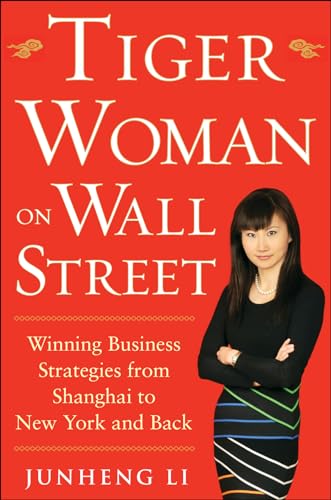
Synopsis
"For investors who are feeling tipsy at 'The Red Party,' Tiger Woman on Wall Street is a much-needed sobering up."
--Forbes.com
Junheng Li was the perfect Chinese tiger daughter, but from childhood on, she dreamed about America and working on Wall Street. Born in Shanghai, the commercial and financial center of mainland China, Li was brought up in an environment that would raise most Westerners' eyebrows. Her demanding father drilled her on her multiplication tables when she was three, and in school she was forced tomemorize facts and regurgitate them perfectly on tests. Success at all costs was the mantra. When she arrived at Middlebury College in Vermont after studying round the clock for months to learn the English language, sheentered a completely different world, where values and morality were taught, individualism reigned, and analytical thinking was encouraged.
Tiger Woman on Wall Street is both the remarkable, dramatic story of one woman's rise in the global business world and a savvy guide to finance and investing. With unflinching candor, Junheng Li tells how a brainy, focused, highly driven Chinese girl who admiredScarlett O'Hara's indomitable spirit drew on the best of both worlds to go where few women have gone before: straight to the top of the financial industry.
Tiger Woman on Wall Street takes you behind the scenes of the world's most important financial markets, from the daily routine of trading to high-level meetings with executives, policy makers, and analysts. Li conveysin fascinating and revealing detail how she arrives at her investing decisions--a powerful combination of keen intuition, meticulous due diligence, and razor-sharp analysis. Li argues that the current Chinese business growth model has hit a wall and shows why investors need to keep both eyes firmly open when investing--especially in China.
By reading this book, you will learn how one of today's most successful China analysts smells a questionable investment a mile away, predicts industry trends, forecasts stock price movements, and develops investmentideas--both long and short--using techniques ranging from scrutinizing data to posing as an average customer in order to examine firsthand a company's latest product. You will also meet colorful characters such as Knucklehedgie,an American hedge fund manager who invests in Chinese companies based on brokers' bragging, and a Chinese executive who takes conference calls with investors while at nightclubs and who made his fortune by selling fraudulent Chinese companies to global investors.
Striking a rare balance between page-turning storytelling and practical investing guide, Tiger Woman on Wall Street shows how one woman has navigated her way through and thrived in this increasingly complicated and exciting period in modern financial history.
Praise for Tiger Woman on Wall Street
"Junheng Li is one of the most astute market analysts I have met in my long career. Her healthy skepticism of China's inevitable rise to economic and market supremacy is refreshing, and her razor-sharp analysis of Chineseequities is as compelling as the story of her own journey from the streets of Shanghai to Wall Street." -- Ron Insana, CNBC contributor
"For investors who are feeling tipsy at 'The Red Party,' Tiger Woman on Wall Street is a much-needed sobering up. For those new to the country, this book is China 101, covering not only the business but also the social and political landscape. Li’s simple, explanatory language makes the book an easy read even for those without an investing background." -- Forbes.com
"Tiger Woman on Wall Street is a fascinating read on a subject that couldn't be more timely. A must-read for Western (and Chinese) investors and businesspeopleinterested in China." -- Jim Chanos, President/Founder, Kynikos Associates
"We can all learn a lot about finance and investing from Tiger Woman on Wall Street. Through brains, honesty, and grit, Li has thrived on Wall Street by applying the investigative and analytical skills she learned in China, and this terrific book shows how she did it." -- Karen Finerman, Cofounder and President of Metropolitan Capital Advisers and author of Finerman's Rules
"While alpha males have long dominated Wall Street, now comes a Tiger Woman who may very well eat their lunch in the ultracompetitive world of stock market research. This book tells her extraordinary story and many ofher investing secrets." -- Minggao Shen, Chief Economist for Greater China, Citigroup
"A profound exploration of the heart and mind of modern-day China. With passionate and penetrating prose, Junheng Li expertly uses her remarkable personal story to illuminate the complexities of China's great economic opportunities--and even greater risks." -- Deborah Davis, bestselling author of Strapless, Gilded, and Party of the Century
"There is no question that Junheng Li is an incisive analyst with a unique perspective on some of the defining international and market issues of our times. Tiger Woman on Wall Street demonstrates this in every chapter. But what is especially remarkable is how she uses her own compelling personal story to both add a human dimension to those issues that brings them to life and adds credence to her reliably sound market insights. She is allergic to hype and superficiality. Her own experiences explain why, and serve to offer refreshingly fact-based and granular perspectives on the sweeping, inspiring, and often misleading stories and myths surrounding China's rapid ascent." -- David Rothkopf, CEO and editor-at-large, Foreign Policy magazine; author of Superclass and Power, Inc.
"This very readable book adds a lot of color to what has been a widely misunderstood process in China. By telling her story as an investor, Junheng Li shows in concrete detail how the financial system in China is currently structured in such a way that capital misallocation is not only possible, but indeed is highly likely. Through her own story, Li also shows that under the right conditions, the Chinese people have the courage and determination to take their country to great heights.”" -- Michael Pettis, Professor of Finance, Guanghua School of Management, Peking University, Beijing"
“Anyone considering doing business with China or investing with Chinese companies may find Li’s book to have relevant insight into the business culture of China.” -- Booklist
"synopsis" may belong to another edition of this title.
About the Author
Junheng Li runs the independent equity research firm JL Warren Capital LLC, a China-focused research firm aimed at plugging the gap between the business reality in China and American investors. Before launching JL Warren, she was an investment banking analyst at Credit Suisse First Boston, an investment officer at Franklin Templeton Fiduciary, and a hedge fund analyst at Aurarian Capital Management.
Excerpt. © Reprinted by permission. All rights reserved.
Tiger Woman on Wall Street
Winning Business Strategies from Shanghai to New York and Back
By Junheng LiMcGraw-Hill Education
Copyright © 2014 Junheng Li
All rights reserved.
ISBN: 978-0-07-181842-1All rights reserved.
Contents
| Author Note | |
| Introduction | |
| 1 * Tiger Dad, Tiger Daughter | |
| 2 * Working in the Gold Mine | |
| 3 * Growing Up Under Mao | |
| 4 * Window of Opportunity | |
| 5 * Dreaming of a New Land | |
| 6 * An American Education | |
| 7 * Wall Street 101 | |
| 8 * Learning, Burning, and Crashing | |
| 9 * The Red Party: Instant Alpha | |
| 10 * The New Chinese Reality Check | |
| 11 * Walking with My Father | |
| 12 * The Human Cost of the Economic Miracle | |
| 13 * Muddying the Waters | |
| 14 * The Power of Investigative Research | |
| 15 * What Keeps Me Awake at Night | |
| 16 * From Shanghai to New York and Back Again | |
| Note to Investors: Do Your Homework | |
| Notes | |
| Acknowledgments | |
| Index |
CHAPTER 1
Tiger Dad, Tiger Daughter
Slivers of wood bore into my skin, my back ached, and my shins throbbed withpain. I had been forced to kneel on a washer board in front of my father formore than an hour while he drilled me on the multiplication tables, and thewooden ridges were digging so deeply into my legs that I could barely think.
"Eight times six!" he barked.
"Uh ..."
I must have taken a beat too long to answer, so he slapped me hard across theface.
"EIGHT TIMES SIX!" he repeated.
"Forty?" I ventured.
"Stupid, useless girl!" he yelled, and slapped me again, even harder this time.
"Baba, I know it! Forty-eight!"
On and on it went, until well past dusk. I was beginning to bleed, but therewould be no respite until I completed the entire multiplication table withouthesitation. I was expected to spit out the correct answers like a machine. Dadwas determined that I get these basic mathematic lessons down cold, and as faras he was concerned, the best way of teaching was through a brutal system ofpunishment and reward.
It was not unusual for my father to take this zealous tutoring too far. Hebelieved it was the only way his daughter would gain an edge in China's highlycompetitive education system and get ahead in the world. Others might call ittorture; he called it tough love. Later in life, he figured, I would understandand even thank him. But right then, there was to be no sparing of the rod.
I was just three years old.
When Dad decided the drilling had sunk in, he lifted me off the washer board andbrought me to a nearby park where I could run around and play. At the park, Ifelt so liberated that I dropped my father's hand and took off, sprinting acrossthe grass. By then, it was so dark that I couldn't see in front of me—the publicpark authorities turned off the lights after 8 p.m. to save electricity. Thegroundskeepers had just mowed the lawn and erected barbed wire to protect thegrass. I ran straight into it.
The barbs pierced my stomach's tender flesh and blood started to blossom,staining my blue dress. Dad scooped me up, took me home, and cleaned my wound,the pain flaring as he dabbed rubbing alcohol on my punctures. When I screamed,his face flinched. Then he said something I have never forgotten: "Pain is justweakness leaving the body."
Dad tucked me in, then sat next to my bed until I fell asleep, touching myforehead from time to time and checking my injuries. In that bittersweet moment,I knew he cared for me. If anything, that fierce love was why he always demandednothing less than perfection. His high standards for me were just part of hislanguage of love that got lost in translation.
* * *
Throughout my childhood, his militaristic drills and beatings were almost adaily routine. If I displeased him for any reason, whether it was for cominghome late after playing games with the neighborhood boys or stumbling as Iplayed a tune on my accordion, I would suffer a whipping from his leather belt.
As brutal as he could be, I never once doubted that my father loved my youngersister, Jasmine, and me more than anything in the world. He would do littlethings for us, small love tokens like leaving toothpaste on my toothbrush for mebefore heading to work in the morning or preparing special breakfast foods. Healways rose early to make breakfast for Jasmine and me; he was a stickler forproper nutrition, especially when it came to his children. When the monthlybudget was strained, he would eat less so we could have more. If I were facingan important day at school, such as a big test or an accordion recital, he wouldprepare two eggs poached in hot milk. But I never liked the taste of egg nomatter how good it was supposed to be for me. Once, Dad spotted me spitting itout the moment I left the apartment. After that, I wasn't allowed to leave untilI finished chewing and swallowing right in front of him.
If I did something that pleased him, like scoring at the top of my class orwinning a speech contest, he would wake even earlier than usual and bike 20minutes to his favorite dumpling joint to bring home my favorite pan-seared porkbuns and curried beef soup. Every time I saw pork buns for breakfast, I knewthat I had made him happy. Poached eggs and takeout pork buns were luxurybreakfast items at that time—a real splurge. And they were all for my sister andme. Dad would sit in the corner of the living room and eat his rice porridgeseparately, a contented look on his face.
Dad never spoke the words, "I am proud of you." He didn't have to. It wasobvious. "One day you will understand why I'm so hard on you right now," he toldme once. "All I do is to prepare you while you are young and moldable, so thatyou will have a bit more control of your destiny when you grow up."
CHAPTER 2
Working in the Gold Mine
New York, Spring 2005
When I first saw Jason gold, he was carrying his dry cleaning into the office, agleaming glass and steel money fortress on Fifth Avenue, right next door toHarry Winston's New York flagship store. He made a good first impression: heseemed energetic, sharp, and youthful, with a ready smile. His dark eyes werealert and penetrating.
Jason was the founder of Aurarian Capital, a start-up hedge fund where I wastrying to land a job. I was there for my first interview. After working forseveral years on Wall Street, I was ready for a new challenge. The ad for theposition said the fund was focused on under-the-radar small-cap technologycompanies. I knew very little about technology—in fact, I didn't even understandwhat a computer motherboard was at the time—but I knew I could learn anything ifI set my mind to it. I could not wait to learn the ropes of a start-up hedgefund by working my heart out.
Before my interview, I asked around on the Street about Jason's reputation. Hehad an impressive résumé graced with some of the most prestigious multibilliondollar fund names in the business. Before launching Aurarian Capital, he was aresearch director at SAC Capital, one of the world's largest multistrategyfunds, run by Steve Cohen. He had also been a lieutenant to Dan Benton at AndorCapital Management. Both funds were known for their cutthroat cultures.
The people I spoke with described Jason as everything from a bulldog toultimately a good guy. He was a devoted family man, but he also worked like amaniac and suffered no fools. I didn't mind working for a tough boss, as long ashe would be fair and even-keeled: a balance I would soon learn that Jasonpersonified.
During the interview, Jason pointed me to a seat by his office desk while he saton the couch across the room. Only much later did I realize that the seatingarrangement was a part of his signature interview technique. By lullinginterviewees into an informal dialogue, he later explained to me, he tried toopen them up to reveal their true selves.
"Tell me about yourself," Jason began, looking directly into my eyes, "How doyou describe yourself?"
"Two words—curious and tenacious," I replied, without even thinking.
I went on to tell him that I inherited an insatiably curious mind from my dad—nothingturned me on more than learning. I also inherited his legendarytenacity, which meant I would never back down in front of challenges, ever.
"I also possess common sense, and I am resourceful," I added, listing thequalities I inherited from my mother. I explained how my mother shrewdly ran ahousehold with limited financial resources. She would make the rounds at thefarmer's market and would speak to dozens of vendors to ferret out the bestdeals. My mom was also a great listener, someone whom other people trusted withtheir stories and insights. She'd listen, digest, and then dispense sage advicewith all that information. In my mind, that kind of instinct and pragmatism weremuch harder to teach than the ability to analyze a company's income statement.
As I talked, Jason observed my body language attentively, checking out how Imade eye contact, watching my hand movements, and listening for pauses betweensentences. When I told him about my experience coming to the United States withnothing but one suitcase and limited English skills, but then graduating at thetop of my class at Middlebury and ultimately moving to New York City with twosuitcases, he laughed. I could see recognition in his eyes. Despite being in themidst of a high-stakes interview, I felt relaxed. In fact, I felt understood andappreciated.
Then Jason's next question ambushed me. "What was your biggest failure?" heasked, watching my facial expression intently.
I paused, my mind racing, and had to answer honestly: "I can't think of any."
"This business is brutally humbling," he warned me. "You are graded by themarket every day. You will make plenty of mistakes, which is okay. But I willnot tolerate an employee making the same mistake twice."
Jason then launched into an explanation of the world of Aurarian. I knew thismeant he was interested in hiring me, or he wouldn't have wasted his time.Aurarian, a name inspired by the Latin word for "gold mine," invested in smallto mid-sized public companies in the high-technology sector. More specifically,the fund focused on companies with market capitalizations of less than $2billion with patentable intellectual property. "These small businesses are thelifeblood of the U.S.," Jason told me. "Our decision to invest in them makes adifference to their growth and success."
It sounded exciting and compelling. I pushed for more information.
"Sell-side analysts write volumes about blue chip names like Apple, IBM, andCisco," I said. "But they typically don't waste time covering small companiessince the trading fees are so limited. So how do you research them?"
"Great question," Jason responded, nodding in approval. "I use the researchtools I learned over the course of my career from some of the best investors inthe business and apply them to the under-the-radar stocks. I'll train you onthat, one technique at a time."
The interview was the beginning of a great working relationship. A few monthsafter I started, the COO told me that Jason went back to the trading desk afterour interview and announced, "I saw fire in this woman. She is a lion—she canget anything done if she wants to."
* * *
I certainly had had my share of challenges in life by that time, from Shanghaito Middlebury to New York. I was striving to learn new skills, solve problems,and meet people. And yet the pace of my life and the challenges it brought, nomatter how daunting, were nothing compared with what almost every Chinese personof my father's generation experienced during the Cultural Revolution.
CHAPTER 3
Growing Up Under Mao
China, 1949–1976
If Chinese people took psychology seriously, Dad and most others of hisgeneration would probably have been diagnosed with some sort of anxiety disorderbrought on by the traumas of living through one of the most terror-filled timesin Chinese history: the Cultural Revolution.
The revolution began in the summer of 1966 as an attempt by Chairman Mao Zedongto reorganize and recentralize power within the government and shore up supportamong the people. He piggybacked off a student movement at the time, encouragingthe antibourgeois beliefs of these passionate students. Within a year, thestudent movement had transformed into a national mindset in which anyone with"bourgeois" or "anti-Communist" backgrounds could be punished—intellectuals,monks and nuns, doctors, experts in any field, people who grew crops for theirown families—just about anyone.
The wealthy and educated classes were considered not merely passé but rather aserious threat to the livelihood of the Chinese people. Everything one needed toknow, contended the cadres (the public officials charged with advancing therevolution) who formed the core of the new party, could be learned in thecountryside, from laboring alongside one's brothers-in-arms.
It was to this end that Mao forced 17 million urban youth out of the cities andinto the countryside during the Down to the Countryside Movement. Collegesclosed, and parents bade their children farewell, in some cases forever. Somestudents were killed. Others, like the countless girls who were raped by cadres,committed suicide. Relevant and accurate statistics from this era are impossibleto find; only stories remain, and even those are murky. But the outcome wasclear: the movement paralyzed China politically and left the entire countryshell-shocked.
At the age of 17, Dad was stripped of his dream of going to college and wasinstead "reeducated"—that is, sent into the fields to hoe turnips. Mygrandfather lost not only his son to the countryside but also the family's riceshop during a local purge of individual ownership. Although the official sloganclaimed everyone was guaranteed an "iron bowl of rice," my father's generationremembers it only as a time of unfilled stomachs. The revolution spared no one.
Worse than the shortage of material possessions was the unpredictability andinstability of a party in which there was no rule of law. People coulddisappear, be imprisoned, or be killed at the whim of the "Great Leadership."Far more common and disturbing than commands from on high were the betrayals offriends, neighbors, and even family members to demonstrate a person's loyalty tosocialist principles.
But at the same time, China was oddly free. While the high ranks of the innerparty rested in Mao's palm and while the treacherous Gang of Four—Mao's lastwife and her cronies—dangled the arts and media sector like marionettes, thecentral government had little to do with the everyday comings and goings of thecommon people. It was as if the government had constructed a metaphoricalbirdcage to house its people, songbirds that could sing as loudly as theywished, as long as they remained within that cage.
China's Red Guard was the most raucous of all the cage-born birds. Nearly everymiddle and high school in the country had a group of Red Guards, a titleconferred upon students by local officials and even other students themselves.With Mao's blessing, Red Guard cliques erupted across the country in August1968, competing with one another for control of their schools. On a good day,Red Guards would write revolutionary poetry and sing red hymns. At their worst,these students burned books, turned their parents in to the authorities, andlynched teachers.
Unbelievable though it may seem, Red Guards thought of themselves as innocentfollowers of a utopian ideology, brethren in a world free of classism andfeudalism. My father was among them—until he spent time in the countryside. TheDown to the Countryside Movement awakened him and millions of other Red Guardsto the harshness of peasant life.
My father's delusions about life in China finally shattered when, as a young manin his twenties, he was confronted with the brutal reality of life in theCultural Revolution. Everyone seemed to be a victim and an aggressor at the sametime.
On one occasion, he went into a government office to submit some papers and washalted at the door by a guard.
"Identification card," the guard barked without looking at him.
When my father reached into his pocket, the man became agitated and pulled a gunon him, screaming reflexively, "Hands up! Hands up or I'll shoot!"
My father came within a hair of being executed on the spot. Yet he still had tohave the last word: "If the people are indeed the master of the country, why areyou trying to kill me?"
* * *
Dad was a driven, outspoken, energetic young man. He thought that most of hiscomrades were too brainwashed to hold a meaningful conversation, and as aresult, he had few friends. While his peers indulged themselves with Shanghaiopera—a slightly more tolerable version of Beijing opera—simply because that wasthe music on the radio, Dad bought a violin and taught himself to play. Insecret, he convinced a professor friend at the Shanghai Conservatory of Music togive him extra coaching. It was his passion for music that kept him mentallystimulated in the absence of the advanced education he coveted.
(Continues...)
Excerpted from Tiger Woman on Wall Street by Junheng Li. Copyright © 2014 Junheng Li. Excerpted by permission of McGraw-Hill Education.
All rights reserved. No part of this excerpt may be reproduced or reprinted without permission in writing from the publisher.
Excerpts are provided by Dial-A-Book Inc. solely for the personal use of visitors to this web site.
"About this title" may belong to another edition of this title.
Search results for Tiger Woman on Wall Street: Winning Business Strategies...

Stock Image
Tiger Woman on Wall Street: Winning Business Strategies from Shanghai to New York and Back
Seller: World of Books (was SecondSale), Montgomery, IL, U.S.A.
Seller rating 5 out of 5 stars

Condition: Good. Item in good condition. Textbooks may not include supplemental items i.e. CDs, access codes etc. Seller Inventory # 00102762317
Stock Image
Tiger Woman on Wall Street: Winning Business Strategies from Shanghai to New York and Back
Published by
McGraw Hill (edition 1), 2013
ISBN 10: 0071818421
ISBN 13: 9780071818421
Used
Hardcover
Seller: BooksRun, Philadelphia, PA, U.S.A.
Seller rating 5 out of 5 stars
Hardcover. Condition: Fair. 1. With dust jacket. The item might be beaten up but readable. May contain markings or highlighting, as well as stains, bent corners, or any other major defect, but the text is not obscured in any way. Seller Inventory # 0071818421-7-1-29
Stock Image
Tiger Woman on Wall Street: Winning Business Strategies from Shanghai to New York and Back
Seller: Once Upon A Time Books, Siloam Springs, AR, U.S.A.
Seller rating 4 out of 5 stars

hardcover. Condition: Acceptable. This is a used book. It may contain highlighting/underlining and/or the book may show heavier signs of wear . It may also be ex-library or without dustjacket. This is a used book. It may contain highlighting/underlining and/or the book may show heavier signs of wear . It may also be ex-library or without dustjacket. Seller Inventory # mon0001316108
Stock Image
Tiger Woman on Wall Street: Winning Business Strategies from Shanghai to New York and Back
Seller: ThriftBooks-Atlanta, AUSTELL, GA, U.S.A.
Seller rating 5 out of 5 stars
Hardcover. Condition: Good. No Jacket. Pages can have notes/highlighting. Spine may show signs of wear. ~ ThriftBooks: Read More, Spend Less. Seller Inventory # G0071818421I3N00
Stock Image
Tiger Woman on Wall Street: Winning Business Strategies from Shanghai to New York and Back
Published by
McGraw-Hill Education - Europe, 2013
ISBN 10: 0071818421
ISBN 13: 9780071818421
Used
Hardcover
Seller: World of Books Inc, Montgomery, IL, U.S.A.
Seller rating 4 out of 5 stars
Hardback. Condition: Good. The author was the perfect Chinese tiger daughter, but from childhood on, she dreamed about America and working on Wall Street. Born in Shanghai, the commercial and financial center of mainland China, she was brought up in an environment that would raise most Westerners' eyebrows. This book tells her story. Seller Inventory # CIN0071818421G
Stock Image
Tiger Woman on Wall Street: Winning Business Strategies from Shanghai to New York and Back
Published by
McGraw-Hill Education November 2013, 2013
ISBN 10: 0071818421
ISBN 13: 9780071818421
Used
Hardcover
Seller: Montclair Book Center, Montclair, NJ, U.S.A.
Seller rating 4 out of 5 stars
Hardcover. Condition: USED Very Good. Seller Inventory # 33100
Seller Image
Tiger Woman on Wall Street : Winning Strategies from Shanghai to New York and Back
Seller: GreatBookPrices, Columbia, MD, U.S.A.
Seller rating 5 out of 5 stars
Condition: As New. Unread book in perfect condition. Seller Inventory # 19540283
Stock Image
Tiger Woman on Wall Street
Seller: Majestic Books, Hounslow, United Kingdom
Seller rating 4 out of 5 stars
Condition: New. pp. 256. Seller Inventory # 96266728
Buy New
£ 19.68
£ 6.50 shipping
Ships from United Kingdom to U.S.A.
Ships from United Kingdom to U.S.A.
Quantity: 1 available
Seller Image
Tiger Woman on Wall Street : Winning Strategies from Shanghai to New York and Back
Seller: GreatBookPrices, Columbia, MD, U.S.A.
Seller rating 5 out of 5 stars
Condition: New. Seller Inventory # 19540283-n
Stock Image
Tiger Woman on Wall Street
Seller: Books Puddle, Woodside, NY, U.S.A.
Seller rating 4 out of 5 stars
Condition: New. pp. 256. Seller Inventory # 2697211959