Order Total (1 Item Items):
Shipping Destination:

Rasmont Franzén Lecocq Harpke Roberts (2 results)
Skip to main search results
Search filters
Product Type
- All Product Types
- Books (2)
- Magazines & Periodicals (No further results match this refinement)
- Comics (No further results match this refinement)
- Sheet Music (No further results match this refinement)
- Art, Prints & Posters (No further results match this refinement)
- Photographs (No further results match this refinement)
- Maps (No further results match this refinement)
- Manuscripts & Paper Collectibles (No further results match this refinement)
Condition Learn more
- New (1)
- As New, Fine or Near Fine (No further results match this refinement)
- Very Good or Good (No further results match this refinement)
- Fair or Poor (No further results match this refinement)
- As Described (1)
Binding
- All Bindings
- Hardcover (2)
- Softcover (No further results match this refinement)
Collectible Attributes
- First Edition (No further results match this refinement)
- Signed (No further results match this refinement)
- Dust Jacket (No further results match this refinement)
- Seller-Supplied Images (2)
- Not Print on Demand (2)
Language (2)
Price
- Any Price
- Under £ 20 (No further results match this refinement)
- £ 20 to £ 40 (No further results match this refinement)
- Over £ 40
Free Shipping
- Free Shipping to U.S.A. (No further results match this refinement)
Seller Location
Seller Rating
-
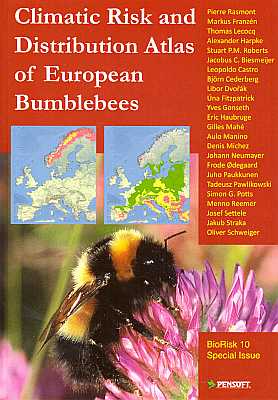
Climatic Risk and Distribution Atlas of European Bumblebees
Seller: PEMBERLEY NATURAL HISTORY BOOKS BA, ABA, Iver, United Kingdom
Association Member: ABA ILAB PBFA
Seller rating 5 out of 5 stars

Condition: New. 236, col photos, maps. . HB. NEW. . Bumblebees represent one of the most important groups of pollinators and, like most animals, are sensitive to climate. This atlas presents maps showing the potential risks of climate change for bumble bees together with summary statistics, ecological background information and pictures of each European species.Thanks to the EU FP7 project STEP, the authors gathered over one million bumblebee records from all over Europe. Based on these data, they modelled the current climatic niche for almost all European species (56 species) and projected future climatically suitable conditions using three climate change scenarios for the years 2050 and 2100. While under a moderate change scenario only 3 species are projected to be at the verge of extinction by 2100, 14 species are at high risk under an intermediate change scenario. Under a most severe change scenario as many as 25 species are projected to lose almost all of their climatically suitable area, while a total of 53 species (77% of the 69 European species) would lose the main part of their suitable area.Climatic risks for bumblebees can be extremely high, depending on the future development of human society, and the corresponding effects on the climate. Strong mitigation strategies are needed to preserve this important species group and to ensure the sustainable provision of pollination services, to which they contribute significantly. [9789546427687].
-
Bumblebees represent one of the most important groups of pollinators. In addition to their ecological and economic relevance, they are also a highly charismatic group which can help to increase the interest of people in realizing, enjoying and conserving natural systems. However, like most animals, bumblebees are sensitive to climate. In Climatic Risk and Distribution Atlas of European Bumblebees, maps depicting potential risks of climate change for bumblebees are shown together with informative summary statistics, ecological background information and a picture of each European species. Thanks to the EU FP7 project STEP, the authors gathered over one million bumblebee records from all over Europe. Based on these data, they modelled the current climatic niche for almost all European species (56 species) and projected future climatically suitable conditions using three climate change scenarios for the years 2050 and 2100. While under a moderate change scenario only 3 species are projected to be at the verge of extinction by 2100, 14 species are at high risk under an intermediate change scenario. Under a most severe change scenario as many as 25 species are projected to lose almost all of their climatically suitable area, while a total of 53 species (77% of the 69 European species) would lose the main part of their suitable area. Climatic risks for bumblebees can be extremely high, depending on the future development of human society, and the corresponding effects on the climate. Strong mitigation strategies are needed to preserve this important species group and to ensure the sustainable provision of pollination services, to which they considerably contribute. Sofia, Moscow. Pensoft. 236 pp., color photos, color & b/w illustrations, color distribution maps, color tables, hardcover gr. 8 [16.7 x 23.7 cm].