Order Total (1 Item Items):
Shipping Destination:

Fodor George (17 results)
Skip to main search results
Search filters
Product Type
- All Product Types
- Books (15)
- Magazines & Periodicals (1)
- Comics (No further results match this refinement)
- Sheet Music (No further results match this refinement)
- Art, Prints & Posters (No further results match this refinement)
- Photographs (1)
- Maps (No further results match this refinement)
- Manuscripts & Paper Collectibles (No further results match this refinement)
Condition Learn more
- New (11)
- As New, Fine or Near Fine (3)
- Very Good or Good (1)
- Fair or Poor (No further results match this refinement)
- As Described (2)
Binding
Collectible Attributes
- First Edition (1)
- Signed (No further results match this refinement)
- Dust Jacket (No further results match this refinement)
- Seller-Supplied Images (9)
- Not Print on Demand (11)
Language (4)
Free Shipping
- Free Shipping to U.S.A. (No further results match this refinement)
Seller Location
Seller Rating
-

Hardcover. Condition: Fine. Mint condition.
-
Condition: Used: Good. 1998 hardcover no dj as issued xlibrary copy withdrawn stamp on edge of pages/ in book clean text Kluwer Academic Publ. 245 pages::: J-15.
-

Paperback. Condition: Brand New. 240 pages. Romanian language. 9.61x6.69x0.55 inches. In Stock.
-
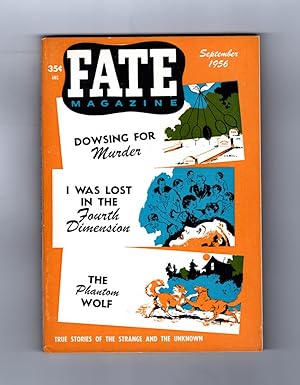
Fate Magazine - True Stories of the Strange and The Unknown / September, 1956. Dowsing for Murder, Lost in the Fourth Dimension, Phantom Wolf, Invisible Wife, 1956 alchemist, Sea Serpents, Handel's Ghost, Poltergeist
Language: English
Published by Clark Publishing Company, Evanston, IL, 1956
Seller: Singularity Rare & Fine, Baldwinsville, NY, U.S.A.
Seller rating 5 out of 5 stars

First Edition
Soft cover. Condition: Fine. 1st Edition. Evanston, IL: Clark Publishing Company, 1956. The September, 1956 issue of Fate Magazine (issue no. 78) in Raymond A. Palmer's now-legendary paranormal-reporting non-fiction enterprise, which began with, in its first issue, Kenneth Arnold's cover account of flying crescents which "skipped like saucers across a pond", an event which, for whatever reason, kicked off the modern era of UFO events. After that, Fate introduced countless events which remain, to this day, fodder for paranormal documentaries and investigation. 12mo, illustrated perfect-bound wraps, 130 pp. A Fine copy, with no flaws at all discernible without close loupe inspection. As high grade as Fate gets. Newsprint page paper has modestly toned, as always, but nor much. Extraordinarily sharp example. Highest Grade, particularly for a periodical which often shows substantial wear from use. See scans. This issue features articles on Dowsing for Murder, Lost in the Fourth Dimension, The Phantom Wolf, My Invisible Wife, a 1956 alchemist, Sea Serpents, Handel's ghost, a poltergeist, and of course much, much else, including the standard Departments, always engrossing in themselves. Interior art and photography is largely uncredited. A piece of paranormal history, and an example of a unique branch of Americana, in very highly collectible condition. l50n.
-

Ontologically Controlled Autonomous Systems: Principles, Operations and Architecture.
Language: English
Published by /Kluwer Academic Publishers
Hardcover. Ehem. Bibliotheksexemplar mit Bib.-Signatur und Stempel in GUTEM Zustand. Kaum Gebrauchsspuren. Sprache: Englisch Gewicht in Gramm: 550.
-
Ontologically Controlled Autonomous Systems: Principles, Operations, and Architecture: Principles, Operations, and Architecture
Seller: Ria Christie Collections, Uxbridge, United Kingdom
Seller rating 5 out of 5 stars
£ 187.59
£ 11.98 shipping
Ships from United Kingdom to U.S.A.Quantity: Over 20 available
Add to basketCondition: New. In.
-
Condition: New. pp. 264.
-

Ontologically Controlled Autonomous Systems: Principles, Operations, and Architecture : Principles, Operations, and Architecture
Language: English
Published by Springer US, Springer New York, 1997
ISBN 10: 0792380355 ISBN 13: 9780792380351
Buch. Condition: Neu. Druck auf Anfrage Neuware - Printed after ordering - Kevin M. Passino When confronted with a control problem for complicated physical process, a control engineer usually follows a predetermined design procedure. This procedure often begins with the engineer seeking to understand the process and the primary control objectives. A simple example ofa control problem is an automobile 'cruise control' that provides the automobile with the capability of regulating its own speed at a driver-specified set-point (e. g. , 55 mph). One solution to the automotive cruise control problem involves adding an electronic controller that can sense the speed of the vehicle via the speedometer and actuate the throttle position so as to regulate the vehicle speed at the driver-specified value. Such speed regulation must be accurate even if there are road grade changes, head-winds, or variations in the number of passengers in the automobile. After gaining an intuitive understanding of the plant's dynamics and establishing the design objectives, the control engineer typically solves the cruise control problem by using an established design procedure. In particular, this control engineering design methodology involves: 1. Modeling/understanding the plant, 2. Construction of a controller to meet specifications (such as stability, rise-time, overshoot, and steady state error), 3. Analysis to make sure that the system will meet the performance objectives (e. g. , we might use mathematical, simulation-based, or experimental analysis), and 4. Iterating on the design until it is possible to 'commission' the control system.
-
Hardcover. Condition: Like New. Like New. book.
-
LE BLOC-NOTES DE LA PSYCHANALYSE-N°4-1984
Language: French
Publication Date: 1984
Magazine / Periodical
Couverture souple. Condition: Neuf. 206 PAGES-FORMAT 13 CM X 23 CM-(1C).
-
![Seller image for Tom Thumb [tom thumb] (Original photograph from the 1958 film) for sale by Royal Books, Inc., ABAA](https://pictures.abebooks.com/inventory/md/md31100254971.jpg)
Tom Thumb [tom thumb] (Original photograph from the 1958 film)
Published by Metro-Goldwyn-Mayer [MGM], Beverly Hills, CA, 1958
Seller: Royal Books, Inc., ABAA, Baltimore, MD, U.S.A.
Seller rating 5 out of 5 stars
Photograph
Vintage reference photograph from the 1958 film, showing actress June Thorburn in conversation with a tiny Russ Tamblyn. With a printed label specific to the film's UK release affixed to the verso. Based on the 17th-century fairy tales "Thumbling" and "Thumbling's Travels" by the Brothers Grimm, about the adventures of a miniature youth. Shot on location in Hollywood and London. 10 x 8 inches. Very Good plus, lightly creased and toned to the edges.
-

Gebunden. Condition: New. Dieser Artikel ist ein Print on Demand Artikel und wird nach Ihrer Bestellung fuer Sie gedruckt. Kevin M. Passino When confronted with a control problem for complicated physical process, a control engineer usually follows a predetermined design procedure. This procedure often begins with the engineer seeking to understand the process and the primary co.
-
Buch. Condition: Neu. Ontologically Controlled Autonomous Systems: Principles, Operations, and Architecture | Principles, Operations, and Architecture | George A. Fodor | Buch | Einband - fest (Hardcover) | Englisch | 1997 | Springer US | EAN 9780792380351 | Verantwortliche Person für die EU: Springer Heidelberg, Tiergartenstr. 17, 69121 Heidelberg, buchhandel-buch[at]springer[dot]com | Anbieter: preigu Print on Demand.
-

Ontologically Controlled Autonomous Systems: Principles, Operations, and Architecture
Language: English
Published by Springer US Okt 1997, 1997
ISBN 10: 0792380355 ISBN 13: 9780792380351
Seller: BuchWeltWeit Ludwig Meier e.K., Bergisch Gladbach, Germany
Seller rating 5 out of 5 stars
Buch. Condition: Neu. This item is printed on demand - it takes 3-4 days longer - Neuware -Kevin M. Passino When confronted with a control problem for complicated physical process, a control engineer usually follows a predetermined design procedure. This procedure often begins with the engineer seeking to understand the process and the primary control objectives. A simple example ofa control problem is an automobile 'cruise control' that provides the automobile with the capability of regulating its own speed at a driver-specified set-point (e. g. , 55 mph). One solution to the automotive cruise control problem involves adding an electronic controller that can sense the speed of the vehicle via the speedometer and actuate the throttle position so as to regulate the vehicle speed at the driver-specified value. Such speed regulation must be accurate even if there are road grade changes, head-winds, or variations in the number of passengers in the automobile. After gaining an intuitive understanding of the plant's dynamics and establishing the design objectives, the control engineer typically solves the cruise control problem by using an established design procedure. In particular, this control engineering design methodology involves: 1. Modeling/understanding the plant, 2. Construction of a controller to meet specifications (such as stability, rise-time, overshoot, and steady state error), 3. Analysis to make sure that the system will meet the performance objectives (e. g. , we might use mathematical, simulation-based, or experimental analysis), and 4. Iterating on the design until it is possible to 'commission' the control system. 264 pp. Englisch.
-

Ontologically Controlled Autonomous Systems: Principles, Operations, and Architecture
Language: English
Published by Springer US, Springer New York Okt 1997, 1997
ISBN 10: 0792380355 ISBN 13: 9780792380351
Seller: buchversandmimpf2000, Emtmannsberg, BAYE, Germany
Seller rating 5 out of 5 stars
Buch. Condition: Neu. This item is printed on demand - Print on Demand Titel. Neuware -Kevin M. Passino When confronted with a control problem for complicated physical process, a control engineer usually follows a predetermined design procedure. This procedure often begins with the engineer seeking to understand the process and the primary control objectives. A simple example ofa control problem is an automobile 'cruise control' that provides the automobile with the capability of regulating its own speed at a driver-specified set-point (e. g. , 55 mph). One solution to the automotive cruise control problem involves adding an electronic controller that can sense the speed of the vehicle via the speedometer and actuate the throttle position so as to regulate the vehicle speed at the driver-specified value. Such speed regulation must be accurate even if there are road grade changes, head-winds, or variations in the number of passengers in the automobile. After gaining an intuitive understanding of the plant's dynamics and establishing the design objectives, the control engineer typically solves the cruise control problem by using an established design procedure. In particular, this control engineering design methodology involves: 1. Modeling/understanding the plant, 2. Construction of a controller to meet specifications (such as stability, rise-time, overshoot, and steady state error), 3. Analysis to make sure that the system will meet the performance objectives (e. g. , we might use mathematical, simulation-based, or experimental analysis), and 4. Iterating on the design until it is possible to 'commission' the control system.Springer Verlag GmbH, Tiergartenstr. 17, 69121 Heidelberg 264 pp. Englisch.
-
Condition: New. Print on Demand pp. 264 52:B&W 6.14 x 9.21in or 234 x 156mm (Royal 8vo) Case Laminate on White w/Gloss Lam.
-
Condition: New. PRINT ON DEMAND pp. 264.