About this Item
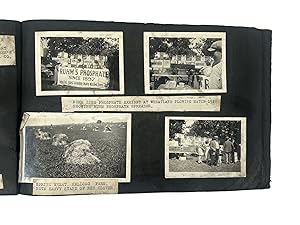
Industrial Extraction and Scientific Farming in the Interwar Midwest: Ruhm's Phosphate & Chemical Company (Mt. Pleasant, Tennessee). Photograph album documenting phosphate mining, processing, fertilizer application, and Illinois farm yield demonstrations. Circa 1928. Oblong black album (11 x 7½ inches) containing 77 silver gelatin photographs (majority captioned in typed slips, several with manuscript annotations) and newspaper clippings; photographs range approximately 2½ x 3½ inches to 7 x 9 inches. This album documents the full industrial and agricultural chain that underwrote early twentieth-century soil chemistry and commercial fertilizer expansion. Following the 1896 discovery of high-grade phosphate deposits in Maury County, Tennessee, Mt. Pleasant became one of the principal phosphate centers in the United States, transforming regional mineral extraction into a national agricultural input industry. Founded in 1897, Ruhm's Phosphate & Chemical Company operated within this expansion. The present album was clearly assembled as a field agent's promotional portfolio, visually linking extraction, mechanical processing, transportation, and demonstrable crop improvement. It functions as material evidence of how scientific agriculture was marketed during the interwar period. Approximately twenty-five images document mining and plant infrastructure with precise operational captions. One typed slip reads: "Showing one of the draglines digging phosphate. and shows approximately what must be removed before the phosphate is exposed." Another extended caption details the washing process, describing how rock is "dumped at the lower end of this runway into a skip," passes through rollers, then into "what we call a washer," before moving to dryers and stock piles. A further caption notes: "Showing a car being loaded at ground rock dock. The car is standing on the scale; the scale house is just to the right of the car, the dryers being at the extreme right." These texts convert the album into a technical explanation of mineral concentration, washing, screening, and rail shipment. Rail lines, dryer towers, scale houses, and conveyor systems are visible, underscoring vertical integration from pit to railcar. The Illinois agricultural section shifts from industrial infrastructure to yield demonstration. Photographs from Will County, Joliet, Kendall County, and other named sites present side-by-side comparisons of treated and untreated fields. One image bears the manuscript notation: "Will Co. Yield 35 bushels per acre." A typed comparison from the Joliet experiment farm states that phosphated plots in 1928 "made a yield of 40 bu. per acre compared to 18 bu. where no phos was applied." Another detailed caption under a spreader photograph reads: "Home made spreader of Joseph Keller, South of Aurora in Kendall Co. Mr Keller covered a very poor acid field with about 1300 lbs. of Ruhm's Lime Phosphate per acre in fall of 1927, getting yield of 72 bu. of oats per acre in 1928. A neighboring field of better ground yielded 48 bu. with no phosphate applied." These quantifiable comparisons demonstrate outcome-based marketing, not merely testimonial rhetoric. Additional images show a "Ruhm Lime Phosphate Exhibit at Wheatland Plowing Match 1928 showing Ruhm Phosphate Spreader," and a banner reading "Ruhm's Phosphate Since 1897," documenting trade fair exhibition and public agricultural outreach. A pasted advertisement asks: "Want Bigger & Better Crops? Then use Ruhm's Lime-Phosphate to build up your soil," tying the technical demonstrations to direct commercial appeal. For institutional collections, this album is significant for environmental history, agricultural modernization, b usiness history, and the visual rhetoric of industrial capitalism. It preserves named Midwestern farms, documented bushel comparisons, and the industrial landscape of Tennessee phosphate extraction during the 1920s. Unlike generic fertilizer ephemera, this album integrates mi.
Seller Inventory # 17591
Contact seller
Report this item