
Items related to Elements, Principles and Corpuscles: A Study of Atomism...
Elements, Principles and Corpuscles: A Study of Atomism and Chemistry in the Seventeenth Century: 171 (International Archives of the History of Ideas ... internationales d'histoire des idées, 171) - Softcover
Book 83 of 111: International Archives of the History of Ideas Archives internationales d'histoire des idées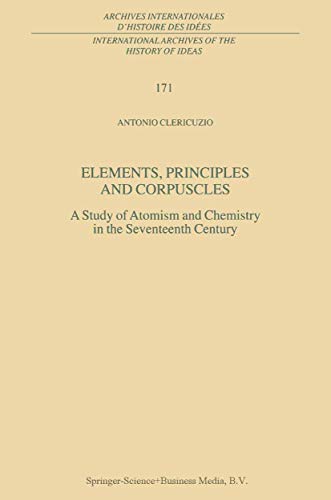
Synopsis
In Elements, Principles and Particles, Antonio Clericuzio explores the relationships between chemistry and corpuscular philosophy in the age of the Scientific Revolution. Science historians have regarded chemistry and corpuscular philosophy as two distinct traditions. Clericuzio's view is that since the beginning of the 17th century atomism and chemistry were strictly connected. This is attested by Daniel Sennert and by many hitherto little-known French and English natural philosophers. They often combined a corpuscular theory of matter with Paracelsian chemical (and medical) doctrines. Boyle plays a central part in the present book: Clericuzio redefines Boyle's chemical views, by showing that Boyle did not subordinate chemistry to the principles of mechanical philosophy. When Boyle explained chemical phenomena, he had recourse to corpuscles endowed with chemical, not mechanical, properties. The combination of chemistry and corpuscular philosophy was adopted by a number of chemists active in the last decades of the 17th century, both in England and on the Continent.
Using a large number of primary sources, the author challenges the standard view of the corpuscular theory of matter as identical with the mechanical philosophy. He points out that different versions of the corpuscular philosophy flourished in the 17th century. Most of them were not based on the mechanical theory, i.e. on the view that matter is inert and has only mechanical properties. Throughout the 17th century, active principles, as well as chemical properties, are attributed to corpuscles. Given its broad coverage, the book is a significant contribution to both history of science and history of philosophy.
"synopsis" may belong to another edition of this title.
Review
`[...] it is an important contribution to our understanding of early modern matter theory.'
Ambix 50 (2003)
"About this title" may belong to another edition of this title.
Search results for Elements, Principles and Corpuscles: A Study of Atomism...

Stock Image
Elements, Principles and Corpuscles (eng)
Print on DemandSeller: Brook Bookstore On Demand, Napoli, NA, Italy
Seller rating 5 out of 5 stars

Condition: new. Questo è un articolo print on demand. Seller Inventory # AFJFLIW22K
Buy New
£ 75.04
£ 4.65 shipping
Ships from Italy to U.S.A.
Ships from Italy to U.S.A.
Quantity: Over 20 available
Seller Image
Elements, Principles and Corpuscles
Published by
Springer Netherlands Dez 2010, 2010
ISBN 10: 9048156408
ISBN 13: 9789048156405
New
Taschenbuch
Seller: BuchWeltWeit Ludwig Meier e.K., Bergisch Gladbach, Germany
Seller rating 5 out of 5 stars
Taschenbuch. Condition: Neu. This item is printed on demand - it takes 3-4 days longer - Neuware -In Elements, Principles and Particles, Antonio Clericuzio explores the relationships between chemistry and corpuscular philosophy in the age of the Scientific Revolution. Science historians have regarded chemistry and corpuscular philosophy as two distinct traditions. Clericuzio's view is that since the beginning of the 17th century atomism and chemistry were strictly connected. This is attested by Daniel Sennert and by many hitherto little-known French and English natural philosophers. They often combined a corpuscular theory of matter with Paracelsian chemical (and medical) doctrines. Boyle plays a central part in the present book: Clericuzio redefines Boyle's chemical views, by showing that Boyle did not subordinate chemistry to the principles of mechanical philosophy. When Boyle explained chemical phenomena, he had recourse to corpuscles endowed with chemical, not mechanical, properties. The combination of chemistry and corpuscular philosophy was adopted by a number of chemists active in the last decades of the 17th century, both in England and on the Continent. Using a large number of primary sources, the author challenges the standard view of the corpuscular theory of matter as identical with the mechanical philosophy. He points out that different versions of the corpuscular philosophy flourished in the 17th century. Most of them were not based on the mechanical theory, i.e. on the view that matter is inert and has only mechanical properties. Throughout the 17th century, active principles, as well as chemical properties, are attributed to corpuscles. Given its broad coverage, the book is a significant contribution to both history of science and history of philosophy. 248 pp. Englisch. Seller Inventory # 9789048156405
Stock Image
Elements, Principles and Corpuscles: A Study of Atomism and Chemistry in the Seventeenth Century (International Archives of the History of Ideas Archives internationales d'histoire des idées, 171)
Seller: Ria Christie Collections, Uxbridge, United Kingdom
Seller rating 5 out of 5 stars
Condition: New. In English. Seller Inventory # ria9789048156405_new
Buy New
£ 106.66
£ 9.37 shipping
Ships from United Kingdom to U.S.A.
Ships from United Kingdom to U.S.A.
Quantity: Over 20 available
Stock Image
Elements, Principles and Corpuscles : A Study of Atomism and Chemistry in the Seventeenth Century
Seller: GreatBookPrices, Columbia, MD, U.S.A.
Seller rating 5 out of 5 stars
Condition: New. Seller Inventory # 11877230-n
Seller Image
Elements, Principles and Corpuscles
Print on DemandSeller: moluna, Greven, Germany
Seller rating 5 out of 5 stars
Condition: New. Dieser Artikel ist ein Print on Demand Artikel und wird nach Ihrer Bestellung fuer Sie gedruckt. In Elements, Principles and Particles, Antonio Clericuzio explores the relationships between chemistry and corpuscular philosophy in the age of the Scientific Revolution. Science historians have regarded chemistry and corpuscular philosophy as t. Seller Inventory # 5819494
Buy New
£ 80.29
£ 41.39 shipping
Ships from Germany to U.S.A.
Ships from Germany to U.S.A.
Quantity: Over 20 available
Stock Image
Elements, Principles and Corpuscles
Seller: Books Puddle, Woodside, NY, U.S.A.
Seller rating 4 out of 5 stars

Condition: New. pp. 246. Seller Inventory # 263066388
Seller Image
Elements, Principles and Corpuscles : A Study of Atomism and Chemistry in the Seventeenth Century
Seller: AHA-BUCH GmbH, Einbeck, Germany
Seller rating 5 out of 5 stars
Taschenbuch. Condition: Neu. Druck auf Anfrage Neuware - Printed after ordering - In Elements, Principles and Particles, Antonio Clericuzio explores the relationships between chemistry and corpuscular philosophy in the age of the Scientific Revolution. Science historians have regarded chemistry and corpuscular philosophy as two distinct traditions. Clericuzio's view is that since the beginning of the 17th century atomism and chemistry were strictly connected. This is attested by Daniel Sennert and by many hitherto little-known French and English natural philosophers. They often combined a corpuscular theory of matter with Paracelsian chemical (and medical) doctrines. Boyle plays a central part in the present book: Clericuzio redefines Boyle's chemical views, by showing that Boyle did not subordinate chemistry to the principles of mechanical philosophy. When Boyle explained chemical phenomena, he had recourse to corpuscles endowed with chemical, not mechanical, properties. The combination of chemistry and corpuscular philosophy was adopted by a number of chemists active in the last decades of the 17th century, both in England and on the Continent. Using a large number of primary sources, the author challenges the standard view of the corpuscular theory of matter as identical with the mechanical philosophy. He points out that different versions of the corpuscular philosophy flourished in the 17th century. Most of them were not based on the mechanical theory, i.e. on the view that matter is inert and has only mechanical properties. Throughout the 17th century, active principles, as well as chemical properties, are attributed to corpuscles. Given its broad coverage, the book is a significant contribution to both history of science and history of philosophy. Seller Inventory # 9789048156405
Stock Image
Elements, Principles and Corpuscles: A Study of Atomism and Chemistry in the Seventeenth Century (International Archives of the History of Ideas Archives internationales d'histoire des idées)
Seller: Revaluation Books, Exeter, United Kingdom
Seller rating 5 out of 5 stars
Paperback. Condition: Brand New. 240 pages. 8.90x5.98x0.87 inches. In Stock. Seller Inventory # x-9048156408
Buy New
£ 129.28
£ 10 shipping
Ships from United Kingdom to U.S.A.
Ships from United Kingdom to U.S.A.
Quantity: 2 available
Seller Image
Elements, Principles and Corpuscles | A Study of Atomism and Chemistry in the Seventeenth Century
Seller: preigu, Osnabrück, Germany
Seller rating 5 out of 5 stars
Taschenbuch. Condition: Neu. Elements, Principles and Corpuscles | A Study of Atomism and Chemistry in the Seventeenth Century | Antonio Clericuzio | Taschenbuch | xii | Englisch | 2010 | Springer | EAN 9789048156405 | Verantwortliche Person für die EU: Springer Verlag GmbH, Tiergartenstr. 17, 69121 Heidelberg, juergen[dot]hartmann[at]springer[dot]com | Anbieter: preigu. Seller Inventory # 107245874
Seller Image
Elements, Principles and Corpuscles
Published by
Springer, Springer Dez 2010, 2010
ISBN 10: 9048156408
ISBN 13: 9789048156405
New
Taschenbuch
Seller: buchversandmimpf2000, Emtmannsberg, BAYE, Germany
Seller rating 5 out of 5 stars
Taschenbuch. Condition: Neu. This item is printed on demand - Print on Demand Titel. Neuware -In Elements, Principles and Particles, Antonio Clericuzio explores the relationships between chemistry and corpuscular philosophy in the age of the Scientific Revolution. Science historians have regarded chemistry and corpuscular philosophy as two distinct traditions. Clericuzio's view is that since the beginning of the 17th century atomism and chemistry were strictly connected. This is attested by Daniel Sennert and by many hitherto little-known French and English natural philosophers. They often combined a corpuscular theory of matter with Paracelsian chemical (and medical) doctrines. Boyle plays a central part in the present book: Clericuzio redefines Boyle's chemical views, by showing that Boyle did not subordinate chemistry to the principles of mechanical philosophy. When Boyle explained chemical phenomena, he had recourse to corpuscles endowed with chemical, not mechanical, properties. The combination of chemistry and corpuscular philosophy was adopted by a number of chemists active in the last decades of the 17th century, both in England and on the Continent. Using a large number of primary sources, the author challenges the standard view of the corpuscular theory of matter as identical with the mechanical philosophy. He points out that different versions of the corpuscular philosophy flourished in the 17th century. Most of them were not based on the mechanical theory, i.e. on the view that matter is inert and has only mechanical properties. Throughout the 17th century, active principles, as well as chemical properties, are attributed to corpuscles. Given its broad coverage, the book is a significant contribution to both history of science and history of philosophy.Springer-Verlag KG, Sachsenplatz 4-6, 1201 Wien 248 pp. Englisch. Seller Inventory # 9789048156405