
Items related to Design of Modern Heuristics: Principles and Application...
Synopsis
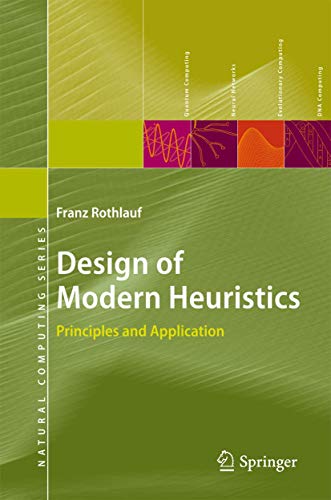
Most textbooks on modern heuristics provide the reader with detailed descriptions of the functionality of single examples like genetic algorithms, genetic programming, tabu search, simulated annealing, and others, but fail to teach the underlying concepts behind these different approaches.
The author takes a different approach in this textbook by focusing on the users' needs and answering three fundamental questions: First, he tells us which problems modern heuristics are expected to perform well on, and which should be left to traditional optimization methods. Second, he teaches us to systematically design the "right" modern heuristic for a particular problem by providing a coherent view on design elements and working principles. Third, he shows how we can make use of problem-specific knowledge for the design of efficient and effective modern heuristics that solve not only small toy problems but also perform well on large real-world problems.
This book is written in an easy-to-read style and it is aimed at students and practitioners in computer science, operations research and information systems who want to understand modern heuristics and are interested in a guide to their systematic design and use.
This book is written in an easy-to-read style and it is aimed at students and practitioners in computer science, operations research and information systems who want to understand modern heuristics and are interested in a guide to their systematic design and use.
This book is written in an easy-to-read style and it is aimed at students and practitioners in computer science, operations research and information systems who want to understand modern heuristics and are interested in a guide to their systematic design and use.
"synopsis" may belong to another edition of this title.
About the Author
Prof. Rothlauf completed his PhD thesis in 2001 at the University of Bayreuth, supervised by David E. Goldberg of the Illinois Genetic Algorithms Laboratory (IlliGAL). His particular areas of interest are optimization and heuristics, particulary in the areas of transportation, logistics and business information systems. He chaired the main international conference on evolutionary computing, ACM GECCO, in 2009, and has co-organized many related conferences and workshops; he has also acted as guest editor for related journal special issues; and he published the book "Representations for Genetic and Evolutionary Algorithms" in 2002, this was published in a second edition in 2006.
From the Back Cover
Most textbooks on modern heuristics provide the reader with detailed descriptions of the functionality of single examples like genetic algorithms, genetic programming, tabu search, simulated annealing, and others, but fail to teach the underlying concepts behind these different approaches.
The author takes a different approach in this textbook by focusing on the users' needs and answering three fundamental questions: First, he tells us which problems modern heuristics are expected to perform well on, and which should be left to traditional optimization methods. Second, he teaches us to systematically design the "right" modern heuristic for a particular problem by providing a coherent view on design elements and working principles. Third, he shows how we can make use of problem-specific knowledge for the design of efficient and effective modern heuristics that solve not only small toy problems but also perform well on large real-world problems.
This book is written in an easy-to-read style and it is aimed at students and practitioners in computer science, operations research and information systems who want to understand modern heuristics and are interested in a guide to their systematic design and use.
"About this title" may belong to another edition of this title.
Search results for Design of Modern Heuristics: Principles and Application...

Stock Image
Design of Modern Heuristics (eng)
Print on DemandSeller: Brook Bookstore On Demand, Napoli, NA, Italy
Seller rating 5 out of 5 stars

Condition: new. Questo è un articolo print on demand. Seller Inventory # XYOXD9UOOF
Buy New
£ 58.58
£ 5.84 shipping
Ships from Italy to U.S.A.
Ships from Italy to U.S.A.
Quantity: Over 20 available
Seller Image
Design of Modern Heuristics : Principles and Application
Seller: GreatBookPrices, Columbia, MD, U.S.A.
Seller rating 5 out of 5 stars
Condition: New. Seller Inventory # 5406942-n
Stock Image
Design of Modern Heuristics: Principles and Application (Natural Computing Series)
Seller: California Books, Miami, FL, U.S.A.
Seller rating 4 out of 5 stars

Condition: New. Seller Inventory # I-9783540729617
Stock Image
Design of Modern Heuristics: Principles and Application (Natural Computing Series)
Seller: Ria Christie Collections, Uxbridge, United Kingdom
Seller rating 5 out of 5 stars
Condition: New. In. Seller Inventory # ria9783540729617_new
Buy New
£ 71.28
£ 11.29 shipping
Ships from United Kingdom to U.S.A.
Ships from United Kingdom to U.S.A.
Quantity: Over 20 available
Seller Image
Design of Modern Heuristics : Principles and Application
Seller: GreatBookPricesUK, Woodford Green, United Kingdom
Seller rating 5 out of 5 stars
Condition: New. Seller Inventory # 5406942-n
Buy New
£ 71.27
£ 15 shipping
Ships from United Kingdom to U.S.A.
Ships from United Kingdom to U.S.A.
Quantity: Over 20 available
Seller Image
Design of Modern Heuristics
Published by
Springer Berlin Heidelberg Jul 2011, 2011
ISBN 10: 3540729615
ISBN 13: 9783540729617
New
Hardcover
Seller: BuchWeltWeit Ludwig Meier e.K., Bergisch Gladbach, Germany
Seller rating 5 out of 5 stars
Buch. Condition: Neu. This item is printed on demand - it takes 3-4 days longer - Neuware -Most textbooks on modern heuristics provide the reader with detailed descriptions of the functionality of single examples like genetic algorithms, genetic programming, tabu search, simulated annealing, and others, but fail to teach the underlying concepts behind these different approaches. The author takes a different approach in this textbook by focusing on the users' needs and answering three fundamental questions: First, he tells us which problems modern heuristics are expected to perform well on, and which should be left to traditional optimization methods. Second, he teaches us to systematically design the 'right' modern heuristic for a particular problem by providing a coherent view on design elements and working principles. Third, he shows how we can make use of problem-specific knowledge for the design of efficient and effective modern heuristics that solve not only small toy problems but also perform well on large real-world problems. This book is written in an easy-to-read style and it is aimed at students and practitioners in computer science, operations research and information systems who want to understand modern heuristics and are interested in a guide to their systematic design and use.This book is written in an easy-to-read style and it is aimed at students and practitioners in computer science, operations research and information systems who want to understand modern heuristics and are interested in a guide to their systematic design and use.This book is written in an easy-to-read style and it is aimed at students and practitioners in computer science, operations research and information systems who want to understand modern heuristics and are interested in a guide to their systematic design and use. 280 pp. Englisch. Seller Inventory # 9783540729617
Stock Image
Design of Modern Heuristics
Seller: Books Puddle, New York, NY, U.S.A.
Seller rating 4 out of 5 stars
Condition: New. pp. 280. Seller Inventory # 26354655
Stock Image
Design of Modern Heuristics
Print on DemandSeller: Majestic Books, Hounslow, United Kingdom
Seller rating 4 out of 5 stars
Condition: New. Print on Demand pp. 280 Illus. Seller Inventory # 7526016
Buy New
£ 96.90
£ 6.50 shipping
Ships from United Kingdom to U.S.A.
Ships from United Kingdom to U.S.A.
Quantity: 4 available
Seller Image
Design of Modern Heuristics
Published by
Springer Berlin Heidelberg, 2011
ISBN 10: 3540729615
ISBN 13: 9783540729617
New
Hardcover
Seller: moluna, Greven, Germany
Seller rating 5 out of 5 stars
Gebunden. Condition: New. Dieser Artikel ist ein Print on Demand Artikel und wird nach Ihrer Bestellung fuer Sie gedruckt. Author focuses on the users needs, providing a coherent view on design elements and working principlesSuitable for students and practitioners in computer science, operations research and information systemsBook written in an easy-to-. Seller Inventory # 4899559
Buy New
£ 62.20
£ 42.06 shipping
Ships from Germany to U.S.A.
Ships from Germany to U.S.A.
Quantity: Over 20 available
Seller Image
Design of Modern Heuristics : Principles and Application
Seller: AHA-BUCH GmbH, Einbeck, Germany
Seller rating 5 out of 5 stars
Buch. Condition: Neu. Druck auf Anfrage Neuware - Printed after ordering - Most textbooks on modern heuristics provide the reader with detailed descriptions of the functionality of single examples like genetic algorithms, genetic programming, tabu search, simulated annealing, and others, but fail to teach the underlying concepts behind these different approaches. The author takes a different approach in this textbook by focusing on the users' needs and answering three fundamental questions: First, he tells us which problems modern heuristics are expected to perform well on, and which should be left to traditional optimization methods. Second, he teaches us to systematically design the 'right' modern heuristic for a particular problem by providing a coherent view on design elements and working principles. Third, he shows how we can make use of problem-specific knowledge for the design of efficient and effective modern heuristics that solve not only small toy problems but also perform well on large real-world problems. This book is written in an easy-to-read style and it is aimed at students and practitioners in computer science, operations research and information systems who want to understand modern heuristics and are interested in a guide to their systematic design and use.This book is written in an easy-to-read style and it is aimed at students and practitioners in computer science, operations research and information systems who want to understand modern heuristics and are interested in a guide to their systematic design and use.This book is written in an easy-to-read style and it is aimed at students and practitioners in computer science, operations research and information systems who want to understand modern heuristics and are interested in a guide to their systematic design and use. Seller Inventory # 9783540729617