
Items related to Software Engineering - ESEC '93: 4th European Software...
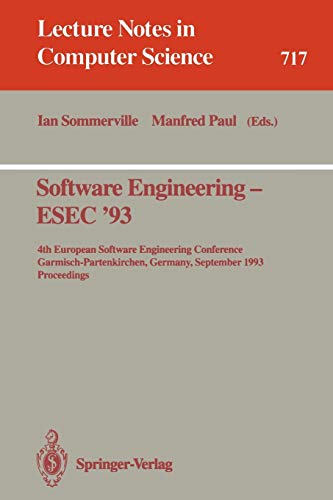
Software Engineering - ESEC '93: 4th European Software Engineering Conference, Garmisch-Partenkirchen, Germany, September 13-17, 1993. Proceedings: 717 (Lecture Notes in Computer Science, 717) - Softcover
Synopsis
This volume contains the proceedings of the fourth European Software Engineering Conference. It contains 6 invited papers and 27 contributed papers selected from more than 135 submissions. The volume has a mixtureof themes. Some, such as software engineering and computer supported collaborative work, are forward-looking and anticipate future developments; others, such as systems engineering, are more concerned with reports of practical industrial applications. Some topics, such as software reuse, reflect the fact that some of the concerns first raised in 1969 when software engineering was born remain unsolved problems. The contributed papers are organized under the following headings: requirements specification, environments, systems engineering, distributed software engineering, real-time systems, software engineering and computer supported collaborative work, software reuse, software process, and formal aspects of software engineering.
"synopsis" may belong to another edition of this title.
Review
"The book is aimed at both students and practitioners of software
engineering. For both, it is an excellent source of knowledge. Practitioners will
find relevant chapters to update their knowledge or to get a clear explanation of
particular topics."
ACM Computing Reviews, on the 4th Edition.
From the Back Cover
Software Engineering presents a broad perspective on software systems engineering, concentrating on widely-used techniques for developing large-scale software systems. In seven parts, this best-selling book covers a wide spectrum of software processes from initial requirements elicitation through design and development to system evolution. It supports students taking undergraduate and graduate courses in software engineering and software engineers in industry who need to update their knowledge on new techniques such as requirements engineering, distributed systems architectures and system dependability.
Extensive market research has ensured that this new edition is useful and relevant for both students and practising software engineers. The sixth edition has been restructured and updated, important new topics have been added and obsolete material has been cut. The end result is an even more focused book that is about 10% shorter than the previous edition.
Changes from the fifth edition
· There are new chapters covering software processes, distributed systems architectures, dependability and legacy systems.
· Program examples are now in Java and graphical system models are described in the standard UML.
· All chapters have been updated and several have been extensively rewritten. Reuse now focuses on component-based development and patterns; object-oriented design has a process focus and uses the UML; the chapters on requirements have been split to cover the requirements themselves and requirements engineering process; cost estimation has been updated to include the COCOMO 2 model.
· The chapters on critical systems has been restructured so that reliability, safety, availability and security are integrated in chapters on critical systems specification, development and validation.
· The section on formal specification has been cut to a single chapter and material on CASE has been integrated with the chapters covering the processes supported. Functional design has been incorporated in the new chapter on legacy systems.It includes an instructor's manual, overhead transparencies, source code of the program examples and additional material on CASE and formal specification.
Ian Sommerville is Professor of Software Engineering at Lancaster University, England. He has more than 20 years of experience in software engineering education and research. His current areas of interest include computer-based systems engineering, requirements engineering, system dependability and software evolution.
"About this title" may belong to another edition of this title.
Search results for Software Engineering - ESEC '93: 4th European Software...

Stock Image
Software Engineering - ESEC '93: 4th European Software Engineering Conference, Garmisch-Partenkirchen, Germany, September 13-17, 1993. Proceedings (Lecture Notes in Computer Science)
Seller: Chiron Media, Wallingford, United Kingdom
Seller rating 5 out of 5 stars

Paperback. Condition: New. Seller Inventory # 6666-IUK-9783540572091
Buy New
£ 47.98
£ 15.49 shipping
Ships from United Kingdom to U.S.A.
Ships from United Kingdom to U.S.A.
Quantity: 10 available
Stock Image
Software Engineering - ESEC '93 : 4th European Software Engineering Conference, Garmisch-Partenkirchen, Germany, September 13-17, 1993. Proceedings
Published by
Springer Berlin / Heidelberg, 1993
ISBN 10: 3540572090
ISBN 13: 9783540572091
Used
Softcover
Seller: Better World Books, Mishawaka, IN, U.S.A.
Seller rating 5 out of 5 stars
Condition: Good. 1993rd Edition. Former library copy. Pages intact with minimal writing/highlighting. The binding may be loose and creased. Dust jackets/supplements are not included. Includes library markings. Stock photo provided. Product includes identifying sticker. Better World Books: Buy Books. Do Good. Seller Inventory # 1826664-6
Seller Image
Software Engineering - ESEC '93
Published by
Springer Berlin Heidelberg Aug 1993, 1993
ISBN 10: 3540572090
ISBN 13: 9783540572091
New
Taschenbuch
Seller: BuchWeltWeit Ludwig Meier e.K., Bergisch Gladbach, Germany
Seller rating 5 out of 5 stars
Taschenbuch. Condition: Neu. This item is printed on demand - it takes 3-4 days longer - Neuware -This volume contains the proceedings of the fourth EuropeanSoftware Engineering Conference. It contains 6 invitedpapers and 27 contributed papers selected from more than 135submissions.The volume has a mixtureof themes. Some, such as softwareengineering and computer supported collaborative work, areforward-looking and anticipate future developments; others,such as systems engineering, are more concerned with reportsof practical industrial applications. Some topics, such assoftware reuse, reflect the fact that some of the concernsfirst raised in 1969 when software engineering was bornremain unsolved problems.The contributed papers are organized under the followingheadings: requirements specification, environments, systemsengineering, distributed software engineering, real-timesystems, software engineering and computer supportedcollaborative work, software reuse, software process, andformal aspects of software engineering. 536 pp. Englisch. Seller Inventory # 9783540572091
Stock Image
Software Engineering - ESEC '93: 4th European Software Engineering Conference, Garmisch-Partenkirchen, Germany, September 13-17, 1993. Proceedings (Lecture Notes in Computer Science, 717)
Seller: Ria Christie Collections, Uxbridge, United Kingdom
Seller rating 5 out of 5 stars
Condition: New. In English. Seller Inventory # ria9783540572091_new
Buy New
£ 55.95
£ 11.29 shipping
Ships from United Kingdom to U.S.A.
Ships from United Kingdom to U.S.A.
Quantity: Over 20 available
Seller Image
Software Engineering - ESEC '93
Published by
Springer-Verlag Berlin and Heidelberg GmbH and Co. KG, DE, 1993
ISBN 10: 3540572090
ISBN 13: 9783540572091
New
Paperback
Seller: Rarewaves.com USA, London, LONDO, United Kingdom
Seller rating 5 out of 5 stars
Paperback. Condition: New. 1993 ed. This volume contains the proceedings of the fourth EuropeanSoftware Engineering Conference. It contains 6 invitedpapers and 27 contributed papers selected from more than 135submissions.The volume has a mixtureof themes. Some, such as softwareengineering and computer supported collaborative work, areforward-looking and anticipate future developments; others,such as systems engineering, are more concerned with reportsof practical industrial applications. Some topics, such assoftware reuse, reflect the fact that some of the concernsfirst raised in 1969 when software engineering was bornremain unsolved problems.The contributed papers are organized under the followingheadings: requirements specification, environments, systemsengineering, distributed software engineering, real-timesystems, software engineering and computer supportedcollaborative work, software reuse, software process, andformal aspects of software engineering. Seller Inventory # LU-9783540572091
Buy New
£ 67.61
Free Shipping
Ships from United Kingdom to U.S.A.
Ships from United Kingdom to U.S.A.
Quantity: Over 20 available
Seller Image
Software Engineering - ESEC 93
Published by
Springer Berlin Heidelberg, 1993
ISBN 10: 3540572090
ISBN 13: 9783540572091
New
Softcover
Seller: moluna, Greven, Germany
Seller rating 5 out of 5 stars
Condition: New. Dieser Artikel ist ein Print on Demand Artikel und wird nach Ihrer Bestellung fuer Sie gedruckt. This volume contains the proceedings of the fourth EuropeanSoftware Engineering Conference. It contains 6 invitedpapers and 27 contributed papers selected from more than 135submissions.The volume has a mixtureof themes. Some, such as softwareengi. Seller Inventory # 4894225
Buy New
£ 42.85
£ 42.13 shipping
Ships from Germany to U.S.A.
Ships from Germany to U.S.A.
Quantity: Over 20 available
Seller Image
Software Engineering - ESEC '93 : 4th European Software Engineering Conference, Garmisch-Partenkirchen, Germany, September 13-17, 1993. Proceedings
Seller: AHA-BUCH GmbH, Einbeck, Germany
Seller rating 5 out of 5 stars
Taschenbuch. Condition: Neu. Druck auf Anfrage Neuware - Printed after ordering - This volume contains the proceedings of the fourth EuropeanSoftware Engineering Conference. It contains 6 invitedpapers and 27 contributed papers selected from more than 135submissions.The volume has a mixtureof themes. Some, such as softwareengineering and computer supported collaborative work, areforward-looking and anticipate future developments; others,such as systems engineering, are more concerned with reportsof practical industrial applications. Some topics, such assoftware reuse, reflect the fact that some of the concernsfirst raised in 1969 when software engineering was bornremain unsolved problems.The contributed papers are organized under the followingheadings: requirements specification, environments, systemsengineering, distributed software engineering, real-timesystems, software engineering and computer supportedcollaborative work, software reuse, software process, andformal aspects of software engineering. Seller Inventory # 9783540572091
Seller Image
Software Engineering - ESEC '93
Published by
Springer, Springer Aug 1993, 1993
ISBN 10: 3540572090
ISBN 13: 9783540572091
New
Taschenbuch
Seller: buchversandmimpf2000, Emtmannsberg, BAYE, Germany
Seller rating 5 out of 5 stars
Taschenbuch. Condition: Neu. This item is printed on demand - Print on Demand Titel. Neuware -This volume contains the proceedings of the fourth EuropeanSoftware Engineering Conference. It contains 6 invitedpapers and 27 contributed papers selected from more than 135submissions.The volume has a mixtureof themes. Some, such as softwareengineering and computer supported collaborative work, areforward-looking and anticipate future developments; otherssuch as systems engineering, are more concerned with reportsof practical industrial applications. Some topics, such assoftware reuse, reflect the fact that some of the concernsfirst raised in 1969 when software engineering was bornremain unsolved problems.The contributed papers are organized under the followingheadings: requirements specification, environments, systemsengineering, distributed software engineering, real-timesystems, software engineering and computer supportedcollaborative work, software reuse, software process, andformal aspects of software engineering.Springer-Verlag KG, Sachsenplatz 4-6, 1201 Wien 536 pp. Englisch. Seller Inventory # 9783540572091
Seller Image
Software Engineering - ESEC '93 | 4th European Software Engineering Conference, Garmisch-Partenkirchen, Germany, September 13-17, 1993. Proceedings
Print on DemandSeller: preigu, Osnabrück, Germany
Seller rating 5 out of 5 stars
Taschenbuch. Condition: Neu. Software Engineering - ESEC '93 | 4th European Software Engineering Conference, Garmisch-Partenkirchen, Germany, September 13-17, 1993. Proceedings | Ian Sommerville (u. a.) | Taschenbuch | xii | Englisch | 1993 | Springer | EAN 9783540572091 | Verantwortliche Person für die EU: Springer Verlag GmbH, Tiergartenstr. 17, 69121 Heidelberg, juergen[dot]hartmann[at]springer[dot]com | Anbieter: preigu Print on Demand. Seller Inventory # 102132252
Seller Image
Software Engineering - ESEC '93
Published by
Springer-Verlag Berlin and Heidelberg GmbH and Co. KG, DE, 1993
ISBN 10: 3540572090
ISBN 13: 9783540572091
New
Paperback
Seller: Rarewaves.com UK, London, United Kingdom
Seller rating 5 out of 5 stars
Paperback. Condition: New. 1993 ed. This volume contains the proceedings of the fourth EuropeanSoftware Engineering Conference. It contains 6 invitedpapers and 27 contributed papers selected from more than 135submissions.The volume has a mixtureof themes. Some, such as softwareengineering and computer supported collaborative work, areforward-looking and anticipate future developments; others,such as systems engineering, are more concerned with reportsof practical industrial applications. Some topics, such assoftware reuse, reflect the fact that some of the concernsfirst raised in 1969 when software engineering was bornremain unsolved problems.The contributed papers are organized under the followingheadings: requirements specification, environments, systemsengineering, distributed software engineering, real-timesystems, software engineering and computer supportedcollaborative work, software reuse, software process, andformal aspects of software engineering. Seller Inventory # LU-9783540572091
Buy New
£ 56.82
£ 65 shipping
Ships from United Kingdom to U.S.A.
Ships from United Kingdom to U.S.A.
Quantity: Over 20 available